Episode 32 · Jul 23, 2026
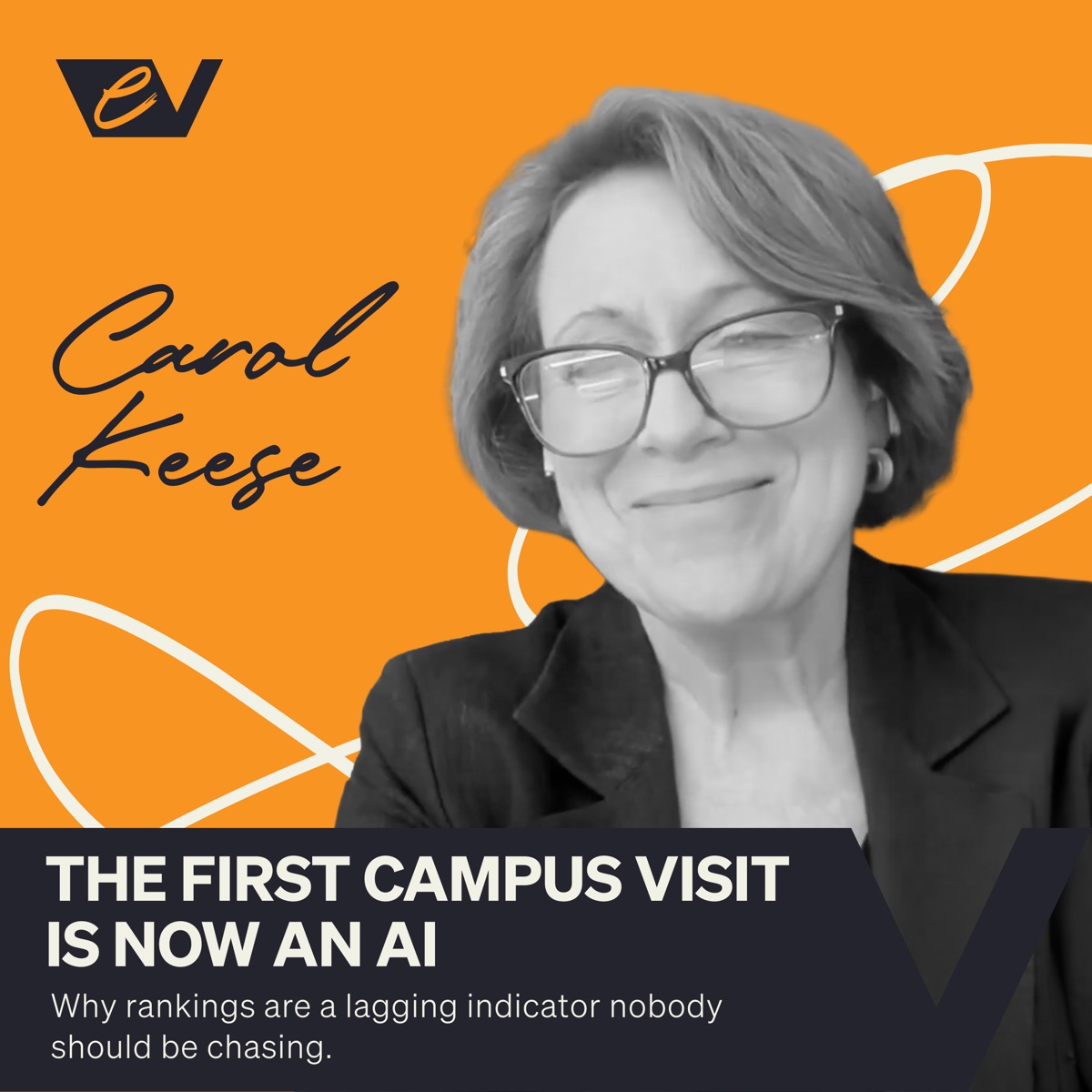
Carol Keese: A CMO Says Marketing Isn’t the Fix
VP for University Communications & CMO, University of Oregon
Watch or listen right here
About this episode
Higher ed websites all sound the same, look the same, and Carol Keese has a lot to say about that. As VP for University Communications and CMO at the University of Oregon, she argues that when an institution has a substance problem, more marketing isn’t the fix.
Before Oregon, Carol ran brand and marketing at the University of Virginia through a bicentennial, a new president, and a capital campaign. Before higher ed, she marketed trust where trust is everything, at Johns Hopkins Medicine and Children’s National. We talk about what happens when the first campus visit is now an AI, why sameness is higher ed’s real crisis, and what CMOs should actually own.
Links from this conversation
Episode transcript
Read the full transcript
Transcribed from the episode recording; names and phrasing may contain small transcription errors.
Hello, everyone. Thank you for joining for another episode of Escape Velocity. Today we're going to be having a very interesting conversation with Carol Keese. As you know, I've been talking a lot about how higher ed websites all sound the same, look the same. And I think that my guest today is going to have a lot to say about that from a very interesting perspective. So Carol is VP of University Communications and CMO at the University of Oregon. Before Oregon, she ran brand and marketing at UVA, University of Virginia, and was there through a bicentennial, a new president, capital campaign. And before higher ed, Carol spent a lot of time working in in healthcare and hospital systems. So she was marketing trust in places where trust is really everything at Johns Hopkins Medicine and Children's National. and Carol and I got on each other's radars because she wrote a piece in Inside Higher Ed titled Higher Education Was Built on Scarcity. That model is breaking. And she says that higher ed keeps trying to solve a trust problem with better marketing when the real problem is the model itself. So this caught my attention because we've got a marketer saying that marketing isn't the fix. I've been looking at this problem from
Hmm.
other perspectives for a long time. And she mentioned blanding on her post and got me on her radar. And so we've been talking about having this conversation. So Carol, wait welcome to the podcast. Thanks for joining me and I'm excited to dive in.
Thank you. Yeah, happy to be here.
just a a little bit about so that article that you wrote for Inside Higher Ed, was this something that you'd been thinking about for a while? have you been have you been having conversations internally about, you know, well, fix it with the marketing and have you been pushing back on that? How is how is it how did you lead up to that article?
Yeah, I think that was really the result of about, you know, a year and a half, two years, really since the conversations about in higher ed were accelerated by the federal administration coming in and what we needed to do to kind of regain trust with with consumers and with the public. You know, Gallup and Pew and others have been tracking the loss of confidence in all institutions, including higher ed, but higher ed is small and the farthest, the fastest. And so there've been a lot of well-intentioned and important work, but it has been focused on the messaging. How do we get Americans to understand the value of research institutions? How do we get Americans to understand the value of a degree, right? But all of those have essentially focused on messaging. And I was interested in exploring why the messaging hadn't really tracked with the feedback from the market over the last probably 10, 15, 20 years, most most aggressively or most clearly in the last 10 years, as consumers became more and more concerned about the price point. and we continued to say things like, you know, it's sort of the old MasterCard, like priceless, like it's just priceless. Like it's just, you know, they we were talking about a quarter million dollar investment. And we were really struggling, I felt, to justify the cost with language that most people could understand, or to rethink how the product was designed and priced. So that it better met what the market was telling us. And instead, what I saw was messaging around how we talk. and unfortunately, when we talk in ways that feel toned up, we just sort of exacerbate the idea or we amplify the idea that higher ed is a touch. And that really concerned me. I've I've given in my career to higher ed in various forums, and so I'm I'm a higher ed advocate. I want to say that as a bit of a caveat because I am also pretty critical of what we have failed to do in the last couple of decades to be ready for this moment. I think what we're seeing is a confluence of factors, not a single one that for which we were really unprepared. Yeah. And the fix is not better marketing.
Yeah, it's it's not better marketing, but it is better trust. And and I th I so no, so I was just curious to kind of lean in on that idea of trust. And you know, I remember not that long ago where almost every higher ed website would hide tuition. You couldn't even find
Yeah. Yeah. Yeah. And I think yeah, sorry.
the where the the cost information was, or they'd bury it under financial aid, you know. Yeah. Which to me is the you know, and y and if we go to healthcare, where there's also a big issue with trust around cost. And everyone is is petrified of, you know, the cost and the way insurance works or doesn't work, the cost for insurance.
To this day, yeah. Mm-hmm. Sure.
Where is do you think healthcare is doing things right where higher ed isn't? Or do you see any yeah?
my gosh. They're both broken in different ways. I think higher ed needs to look at its product differently and be more responsive to the market. I think that healthcare, you know, we've decided that medicine should be sort of arbitrated by insurance as a society. And that has consequences that are that are really hitting consumers. And frankly, those who practice medicine in this space. What I think is different is that in medicine your outcomes are more immediate, right? You can't say you can't prestige signal in the same way that higher ed can, and kind of say get away with it and and be divorced from outcomes in the same way because they're so they're so much sooner, right? So your quality metrics, your the number of surgeries that you perform, the the success rate of a certain procedure, those are all public and they're all pretty current. And so they inform a population that has a choice about where to direct their care most of the time, even when arbitrated by insurance. And so that sort of cycle of outcomes to marketing, to positioning, right, to revenue is pretty tight. In higher education, there's Lead times are enormous, right? We're talking about a once-in-a-lifetime purchase. It's, you know, somewhere around a couple hundred thousand to a quarter million, depending on where you are going. And that decision is often a two, three year lead up, and the outcomes are a five year lag. And so I think that provides kind of a buffer for universities to continue to address messaging rather than looking at the product and the outcomes it themselves for more concrete proof. And that's what consumers are increasingly asking for.
So outcomes and proof. I know that, you know, there's this lag time. There's not always great resources for these schools to stay in touch with their alumni and find out, you know, what is actually going on. So how much of it is just lack of research that the schools themselves, you know, whether it's through their own resources or just that they haven't paid close enough attention to tracking the the data. to really understand how their alumni have done.
I think that's an important component. So I I think that there are challenges with that data. Like the first destination survey is voluntary, right? Like could we just make it a requirement of getting your diploma? Like that would be relatively easy for all of us to do. So I think we do bear some responsibility for making sure that we have access to accurate data about that because we are being asked by the administration and and by parents and students to demonstrate that ROI. So I think that That we can't just sit back and say, data's messy. Like let's let's let's fix that. But I also think that there's this convergence of, you know, we've heard this paradox of, you know, when an unstoppable force hits an unmovable object. So that was cited a lot in the World Cup, particularly in the Spain v Argentina final, right? I had to look up like where did this come from? So apparently it's a it's it's an ancient Chinese derivative. Anyway, it's an interesting and true, I think, analog to higher education, which
Yes.
Let's rem like remind ourselves is a thousand years old. And it was designed for permanence, right? It was designed to study the world, but not really be a part of that world. And it was designed for the elite. We can talk about that as part of the prestige and scarcity model. It was never really designed for scale, at least the four-year residential model, right? And so that kind of immovable object. is hitting this unstoppable force. This is which is the renegotiation of sort of economic, geopolitical, market forces that of course now with AI are being accelerated, but certainly aren't just AI, that are now so prevalent and so formative in what American families are experiencing that that it just doesn't have enough intersection with the older value proposition that higher was literally designed a thousand years ago to deliver. And that's where we're sitting. And so it's product design, it's pricing, it's responsiveness, but it's also this thing that was designed to be more or less eternal. Like how do you how do you reconcile those two things? I think it's a really interesting problem that I don't see enough institutions interested in in digging into. Instead, the sort of the the easier avenue is messaging, which I think for the actual elite institutions are is probably enough. They they have enough brand equity and they have enough ROI and there's enough demand there that they actually they're they're fine. I think it's really everybody else that's not in the top fifty or top seventy five that really needs to rethink what we're doing.
Do you do you see that starting to happen or do you feel like it's gonna be a little bit of a You know. Yeah, bumpy ride and still
Bubby Right. Yeah. Yeah, I think it's a a Bobby right for for two reasons. I mean, that number one, I mean you're seeing it some on the edges. And you're s there's not one answer to this, right? There and that's a good thing. There's there's sort of a a many sort of multiple paths that universities can take. And that again, that's a good thing because the market is in different places. There should be demand across different kinds of educational experiences. So you're seeing like the Vanderbilt Of the world and the northeastern do more in person by creating campuses in other markets in New York and other kinds of places. So you're seeing that investment in capital and building that up. And then of course we have the Arizona State Starbucks model where you see massive number of students access university credentials through this partnership. my future daughter-in-law being one of them, right? So you have this amaz this huge an affordable access point to hundreds of thousands of people. So those are two, but those are those are not new. And there haven't been universities that have really replicated the Aerozone state model for reasons maybe you maybe just need one critical partnership and that's not replicatable. But I think that there's these two things. But I also think that we have to acknowledge the cost of rethinking the the whole structure is enormous. It's enormous. everything from the way we've have tenured professors that have you know that are that are have a lifetime's work protected by that structure to how universities actually make business decisions, which is often in a matrix organization, this is Tree of Healthcare too, somewhere negotiated between the provost and the academic councils and the present CFO structures that it's very negotiated.
Yeah.
There's no one really responsible for like let's develop a couple pilots that might explore new business models or or even new revenue generation, certainly less so at the state publics than at the private institutions. And I I can't speak for privates because I have not been in them, but but I I'm surprised there isn't more piloting at least to be like, let's just put a pilot out there and see what happens. I think we're well past time when we should be doing that, all of us, publics and privates.
How are you? I'm curious that you know, you made this the this transition from UVA to Oregon. So what was that switch like in terms of of how operationalized things you know, when you talk about a pilot, is that something that you feel a place like Oregon would be more receptive to as a as a public? Or is it is it
Mm-hmm. Well they're both they're both publics. They're both publics. I think it's I think, you know, we talk about my I think I s I don't think I said this in the I higher ed piece, but talk about public education and education, higher education being kind of this monolith when it's made up of very different kinds of institutions and very different kinds of environments. So I'll give you Oregon as an example. So we are a member of the AU. We're an R one research major research university. And we're in a state that is 46 out of 50 for supportive education, all education. That's K through 12, they come first, and then there's all of the university systems of which the University of Oregon comes last. And so that is not comparable to many other states, including Virginia, that invest, I'd say more wisely, but certainly more substantially in education. And so even when you say public for your research universities, you're talking about very different dynamics around the resources available to do things like piloting or you know, taking any resources out of like the main structure that exists and putting it into an area that can take risks, which is something that the corporate does all the time. Like they might create a separate arm of the institution to say, we're gonna give you this sort of this timeline, this budget. We want you to assume the risk while we run the main operations so that we don't lose market share, but like have an exploratory space. Higher has some real constraints around how it does that. So even though I'm saying we should be doing that, I also acknowledge that there are financial and structural barriers to that that might be higher at a place like University of Oregon than a place like the University of Virginia. And you take those two things and you just multiply them in, you know, four directions and you get this very different setup for the appetite, the capability and the resources available to do that kind of work.
Yeah. So in terms of the, you know, the model itself needing to be rethought, reimagined, maybe expanded so that there are different kinds of models available. and yes, there are some very real constraints to that happening and at at speed and a lot of different reasons why, whether it's financial or resources or just tradition and appetite of the of the school itself to doing things like that. When it comes to marketing and brand, which is where where you and I both focus a lot of our attention, where we've got to work with the model that we have.
Mm-hmm.
Where do you think that this this intersection between the the marketing, the prestige marketing, the the scarcity signaling still kind of playing that game, which will work for the most prestigious, right? And the ones with the with the name out there already that don't have to worry as much. But where is this n why is this also still remaining the case with schools that that they aren't highly selective. They they they are a better choice for certain kinds of students, but they're still kind of pandering to this this this blandness as I call it or it but it is it's signaling, you know, we they want to look like everyone who's above them.
Yeah, yeah. I yeah. Yeah. Yeah. I mean, all kinds of things play a part in that. One is just the structure was always designed for the elite. I mean, if you go back a thousand years, it was designed literally as, you know, originally part of the church, and then for the sort of the the second sons of the aristocracy, they're like weren't, you know, weren't the inheritors to the throne. and you fast forward and until really the thirties, it was still reserved for a fairly elite group and was not essentially redesigned when the GI Bill and when the SATs, you know, sort of broke it open. and it it never really scaled enough to handle kind of the growth of the population. And I think there is still structure, there's still days when I remind myself I'm working in a thousand year old, you know, structure. And I I love so much about that, but there are some real structural constraints to that. So I think what happened is what you're describing, and I think what you described in the blanding piece, which was is so accurate, is When scarcity and prestige become the proxy for value in ROI, you you run into you you take some risks with that. One is that you sound start to sound like everybody else because everybody else is doing the same thing. So human psychology also plays into that. We want to be aspirational. We can't afford the Chanel bag, but maybe we can get a scarf, you know, maybe we can like get on, you know, the real real or whatever and like pick up something. We we are wired to kind of want the aspirational prestige thing. So it has worked for a really long time. It stopped working when the economics stopped working. And what I mean by that is that the price tag for higher ed has gone up and up and up. And part of that is the disinvestment at the state level and to some degree the federal level too. So the price tag has gotten much, much higher. Consumers, students are paying more than double percentage wise what they paid in nineteen seventy. So of course they're asking questions like number one, they're seeking prestige because they want to make sure that they're buying the highest value product possible. But increasingly now they're asking what the trade-off is for that and what the ROI is for that. And instead of answering that question, sort of the aspirational or near-peer organizations continue to sort of lean into that prestige thing that worked for so long. And because of you know, human psychology. The the trek is like right now, it's it's not only not working, it sounds tone deaf. To the real concerns as people grapple with of uncertainty about the economy, uncertainty about the future, much of which has to do with AI, but not just AI, also geopolitics. and they're asking the same questions, and we continue to revert to the same language, which just makes us sound out of more out of touch with people. And I think what's gonna happen, or what actually is happening, is that you have this F shaped, when we talk about K-shaped economy. Like we've got the the high, the high the top of the earners doing just fine and everybody else is kind of on the slow scale. I think there might be something like an an F or an E-shaped economy happening in higher ed where the true prestige brands that don't have to signal because they are the signal, they'll be fine. The top fifty, the top seventy-five or hundred, I don't don't know where that line is, but it's it's somewhere. They they they can keep doing what they're doing because the brand equity is so high, the demand is so high that they can do that. Then they're kind of the near peer because the selectivity is so high at those very high prestige organizations that they're not going to accept but a fraction of the students that apply. So then you have a second layer of near and aspirational organizations that can charge a premium, and this is what Scott Galloway was talking to, because they're basically arbitrage down to this next layer that needs to be, you know, high status enough for these students, but may may not have as much pressure to demonstrate the actual outcomes. And then you have the stem of the F, which is more or less everybody else at the moment, which is you're somewhere along that long tail. Unless we rethink how the product works, how it's delivered, how it's priced, that's what we're gonna end up with. And that's not certainly what I want to see as someone who's been somewhere in higher education for the last thirty five years. Yeah.
Yeah. Well, you mention the well, a a bunch of things in there, but you know, one of the things I always wonder about is if you if you're showing outcomes, if you're sharing results or you know you're extrapolating data and saying, you know, we're gonna make an average here assumption. I I feel like everyone's scared of like, well, if we say that people who graduate from this department are likely to get jobs within the first year in this salary range, but not everybody. And also then, well, what about that other department? That we all you know, we don't want them to be angry and upset that we're not talking about them, but you know, it's the maybe it's the the theater department or the the fine arts department where, you know Yeah, like
Mm-hmm. Yeah. Yeah. Yeah. Or or French or yeah. And and this is where the the humanities feel defensive, which under s very understandably so. And I will say that as an English major, I have found my humanities degree immensely helpful because it turns out like no matter what you do, you have to communicate well. So there is that. I I I think that's real and I think it's not enough.
Yeah. Yes.
Of an excuse to say we're just gonna go to silent because our silence is also communicating that we ourselves are unsure of the value proposition. And that is that's a dangerous place to be when when when your price tag is where it is and where it's a four you know a four-year commitment, and when we've been telling people that this is the access point to successful careers or meaningful lives of contribution, for some people, networks of of access to you know financial networks, social networks, all of that, all of those things that you know all of us want for our children and go into spoken or unspoken, go into the decision about where we send our kids to college and where they want to go to college. I'm actually encouraged that younger generations are asking more thoughtful and direct questions about the connection between careers and their future and the college degree and not just going to the prestige place that their parents want to go to. And that's always been at both and but I think there's more conversation now happening, which I think is really healthy.
Yeah, and I think the conversation around even what is what is a liberal arts degree worth? You know, what and being someone who who got a bachelor's of fine arts, you know, I definitely understand that some of these things are har it you can't necessarily track it to an immediate job in an immediate you know, it's like, these people will get jobs in finance within the first year or they'll go on to To get into go into law school or med school or whatever the the next steps are that you might be tracking, that gets a lot harder to do in a with a liberal arts environment or degree, where it is sort of like you're gaining the l a lot of life skills that can be applicable to a lot of different careers. versus like a trade school, which is, you know, it's always like, well, you know.
Yeah. Yes.
There we can show. We we pla you know, we we train people for a certain trade and then they're placed into that profession. And this is the salary, and it's kind of apples to apples. It's easy to to show the comparisons, or the or the attributions or the value. Now on the along the same lines, you work in marketing and brand, which is also often seen as a cost center because it's not easy to show, you know, we we we
Yeah. Yeah.
made this many widgets and we sold this many at this price point. so I think there's some similarities there in in how we're trying to connect dots for people in terms of value. And I'm just curious from the inside in validating the work that you and your teams have done over your career when it comes to marketing and brand, have you found more effective ways to try to explain value?
So the two organizations that I've worked for most meaningfully in this regard are completely different. So I'm gonna just sort of s come back to it in terms of how brand messaging can escape the brand dynamics. And we're we can talk about that differences between UVA and Oregon. I think in Oregon we're we're really thinking about certainly in the digital space, how to create pathways. we're not a vocational school, like higher ed should not be a vocational school. and you know. For all the congressional pushback, appropriate and not, on sort of our price point and our value prop and outcomes and all that stuff. Like, I don't see a lot of Congress people putting their kids in vocational skills. Like, not you know, nothing against vocational schools. In fact, I think we should have more of them. But and right, we're we should be doing the hard work of showing and illustrating how pathways, what those pathways are, how a liberal arts degree sets you up for different kinds of Pathways, including graduate school, including law school, including some cases medical school, right? Including graduate work in other ways, including professional work, in in met across many, many industries. And that's where the critical thinking comes in. But like we can actually should be able to reverse the data to say, you know, of all the people in Congress or in civ or in government elected officials across the United States or people in the State Department or people in finance and policy. Like how many of them have liberal arts degrees? A very significant percentage, right? So we I don't have the data right at my fingertips, but we can get it. So we should be doing more work to actually illustrate those pathways all the way through. That's one thing. Second, there will always be people who go, I think goodness and will go into education and higher education for its own sake, right? Researchers, scholars. Like I hope that never stops. Like that needs to be, continue to be, and we need to continue to offer spaces for inquiry for its own sake. And that's very important to the world. It's where new knowledge is born, it's where new research happens. It's also just important as a as a human endeavor. But not everybody is going to go that path. And so to say everyone has to be in the same model that creates a PhD in philosophy is unrealistic. So that doesn't mean the model is broken for that avenue. It means that we can s better support a multiplicity of pathways. We just haven't done enough work to show that that works and then to create product design that actually lives that out. So in a in fine arts or in something that's applied. Could we partner with community colleges? Could we partner with museums to have some of the core curricular with the best faculty in the world teaching on some of the essential courses and having some of the hands-on practicums done at a local level? So you don't force everyone into this very beautiful but expensive model where it's a residential four year experience followed by two years of masters, followed by six more years of PhD. So, you know, God bless that. I hope it never goes away. But we've tried to scale a model that that has too many barriers for the modern world, including cost, but also including time, right? Stop your life for four years. Come over here. Do this thing. Uncertain outcome. there's a lot in there. I hope I answered the question. There's a lot. There's a lot of opportunity in there.
Well, I it's all it's a it was a I think it was a it was a meeting, yeah. I think that my question had like five in it and I think you I think you touched upon all of them. and it's a perfect segue to talking about AI. you know, I'm noticing it's it's adding to what was already there, which was this like we've got to speed up, we've gotta go faster. Now we've got AI, which is changing so fast and becoming
Yeah. Okay. Yeah. Yep.
so ever present and there's the all the pearl clutching about it's gonna take all the jobs and it's gonna turn us into, you know, illiterate consumption creatures living off of our universal income that open AI or Claude or Anthropic will give us.
Here. I'm just literally the age I guess this is backwards, the age of reading is over. is the cover story in the Atlantic. So I hadn't heard the word curl clutching and AI in the same sentence, but yes. Exactly. Yeah.
Yes. Yes. Well, I mean, because I think it's reading was already kind of becoming something that I I was I'm like, you're you're proud to share that you don't read. You just don't like to read. I I started to hear more and more people kind of just say, I don't read. I'm like, How can you not read? And then it's like, Well, then you can't expect those people to write anything for you. But to me, just there was already an appetite for something to kind of come in and like figure do all the thinking. And now we've got AI, which very confidently proposes lots of very sure sounding answers to things which aren't always accurate. but it it does it's it's removing a lot of critical human skills from the the plate of in a in a way that I think is very troubling. So I'm that's a very loaded question. lead in, which is, you know, how are you seeing AI impact? the the higher education space in terms of I mean, everything from how you're operating to how you're seeing the concerns of the of the incoming students who are looking facing at this facing down this very unknown future.
So I think smarter minds than than me are gonna grapple with kind of where I AI lands in the academic space and the the teaching and the pedagogy and the transference of knowledge and creation of new knowledge and and all that. I don't know the answer to that. I think a lot of people are worried about it. I'm tangentially worried about it too. I think we we do tend to paint AI as one thing when it is a Of 16 different categories. So it's it's how AI is or could reshape the academy and the transference of knowledge and what a degree even means and where human knowledge resides, right? But it's also generative AI. What happens to human creativity, what happens to human expression, right? And what happens to like the the rights of artists and all of like there's that. where we've been focused at Oregon is how AI is shaping And changing the marketing communication space. So for our own division, we've created put a lot of work into creating our own AI principles document for our own team so that they feel safe and encouraged to explore ideate, practice, fail, like fool around with, but also figure out where the value add actually is without fear of you know punishment or whatever. Right. We also have some rules about nothing nothing happens without human review, right? So just sort of some obvious things like that. But we've we we spent a lot of time and we got a lot of a lot of good conversation from people that brought a lot of the concerns that you're talking about to the fore, including the environmental impact. And we have really robust discussions. I think that we wouldn't be in the space as effectively if we hadn't had a bit of a town hall and a an open discussion where like everything there's no stupid questions. because reality is like Nobody really knows where this is gonna end off, right? So that's one. The second is I think we we need to understand that we will be in an AI mediated environment on everything. at least that certainly looks like the way it's going. We need to be prepared for that. that's not just the choice about where you go to college. It's also planning your next vacation, it's also buying the pair of shoes, it's also everything else. You know, and the the AI platform you're using also knows everything about you. So it's going to offer it's the only technology that will confidently offer cross-channel, cross competitor suggestions. It will reinforce what you've already done. So it will understand your buying habits, which makes it both potentially like deeply exploitative, but also deeply insightful. That's problematic. So we are rethinking our content environment with AI as the first reader. We happened, I wish I could say that this was like totally my design, but there are times when you just circle a thing and call it strategy. This is what this is. So we were building we were building a new enterprise site because ours was really outdated. And we started the the first work on it a little over a year ago. And with the skill of of really talented A V P Brian Hawkins for digital strategy, realized that like AI is the first consumer of all of this content. So we are building to the technology today. So we'll be launching that in I don't know, six weeks or so. So we had the good fortune of coming in at the right time instead of retrofitting an existing site we're actually building to the moment. And that's just that's luck. It's it's also just good insight on whose part. But we are embracing that as uncomfortable it is as it is. Our AI is now our first campus visit and our website is the second campus visit. And We know that if we can get them to our campus, we have them. But we have to navigate those two things first. And that's the funnel. That's just where it moved. It's not a it's not a different dynamic, it's just a different placement. And that's where marketers need to need to need to lean in rather than resisting.
So I d I'd love to dig in on this because I'm I'm sure a lot of people that will listen, you know, are curious about what does that look like to really, you know, so many people are are looking at their sites and and they know that they need to be communicating better to the AIs. because that is there are a lot of people who are going to get all their information from these these systems and never end up on the website.
Yeah.
or way down the the process. But at some point they will. And so you know you can't disregard the website. But I I'm really curious to are have there been three or four things that you've really approached differently, having the luxury of of redoing it at this time, you know, with the the support behind you to to really make sure that you're thinking it through from the right directions.
Right. Mm-hmm. Yeah, I mean I think from sort of website content, you know, we were told for years that longer narrative sections in terms of content, longer narrative writing was the thing, and not to do FAQs. And the exact opposite is now true. So AI wants, you know, digestible bits in response to real and hypothetical questions because that's how it's it is a it is a different kind of engine. It is still an answer engine. So you need to fit in answers. And This could be a great accelerant to us also figuring out a different way to the market the value proposition where we where we talk about pathways, right? Where we meet students who, like, let's be honest, at 17 aren't really clear what they're gonna do, but they wanna see a pathway. They wanna see like a trail. And we can do a better job in that content and and through functions like FAQs or intuitive AI driven. journeys on our sites. Like, what are you looking for? It's like I want something in the arts. Okay, let's take you, like, look, let's show you the programs. Forget about the school they're in. Like let's just show you programs that are here and where those things tend to lead in terms of careers. So we actually let's reveal that in a different way. Nobody cares how we're organized. Like really, nobody cares how we're organized. And whether, you know, the the data analytics program for sport, it lives in the business school or lives in arts and sciences or lives in somewhere else, it doesn't matter to the outside world. so this is just accelerating our fluency with meeting people where they are. And I I think this is sounds super corny, but it's also really true. Like market is the first word in marketing. Like we are supposed to be, right? Like remember that we are supposed to be and represent the voice of of the consumer and the voice of the market and the data from the market that should be informing how we're talking about the product and
Mm.
you know, hopefully down the road how we're designing and pricing them.
Yeah. I think that's
one other thing. I'm sorry. No, as as AI can looks more to earned media. So as news outlets become a a much more important source of credibility for AI engines, and we have done a lot of work in our earned media strategy and do a lot more national pitching and a lot more effort around that. We're also rethinking our own content, but I think earned content is really becoming a a key component of
No, go ahead.
making sure that because it it will look for quantifiable sources. So the signaling that we've all been doing with narrative and storytelling now needs to be quantifiable, verifiable, and consistent. And that means it can't just be your platform. So you have to do more work.
Yeah, and look at more platforms and pay attention. I think there have been a lot of many years where it's it's preferable to kind of stick your head in the sand versus worry about what's being said on Reddit about certain programs or whatever. as well as putting the emphasis right on the on the earned media. So a lot of that can be hard to reach for for school that
Right. Yes.
maybe doesn't have the rankings or the recognition coming out to kind of tout or the numbers. But I you know, where do they look to when it's when they are looking to to get more media to back is it is it faculty? Is it you know
Yeah, it could be. I mean, rarely is earned media all that interested in who's number one this year and like US news, right? Like they're just like that's a pro it's always ends up being the same ten people, right? The same institutions. So that's not a news story. I think that the job for higher ed is also to become more relevant. Like, you know, we need to be more in the spaces where people are living their lives. So that means that we need to be thinking about both paid and earned differently. because you know if they're gonna say like higher is disconnected and they're like over in the ivory tower, it's because they're kinda are. Like, you know, we advertise in the Chronicle, we're like God bless the Chronicle, but like we're talking to ourselves, right? So we're not on the Hallmark channel, we're not on Spotify as much as we should be. We're not like we're not in these, we're not sponsoring things that could be a co branding opportunity with a consumer brand. That again, not every organization can do that, but every organization has opportunity, different set of opportunities. You know, Oregon We d we did a very successful collab with Nike and with The Grateful Dead about a year ago on Grapled Ducks. And it it got national attention. It was in the PR Week move of the week. It was covered in GQ and Rolling Stone. Like we have that because we have the history of the Grateful Dead in Eugene at and at the University of Oregon. So it was part of our sort of authentic authenticity and narrative. And you know, the greatest, one of the greatest consumer brands ever, Nike was part of that. So And of course, Nike born at the University of Oregon. So we have this confluence of stuff that was sort of cultural relevance that people cared about and were delighted by. So I'd love to see higher ed, you know, Dartmouth has its thing. UV like we all have a thing or a couple of things. We need to continue to we need to think differently about what those threads are that are that intersect with music, culture, sport, or just what's happening in the news cycle.
Yeah.
Every university in this country can put an expert into the news cycle to talk about wildfires or talk about the economy or talk about any one of a number of things. Like that's what we do in the thought leadership space. So we need to act more, I think, like consumer brands and get our people out there in the spaces where people are digesting news, commenting on it, interested in the topic. yeah, we shouldn't be walled ours, we shouldn't wall ourselves off.
Yeah, I agree. how much of that do you think is a symptom of of higher ed in general not wanting to treat itself like a you know, a business per se? And you know, I've said many times that I was always shocked how reluctant, especially, you know, going back twenty years, to use the word brand when you were talking to a higher ed
Mm. my god, no, right?
potential client was was just no, we're not gonna use that. It was like a dirty word. Marketing was seen as a dirty word. That was all seen as like, that's big business. That's core, that's for profit, right?
Corporate. Right. Yeah. It's complicated. It's complicated. I think, you know, and I saw this thirty years ago in medicine, some of the same day, you know, we don't we don't need to advertise our market because we're us, right? and I watched that sort of light bulb go off in medicine, even in academic medicine, and realized like the markets are actually very competitive and that competition forces those organizations now to be
Yeah.
much more proactive in predictive analytics and understanding like what their position is relative to competitors offering same or similar services. It's still a service model. And again, the cycles are fast, right? They're not once in a lifetime purchase. They could be purchasers, especially for women who make the medical decisions in their household. They've got, you know, maybe four people, five people that we're making decisions for and they can move across town almost any moment. so there's that. I think that higher education has followed medicine realizing in the last certainly ten years that it it can't just it's us, you know, so it doesn't need anything. I think even the prestige brands realize and that, you know, having been at at EVA, the task there was really to professionalize the marketing function for a legacy brand, which is which has its own challenges. and to get it into the market in ways that had not been in the market so that you know you're either spending down that brand equity or you're adding to it, you're never static. For Oregon, it was really better defining what the value proposition is and leading into spaces where people are living their lives and being more relevant culturally and in other ways, and leading into our own areas of differentiation, which makes us not bland but specific. So the the challenge is different in different places. I I would like to see.
Yeah.
Higher education and even with the strength of the business schools that we have, do more to bring that knowledge to the actual problems that higher education is facing and not be on the outside looking in, but to also apply that immense body of knowledge and skill to the to the challenges of how do we design the product or to create more pathways into the product or more kinds of products, layered products. where you still have the PhD that's gonna go into knowledge for its own sake, but you also have access points in that meet people where they are. And and I hope that's happening more than more than I'm seeing it. and I hope it will happen.
Yeah. I I hope so too. And I I think even you're using the word product when you talk about the the the challenge and I and you know, you use the word market, you use the word product. I agree differentiation is critical and the best way to do that is to tell specific stories, to be specific about and and even to be okay saying here are some pathways that we can
Yeah.
validate as as likely pathways that a graduate from this program may experience in their life, but we don't necessarily know the pathways coming out of this one yet. But we're not gonna hold off on sharing these things until we've got everything democratically spread out, you know.
Yeah. Yeah. It's never you're never standing still. You're always moving. And it's a great case in point that ethics is now so important for AI. Like all of a sudden ethicists and philosophers like in high demand because as AI, right? Like it's just like the the irony and the beauty of that. Like is as AI takes, you know, becomes a a force in its own right, like the what is human and what human discretion is and what ethics are becomes much more important, which is fascinating and interesting and I'm glad to see that, right? So how can we move into spaces where the the human judgment and human creation become actually more valuable? universities I hope are providing ethicists and philosophers into that space, but we that's the kind of questions that universities are great at debating and discussing and hopefully producing people who are who bring that.
Yeah. I think in a world of AI we need the the liberal arts educated thinker more than a lot of other kinds of thinkers, assuming that we remain in control of of what we do with the AI. And you know, there's all sorts of conversations about super intelligent AI where it becomes smarter than humans, but this ethics morality, you know.
Yes. We do.
questioning idea is how does an AI ever reach that when it's really just been trained on everything that's come before on the internet for the most part, where we don't always see our best and brightest thinking on full display. so yeah, I mean it's tr it's concerning, depending on how it goes, where it goes. But I I think with so much uncertainty
You don't think?
in what the next few years will look like. It must be it must be a hard place for especially a higher ed to be in because no one's really sure where it's gonna go.
Yeah, yeah. and the same can be said for many other industries from that from that perspective. I think nobody is sure where it's gonna go, but I I think to kind of wrap your last thought, higher education has always been deeply invested in what it is to be human and what it is to be, you know, conscious and sentient and it to examine the world and to approach the world through curiosity and inquiry. That's what we do. And this moment demands all of that and the uncertainty surrounding it actually just makes it more important that we employ those tools the higher end was created to to support and and disseminate.
Amen to that. That is very, very true. well, I as we kind of wrap up on our session here, is there anything else? You know, I I've I had a lot of questions that I thought we could dig into, and I think we've we've dug into some of them, but is there anything else that you think, you know, a listener would be would be better off having heard than not from your perspective right now. Let's assume that this is someone who is sitting in a similar seat, trying to make sense out of this within their own team, within their own institution, grappling with very, you know, in a situation where you can't necessarily remake the model right now. It's the model that you've got. how can they be doing a better job getting the
Yeah, yeah, yeah.
And the getting past all of this surface stuff that that I think is is not doing anybody any any good. It's not connecting it's not connecting the right students who need the kind of education that these schools offer. how do they save themselves and do a better job and compete?
You could yeah. Yeah. I think there's a probably a immediate midterm, like long term thing. I think the immediate thing is like accept the fact that AI is gonna mediate everything you do. And that just is. You can argue it's a good thing or a bad thing, it just is. So rethink your balance of your portfolio, earned media to own content, how that owned content is structured. Your website content needs to be rethought, all of those things. Like make yourself visible. If we don't do that, you're invisible. So like that's just greens fees for at this point for for universities to be seen. I think we sometimes forget, especially in light of the the Gallup and you know, all the other confidence indicators that we've been staring at, you know, for the last couple of years, we forget that there is demand. there's a there's still even today like a lot of demand for the product that we have and there's a lot of students who have stopped out that would like to complete their degree and so we we need to we need to answer that demand and we need to to lean into it as as much as we can sort of have these existential conversations there are people today right now who would like to have better access and information about what we offer them so we need to respond to that And I think the third thing is, you know, there was been a lot of talk over the last dec you know, decade, five years or so about marketing having a seat at the table. And I'm delighted to see that a lot of CMOs now exist and are are reporting to the president. That's as it should be. It's a business function. It's a strateg it's a fulfillment on your strategy. It's a business strategy function. So it's it's that's important and it's great. That said, it's not about getting the seat, it's what you did to get it and it's what you do when you have it. Because if we don't move on the opportunity we've been given, we will lose that seat and the inst the institutions and the industry, the sector will be will miss a huge opportunity. That means we have to make the hard choices and we have to ask the hard questions. And you know, the unpopular questions, including the questions about design and pricing of our product, even though it doesn't that's not traditionally in my portfolio. If if no one is raising those questions again, market being the first word of marketing, who who's doing that? so that I think is really our obligation and some of the best service that we can provide to our institutions right now.
What you think i if you if you could say just stop talking about these things, they don't matter?
Mm.
Are there are there are there any top of mind things, you know, vanity metrics, whatever it might be that
Yeah. Yeah. Yeah, get over the rankings. They are what they are. They're a proxy for quality and all kinds of other things and people will use them. So like they're gonna exist forever whether it's US news or something else. It's how we make decisions. Like get over that. Get over the idea that communications can do anything to change the rankings. Like, please get over that. I think it's it's not that it's not important, it's just that rankings is an outcome of what you are already doing. It's a lagging indicator. So if you're doing all the things right. You'll see it reflected in the rankings. And by the way, they're a three-year rolling average. So it's gonna be a while. So like everybody sit down. So it's that one. I think sentiment is really important. And I think real-time sentiment. So we do perception study done perception studies at UVA in Oregon. They're also they're terribly important, but they're typically once a year or twice a year. We need those paired with real-time AI. enhance sentiment analysis so we really understand where our brand sits because you're only ever participating in your brand you never control it. So I think with the news cycle being the speed that it is, with decision making being as informed by earned media and AI as it is, we really, really need to understand sentiment and reputation in real time. Those are leading indicators. Rankings just they're old. They're old. And if you're doing the right things anyway, you'll see it show up. And if you're not then that's your problem. Not your rankings. So I'd like to see more emphasis put on understanding sentiment in real time. Yeah. And engagement.
Wow. Yeah. And engagement, where do you measure engagement?
We measure it pretty much everywhere. We measure it owned content. We measure it certainly in social a lot. You measure it on our site differently. Well, our site is our new site's going up in shortly. So that'll be different. But you know, how's how sticky are you? How do how do people want to interact with you? You know, are you bringing people let's not forget, like delighting people is a great marketing strategy. And I think FIRET needs to like get a little lighter. You know? Get a little bit more like funny and interesting and like less a little less a little less pompous and we have it. We have all kinds of things that we can put into that space. We just aren't in the habit of doing that because we're not in the habit of, you know, meeting people where they are and and bringing all the parts of our culture and community into those spaces instead of just the prestige ones. Turns out when we do that, people respond. So do more of that.
I agree. I think it's a it's a complicated time and a complicated set of problems that that we're talking about. So I do think that you've given some great words of wisdom to anyone who's listening. And I agree these are these are fights that need to be won and I'm glad there's more seats at the table for people that are thinking about brand and marketing and how we talk about who we are. and make meaning out of that and connect with the right people. It's it's very important. So thanks for coming on and talking about all these things and I will look forward to continuing to to read all the things that that you write about and keep putting them out there. For anyone listening now, I'll share a link to to Carol's LinkedIn and to her article that she wrote recently at Inside Higher Ed. and anything else Carol that you want me to share, I'll I'll share all of those links.
That's delightful. Likewise. Likewise. Right. That's great.
And thanks again.
Thank you. And and likewise, I so enjoy reading your pieces and I will continue to do that and thank you for the work that you do in this space.
thank you.