Episode 33 · Aug 16, 2026
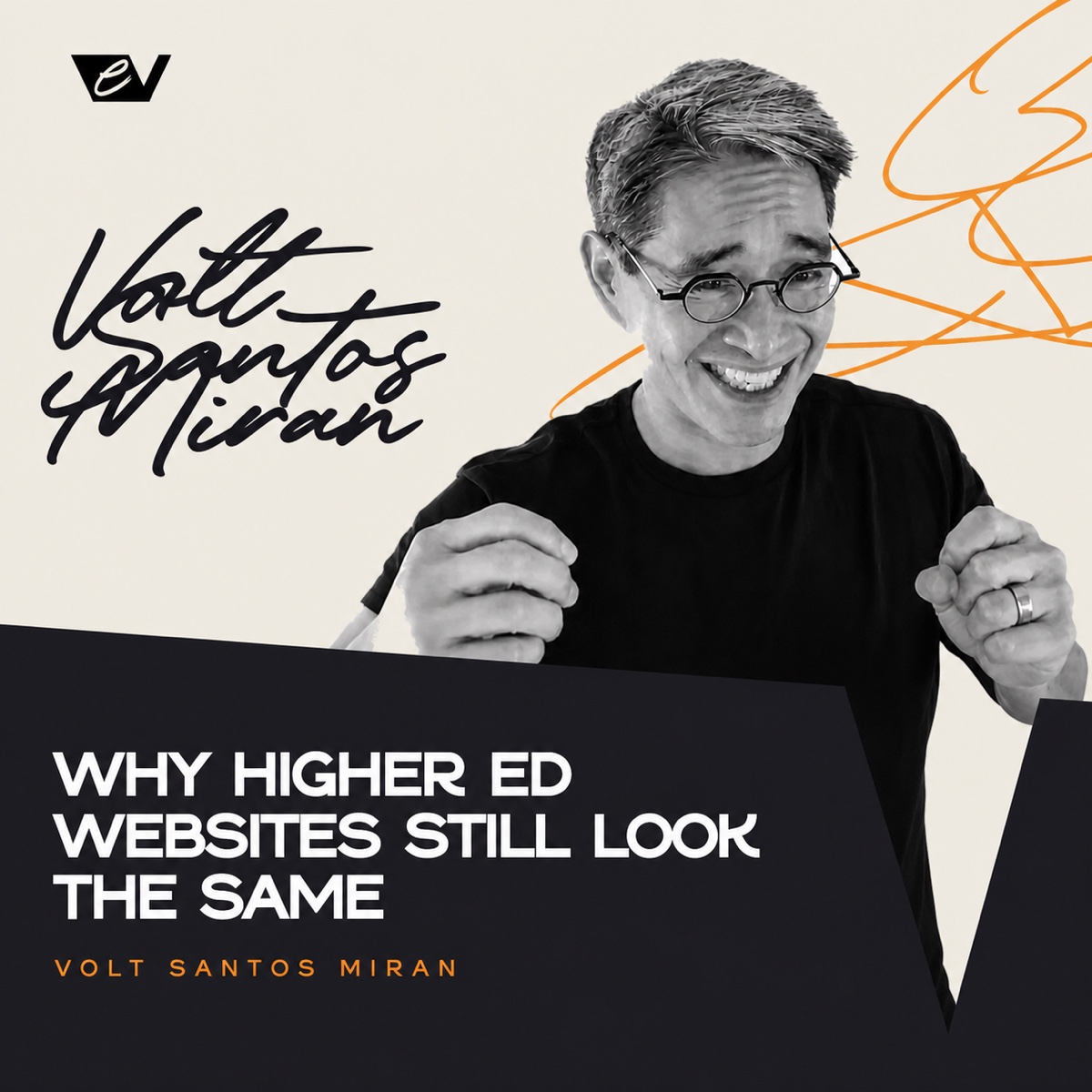
Volt Santos Miran: Why Higher Ed Websites Still Look the Same
EVP, Brand & Web Strategy, Carnegie
Watch or listen right here
About this episode
Why do higher ed websites still look the same and wrestle with problems that were already familiar when the web was young? Volt Santos Miran joins Tracey to talk about copycat design, underfunded web teams, shared governance, and why the institution should never be the hero of the story.
They get into the tension between innovation and proof, the institutional habits that turn websites into five-year capital projects, how AI is changing discovery, and why accessibility, usability, and proven pathways still matter. The strongest higher ed stories center the people whose lives are changed.
In this conversation
- 01Why the same web problems persist
- 02Shared governance and the copycat cycle
- 03Innovation, proof, accessibility, and usability
- 04Websites as ongoing processes, not capital projects
- 05AI discovery and the authoritative .edu
- 06Why the institution is never the hero
- 07What strong agency-client relationships require
Links from this conversation
Episode transcript
Read the full transcript
Transcribed from the episode recording; names and phrasing may contain small transcription errors.
Welcome everybody. It's another episode of Escape Velocity. I'm your host, Tracey Halvorsen, and today we have Voltaire Santos Miran, otherwise known as Volt. He co-founded mStoner in 2001, ran it for almost 25 years, and worked with over 350 institutions. he's now executive vice president of brand and web strategy at Carnegie. Who acquired mStoner a couple of years back. And he co-hosts the podcast Higher Ed Icons, which he had me on as a guest not that long ago. And so I jokingly told him this was payback for that. So welcome, Volt. It's very good to have you.
Thank you, Tracey. It's great to be here.
so you've spent your entire professional life in the higher ed space, whether it was on the inside or on the agency side. And, you know, we were talking about this conversation and and I said, you know, what's on your mind? What what are the topics you want to get into? And one of the ones that you brought up, I think, is a really good place to start, which is why are we still wrestling with the same problems that we were wrestling with in 1996? And so let's let's dig in. Why are some why are what are these problems and why are they still here?
Cool. It's such a a fascinating question. And there's actually a story behind this for me. So I, as you said, I co-founded mStoner and we were a web agency. And so I spent 25 years just steeped in web strategy, user psychology, information architecture, governance. And then when we got to Carnegie, when Carnegie acquired mStoner, I was running the web team with my business partner, Bill, for about nine months, and then my boss, Tyler. Who was one of the founders of modern day Carnegie came up to me and asked, Hey, I got a new challenge for you. Would you be willing to run the creative team? And the creative team had gone from like three people to 35 people in less than three months. Carnegie had just decided, we're going to invest, we're not going to farm things out to subcontractors. We want the best creative. So I said, You know, I would love that new adventure. And so for roughly four years, I led the creative team and I got involved with brand strategy as well. And then at a certain point, my business partner Bill called me up and said, Listen, I'm considering a change at Carnegie. I'd like to go full-time sales for web. How would you feel about taking the web team back? And I said to him without hesitation, they were always my team. As much as they were your team, of course I will take them back. And so I came back to the web team and I got knee deep in strategy again. And I'm like, all right, y'all, it's been like four years since I've done anything related to web. Let's talk about where we are. And they're like, yeah, so you know, the industry is still wrestling with production of content. We're still talking about how to separate internal from external information. Our clients are still having trouble getting visual assets. Staffing and funding for staffing is still a problem. University university home pages all still look the same. And they've got the drone video or the highlight reel followed by the program finder and the alumni, and then the news and then the social media feed, which kind of broke my heart a little bit. And they were saying we still wrestle with web strategy, governance is still an issue, accessibility is still an issue. And I'm like, Wait a second, I thought you were gonna solve that in the four years that I was gone. So it was really remarkable to me that all of the things that we were wrestling with when the web was young are still problems that we have today. And I I think you had asked me where why do you think that's the case? And I think it's a bunch of different things depending on what we're talking about, right? So one of my favorite colleagues, her name is Stacy Grimes, and she works at Gettysburg College. Do you know her?
I saw her give a fantastic presentation at the last AMA higher ed symposium about I'm not sure. Yes.
the DIMPY? The DMPI. Yeah. That that one magic number that they reported to the board. So I saw that presentation as well. And I was like, Stacey, for eduWeb Summit, let's work together. Let us put together something that matches up my storytelling body of work with your work in operationalizing storytelling. And when we were there, I was talking with her about the fact that, you know.
Yes.
Just noticed that we're still wrestling with the same things. And she said to me, Volt, part of the reason is shared governance. And I'm like, okay. I can I can actually see how that is the case with universities. it's far more complex than corporations. With corporations, I mean, corporate sites are so easy in comparison. You know, there's a very clear line of sight to what is being accomplished, everyone is rowing in the same direction.
Mm-hmm.
And there are very few people who are charged with making decisions. And then you come into a university setting and it's the exact opposite. So I do think shared governance is part of it. And I'm curious, do you how do you see shared governance playing into this?
I mean, it's i i it's a problem for it's it's lovely in theory. And I understand why it is as complicated as it is in a higher ed institution, especially a large one, but you have a lot of different stakeholders and if you think about it, almost every department is like their own business unit. And they're all expected to be providing content or an you know, answering questions or maintaining their own section of the site and you've got centers and graduate programs and and I also think it's not just sh it's not just governance, but it's the it's the very insulated or bubble way that that governance is is created. Like it comes out of an internal complex structure. So the governance tends The governance for outward facing things tends to model the same governance structure that that runs is that's how they run their internal organ that doesn't align often.
Yeah, yeah. Yeah. Yeah. So I do think shared governance is a real issue. I also think that IRED is one of those weird industries where we have a love-hate relationship with our peers and competitors, where on one hand, we want to be different from them, and yet on other on the other hand, we copy and steal everything from the last really great website that we saw launched, right? So at a certain point, innovation becomes quotidian and something that was different and exciting becomes what everyone is doing on any given Monday. So there is definitely a copycat sort of syndrome that happens when particularly when we're talking about web redesigns.
Sure. I I remember being asked of this of me multiple times by new clients. They would say, We want something completely innovative that no one has done before, but I wanna know it's gonna work. So I want two proof p you know, two case studies, two examples of where this worked for someone else. I'm like, you can't have both.
Yeah. Yeah. But I will say, Tracey, that I mean, and I have I I I think I said this to you when we did the higher ed icons podcast. I have watched all of your redesign projects over the years, and I've just been astounded about how you walk that line so well between doing something that is beautiful and innovative and out of the box, but not pushing the envelope so far that you are damaging accessibility or usability. Or proven pathways. So I'm curious of everyone in the industry, you do it best. And I'm curious what the secret sauce is.
Well, thank you. Number one. That's a huge compliment coming from you. I think the thing is, you know, I was having a actually I was having conversation with Jeff Holman, who runs Warrington, right? Right. And he was talking about, you know, he finds the word differentiation problematic as compared to distinction. And I agree with that, but I think that distinction is is sort of the it's what you do with the differentiation. Like
I love Jeff. Yes. Mm-hmm.
Don't be different just to be different. And there is a certain element of belonging that does have to happen here, whether that's, you know, common user pathway, things you don't want people to have to figure out how to use your website every time or figure out a new navigation every time they get to a new section. there are things people expect. It's like I wouldn't say, let's change the steering wheel if I was redesigning a new car, you know? So there's there's form follows function thinking that is sort of baked into my DNA. But I do think that the things that make the client distinctive, which is part of that discovery process to unearth that, how can we leverage that in a in a way that's felt on the website through how it's designed and built? And so sometimes that's it's a little bit of a conceptual exercise, right? Because a healthcare site, a hospital system that was also a university system comes to mind because what we realized is that when people came to the hospital system portion of the of the this, you know, entities experience, they were dealing with real crisis. Probably real immediate crisis, lots of stress, lots of, you know, just lots of stress, lots of anxiety. And so we really needed to treat that with care in how we set up that that everything for that. Whereas it's a different mindset, someone that's coming to the university systems experience. And I think that when you're trying to create something.
Yeah.
innovative and new and different, because everyone does say they want that. I just think you have to be really specific about why. why do you deserve to have something different or innovative? let's find out what's truly different and innovative about you. And then let's make sure that that's where we're pushing on the design on the design. We're not just changing it to change it or make it look different to make it look different. So
Yeah. Yeah.
I think with with Bucknell back in the day, it was like we really built in kind of a auto bookmarking feature. I mean, this was, you know, long time ago, but it's but it's like, all right, you've got visitors coming that are looking at lots of different information. They don't want to have to come back and hunt and peck to find that again. Like, let's give users just a really easy way to keep track of their the key pages that they want to remember, kind of set them up for that application process.
Yeah.
You know, we we would mess around with with anything where again the the form could follow the function and not interrupt the the user's needs when it comes to the site. So I don't know if that answers your question, but
Yeah. It does. And I think that, you know, it we hearing you talk makes me think there's also this tension between what people expect and surprising and delighting them. And I remember we were working for a graduate business school in the Midwest, one one project, and we had and they wanted something innovative. They they wanted something completely out of the box. And so we did this beautiful design. That at the time was something you'd never see, you'd never seen on any other site. It was basically what we called digital postcards. And you could shuffle the deck, and each of these postcards talked about a different aspect of the business school experience. And we used cream colors and a very, very open sort of layout because we wanted the images to pop because it was about the people, right? It was not about the school, it was about the people. And I was in love with the design. I just thought. I really want to bring this to life. The dean loved the design, and the the senior cabinet loved the design. And then we tested the design with current and prospective students. And they said to us: for the amount of money I'm paying for this graduate business degree, I don't not want to look like a business school. I want to look like the most expensive business school in the bunch. And when we heard that, we dialed back and we went up with a much more corporate style that served them well. But it was one of those situations where I thought, okay, that's what you're used to. But if you lived with it for a little while, would you have been happier? If it you and it's like some of the design conventions that we now just use up out of turn, like Parallax, for instance. You remember when Parallax was new and everyone either loved or hated it? And we had clients who started with Parallax on their homepage and they'd pull it in a month because They got bad feedback from senior administration. And now it's like parallax is everywhere. So there's that point at which what is foreign flips into what is expected or what is no longer disturbing. And I think there's also that line that we walk of when is that magic moment to introduce something that becomes a trend?
Yeah. Totally. Totally. and I do think that I think this th that it what you talked about before where everyone, you know, copies whatever the newest trend is. I think that happens across all markets to some extent, right? I think that's human nature is is we look to who we aspire to look like and we we try to model that. I always
Okay.
used to reference this with when people would say like we really need to test the you know something kind of obvious and I said well look you know we're we are referencing the groups that we know like we're looking at Apple. Apple always sets a very great design standard, always has, I think hope, I hope, always will. And I said, you can guarantee they're spending millions of dollars testing this to make sure it works right and works well for the user and is is living up to the Apple brand, which is about as, you know, sort of elevated as you can get. And so I said, so let's not sit and second guess stuff that we can safely assume like this is not really something that has value in changing. But when it comes to the yeah, so many things, right? With with a website, you don't know where they're coming in, you don't know who they are, you don't know what they want, and what's gonna turn them off versus what's going to pull them in. It's just I don't know that we we will ever crack that code. But I think those are all things we have to be considering.
Yeah.
But back to the original question of why are some of these same problems here that are in part around the shared governance? I feel like the other thing that Stacy was getting to with that one number is we need to show attribution for the work in a way that's meaningful to the senior stakeholders. And so I wonder what you think about. attribution and sh and helping connect the dots in beyond vanity metrics, right? Beyond like, the website's getting more traffic now or whatever. because in marketing in general and in brand, right, that's it's so far in the future. Like, how are we going to know if this made a material difference? And I feel like Stacy was starting to get at some of that.
Yeah, I and I think that what she did with the DMPI was brilliant because it basically boils down a bunch of consistent metrics into one number over time that they can share with decision makers at the institution. And one of the things I've always loved about Stacy is that her approach to web design, her approach to digital digital has always been form and function in service to effectiveness. And so I do think that we are at that point in time.
Yeah.
Where we have more tools to be able to chart attribution to show how effective a site is. But what's really interesting to me is to be honest with you, how few people actually use those tools. I mean, when we get into the analytics of and we work with some incredibly sophisticated universities that have like over a dozen people on their web team. And we'll get into their analytics and we'll find out that they never separated internal from external traffic. And they never set up events. And I'm like, wait, what? This is not the way it's supposed to be. So the tools are there, but the discipline and the rigor of applying those tools and looking at the metrics, it's far more inconsistent than I thought it would be in twenty twenty six.
Now I have a theory about that. And that is because higher ed has long been. I mean, if you think about where higher ed started, it was it was for, you know, it was elite. It was elite access to get in. And it gave you, you know, it was very expensive, and it was only for the privileged few, you know.
Yeah.
white only privileged few white men back when it first was created, right? And then we've evolved. But I was surprised when I started working in the industry how much they didn't like to talk about anything that felt like a capitalist entity, you know, like a a business. You couldn't use the word brand.
Yeah. Brand. Right. Not in front of faculty members. No, that was
You couldn't use the word marketing. No. And certainly not sales. Right. And but what is you know, the the functions are the same. But higher ed has has remained in kind of this soft, like, we're not for profit. We're not trying, you know, and the for profit schools obviously get get such a bad rap because they're, you know, they're dishonest or they're whatever. but at the same time, everyone's selling the same thing, which is, you know, a better you. you know, in in service of a better world. So I I'm curious what you think about that. Is it is it partly just that that higher ed has remained outside of the mechanics that drive capitalism and business?
Yeah. I think that that's definitely part of the picture. And I remember the time that we couldn't talk about anything that smacked of providing service to a student or brand management. I mean, those were just forbidden words. And I feel like over time that's changed. I don't walk into faculty meetings anymore dreading the explanation of why marketing is important. That has changed, and I think that that is great.
Yeah. That has changed, yeah.
But I do think that when we talk about how people are held accountable, very few institutions actually go as far as the metrics. And it's and I I would say, and this is one this is something that has been a personal crusade of mine, is that higher ed still treats websites as syncopated capital projects. Right? They they basically, every five years, someone will say, This website is a dumpster fire and we need to fix it. Or a president will come in and they want to put their stamp on something. So the first and most visible thing to do is the website. And so someone finds the money to do a website redesign. Everyone gets really excited about it until they're not excited about it, because by two-thirds through, they're like angry with you. And, you know, you're like, I'm just building your website. I am it is not my fault that your content is crap, or that that you have no photographs, or that your president doesn't like the design because they don't like the color of your your your palette. but then we get to the end of the site, we all celebrate, and the site gets launched, and then we all go back to what we were doing before we did the website, and then the cycle repeats itself.
Yeah.
No one really treats web as a process where you launch, you measure, you refine. And that I think is part of the problem as well, is that people just don't see it as important enough to invest in continual improvement in and looking at hard numbers. I think everyone gets excited when the picture on the homepage changes or there's a new video, but they don't really spend time looking at how effective. that content is, how people are moving through the site.
Yeah, I I used to joke that that I've I've yet to walk into a higher ed client and be given the document that tells me when I say, Can you show me your page deletion policy?
Yeah.
Okay, so everything stays forever. That's the that's how the website's been run, you know? And I and then I'm like, well, if we look at the metrics and we in the analytics, we can see that something has not had any traffic except internal for the last year. We should have a plan for what to do with that. Right. So it's not even what I always say is let's not just figure out that we're gonna look at those metrics. Then what are the triggers to do something? And you have to have a team to do that. And I think that this goes back to the staffing issue and the investment in that, in that team. And you know, we're seeing teams get compressed and and be asked more of in you know, increasingly. But now you've got all these different channels with
Yeah. Yeah. Yeah.
all these different metrics. And so I feel like the I think feel like things are really converging on higher ed in a in a tough way right now.
Yeah, I I would absolutely agree. And it's not many t most times the coming back to all the same issues that we've had for thirty years is is not for want of trying or for lack of trying, right? People want to do good work, but governance policies are only as good as the senior administration who is willing to enforce them and say, Yes, these are the people who get to decide.
Yeah. Yeah.
And that's a lot of what governance is about is being able to articulate that person gets to make the final choice about whether this is good enough to go on the website. So the policies are great until the person who is enforcing them leaves and they don't fill that position. Or a new administration comes in who doesn't believe in governance. So the longitudinal success of a website is so contingent on, I would say, a continuity of support that. We just don't have in education. And so we continually reinvent the wheel. We teach new people how to do stuff. Yeah. It's it's constantly coming back to the beginning because there isn't enough momentum to keep something moving forward as a process. And again, becomes that syncopated capital project that we pay attention to when someone screams loudly enough at a high level, and when the funding is available to do something.
Yeah.
Good and real.
Yeah, that's very well put. And I think that's a it's a that's a a big issue. are you having those conversations with clients when you start working with them? Like are you helping them assess that structure and
yeah. Yeah. And it's really I mean, so I love governance. I I just adore governance because I just feel like having a clear plan in place that everyone can get behind is important. And I will say that I've never written the same governance policy twice because every school has a different landscape, every school has different issues and political battles that need to be fought. And a lot of times what will happen is a client will say, in fact, I'm working on a governance policy for a university right now, where they're like, All right, we need three versions of your governance policy. And I'm like, Okay. And they're like, We want a governance policy with the resources we have now. We have we want a governance policy with the resources that we think we can get. And we want a governance policy for the goals that the president has. They are all contingent on different amounts of resources. And so yeah, right. And for me, if you're going to hold a standard like this, then you have to provide resources like this. You can't say, here's the standard, but here are the resources. This is all you get. You have to calibrate that so that it makes sense and people can be successful. And the moment the government policy does not allow people to be successful, everything breaks down.
Yeah.
So yeah, we we have these conversations, we fight the good fight, we argue for more staff. We usually get twenty-five percent of what we ask for, but it's twenty-five percent more than they would have gotten sometimes if they didn't have an external consultant come in. So little little baby steps, yeah.
And just on the financial side, is this just a chronically underinvested mechanism within higher ed? Do you think that that I do see that starting to change, but it's you know, and marketing tends to be the first thing people will slash, and of course that's the but then you're gonna reach for it in a state of desperation and that it's too late at that point. Right. But how much of the the sort of mindset that this is this is extra, this is fluff.
Well, I mean, Tracey, it's the web, it's free, right? It's like y you you type something into WordPress and you pr press publish and we're done.
Right, right. yeah. Yes. So there's a lot of there's a lot of people's cousins that are helping out. Yeah.
Exactly. I I do think that the web is relatively and has always been relatively or extremely underfunded for the role that it plays. So it boggles my mind that there isn't money for photography and videography. And when you realize that people form impressions of your web your institution based on your website in three seconds, the dirty unspoken truth about that is it's largely visual. And so if you're gonna go, if you're gonna spend the money to launch a new website, but you don't have the money for good photographs, you don't have the money for multimedia, that's a problem. And if you don't have staff to write content or to edit content or to provide resourcing within a decentralized organization where you've got editors here and there with incredibly varying levels of skill and expertise. You can't expect the website to be good if you don't provide the resources for that. And I don't know any, I don't know any client who's ever come to me and said, we've got more money than we know what to do with. We've spent all the money we can on the website, and we still have more.
Yeah. No. Nope, not yet. maybe one day.
How one can dream.
One can dream, one can dream. But yeah, you well, so let's jump to another question that this leads to, which is you know, yes, three seconds people are gonna make this emotional, they're gonna have this emotional response. They're gonna connect or they're not gonna connect. it's gonna rub them the right way or the wrong way. They're gonna see themselves or they're not. But now they might not even be coming to the website. before they're ruling you in or out. So now you've got an AI agent or an AI search function that it so how is that changing things?
It, I mean, as you said, people are coming to your website much further down the non existent funnel. We've talked about how the funnel is no longer a funnel, how it's an ecosystem. But when we when we talk about user journeys, we still use the funnel. So what I know is that students are coming to the website much further down the funnel after they've done a lot of investigating. And at that point, they're not coming to learn about the institution, they're coming to validate the vibe.
Yeah.
And they're coming to find out what they can't find out on an AI search, right? And even though AI search is going to get more and more sophisticated, there is a certain point where you're like, I need more than what is being provided. I want to see a virtual tour, or I want to read more stories, or I want to dive deeper into the outcomes of academic programs. So eventually they're going to get to your site. And I think that what that means is some people. Some prognosticators say that web is supposed to turn into the back plumbing for AI. And I don't believe that. I don't think that's true. I think all the things, and it ties back to what we were just talking about, all the things that we struggle with, whether it's content production or assets or accuracy of information or separating internal from external information or getting rid of redundant content, that all becomes so much more important. Because AI engines, when they are looking at your website, are doing a much more holistic review of that content. And for you to rank in AI means that you need to have what AI bots consider the most authoritative content on you. And the sad thing is there are a lot of institutions whose websites are in a matter of disarray enough that they're not the main source of information. Reddit or YouTube or Wikipedia becomes more of a source of information for AI bots than the website itself.
Yeah. Yeah. Yeah. I I think that's that's a new and very interesting development. And I always watch when I'm doing any research where what the the list is of the sources that the AI is giving me for where it pulled its information. And it's very interesting because sometimes it will be the the source of you know, I didn't mean to do that. But yes, that's what's happening.
Yeah. Yeah. Ha ha ha.
right. Like sometimes it will be the the primary EDU where it is saying, I got all of this good, valuable, trusted information from the website, and then a few other places too, right? That backed it up. And other times it will be Reddit first or some of the, you know, c college confidential or whatever, you know, some of those like other sites out there that will be listed first. Above the primary EDU's website. So that is I think that's a great place for people to go and scratch the surface here to start to understand, you know, how reputable, how authoritative is the AI considering their content. But it's also a constantly shifting landscape. So who knows where we're gonna be in a year?
Yeah, it is. That does tie back to what we were talking about in terms of analytics, though, right? Because when we talk about attribution, attribution has to naturally become more important because you can't look at the vanity metrics anymore. I mean, if you're looking at the vanity metrics, then you're having an shit moment where you're like, traffic to the website has dropped by a third in the last year. No one knows us anymore. So so In a world where you're not getting as many people coming to your side at the beginning, it's all the more crucial to make sure that it's a friction-free experience and that your site actually converts and that you're measuring that conversion and that you're identifying those weak points in the flow where people will bounce or where people get frustrated. So the all of the stuff that again has been a problem or a challenge for us as an industry. becomes more important and analytics, which has been, I would say, a discipline for the few, becomes even more important.
I agree. And I when you were just talking about that too, it almost hopefully will let will will let everyone stop focusing on the top of funnel. Because when you're trying that that's part of the problem that matches or aligns with this idea of shared governance, is also that that spread of trying to make sure that we're talking to
Mm-hmm.
Everyone that could possibly come. But at this point, that top of funnel is making their decisions in other ways. So I think once they do arrive on the website, they're a little bit further along in that thought process. And you don't need to do the same kind of signaling that I think lent to a lot of the
Yeah. Mm-hmm.
Category enforcement, you know, the the cliches that make sure you sound like an elite liberal arts college, or all the things I I found in blanding to be true and the data, those are symptoms of I think trying to appeal to too broad of an audience and try to make sure that you fit into an aspirational or a real category, market category. And I'm I'm hoping that.
Yeah.
we can see some of that pressure come off of the internal teams that are still feeling the need to to do that. Does that make s
It does. And it it reminds me, we we were having a conversation on higher ed icons with Lee Coffin, who's the dean of Dartmouth. And one of the the topics that came up was this idea of volume. And he basically said, Volume is not the key to the game. It's not how many people you put in the top of the funnel. At the end of the day, it's attracting all of the right people. And when you try to be all things to all people, then you are
Mm-hmm.
Going to inevitably displease everyone. And he shared that there was a consultant who had come in, and I think it was for Dartmouth. And the consultant said, Well, you have to talk about Dartmouth's urban location. And Lee was like, What urban location? And the consultant's like, no, no, no. I mean, the survey says that students care about an urban location. And Lee said, Yeah, I fired the consultant. And said you have to own who you are. You have to tell them the truth about who you are. And if it's not the right decision for some people, it's best that they know that immediately. Then you're pretending to be something that you're not, attracting people who inevitably will not be happy with their decision because you basically lied or only gave part of the truth. And I think that that's Part of what and it's a little more innocuous when we talk about the Universal University homepage, where everyone is going to talk about faculty who know your name and are committed to your personal success and making friends for life and having leadership opportunities and becoming a global citizen and having this incredible location that's somewhere between a metropolis and a bucolic wilderness, and alumni who have your back from the moment that you graduate. I mean, we all talk. About that, right? Because it's part of what people are buying. And I think your point and what Jeff was also saying about distinction versus differentiation is, you know, trying to be or sound different from other institutions is number one, somewhat pointless because we're all selling pretty much the same thing and silly because people are buying this as part of the experience. But the distinction says why here.
Yeah.
And it's much more emotional, it's much more ownable because it's not comparative. It is about who you are as an institution.
Have you ever seen an institution articulate publicly who should not apply?
That is such, such, such a good question. And I have not, have you?
No, no. I mean, except maybe in like the application criteria, right? Like, I clearly don't have the GPA to get accepted or whatever, you know, there's usually some criteria. But, you know, again, that game of like, well, we want as many applications as we can get, because then we're gonna look more selective because we're only gonna take so many of them. So that's gonna be a good number for us. And then
Yeah.
Of course, if most of those people don't say yes because they find out that you're not actually what they're looking for. And so then you don't get your class, that's a a problem. But but there are these competing games for that that selectivity ranking, you know, the yield, the all those all those numbers that kind of establish like how prestigious a school is, I think get in the way too.
Yeah, I absolutely agree. And while I don't know of any institution who has done a very good job saying this this is not for you if I do I I'm I hats off to Moravian University. I've been working with them for the last few months, several months on their website redesign. And one of the things that I loved hearing the most from the president when we first started the project is he said something along the lines of Volt, a lot of in a lot of institutions. Find value in the number of people they can say no to, the number of people we can keep out. And that's not the way we are at Moravian. What we want to be able to do is open the doors to as many people as possible for the needs that they have. And sometimes it's on campus residential four-year, sometimes it is hybrid, sometimes it's completely online. But I loved that mentality, that selectivity is not the goal.
Yeah.
Right. It that's not that's not what something that we should be aiming for because that basically goes back to what you're saying at the very beginning of it was an elite institution for white men. And in this day and age, the value of education is making knowledge and experience available to all. And that's when we see transformation. So I love I loved hearing that from the president because it just helped me understand the institution. in in a way that I've I've never I have not seen other institutions take that stand of it's not selectivity is not a number that we are going to judge ourselves by.
Yes, my hat's off to them as well. and I think this makes me think about look, I can't believe how expensive these schools are now. And how much it's even just changed in five years. Right? Not not not even if you go back to when I was going to college, you know, it's it's crazy. But even just year over year, if you look at a snapshot of five years.
my gosh. It's crazy. Mm-hmm.
The the cost has been going crazy. There's been a lot of scrutiny around it, and the value of what you're getting, right? What's the ROI on this? And so I think that A lot of schools are scrambling because they're like, well, but no, no, no, that's that's just the number, but nobody pays that. Like, here's what we'll do with scholarship, here's what we'll, you know, but I think to a prospective student who has no idea, maybe a first a first gen, you know, college applicant, they they're just going, Wait a minute, is this a loan that I'm gonna be stuck with for the rest of my life? Like it's it's complicated to even understand the mechanics of financial aid and higher ed. and so I just think that Even if schools really are like saying, Well, I know it says eighty thousand here, but it's really not. Like, how do you how do you make that case? Because well then why is it eighty thousand here? Like and who's paying that? And I don't know. I I think that's a real ball of wax or ball of I don't know ball of yarn.
Yeah. It is You know, when I graduated from undergrad, I went to Northwestern and they gave me a decent amount of scholarships. I graduated with $10,000 of debt for four years at Northwestern. Now I believe $10,000 is basically what you pay for like, I don't know, fraternity twos. I mean, it's just it's crazy how expensive it is. And I think you're right that people who don't understand that the retail cost is A retail cost that almost no one pays except for the ultra wealthy who go to the school. You you are looking at that and thinking, what happens if sophomore year I don't get as much aid and suddenly I'm liable for more of that information, that that amount, or how many loans do I need to take out and how long was is it going to take to pay them back? I mean, I can see why people don't want to spend the money and I I was talking with a client recently where the client literally said to me, only twenty-five percent of our students apply for financial aid immediately. And I'm like, What is going on there? And she said, a lot of them are first gen. They don't know. I have to actually beg them to fill out the FAFSA in order for them to get aid because they don't realize what is available to them.
Yeah.
It's and if you look at that and you couple that with an eighty thousand dollar price tag, ninety thousand dollar price tag, then college definitely does seem untouchable.
Yeah. I just think that that is the same problem, much more expensive problem now as it was in nineteen ninety six when they would h hide the price completely. You know?
Yeah.
I mean it was a different problem, but it was again just sort of this obfuscation around the most stressful, most important aspect of this decision. And probably the biggest financial decision many of these families and certainly these young people are faced with looking at in their lives. It's just it's you know. Like, here's a bunch of forms, and you dig around, maybe you can find out what the actual price could be. And no one talks about those long-term things. Like, what am I, what am I saddling myself here with if I make this decision? and I think that combined with the public discourse and disdain from the administration around the value of higher education is again just more of those converging, like.
Mm-hmm. Yeah.
Tough spots. well let's get into something more upbeat.
Okay.
Well, let's talk about story, right? You you are a fantastic storyteller. I've I've now come to learn. And you're a big proponent of the power of story, the importance of story. I've live I I I'm on your side here. I I think that's how humans have evolved. I think it's core to our culture. It's how we learn, it's how we experience things before we actually have to experience them to understand and react better and do better. It's core to learning. And I've been through these waves of where everybody was like storytelling, storytelling, storytelling. And then everyone's like, that's just the buzzword. so I've seen it, you know, go through all of those iterations. Talk to me about story. Talk to me about how why it's important and where it's underutilized in your opinion.
Mm. Fair. Well, I absolutely agree with you about story. And there's this really great book that I read probably a good twelve years ago. It's called The Storytelling Animal, How Story. Don't you love that book? It is one of my favorite books ever. And I actually just finished his second book that talks about the weaponization of story. story paradox is what it's called.
I have it on my bookshelf right there, I guess. Mm. I'll be getting that right off right after this.
Yeah. You'll you will love it. But I love that book because it talks about the fact that we through space and time have been wired for story. And that story affects us not just emotionally and intellectually, but it affects us neurologic neurologically and viscerally. And it's story drives learning, like you were saying, and teaching, it drives assimilation into cultures. It helps us to break down barriers. It helps us to define ourselves. For ourselves and others. So for me, story is so important, not only because we were built to consume stories, but also because it's something that everyone seems to agree upon. Like, and it to the point where if I get another RFP that says we need to tell our story better, it just drives me crazy because most times when institutions say that. They're not actually talking about story. What they're saying is we need to say our name louder and more often to more people. It has nothing to do with the form of story or the narrative arc that gets people like genuinely physically engaged in the narrative. So for me, the biggest problem with colleges and universities is they don't actually tell stories. And I was doing training for this admissions team, these counselors a couple of years ago here in Chicago. And I was just telling them, all right, here's here's how a story progresses. It starts with the the Pixar version. Once upon a time, one day, and because of that, and because of that, until then. And I emphasized it's not a story until there's some sort of conflict, there's some sort of need, some sort of catalyst, cataclysmic or catalyst that changes what was happening and presents a different trajectory. And it doesn't end as a story. Until there's a resolution. And it doesn't have to be happy, but it has to end. And I remember the head of the counseling team came up to me afterward and said, I just realized the biggest problem with the stories that I tell is that nothing ever changes. And what we see a lot when we talk about higher ed storytelling are all these anodyne testimonials of, hi, I love this place so much and I made the best friends in life. And my God, I'm like so ready to take on the world now. And that's the the depth of storytelling. And that's not story. That is just simply someone saying how much they loved a place. But if you talk about the challenges that people face, and they don't have to be extreme, but there has to be a conflict, there has to be a challenge, there has to be a resolution. I think we could get so much better at presenting the institution through the lives of the people that the institution changes, and we don't push hard enough into what makes story powerful in order to realize the benefits. And I'm curious, do you feel the same way? Because you've lived Story like I have for clients across the nation. So what what are your observations on Story?
I mean, I think it's I I think it's it's like our DNA, right? I so I think it's it's part of who we are. And what marketing as a function has done is to try to tell stories about something that isn't relatable or real. You know, an institution. What is that? That's an abstract idea. Because we relate. Person to person. Our lives are made up of experiences that we have with other people and with ourselves. And
Yeah.
None of us are living lives, maybe a few are, where there's no tension, where it's just like every day is a sunny day, I'm on the beach, I'm drinking my drink. Like life presents tension and challenge, whether you want it to or not. Throughout life, I think we're navigating the challenges we set out for ourselves and the challenges that life brings to us. But those are usually in the form of other people or ourselves, right? So there's a specificity in the the storytelling that I think gets lost when you're trying to speak about big abstract.
Yeah. Yeah.
Ideas. and I think that is a challenge for brands. how do they get comfortable letting an individual specific story lead instead of all of this bullshit?
Yeah. Well, and I think part of it is that I I say this in my workshops and I I usually will flash a slide of Back to the Future and I'll ask who's the hero of the story? Is it Marty McFly? Is it Lorraine? Is it George? Is it Doc? And you know, people will vote. People some and most people vote for Doc, honestly. But I will then ask, you know who never gets chosen as the hero of the story? And then I will flash a picture of the high school and I will say the high school is never the hero. Here's the deal: your institution is not the hero of the story. And a lot of higher ed wants to put the institution at the center of the story instead of realizing it's the people, like you were saying, that make the story strong. And if you feature those people and you tell their stories with authenticity and truth and vulnerability, it's going to be so much better than all of those very Amorphous platitudes that we talk about when the institution is what we're talking about and the institution is what we're selling.
Yeah, or you know, ninety percent of graduates from this you know, I don't you know, I I do think people look for, you know, will I belong, will I fit in to this community, this this space. But you're right, the institution is the stage. It's the backdrop, it's the setting, and it's the it's got the distinctive lighting.
Yeah.
set design, directors, right? But the heroes are all the people on the stage that are the students, the faculty, staff. if I think back to my own big decisions for undergrad and grad, it all came down to experiences with people. Whether that was an admissions counselor or a conversation with a current student when I visited, or hearing stories from people who'd gone there.
Mm-hmm. Yeah.
yeah, it it's how you how it's how you try to get as much information as possible is to get to those stories, find those stories. And that's why I that's why you see everybody on YouTube before they'll ever come to the institutional website because they're looking for those stories.
Absolutely. Absolutely agreed.
Yeah. but I love storytelling. I mean, I think it's, you know, and I love getting to the root. I I did a lightning talk many years ago where I was I was talking about storytelling. And, you know, when when we we all share stories all the time if you look at social media. And so I did kind of an experiment and I was like, I'm gonna look at just every social media post on on Facebook that my friends and neighbors are making, and I'm gonna try to get to the
yeah.
underlying story it's that's underneath and someone posted a picture of like their old their car they were getting rid of their their car so it was that one last picture like goodbye old friend we've traveled many miles together and I was like why did they feel the need to do that? Well they're they're sad about the loss, the transition, the passage of time. You know, this holds memory for them. Well why is why does that matter? Well because you know we're we're finite creatures and
Yeah.
This has and this has meaning in that car was part of their story for a period of time and now that's ending. You know, and well, why does that matter? And and basically I I say this a little bit as a joke, but also true. I think we are all very aware of our mortality and the fact that we're all gonna die. So I think if you start there, it's sort of like.
Yeah.
Why are we telling these stories? Why do these stories matter to us in the first place? Well, it's they're defining aspects of how we are here for the brief amount of time that we are. That's all we have. Right.
Yeah. Yep. Yep. I love that. It's absolutely true. And you know, when you think about the power of social, I I was thinking about his posting that photograph. His friends probably rode in those car in that car, right? There are probably some memories of some great road trips, some fun stories that he shared that with with his network for. And and you we had gone back and forth on or actually you'd sent me a question about, you know, how stories are getting compressed. And they are. I mean, I find that there there's like this barbell sort of thing going on where stories are all of a sudden getting compressed, where people are not necessarily I don't know that it's their attention span shrinking. I think it's their tolerance for boredom that shrinks and they want to be more entertained. And then we've got these movies that are now running three and a half hours.
Yes, I think.
So we've got these long form narratives, but one of the things that I love about the short form storytelling that we are like living every day in social is that it's easier in a short form story to create the details to make that story or that narrative meaningful for you. So one of the things that I find with story is that, and my executive coach, one of my coaches, said to me once, Volt. In the absence of information, our minds will run to the worst possible scenario. And the reason is that we are wired for story. And if we don't have information, we will create those details in our minds in order to give ourselves a story to tell. And we typically lean toward the negative, right? That's just the way we are. exactly. So
Yes. Yeah. Survival instinct, yeah.
When you talk about a short form story like that, where the details are implied, or you basically have the climax and the trans transformation, but you don't have the backstory, you don't have the exposition beforehand, that forces the person to con who's consuming that to create those details. And you you're doing that with a visual medium. And so I think part of what makes story in social so compelling is that you you have the delight of the eyes because you're looking at something and sometimes it's a video, but it's also you have more agency in creating the entire story around that post. So I think that there's some really cool dynamic in the way that we consume short form storytelling. Though I hope that long form never goes away.
Yeah, I hope I hope so as well. And that's really interesting what you just said about the short form. Do you think am am I hearing you right in saying that it gives us more of a a role to play in the story? Does it make us feel more part of it?
Yeah. I think it does. And it it allows us to create a story that we're gonna like, right? Because no one's editing what's in our minds and saying, No, that's not exactly the way it happened. So we can create a narrative that we find fulfilling. And that that is a really interesting dynamic, I think.
Are you seeing anyone do a good job at this?
golly, I I honestly think that people who are on social are turning out to be better storytellers than they know. I think there's something instinctual about the way that we tell stories on social, where we we know what picture that we want to share, how we're going to frame it, how we're going to either put it on a reel or put it as a post, what the captions are. So I think that. Frankly, s when we talk about institutional storytelling, students are incredible at right?
Okay. Yes, I agree with you. They and they've grown up in this medium. Why are schools so scared of giving their students more leeway here?
Yeah. Yeah. Because of the possibility of doom, Tracey. Because of the fear that something will go wrong. And then and it really is a matter of the the sort of institutional comfort with telling a story that is true, but might be off-brand for some people, right? But it's true. And I find that the social media teams that do better are the ones who say, I'm not going to gloss this over. I as long as it's not offensive, as long as it doesn't violate any privacy policies, it's an authentic view from someone who is part of our community who is sharing their story, and it's okay. And some institutions are just not there.
Yeah. Yeah, it's a great untapped resource. Great untapped resource. I also think no, no, what were you what?
Yeah. Yeah. I would never put them go ahead. You also think? I would never put them in charge of web pages. I wouldn't give them access to the CMS, but I would allow them to take over social. Absolutely.
Yeah. And I think they would feel so good. The you know, if you're you're obviously asking the ones that would feel good, but I think the same goes for alumni. I think that alumni storytelling
Yeah.
is so underutilized by higher ed. I mean, I think they've got their sort of highlight, you know, foundational alumni stories that they feature that are always, you know, this big success or this cool story. Or what about somebody who's just five years in at accounting job in Milwaukee? You know, like let's hear from those people.
Yeah. Yeah. Yeah. Yeah. It's not glamorous, but it's true. It's real. And the his friends, his classmates will appreciate that story. Absolutely. And we should be honest that not everyone is going to leave an institution and get a super high powered, high paying job at first, right? We all end up paying our dues and working for less money than we want and living less large than we want. and it's all part of building the career.
It's true. Yeah. Yeah. I don't know. Tell Gen Z that.
Yeah.
Sorry, Gen Z, if you're listening. I joke. I joke.
Yeah.
All right, now for a couple fun ones. Tell me about one of your biggest fuck ups with a with a client and how you handled it.
Okay. Okay. Okay. spoiler alert, this does not have a happy ending. So we were working with a state school out east, and I had brought on board a former client as a senior strategist. And he he was working as the lead strategist on this project and
Okay, even better.
A couple of days before the strategy report was due, and he had done all the interviews. He'd gone to campus, he had met with people. So he was really the one touch point on the project. And he called me up and said, Volt, I'm really slammed. I've got a final that I'm prepping for. Can we push back the deadline for delivering the report? And I said, You've known about this deadline for a long time. This is your job. You need to do it. I expect that report will be ready in the next two days because There were no mitig mitigating circumstances other than he just didn't get to it. And so he said, okay, fine. And he turned in the worst possible strategy report. It was copied and pasted from multiple strategy reports. It had nothing about the institution itself. It was like getting a PDF, do-it-yourself manual with no information whatsoever. The client was absolutely livid, livid, livid, livid. And I understood why. And so I redid the strategy report myself. And because we were on a tight timeline, I said, listen, I know that you need to go live at X, Y, and Z. So this is what we're gonna do. We're not gonna have time at this point to take your site live in the content management system. We are gonna build your site in HTML and we're gonna launch it on time. And then once we get past the remediation of any problems, we will. Build your site into CMS as planned. And so we worked evenings, we worked weekends. I was literally editing code, which I don't actually do very well at all. But we launched the site on time and the client was thrilled. And then two weeks later, I went to the client and said, All right, we've launched the site, we've got everything done. Now let's talk about the timeline for the content management system. And I'm hoping that we can have a reasonable timeline. Because you've got an HTML site up live. And he said to me, That's not the way this works. You are my vendor, and I'm going to squeeze you, and I'm going to squeeze you and I'm going to squeeze you and I'm going to push you as hard as I possibly can, and I will never give in. And I had a conversation with our attorney the next day, and we ended up firing the client and finding. A very Gwyneth Paltr way of consciously uncoupling from them through the remediate or the mediation of two attorneys. but that was the biggest F up I made. And I'm not sure what the worst mistake was. Was it launching the site and meeting an unrealistic expectation that then gave him the the agency to say, I'm gonna hold you to that crazy. case that you just proved you could do? Or was it my saying to the strategist, no, you have to deliver this on time and expecting that it would be good? I'm not sure which was the bigger fuck up. but it was the worst project we ever did in the history of mStoner.
Yeah. Sounds like this was a probably a good client to cut ties with if that was how they handled the initial, you know, problem. But yeah, if you could go back in time, like I was thinking, if you could go back in time and like get that strategy report really good, would that have fixed it? But no, this guy was probably like just looking for any opportunity to to say, I'm now gonna abuse you as my vendor.
It's I you know and I didn't see any signs of that until the first escalation. So it could have been that if everything had gone according to pace, then the relationship would have been much better. But you know, sometimes you reach that point of escalation with a client where no matter what you do, you are making up for the past. And that never ends. And that's the point where you're like, this relationship is toxic.
Yeah. Yeah. Yeah. Yeah. Yeah, yeah. Well good for you for getting out of it. what about what about a pitch? What's have you do you have like a a crazy pitch story you remember?
You know, it's when you had sent that question, I racked my brains about the the pitch or the kickoff and any one that could have gone badly. And the conclusion I came to is everyone is on their best behavior in the pitch. Everyone is on their best behavior in the kickoff. It's when they start to see deliverables that things go off the rails. And yeah, and they're just at that point, there are too many. There are too many instances to count. The the design presentations where you're like, Isn't this amazing? And they're like, No, this is horrible. Or the information architecture that you present, and they're like, This doesn't make sense at all. Or when you present a strategy and they say, That's not what we hired you for. Why did you give us this? We hired you for why and you gave us C. And there are there are more of those than I'm comfortable admitting.
Yeah. Yeah. Yeah. I that's why I love no more big I always say no more big reveals. We're gonna show you where we're going and what we're doing and and there's gonna be a lot of collaboration and transparency there because because I think now I actually I think now clients are th this industry is mature enough that people understand. I think you needed those gatekeeping
Yeah.
long process time periods when we were all having to work in that kind of waterfall system. And there was a lot of confusion around like information architecture. What is that? You know, it's like, okay, I actually don't need you weighing in right now because you have no idea how this is going to impact things. But now I think people do. So I think it's it's better to be more transparent than the big reveals where you could be like, ooh, we really missed the mark.
You know, they can go so well, but most often they don't
it's not for the faint of heart, that's for sure.
Yeah.
Volt, what is what's one thing that you wish people on the higher ed side knew about how agencies run, the reality of agencies. And I would also say, what's one thing that you wish people on the agency side knew that was true of higher ed? That they just are there any realities there that just need to be clarified?
Yeah. Well, I think from the standpoint of agency un understanding higher education, what I've seen most often is that when people within an agency, you you are typically going to be making a decision about what's going to be more important. Is it gonna be higher ed experience or is it gonna be agency experience? Right? That and they are not necessarily diametrically opposed, but the number of people who have both higher ed and agency experience. In equal parts. You know, those are the those are unicorns to a certain extent. So the people in agency who say, I can train h for higher ed. I need people with agency background, I think have got it wrong. Because I personally think I can teach anyone to run at agency pace. And the big thing about being an agency is that it's not higher ed pace. You are running hard, you are servicing multiple clients.
Mm-hmm.
It's a consulting line pressure that you feel. I can train people in higher ed to do that. I can't train people who have worked in agency all their lives to understand shared governance or why it is that there are 26,000 pages on a person or an institution's website and why that's sort of okay. Right. So I think that people who discount an understanding, a grounding in our industry are shooting some themselves in the foot. Because it is a hard industry to understand. And it is very different from corporate. It is very different even from nonprofit. So that's what I would say. I would say on the flip side, what I wish higher, well, and this is a bit of a cop out. there's a part of me that it wants to say, I wish people in higher education understood that agency people are human.
Mm-hmm.
You know what? Because there's a certain level of you're a very expensive agency, so I can treat you somewhat more badly than I would treat my own staff. there are some the there the expectations for how an agency, particularly a large agency, will communicate are untethered from the way that reality works.
Yeah. Mm.
The same way. So, like, for instance, a client who's like, Well, certainly your teams talk with each other and share information. And I'll look at that and I say, Yes, but you've got six different projects that are in flight with six different parts of my agency. So something might split through the cracks, a little bit of grace. Please, we we want to get this right. But then they get very upset when a l an alum comes to them and said, Well, I told my department that this is my new address. Don't you talk with each other between the alumni association and the academic departments? And they're like, no, of course not. We're we're separate. So it's it is the same sort of dynamic, right? Where we as individuals expect that the institution or the agency or the organization that we're working with is going to provide us with a seamless experience. There are going be no gaps and the knowledge transfer. Will be comprehensive and ongoing. people expect that from agencies, alumni and students expect that from institutions. And there's a certain level at which that's fair and right. And then there's a certain level at which you have to say, every organization is flawed because every organization has human beings and we're messy.
Mm-hmm. Yeah. Yes. And we're not all great communicators and life happens and people misunderstand and yeah, all that. I wish, what do I wish? Well, it's interesting because now I've I'm working with lots of different types of organizations. So I can kind of and even back, you know, prior to Adeo, we have you know, we'd work with museums or we'd work with cultural orgs or nonprofits. So I liked always having different types of clients to orient around. And higher ed is unique and special. but I I found that I don't know, I get so invested in my client that I don't see it as a project because I'm like, we are, we've got some big objectives here, some big goals that'll be really good for you. And and hey, you know, you're you're paying us a good rate. So it's it's beneficial for us, it's profitable, but that's not why we're doing this. We're doing this because we actually care. And Hopefully, you know, the more we learn, the more we care and that we do a great job and we it's all successful. But I always just think, God, that is a lot of invested knowledge and buy-in that you get with a good agency partnership that I wish people didn't feel like, I need to go to someone new now to get new work, to get different looking work, you know, a different style.
Yeah. Yeah.
Is that really what it's about? Because isn't it about understanding, like having that knowledge of I don't know.
It's and it's such a hard dynamic. I don't know about you, but I found that the number of institutions that would hire mStoner twice in a row for a project redesign, I could count on two fingers over 20-some years. And and and most of those were really great relationships where, like you said, we we were emotionally invested. You know, it's almost every school I end up working with. I'm like, I wish I could go back to college again and I wish I could go here, right?
Yeah. I know. Everyone, yep.
Every single one of them. But then the the pragmatist in me realizes that what typically happens is everyone loves the site. And then four or five years pass, and then governance breaks down, content starts to sprawl organically again. And then we as the agency get blamed for all the bad decisions that were made after the site goes live. And I've had clients say to me, Volt, we have a great working relationship. But I can't justify bringing back the team that everyone associates with all the problems that we now have with our website. And that just sucks. I mean totally sucks.
Yeah. Wow. Right? Yeah, that's why you want that ongoing relationship, right? So it's like, hey, the work begins on launch day. That's not when it ends. But you know, like in most cases it launches and then the dust starts settling immediately. And you check back in, you check back in six months later and it's like we still haven't changed anything. Come on. Like we why'd we build this great CMS and and do all this training and have this great content strategy? It's all there, the assets, the thinking, but nobody's been empowered to
Yeah. Yeah. And the money dries up. Yeah.
Keep it alive, right? It should re it should be alive and growing and evolving the minute it launches. If that's a funding issue, I don't know. I mean, but it's it should be a never ending website, not a s launches and then starts degrading immediately.
Yeah. Yeah. Absolutely agree. totally agreed. Totally agreed.
But I I don't know. That that seems to be more unique to higher ed. I don't know if that's a funding issue or a a mentality. It's just
I most corporations will continually invest in their website and and build it and continue to build it. I don't know any corporations like we're gonna launch the website and then we're gonna come back to it in three to five years and all of our content contributors have pretty much free reign to do whatever they want in the meantime. That that is just not the corporate way.
Yeah. Yeah. No. No. But I think it's again, understanding the value of the marketing function within the business is much w better understood in corporate than in higher ed. I mean higher ed's catching up a lot, right? But it it doesn't look at that long it is like what you said, right? Every five years a new president comes in or the budget finally pops up, it's time to grab the big piece of the pie for the new shiny website and
Yeah.
Yeah, hopefully we'll see that start to change. and before we kind of wrap things up, what are you just tired of talking about, like or dealing with, like burned out beyond a crisp around?
golly. I most more than anything else am tired of capitulating clients who want the exact same homepage that every other institution has. I mean, it's just the video and then the the the count up stats that were cool until I was like, if I see another set of contupt stats, I think I'm gonna heave. I mean, it's just and everyone is like.
yeah. Yeah.
No, we have to have the stats and we have to have the news. And I'm like, does anyone click on your news? Look at the stats. No one clicks on the news. Analytics will tell you that no one and and if you talk with alumni and you talk with people who they're targeting for the news, they will say, I never come to the website for that. I expect it in email. I expect it in social. So so why are we throwing news item upon news item on the homepage? Why are we putting social polls on the homepage in 2026 when
Yeah, yeah.
People who want to consume social will stay in social. They're not gonna come to your homepage to get to Instagram for your for your images. Look, another tiled set of square photos. This is wonderful. Yeah, I I I am tired of giving clients the same stuff on the homepage because they feel they need to, because everyone else is doing.
Right. Or be like, ooh, Instagram. They have pictures there. How much do you think that is also the agencies, you know, it's a small set of of agencies that serve higher ed exclusively. How much of them are to blame for maybe the client didn't ask for it, but it's just what you're gonna get?
Yeah, well, it's very possi. I mean, there are some, I would say, some instances where you're fairly sure that the agency phoned it in and just gave the client. Well, and there are two parts to that. There's the the part of did the agency just fall down on their job to do something unique and incredible for the client? There's that. There's also did the agency give the client
Yeah.
As much as or more than they could afford, and they ended up with a skeletor set of you know modules from WordPress, or this was the this was the budget that they had, and this is what they wanted. So we delivered that, and it's 10,000 times better than the website they had before, but it doesn't look any different than anyone else. So yeah, I think there's a little bit of both of that going on, I would say.
Yeah. Yeah. Little bit of both, but yeah, I'm tired of the the president or the dean or the VP of Marcom insisting on you know, the new drone video. The drone video the drone video is what I'm most crispy about right now. I'm like, please don't please don't show me another one. I don't wanna see it. I don't care.
What? Yeah. Yeah. Yeah. Absolutely. And those it's amazing how you do those drone videos. Magically no one's on campus. It is like a ghost campus. Yeah. This is the university that you'll be attending and you will see no one else, but you've got lots of trees. Enjoy.
yeah. Right. It's it's creepy. Yeah. Enjoy. and what are you okay, AI. Is the hype real? Or is this a bubble? is this something that that has had really good marketing applied to it? as somebody said to me recently, they said AI is just an example of great marketing, which I thought was interesting. and is it a hype bubble or do you think there is real significant transformation happening with this technology.
I think that there is significant transformation, but happening in different ways than people expect. I remember I was the first AI ambassador for Carnegie when AI came out and they were like, someone needs to talk about AI. And I'm like, sure, I'll do it. So I put out a piece and what it basically said was, listen, y'all, we've been through this before. We there are several times where technology has come out and transformed the way we work. Think back to when the web came out. And now we can't imagine our lives without it. But what happens is there's a massive hype to it, and then eventually it becomes quotidian. Right. And it's not not in the like clippy Microsoft Word sort of way, but more in like spell check sort of way. And so when I look at what we're doing at our agency, I can say that every single part of the web team has embedded AI into the work that they do. For me, it speeds Analysis for strategy like seven, eight times. When when I'm doing experience maps, I used to spend five hours for every transcript just combing through and getting every detail. I can run it now through AI and gets 95% of what tick me like five hours, but it does it in five minutes. So there are definite advantages to the way that we approach our work. I know that our designers are doing rapid prototyping now. Our developers have reduced the time that they're spending on back-end and front-end coding significantly because of what they can do with AI tools. So it is transforming the industry. it's getting us, it it makes us better at what we do and faster. It does not take away the need for a human being. So, in many ways, it is not the Cataclysmic transformation that some people were thinking of, human beings are no longer going to be essential. But it is not like we just spent billions of dollars on hype and AI actually does nothing because I can't I can't imagine anyone not using AI on a daily basis throughout the day now.
Yeah, I was just talking with Jaime yesterday and she said, I can't imagine what I would do if this went away.
Yeah. Yeah. And it's everything, right? Personal life. I mean, it now comes up with stir fry recipes for me and I'll basically tell it what I've got in the fridge and it produces that. all the way to deep analysis and research projects. So it is it is significant and I do think transforming. I mean, are you feeling the same thing and seeing the same thing in your work?
Yeah. I am. I'm I haven't been this excited about something since the web. Right? Since I I found out about the web. I mean, I think I thought it was AOL back, you know. Like, what is this? What do you mean you can talk to people and and then when I found out about websites, you know, I was a painter, but I'm like, wait a minute, I could take a picture, a digital picture of my painting and put that on a
Uh-huh. Yeah. Ha ha ha. Ha ha ha.
The internet and anyone could see it anywhere in the world, anytime they wanted. That just blew my mind. I was like, I need to know as much about this as possible. Because it just that changed everything. And from there, I haven't been that excited. There have been moments, but now that AI is here, I just think it's the more I learn to work with it, the more powerful I find it to be. My concern is that just like with, you know, digital platforms taking a replacing kind of standard publishing, right? Desktop publishing replacing the the old style of doing things. There are a lot of people who are like, it's BS, it's hype, you know, it's taking all of our jobs, it's stealing creativity without at you know, attribution, like it's just sucking everything in. So there's a real negative sentiment towards it. And a resistance towards it that I can also understand, but I think There's where we're going and then there's people who are just gonna kinda be like, What happened in another couple of years? Because I think that gap is what worries me. but I think that happens every time there is a a big new transformation.
Yeah. Yeah, absolutely agreed. And it's never as as extreme as we expect it'll be, right? Good or bad. It's always somewhere in between our worst possible scenarios and our biggest dreams for what it can do.
And it'll Yeah. Yeah, and I think that is bearing out to be true in AI. What I do think is the pace of it, the speed of change that we're going to continue to see as it gets faster at making itself better, which will get better at making the robots and making the automations and developing the factories and building the data centers, like all of that I think is going to pick continue to ratchet up. So I think it's going to be very hard to keep up. You know, and I'm not like one of those doomers that's out there like, you better keep up or you're going to get left behind. I just think it's going to be di difficult.
Yeah. Yeah. Yeah, yeah, agreed. But we at least I my guiding principle has always been how do I use it in a way that is going to enrich my life and make me better at my work and all the rest of the use case scenarios don't matter as much to me as what I can apply within what what lets me stay true to my own philosophy about life.
Mm-hmm. Yeah. I think I'm very happy that AI is coming into my life at this point in my life versus I wonder how my kids are gonna think about it coming up as kind of AI natives. You know, we used to talk about like the digital natives and
Yeah. Yeah. Yeah. I'm very curious. I mean, do your do your kids use AI ubiquitously now?
I mean yeah. No, but that's just because we don't give them access to it. Right? But they do I I just wonder about what that's gonna do to
okay. Okay.
The idea that sometimes you have to grapple with a complex idea through writing about it, through thinking about it, through like it's not just get the answer. It's it's the process of thinking about it or writing about it that is the important parts. And so I just worry that with a generation that's already got l way less tolerance for boredom, as you put it.
Yeah. Mm-hmm.
that there's gonna be tolerance for that journey that I think is so important to intellectual development and maturity and understanding of of existence and what this is, if we just have this easy answer that we're always going to. And, you know, we worried about that with Google too, but
Yeah, yeah.
Google wasn't Google didn't sound quite so convincing as the AI does when it gives you the answer.
It's true. I mean, the the the confidence with which AI can lie is just incredible. Yeah, I I actually have a a project programmed with Claude and I've been studying French. This is one of my when I sold the business, I was I was like, I need to find a hobby because I cannot make work my life anymore. And so I decided to learn French. And then when
Mm-hmm. It's a little scary, right?
Claude came on the scene, I was like, okay, I'm gonna teach Claude or program Claude to give me a daily French lesson based on popular French music that I listened to. And it got to the point where I was looking at the sentence and Claude was saying, No, that's wrong. And I would say, No, Claude, you're wrong. And Claude was like, yeah, my bad, you're right. And I'm like, whoa, you just told me that I was wrong with full confidence. And I can't believe I knew enough French to tell you that you were wrong. And I can't believe that I was right that you were wrong. This is just true.
Yeah. It's like a w win win for you, but disturbing overall because that kind of behavior is it pretty in line with like a psychopath, right? Like you know, if it's like, no, you need to go to the, you know, you need to take this medication and do this for sure, you're gonna die. And it'll tell you that, you know, convincingly, and then when you finally prove it wrong, it's like, you got me. I'll take I'll take my own medicine on this one, you know, or
Exactly. Yeah. Yeah, exactly. Whoopsie. Yeah. I'll do better next time.
Whoopsie. I'll do better and it won't. Yeah, I know. I I yeah, I try not to speak too harshly to my AIs, but sometimes I do. but I also try to give praise.
Ha ha ha.
okay, we had a little glitch, which is what you're back now. You're back now. Am I back now? I think that was AI being like, mm-mm-mm, you don't talk bad about us. Glad we got that over with at the beginning. So, Volt, I'm gonna thank you for spending all this time with me talking. this was great. I really enjoyed hearing about how you
am I back now? Okay, you're back now. Better AI than Trump. Yeah.
see things and what you think is important and that gives me great hope that you know good things will continue happening and creativity and storytelling and all of those things won't get crushed.
Well, this was delightful. Thank you. And I hope the exact same thing. Cause a world without creative creativity and storytelling would be a very, very dark place.
Yeah. Agree. Agree. All right. Well let's go make some good ones and thank you again.
Awesome. Sounds great. Thank you, Tracey. It was great talking. Bye.