Episode 31 · Jun 1, 2026
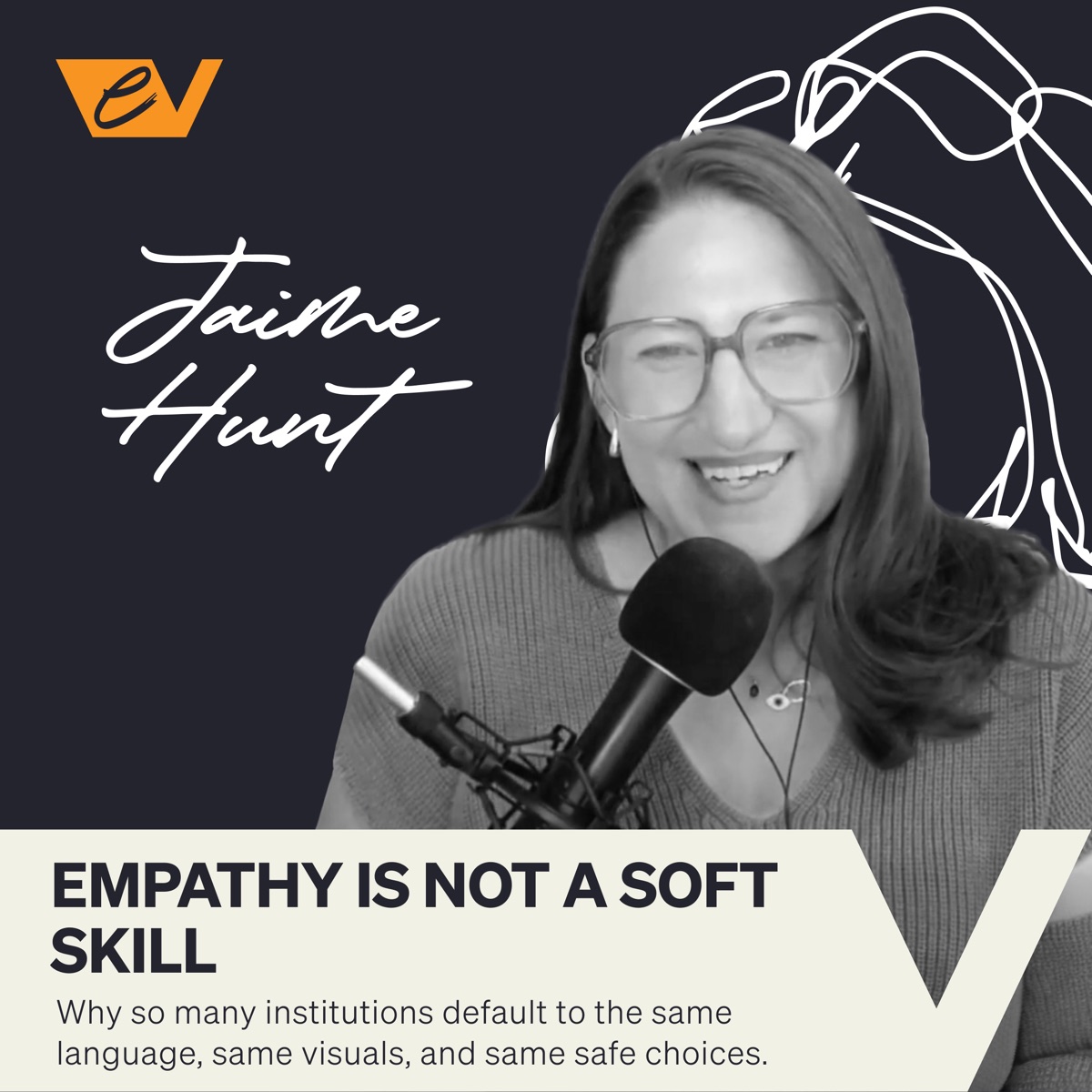
Jaime Hunt: Empathy Is Not a Soft Skill
Founder, Solve Higher Ed Marketing · Author
Watch or listen right here
About this episode
Jaime Hunt has spent a career arguing that empathy belongs at the center of marketing strategy, not on a poster in the break room. As the founder of Solve Higher Ed Marketing and an author in the field, Jaime makes the case that understanding your audience deeply is the hardest, most rigorous work a marketer can do.
We talk about higher ed marketing in a moment of enormous pressure, what empathetic leadership actually looks like day-to-day, and how teams can integrate AI without losing the human insight that makes marketing work.
Links from this conversation
Episode transcript
Read the full transcript
Transcribed from the episode recording; names and phrasing may contain small transcription errors.
Hello everyone. Thanks for joining me on another episode of Escape Velocity. My guest today has spent 20 years inside higher ed marketing, nine of them as a chief marketing officer at three very different institutions. A big public research university, a mid-sized public, small HBCU. She saw how the work actually gets made or doesn't from the inside. Then she left. She started her own firm, Solve Higher Ed Marketing. She wrote a book, Heart Over Hype. She still teaches the next generation of higher ed marketers at West Virginia University, and she hosts her own podcast, Confessions of a Higher Ed CMO. I have gotten to know Jaime and watched as she's launched Solve. And what I keep coming back to is how clear eyed she is about an industry that mostly talks in circles. She named her company Solve Higher Ed, and that tells you something. So Jaime Hunt, welcome to Escape Velocity.
Thank you so much, I'm so happy to be here.
I'm so happy you're here too. I really was like just, I watched how you launched Solve and ⁓ all of the different pieces and parts. I thought this is someone who really knows marketing. ⁓ It was a really great launch. I was intrigued, ⁓ really watched how you were rolling out all your content. And before we dive into all of that, I do want to go back in time a little bit.
Thank you.
and just kind of know who was Jaime Hunt before you were Jaime Hunt married and in the world of higher ed. ⁓ Give us a little backstory on your background.
Yeah. Yeah, so I've worked in higher ed for 22 years, which is wild to me. I can't believe I started in 2004. So I started my career as a journalist and quickly discovered after about four and a half years struggling that it just isn't, there's no money to be made in journalism. And I know that makes me kind of sound like, you care about his money, but we couldn't. pay the bills, like it just wasn't working. So I saw a job posted at a university and I was like, I can look in the mirror if I'm selling education, right? Like that feels idealistic to me. And so I started working in higher education at an alumni magazine at a small private niche college in Minnesota and it stuck. Like I fell in love with it ⁓ and that's where I built my career. I spent the first half of it in various roles from PR, alumni magazine, digital marketing, web strategy. And then I kind of combined it all together in my first CMO job, which was at Winston-Salem State and ⁓ have had just a blast. I can't imagine working in a different, I don't understand how people work in different industries. It's such a great place to work.
It is, it is. ⁓ I have loved my journey working in the higher ed space as well. And you know, it's so funny. ⁓ One of my favorite things is when I get to actually go on campus and meet the people that make the place what it is. it's so, you know, they all say they're unique, but of course then the language they use. doesn't actually articulate that very well, which is why we're all in business. ⁓ But they really are unique. Each one is so special and you don't really, it's hard to, how do you share that and convey that to the world without them being able to be there? so it's a great challenge. ⁓ So you spent all that time inside higher ed. What made you decide to start your own company and make that jump.
Yeah, mean, early, early in my career, had a journalism job, then briefly worked for an agency and then went to journalism again. And when I was at that agency, ⁓ I was like, I want to be a consultant at some point because I see this, I love this. The industry I was in was a little weird, but I was doing comms and I loved that. And I set as a goal by the time I'm 50, I want to be doing consulting or have a small agency or something like that. And the opportunity just was the timing was right. Two years ago when I launched it, I felt like, you know, I'm close to 50. I'm ready to take this leap. And, you know, some folks had given me the advice and I can say even just two years after that, that I found to be true, that when you're 50 and 55, you're be more tired than you are at. So, you know, launch and do the hard thing when you still have a little bit of energy. I don't know if I describe myself as having energy, but ⁓ I'm really glad. The timing was perfect. And people ask me all the time, like, do you regret it? And I have not regretted it for one fraction of a second. It has been such a great journey. And I have all the years of my life up until two years ago added together. I did not learn as much as I've learned in the past. 24 months, it has been such a journey.
Wow, well, I have to follow up by saying like, what are the biggest things you've learned then in the last 24 months?
Yeah. So, I mean, from a practical perspective, I didn't know anything about taxes or bookkeeping or business plans or business banking or how to do retirement and how to get paid and none of that. And so I would say one of the biggest things I've learned is like ask experts, like hire the people. who have the expertise, you I got a bookkeeper immediately because I knew I was going to mess this up. I got a tax accountant immediately because I knew I would mess that up. I learned how to do so many things that go into running a business, how to write proposals, how to, you know, all of it. ⁓ But I also learned about myself. And I tell people like I'm ungovernable now because I my belief in myself is so strong. Like I believe I can do things that are hard that I didn't know how to do yesterday and accomplishing things and doing things you didn't know how to do that you had to figure out gets that muscle memory for like, well, maybe I don't know how to do this, but I'll figure it out. Look what I figured out before. And that belief in myself has made it like, yeah, I can figure out anything. Like there's nothing I can't figure out. which is probably slightly delusional, but it's also so powerful, right? To have a belief in yourself like that is so powerful. And I'm so grateful.
How does this, ⁓ this must influence how you teach, not just how you work with your clients, but also how you're teaching students? ⁓ Have you, have you found that to be an impactful evolution?
Yeah. Yeah, I would say my students, I'm often getting messages while I'm teaching over the course of a semester from a student saying that they're afraid they're going to be laid off or can they sit down with me and pick my brain about my career trajectory. And I find myself spending a lot of time helping students more with mindset than it is around the skills necessarily. Like the curriculum takes care of the skills. But I want them to be able to see that if you don't believe in yourself, nobody else is going to believe in yourself. If you don't bet on yourself, why would somebody else bet on yourself? most of the people that come to me in my classes are women who maybe they haven't let somebody or somebody hasn't let them say it's my turn and giving them some confidence around like, it's your turn when you say it's your turn.
Yeah.
⁓ and really providing that kind of guidance to them. I'm such a believer that mindset's reality. that's a, we teach curriculum, but we're also helping influence character, influence mindset, influence who you are as a human. And so like what a privilege to be able to share what I've learned with other people.
Mm-hmm.
who maybe need to hear that message. Maybe this is the moment in their life they need to hear that.
Yeah, and better to hear it at that stage in their journey than waking up one day way further along and realizing you were waiting for someone else to give you the certificate of, you know, yeah, it's your turn. You are now officially allowed to have an opinion and solve these problems. ⁓ I used to ⁓ advise, I mean, I still share this like...
Yeah. Yeah. Your turn, Ness. Yeah.
That is an inner voice. All that criticism, all that self doubt, you're projecting outward and giving something that doesn't exist a voice and power over how you're living your life. And it's really just a deflection to avoid the scarier reality, which is that like, you gotta work with what you got. And so why would you be
Yeah. Yeah. Yeah.
putting these barriers in front of you. So it is, yeah, a lot of self-reflection and confidence and knowing you can do hard things, you know? Because that's life, like problem solving, dealing with hard things, challenges. That's what I enjoy about the work. The work is all problem solving. And ⁓ it requires creativity and it requires confidence and just knowing you can figure it out.
Yeah. Yeah. Yeah. Yeah. Yes. Yeah, whenever I have sleepless nights and I have these like, my God, you're gonna fail and you don't know what you're doing and negative self-talk, I have started saying to myself, that's not your voice. You're hearing another voice in your head. This isn't your voice. You don't have to listen to it. And sometimes that works. Sometimes 3 a.m. Jaime is like, well, that's too bad, because you're gonna hear it.
You
now until you finally get out of bed. ⁓ But don't let your voice be the thing that holds you back. Your voice should unlock you and let you fly and not cage you up and keep you down.
Yeah, I mean, there's a lot in, I found meditation really helpful when I've been going through hard times. When I had to exit my agency and was dealing with nasty divorce and all sorts of, lots of pieces of my identity just getting ripped out from under me, I'd never been in such a state of insecurity and fear and pain and all of those things. ⁓ I've always just had an abundance of confidence or at least given that off even if I didn't feel it. And it was one of the first times in my life when I really was just rocked. And so when I would go through some of these meditations, I realized that yes, I'd separate myself from those thoughts and just realize they don't have power. mean, just let them go by, recognize them for what they are. Like it's okay to have anxiety and those feelings.
Yeah.
let's just, let's be friends, it's part of life and just pass on by and don't have any impact on how I then get up and conduct myself. And it was very helpful.
Yeah, meditation is such a great practice and I started doing it because I was a chronic pain sufferer and I could meditate and deal with pain that way and it is so helpful to be able to flip into that mode and have it impact how you physically feel in your body.
Yeah. Yeah, yeah, it's a good reminder that everything we are experiencing, ⁓ all the thoughts we have, it's all our consciousness is being created by our minds, our bodies, our experiences, our emotions, and ultimately, it's the one thing we can control.
Yeah. Yeah.
And I think a lot of times people go through their life thinking they can't, they're just reactive. I've just got to try to survive another day and react to whatever is getting thrown at me. But no, you're creating it all. So it's your choice. And that was one of the biggest unlocks for me at this stage in my life was just realizing, you know, I can't control a lot of things, but I can control how I show up.
Yeah. I love that.
how I talk to myself and how I experience the world, know? How I experience my life, that's my choice. So yeah, it's an easy thing just to give yourself permission. I don't know why we have, especially women have been brought up to think we don't have that right. It's absolutely, it's the one right that you absolutely have.
Yeah. I love it. I love it. Yeah, people can't control your thoughts, but that is not something that most people, most people would say, I agree, but then they allow other people to control their thoughts. Like they allow other people to put them into a negative head space or, and that's not to say you're never gonna be angry, you're never gonna be mad, you're never gonna be disappointed, you're never gonna be sad. That's okay. But how you,
Mm-hmm. That's life. Yeah.
get to the other side of that is something that you can control. And I saw ⁓ a Stephen Colbert clip last night where he was, it must have been an old one, because he looked a lot younger than he does now. But he was saying that he is grateful for everything in life, including suffering, because you can't be only grateful for the good things, because that's not what life is. That life is... this much bigger picture of the good and the bad and the suffering and the pain and the joy and the heartache and all of that is what life is. And to truly be grateful for life, you have to be grateful for the whole thing. And that, I needed to hear that last night to be honest with you.
Yeah, yeah. I mean, I do think ⁓ everyone gets ⁓ a different recipe. ⁓ Some people have had lives full of immense suffering. And to read about their stories and the fact that they're still able to find joy and happiness and ⁓ have an outlook on life, sometimes those are the most joyful people.
Yeah.
and the most optimistic. ⁓ So as a painter, I always share this story because it really shaped how I look at life. ⁓ There's this idea in painting that you put your darkest dark next to your brightest light for the focal point of where you want the eye to be drawn to or sort of in your composition. But you can't have that brightest bright without the darkest dark.
Yeah. Mm-hmm.
So you need the compliments. And this is in color theory and all of that, but it's what's next to it. It's what's surrounding it that makes it the brightest bright. And it's the same in life. I remember marching into my therapist's office when I really knew that shit was hitting the fan. And I said, Matt, I just want you to know that I want to get as much out of this.
you I love that.
horrible situation as I possibly can. Like I'm coming here to do the work. I do not want to ruminate. I know I'm prone to do it. So apologies in advance if I do, but like this is an opportunity. ⁓ How I move through this is going to be important and I want to grow from it. You know, and it was just a mindset of like, all right, this is what life has served up and
Good for you.
This is the journey I'm on, so let's make the most of it.
I love that. I saw something where someone said, you think about this, this changed my mindset a little bit. Would you be willing to put your name into a hat with everybody else on earth's name and have a name drawn out? And that's what your life is. And if you think about, well, no, my life is pretty good. There's just these, this little thing and that little thing and this thing, but. Most of the world doesn't have a life that I would want to have. That helps you think how lucky you are.
Yeah. Yes. Yeah. Gratitude is ⁓ very powerful in dealing with anxiety and fear. And, you know, I don't know why we as a species just really think there's certainty when there is none and we crave it. I mean, I guess it's just instinct. You know, we want, we want to feel safe. And we, you know, I...
Yeah. Yeah, yeah, yeah.
Again, if the cave is providing the shelter and we're not in risk, like why leave? Why leave the thing that we find or whatever is safe? I think we just want that because there is some level of certainty versus I'm going to go over there. I don't know what I'm going to find, but I'm curious. And so that's where I'm going to go. It's just a very interesting, we have interesting. motivations as a species I think that ⁓ set us up for an interesting journey. So let's bring it back to you and what you're up to. ⁓ I think this is actually a good time to ask you about your book, Heart Over Hype, and tell me a little bit about when the idea for the book came about, the title, and some of the reactions you've gotten or heard.
Yeah.
from your focus on empathy and let's hear more about that.
Yeah. So for a couple of years, I was working on a book about higher ed marketing and I didn't have what I felt like was a hook. So it felt like almost more like a curriculum than a story. know, good writing has a story to it, right? And I was talking with a friend of mine who said it was having a rough day with her boss and she used to work for me and she said, you know what I loved about you? I loved about you. that you always had empathy at the center of what you did and how you made decisions. And I really wish that you could like teach a class on that. And something just clicked. And it was like, well, that's what this book should be about, is how having empathy and using empathy in marketing and in leadership can help you to accomplish your goals while also being a good person, right? And so the book is Heart Over Hype, Transforming Higher Ed Marketing with Empathy. ⁓ I genuinely feel like it would perform better if it wasn't about empathy, honestly, because I do hear from people like, if there's empathy, there's no accountability, or empathy is just the soft, and I'm putting that in air quotes, thing that's not really concrete. And somebody said that their boss scoffed at the title on their table. makes me feel like the wrong side of life is winning. Because I wrote this book at a time when there was literally news stories bashing a pastor for asking our president to have empathy and saying that was like treason. Like talking about empathy is like the worst thing a person could do. It's all it's weakness and we don't need it. And I think we need it more than ever. And if you're a sociopath and you need a reason to have at least fake empathy, I think having empathy allows you to produce better stories for students. allows you to reach them where they are. ⁓ It allows you to you know, connect with them better. So if you're not born with empathy and you're a sociopath, you know, at least look at it from that perspective, that understanding somebody's motivations and where they're coming from and their lived experience. helps you be a better marketer and a better leader.
The problem with sociopaths though is that they don't ever ask themselves the question of, know, do I have empathy or if I don't have any whatever, who cares?
No. Like imagine if you didn't suddenly didn't have empathy, you would notice it, right? If you if the commercials didn't make you tear up anymore or whatever, I feel like I would notice it. But I suppose if you've never experienced that, you don't even know what you're missing.
I think so. It's true, right? ⁓ But it is such a superpower because if your goal is to connect with other humans in whatever, you know, in your life and in your work, if you can't put yourself in their shoes, if you can't truly feel or imagine what it feels like to be someone other than yourself, how, what a, ⁓ narrow little slice of life you're living in. So I feel bad. I feel bad for people that just don't understand it, but the scoffing at it as a soft skill, that is, I do think that's indicative of the times we are in. And I do think that we have been sold a lot of
Yeah. I hope.
nonsense and noise about what matters. And if you think about where those messages are coming from, it's coming from people that either want your money, they're trying to sell you a sense of belonging that you want, ⁓ or it's coming from people that want to control you. the mechanisms that those people and companies have to get those messages in front of you in a way that can really influence you have never been more powerful than they are today. So I think it's, you know, ⁓ it's a different kind of pandemic that I think is very real.
That's a really good way of putting it and it is it's stunning to see people that I've known for decades sort of move into a space of I got mine screw you you know what I mean like I feel like helping somebody else is bad and to have people that you've known like literally 35 40 years have that attitude. I'm just thinking, I think we're put here on this earth to help each other get that. Like we've talked about life is hard. Life is full of suffering and pain and moments where sometimes just the tiniest help can help somebody get through something. And why would you not want to do that? Like what would motivate you to not want to do that? I opened my book with a story about my dad passing away. and the lack of agency that he had while he was dying. He was sick for about four months before he passed and he was bedridden. He never walked again after he was diagnosed. it was hard to see how his caretakers were so busy and so harried and so pressed that they just saw him as this old man in a bed without the value that he had. And so I started whenever he got a new nurse telling them all about him and how he was like this and he did that and he helped people with this to try to insert more humanity into them. And then on the flip side, try to understand they have 75 patients on this floor and people are ringing bells and people are frustrated and angry. And so if they come in here, I want all of us to be communicating with them, even though we're stressed and anxious with them when they come in here. This is a warm space. We're grateful for them. We're thankful that they're doing this so that they want to come back and help him. ⁓ But if I had not applied empathy in those two areas, his situation would have been just, I think, a lot harder for him. ⁓ And then I think that if I hadn't applied the empathy to understanding what they experience as healthcare workers in a distressed system, I think his care would have been worse than had I not. And that's what we're here for, right? Is to help bridge those gaps, I think.
Yeah. I think so too. did this powerful story and how did writing the book influence how you are running your company now? ⁓
Yeah. So I think, I mean, most of the work that I do, particularly on the enrollment side of things, ⁓ is geared towards how do we insert empathy into the work that we're doing. And it's not necessarily like being nice. It's not necessarily just adding flowery language to stuff. It's understanding like the foot, let's say we're trying to communicate with a senior in high school.
Right?
⁓ It's understanding the flow of their year, right? Where are their moments of stress? Where are ⁓ they having this tension? Where are they struggling with decisions? ⁓ What are parents feeling? And how can we get in front of them before they even have that anxiety? So maybe they're having an anxiety about, what are the next steps I need to take? If we're just right out of the gate, helping them walk through and letting them know they can reach out for help. ⁓ that kind of thing, when we send the messages, what time of day we send them, what day of the week, what time of the month, that kind of thing, and embedding that view into what their emotional reality is through their journey. I think that's especially impactful. I like to think of the college search journey as the first part of it is very functional. Does it have the majors I want? Can I afford it? Is it geographically where I want to be? Does it have the kind of environment I want? but the final decision's an emotional decision. And so our tone has to shift to recognize that. And then when we're talking about yield and anti-melt and all of that, like that's a moment of like they're making the biggest decision they've ever made in their lives to date. that's, and their parents are sending their child into the unknown. Yeah. Yeah. So how do we...
Yeah, everyone's freaked out.
How do we communicate in a way that supports that emotional reality? So that's how it gets into that work, into the brand work that I do, ⁓ like brand messaging and stuff. It's around how do we tell this story in a way that recognizes the centers the student in the story or centers the audience into the story. But then also from a ⁓ business perspective. I am not going to email you the day before commencement and ask you a question about the project we're working on because I have empathy and understand that that week is just bonkers for you, right? I also know that about November 15th, we enter circle back season and we're not moving anything forward between November 15th and the end of the year and I'm not going to hassle you because I understand you're just trying to make it to the end of the year and survive. know, so it works its way into that too.
Yeah. I've been struck, again, I think my first higher ed client was in 2002 or 2003 or something. This was early days of the web. I, and then, you know, it was just kind of stuck and I continued to work with higher eds also for the last, yeah, almost going on 25 years. And the word marketing has only recently become a word that is allowed to be spoken amongst, you know, internal groups and is, it was always, you know, communications or admissions. ⁓
Yeah.
And I've seen this as evolution, you we can use the word brand now and we can use the word marketing. What's that been about? ⁓ Have you seen the same thing and that shift towards just understanding that it's not a dirty word, it's actually a function that needs to happen? And how much of ⁓ that preconception of marketing and brand as kind of like false profits or you're trying to, you playing the numbers game, need to show the attribution and buy the lists and spam everybody. There's just a lot of negative perceptions around those things, which is why I think higher ed resisted it for so long in terms of being part of the vocabulary.
Yeah, so I remember my second higher ed job. ⁓ The department had just changed its name from University Communications to Marketing and Communications. And I remember, I mean, just changed it, like within a matter of months before I joined. And I think it was changed over the summer. So faculty come back in the fall, I start in the fall. And I remember we met with a couple of faculty members who were irate that marketing was in the name. And they were irate that we were going to work on our brand. ⁓ And their message was like, this is a waste of money. Basically, we've built a campus. Students are going to come here. Why do we need to spend money on you telling students to come here? We've never had to do that before. Why do we need to do it now? Brand was very much a dirty word. was like, brands are Nike and Starbucks and McDonald's. Universities aren't brands. ⁓ And I have to give a lot of kudos to Chancellor ⁓ Richard Wells. who I'm still in touch with, Adore. ⁓ He was like, no, he was one of those first presidents, or first chancellor's presidents that said, we're gonna call it marketing, we're gonna invest in it as marketing, we're gonna have a brand. ⁓ But there was a lot of getting faculty on board with this. My next job, was in ⁓ a web and digital strategy role, and I remember meeting with a faculty member who said, having a CMS and a template is a violation of my academic freedom. And I was like, well, you don't need to use it for your website. We just need it for the college and the department website. And he was like, right, that's a violation of my academic freedom. Having a template is a violation of academic freedom. So lots of education, lots of like, no, this isn't right. Where I saw the biggest shift though was the pandemic. I was a vice president at that point, ⁓ vice chancellor, but ⁓ I was one of the only ones in the UNC system who was a vice chancellor. Almost everybody else was like AVP titles. And I saw colleagues across the country get elevated because people suddenly realized how important marketing communications were in this moment of crisis and who were the trusted voices in the room, who had their fingers on the pulse of the students. who was necessary to get us through this pandemic. And suddenly marketing and communications was that person, was that department. ⁓ And so I think almost all of my peers in the UNC system were elevated to vice chancellor around that time or shortly after. And I saw more and more of that happening in higher ed. Now as we face the enrollment cliff, I think the very few that were holdouts on it making it a senior level role ⁓ have are shifting understanding the important role that we play.
Yeah, it's been an interesting evolution for sure. And especially seeing it from the inside and then, it's a good segue to my next question, which is that you worked inside Higher Ed for a long time. Now you're outside, but over your career, you worked with, I'm sure, a lot of agencies, a lot of outside consultants and other ⁓ vendors and partners and all of that.
Yeah.
What are they getting wrong from the marketing and brand perspective about higher ed?
Yeah, that's a great question. Yeah, so I would say sometimes I felt like they didn't understand how important those internal audiences were. So they would over index on the external polish, the external strategy, and under index on internal change management, adoption, that kind of thing. And I'm seeing that shift some. But that was one of the things like this is a beautiful
Yeah. Yeah.
campaign, but we need to make sure the admissions counselors understand it. We need to make sure the deans are bought in on it. We need to make sure that cabinet is supportive of this because it can't just be this pretty campaign that we send out but isn't reflected on campus. And so I think a really great agency understands it's not just about that creative output, but it's about understanding the institutional stakes, understanding the change management that's needed, understanding that shared governance is a thing, and not just bring these big, glorious, beautiful ideas, but also how do you sell those big, glorious ideas to the rest of your campus in a way that works.
Yeah. And how do you make those true, right? You have to get that truth from those stakeholders. And so you've got to have those transformative conversations where you're both pulling out the truth that they contain and they hold and they know and translate it in a way that works for the audiences.
Yeah. Yeah.
⁓ and have those conversations that help people understand this is nothing against you. You're doing fantastic work here. We can't wait to elevate your visibility and all of that. But what we are focused on is not about you. It's about them. And so we have to bridge that gap. right now, the longer that you're in the fishbowl, the more you just described the fishbowl from the inside. So I always loved the partnership model because I was able to kind of try to help everyone understand that that's why we were making the changes. ⁓ And you can usually just show people a lot of the communications that they maybe had been using or the way the website ⁓ architecture. might have been constructed and just say, this is all important to internal audiences. They're the ones that need to know where everything is based on how they understand the internal structuring and mechanisms of this place. No one outside of here understands that. So you're just forcing them to go through all of these very foreign, complicated, different in every place kind of situation. ⁓ So I definitely think that those conversations and working with the internal stakeholders was always required a lot of time and empathy as well. You can't come in there and kind of beat people over the head with that stuff either.
No, and you can't trash what existed before. And that's something I haven't seen that happen very often, but when I have seen it, it backfires immediately. And I was guilty of something slightly like this when I was at Winston-Salem State. ⁓ I did the rebrand in-house. We didn't have money to hire an agency, so we did it in-house. And when I was presenting it to cabinet and the AVPs, I made the mistake of saying something like, know, our previous story wasn't telling the whole picture. it was, it was, you know, kind of dissed the previous brand. And one of the AVPs said, I need you to stop saying that because some of the people who are part of that are in this room. And that's like, well, we recognize it wasn't perfect. We worked really hard on it. And it was like, my gosh, like that wasn't my intention. But I think you have to be really careful in those situations to realize that people put their heart and souls into something and even if it's missing the mark, that doesn't mean they didn't try and feel some sort of way about it.
Yeah, absolutely. And you don't know what you don't know and everyone's doing their best. And I think also everyone's kind of gets a little territorial. I remember seeing this with internal IT teams. ⁓ Here's me, this young woman coming in talking about making a big CMS change. And they're like,
Yeah. Yes.
you know, usually a bunch of white dudes who are like, well, they know, but they've spent, and I have empathy, right? They've spent a number of years carving out their little corner of the castle that only they have the keys to. And they don't necessarily want to give that up because what does that mean for their jobs and their own, their own ⁓ safety and security? So I totally, you know, that's another part of change management that I think has to be discussed is like, what's, what's the impact?
Yeah. Yeah.
just to my job? Am I going to have to work harder? Am I going to have to learn new things? It's also why I'm sure you've dealt with this. Actually, I'll just ask it as a question. How collaborative or not did you find ⁓ your interactions with agencies in terms of working with, so everyone was kind of working together.
Yeah.
on some of these initiatives. And did you ever have situations where your team was like, well, we're paying all this money and we're not even getting to like learn about this process and what's being done.
my gosh, yes. I've had ⁓ experiences where the agencies are not including the team members or they're holding stuff very tight to their vest. And what I think results from that is that the team feels like the agency doesn't trust them and so then they stop trusting the agency. And then as a leader, what I'm hearing is, you know, I don't know if they're gonna do a good job. I don't really like this work. I don't really think this is hitting the mark. And it may not have anything to do with the work, but instead have to do with how that agency made them feel. that's, again, empathy, right? Understanding, I've been very lucky that at multiple institutions, we did the brand in-house. And that what a... ⁓
Yeah, right.
great thing for me professionally. And, but what was great for that is my team got to do this really creative outside the box stuff instead of just doing the resizing the ad to 15 different dimensions that, you know, they, got to do these fun out of the box things that are conceptual and, you know, sit in on the focus groups and, be part of all of this. And like, that's where growth happens, right? When you're doing things you've never done before. And you know, people that worked for me that I learned from a boss when we did it together, and then I got to teach them, this is the process for how you would do it. They get to teach somebody else down the road. Like it's just, it's a beautiful thing when people can learn.
Agree. And I think you don't want to be stuck dependent on an agency that may not be around in another few years or the team that did the work is not there, scattered to the wind. And you want your internal team, even if it's an outside partner, to be able to be
No. Yeah.
and continuing to evolve that work and be bought in. So that's like the longevity of the work and its success has as much to do with that as the quality and the effectiveness of the work itself, I think. Go ahead.
Yeah. Yeah. When... ⁓ I was just going to say ⁓ when I do focus groups for brand projects, we need to include administrative assistants. We need to include people that counting... We need to include people that you wouldn't think to include because they need to understand this too and they need to be bought into this too. This isn't just... We just have some creative people. in this room doing this, we need everybody part of this process.
Yeah, agreed. ⁓ I think we talked about this recently, and I forget if you wrote about it or we had just seen the same thing, but there is ⁓ people who work inside higher ed in marketing and communications and brand don't get the respect they deserve in terms of the professional skills and And I don't think that the outside world understands how complicated and challenging higher ed is in general in terms of, you talk about different audiences. If you've, if you're trying to market different kinds of programs, you know, online graduate, how do you, how do you represent programs democratically and fairly when a few are getting the, you know, the bulk of the interest, all of that. Why do you think that's the case?
that they don't get the credit? Yeah, I think a couple things. One, I think that there's probably still some of that hanging on to marketing is spin or branding is a bad word on campus. So ⁓ we can't have that. I also think there's this idea that everybody feels like they could do marketing. I know what I think looks pretty. I know what I think resonates.
Yeah, yeah.
So I feel like I could do this. I would never tell the CFO how to balance the books, but the CFO has no problem telling me how to do marketing. And so I think there's a piece of it. I also think a piece of it is like, we don't always do a good job telling our own story about what we do and how we do it. ⁓ We don't always market internally our departments and the impact that they can have. And I know...
Yeah.
I, when I was at Winston-Salem State, we pivoted from like a service office. was purely you tell us what you want and we will do it that way. they're one of the most high performing, most innovative teams in higher ed still to this day. And they, we pivoted to, we're partnering with you to accomplish university goals. And it took a long time for people to get bought into that, but We had to market that we had the expertise. We had to say our first pilot was with the MBA program. They wanted to tell us what to do. And our first pilot was like, why don't you trust us? Let us try. And so we did a campaign for them and apps went up 50%. And suddenly all of these departments on campus were like, hey, so remember how we said we didn't want you to direct what we do? What if you did though? Can you do for us what you did for them? But we had to market that. Like we were like, hey, look it, we got a 50 % increase in this program. We could do that for you too.
So there was attribution to the work. You did the work, and then there was a very significant change in a very important number. That is a tricky thing to connect the dots around. And sometimes there is resistance around creative work.
Yeah, yeah.
not only is it harder to show that attribution and that result, that ROI, but there's almost a resistance to it. ⁓ you know, it speaks for itself or whatever. ⁓ Talk to me a little bit about that dilemma of connecting those dots and not sort of ending up feeling, you know, spammy or... ⁓
Yeah. Yeah. Yeah. Yeah.
less elevated than what the work deserves to be thought of as, but it still needs to move the needle.
Yeah, it's funny. I do, ⁓ I have a couple of coaching clients. I keep it really small. And one of them was, has a team member that was like, but my work can't be measured. Like this isn't, this is creative. It's creative, it stands on its own. ⁓ And, you know, the idea that I'm encouraging her to communicate is that, like we're in an era where a lot is actually measurable. And, We're also in an era with tightening budgets. And I need to be able to demonstrate that the work that you're doing is moving the needle in a way that keeps that position. So if what you're designing or writing or whatever, if it's just pretty, the first thing we might cut is the mural designer, right? Well, we're just not going to have any murals. But if we're able to say, like, yeah, but 80 % of students on tours stop in front of this mural and take a picture of this mural with our school name behind it. And we had 14,000 students use the hashtag that's on this mural and post this on social media. Like suddenly, this mural is really important. Now I know this is like kind of an abstract sort of example, but I think the idea of being able to tie our work back to some sort of institutional goal or objective, even if that's hard to do. mean, people say all the time that billboards aren't measurable, but I would disagree. I think if you start off by targeting billboards in areas where you haven't had a ton of applicants from in the past, and then you look at the uptick in inquiries and applications from that area, you can draw a straight line if that's all you did in that area. So I think it's just being smart.
Yeah. Yeah.
overlay the whole state your first year of doing billboards, maybe overlay the areas where you're having the most problems reaching so that you can get that kind of data. And I also think testing is really important. Like, does this resonate? Does this do what we think it's going to do? I I'm really curious about how you approach testing creative.
Well, I think it's really ⁓ funny because everyone's always so resistant to it. And so first of all, it's usually a conversation with all the creatives involved to explain that here's how we're going to incorporate testing and here's where we want to test before we move forward. Because there are early stages where you can test and get feedback. ⁓ so I think being really clear with the team about where and when and why you're going to solicit specific outside feedback or, or run tests. There's so many different ways to do it, but it's like, what's the purpose, right? So I, I think the problem with testing is that a lot of people do it, but there's no action plan for. Okay, if the test is here, we will proceed in this direction. If the test is here, we'll proceed in this direction. If the test is here, we're gonna, you know, like what next? It's like analytics. Everyone wants to see analytics, but nobody has a plan for what to do when they look at those numbers. So I think testing is ⁓ critical and this is all work that it doesn't just go out one shot and
Right?
And then that's it. So most of the work that we do has a long lifespan. And a lot of it is malleable. Websites, which is I spent the bulk of my time really focused on that ecosystem. And it's changeable. It's adaptable. And that's a great thing. So how are we going to start to test and then react and let this thing evolve in
Yeah. Yeah. Yeah.
and use some of the testing feedback ⁓ to inform our decisions, not make our decisions, but inform our decisions. So I think that testing has to be balanced with ⁓ a good strategic understanding of what you're testing, because I do think sometimes you can test for the wrong things, and that can... throw a big wrench into the process.
Well, I think your point about understanding what you're going to do with the results of the testing before you do it is so important. the big thing at Winston-Salem State was we moved away from the tactic is the goal, because people would be like, I need a brochure. And we'd make a brochure. And we pivoted to, what's the goal? How are we going to measure if we've accomplished that goal? And then we'll define out the tactics and the project plan.
Yeah.
So it really turns it around so that you're thinking about how will you measure this and what will you do with that from the very beginning of a project. And that makes it so much easier. Trying to fit a measurement plan in after you've launched something is so difficult.
Yeah, I think starting every project that way, right? It's like, okay, what's, what's, I love, I think it's Blair Ends, who's a consultant and has, he wrote a great book called Win Without Pitching. And he consults agencies and talks about positioning and all of this. And he framed it up as sort of like, you know, ask people, okay, it's three years in the future. ⁓ You and I, the work is done, we've parted ways, ⁓ but we bump into each other in a park and we sit down and enjoy our coffee together on a bench and you're really happy. What has happened? What has happened that's made you so happy that you are excited to tell me? Because sometimes I think the client too isn't sure how to frame what that success really is.
Mmm. Yeah.
and get their mindset out of like numbers and tactics and because it's never like, oh, we managed to blast more ads and emails out than ever before. That's not what's gonna make someone really happy. It's the results, right? And so what is that? And then what's the value of that happiness, right? What does that mean in value? And then, all right, now let's back up from that.
No. Yeah. Yeah.
How do we get there? But let's start with what that picture is and then ⁓ orchestrate it backwards.
Yeah. I love that. I always say you can't check off a KPI. It's not a checklist, right? It's not, ⁓ I delivered faculty media training. I've completed a metric. That's not a metric. ⁓ you're absolutely right. I love that idea of like, yeah, you're not happy because you sent out a million emails. You're happy because you made your class.
Yeah. Yeah. Yeah, yeah, or you've suddenly got the kind of student that you'd always wanted applying and coming, or you've got more faculty engagement ⁓ with the communications team than you've ever had before and everyone's feeling unified. But yeah, certain numbers have changed. And so I think there's measurable and then there's the intangible feelings too. And both have to be discussed.
Yeah. Yeah. Yes. Yes. And I used to tell my teams all the time, they might say this thing isn't strategic. And I would say that thing is going to make the board happy, which is going to make them more likely to give us additional resources so that we can accomplish different goals. That's like the downstream consequence of this whatever that we feel pressured to do is potentially more resources to do the things that we think are worthwhile. And so sometimes you do things that aren't on their face strategic in order to get something else in the end. maybe we just need to get the board off the chancellor's back. he's tired of feeling phone calls from the board chair. We need to just do one thing that the board chair thinks we ought to do. And then that will make everybody happy and we can move on.
Well, let me ask you this. You've seen what sets up success for a marketing initiative or a brand initiative, and you've seen what makes it challenging and not as successful. What are the big levers there? You mentioned making the board happy. ⁓ Who do you need to make sure is leading the charge and is supporting these things so that you don't end up in a situation where it blows up in your face?
Yeah. Yeah, that's a great question. ⁓ And I would say when you first start these projects, you need to find your allies within the cabinet. ⁓ who is, who does the president give his ear to, even if it's not connected to the project? So every campus I've been on a cabinet for, ⁓ there's always been like the one most influential person with the president. Sometimes it has been me ⁓ and sometimes it's me plus somebody else and sometimes it's not me. ⁓ But you need to get the person that does have that ear, that trust in on this project, even if it doesn't seem to intersect with them ⁓ and help them to see why it's important and to go along on this journey with you for it. ⁓ Also, think getting... getting your president on board is also super, super important. And I will say from experience that when you don't have that, it's a rough go. It's a really rough go.
Yeah. I think... ⁓ So you mentioned the enrollment cliff. And we can sprinkle in some AI panic, which nobody, think everyone was like, really? This is the last thing we need added in after the pandemic. ⁓
⁓ my gosh.
But I have found, and we've got shrinking budgets as well, and inflation, everything's costing more, and there's just all sorts of pressure. And to me, when the pressure increases, people tend to start having more knee-jerk reactions and grasping for, it's that panic, like I'm gonna grasp for this thing, because it's the closest thing I can see that seems like it might.
Yeah. Mm.
me from falling off the edge of this cliff. It's not always the most strategic. So how do you see right now at this moment that we're all moving through, how do you see those stressors impacting in both good or bad ways?
Yeah, my gosh, this is a very stressful time in higher ed. I just wrote something. I'm the chair of the PRSA counselors to higher education section this year. And I just wrote a piece ⁓ for that audience about how this is our opportunity to, if we don't already have a seat at the table, if we don't already have the year, this is our opportunity to have that. And part of that is gauging how risk adverse or how anxious your leadership is. and identifying the ways that the work that you do can help mitigate that risk or help to solve a challenge. I think I would also say though that I've lost my train of thought.
Well...
yeah. Yes. Yeah. I mean, I think like this, this is a moment of, can you be the person that comes up with the solutions that can alleviate that stress and anxiety as much as you can? Because I think I always tried to when I was on a cabinet, I tried to be the calmest person in the room when everybody was like getting amped up. I remember ⁓
Yeah, because we're all panicked because we've all got stressors.
I actually have had two of the three leaders I worked for be like, do you not care? Why are you not worked up? Like, this is upsetting. And I was like, right, but being worked up isn't going to solve it. I'm trying to help us solve this. ⁓ being worked up is not a productive emotion at this point. ⁓ But trying to be like that calm voice in the room in these moments of stress and anxiety, that is what gets you that ear. That's what gets you that trust. Because if you have the solution, I'm called Solve for a reason, ⁓ you are magic in those moments.
Yeah, well, let's go back to that. Was that the name that you knew you were going to call your company? Were there other names you thought of? And just give me the backstory on that.
Yeah, I was struggling because I couldn't decide when I first launched, wasn't sure. Is it just going to be me? Am I ever going to bring somebody else in? Is it just Jaime Hunt consulting or, you know, will I build an agency? What will I do? And so I'm like, I have to have a name. Like, I can't I can't figure this out. And I was working on my website and I was like, you know, on my home page, and it's not there anymore, but I had I'm Jaime Hunt. solve problems. and I highlighted the word solve. And then I was like, duh, what a perfect name for my business. Because that's really what I'm doing, right? I'm not a creative agency. I'm not a digital marketing firm. I'm somebody that CMOs and presidents bring in to solve some sort of marketing challenge, branding challenge, comms challenge. So what a perfect name, just call it that. And so my business card, I, oh I have one here, I think. My business card has, this is it, it says I'm Jaime Hunt, I solve problems. And that's it, that's what I do. So it was a perfect name.
I love that. ⁓ I love that. ⁓ I'm curious, have you always been a problem solver? Is that something that you think is sort of part of your DNA?
Yes, so I'm an oldest daughter of an oldest son. We have backup plans to our backup plans to our backup plans. I told my husband last night, I was really stressed and I'm sorry, because I'm sure my sisters are listening, but I was like, I just want an older sister. I just need an older sister today. I'm married to an oldest child. So that's another layer on that. But I've always been like, well, I have to figure this out because I'm quite a bit older than my siblings. ⁓ And my parents' philosophy was basically like, life's not fair. You just have to figure it out. So I've always been two steps ahead of seeing the downstream consequence of something and being prepared for it. 90 % of my anxiety is, if this thing happens, what will I do in reaction to it? And if that thing happens, what will I do in reaction to that? And I think that's part of what makes me a good problem solver is I see all the possible endings and what's going to be the best solution for all those possible endings.
Yeah, it's a lot of good game theory and all sorts of different structures and frameworks you can apply. ⁓ How much do you think curiosity has to play into being a good problem solver?
⁓ it's essential. think curiosity is almost one of the most important skills that you have in life. ⁓ My dad was an intensely curious person and you might feel like you were being grilled by him. He just wanted to know all the things. And I feel that way too. It's hard for me to be on this side of an interview because I just want to ask you all the questions. ⁓ I want to know every single thing. That's like my... I have curiosity and I have wonder. I marvel at what technology is capable of, what's possible. And I think those two things unlock problem solving, unlock creativity. I think they set you apart. I I'm a workaholic, but it is in part because everything that I do I'm learning from and I'm so excited to be learning something new, you know?
Yeah, I think it's hard for people to understand how curiosity and confidence can live together. And I think a lot of people see curiosity as a sign that maybe you don't have all the answers already. so I shouldn't ask too many questions because if I'm curious, that might imply that I don't know at all.
Yeah.
coming in, I'm supposed to know it all because I'm the leader or whatever. Do you see those things at odds ever in how people perform or show up?
Absolutely. I mean, I think if you're not curious, you're not going to understand your audience. You're not going to understand your colleagues. You're not going to understand your team. If you're not curious, I don't know how you go through life without curiosity. Like it's just, I can't figure that out. It must be like the empathy thing. Like if you've never experienced it, maybe you don't know what you're missing, but.
Yeah. Yeah.
I made a great journalist because the interviews just never ended. was like, me about this and now this and now this and now this. And I guess I would say you can't worry about whether your questions ⁓ make people think you don't know something. At the end of the day, you still don't know it. So all you've done is hidden that you're not any smarter. You're not any wiser. Yeah, I would rather know and have somebody know I didn't know than not know. That was a lot of no's. Right.
Yeah. But now we know. Now we know how you feel. ⁓ No, I think it's so great and I love ⁓ thinking about curiosity and empathy as these important foundational things that make you a better problem solver, make you a more creative thinker, ⁓ and really a
Yeah.
How can you innovate? And if you're trying to solve a problem that has been plaguing a situation for a long time, it's because it's not an easy problem to solve. And usually we're talking about pretty complicated things. So I'm sure there's plenty that has not been explored and people haven't looked under every rock and asked every question.
Yeah, I- I just wrote a piece, it's not coming out until August, about how if you're not curious and asking questions, you're not innovating. Even if you're doing something new and different, you don't even know if it's solving a problem. You haven't asked the question. You don't understand what the problem is. So I use the example of we did these wayfinding kiosks at Radford. The parking director went to a conference, fell in love with these kiosks, bought them. probably close to $100,000. Somehow it became Jaime Hunt's project to implement them. Everybody is walking around with a map in their pocket. Nobody was using these kiosks. We spent hundreds of hours building an interface, getting them deployed, figuring out all of that. And I'm telling you, some weeks, the analytics showed us one person used them. And it was like, we're being innovative, these innovative new kiosks. It's not innovation if it's not solving a problem. And it was not solving a problem, or it was not solving it well.
Right. Yeah, shiny objects. Well, yeah, it solved the shiny object problem for that person who bought them, ⁓ which is hard, right? Because everybody gets attracted to ideas and things and just wants them without saying, like, is this really going to make things better or worse? And for who? In service of who? And what's going to, are these going to make everyone happy when they bump into each other at the park?
Yeah. Yep. Yeah. Gosh, wish I had wayfinding kiosks on my campus.
three years from now. I'm sure a lot do. ⁓ Wow. Well, you know, we've also talked a lot about the
You
the the blending of higher ed, the homogeny, the sort of like, we fit into this group that we need to make sure we're signaling we're part of and but don't look too close because we're also all trying to stay under the radar these days. And this is true in a lot of different industries. So it's it's not just higher ed that has this problem. But I'm curious what your take is on why it's I mean, Why do they all kind of follow this similar pattern that makes them look more, know, from the language and the strategy to the way that, you know, the drone photos on the website or the drone videos on the websites now, it's just like out of control. ⁓ Where is that coming from, do you think?
I loved your landing thing. That was amazing. I put in so many different websites into that to see what came out. Right? It was amazing. ⁓ I think there's a lot of things at play here. I think one is risk aversion. So it's like, don't, I have heard the words. We don't want to be like the first mover. We don't want to be too far outside the box. There's a huge risk aversion.
Thank you. You're why the number went up.
And because the stakes are high, right? If students don't resonate with this out of the box thing and they don't enroll, people get laid off. So the stakes are really high. So I think there's a risk aversion. I think there's also as CMOs, ⁓ our presidents are sending us like packets from other schools, right? This is the stuff I got in the mail from the school. and with stickies like this is cool. And I think sometimes we think that means we have to do this exact thing instead of just like this is for your situational awareness or this is just, you maybe you might find some inspiration in this. So I think sometimes we copy because we think we're supposed to copy without ever asking that question. And I think.
Mm-hmm.
Another big challenge is at the end of the day, we are all selling a high quality education taught by a dedicated faculty in an inspiring environment. And that's the easiest thing to do is just say that. And I don't know that we're spending enough time trying to understand what the competitor isn't saying and understanding that that is where we can stand out. And it doesn't have to be my favorite campaign of all time. It's so controversial.
Mm-hmm.
was Drake University's D Plus campaign. And it's like 18 years ago. Yes. And that was a risk. That was outside the box. ⁓ And we don't necessarily have to go that far outside the box to be different. ⁓ But sometimes it's as simple as saying something other than just a high quality education taught by dedicated faculty in an inspiring environment. So where are those moments of open air? That's how I describe them. This is open air.
⁓ I remember that, yeah.
Where can we find those? And slot in.
I love that. Yeah. And what's buried? ⁓ I think there's so many times when I'm working with, I think this is actually something I noticed more in higher ed. And it's probably because it's just such a big community and a lot of people have been there for a long time. And so there's this institutional knowledge and people are like, that's old news. We've already run that story.
Yeah. Yes. Yes.
You know, and I'm like, it's old news to you, but what about the person who's never like heard of you before? This is a, this is a beautiful story. This, this is going to connect with the kind of student that you're looking to connect with. No one cares that it's old news to you all. Like, come on. But it's, it feels like bragging sometimes too. And I think that a lot of higher eds and nonprofits and
Right? Yeah. No. Yeah, we've.
cultural orgs, it's uncomfortable. They feel like they're tooting their own horn enough. I mean, it's uncomfortable to do in general, I think for a lot of people. So how do you think that plays into it?
Yeah. I completely agree. And I can't tell you how many times I've heard like, well, we highlighted that faculty member last year. Like, right, but they just did this really cool project that I think will resonate with students. Like, right, but we have to balance out which colleges we showcase. And Miami University's motto is literally to succeed with humility. it was very much like a,
Hmm.
toot our horn because that's gauche. So like, let's, like people can discover how great we are, like, right, but that's not how it actually works. Like we have to.
Yeah, I mean, it's a big financial and time commitment here. So maybe you should do a little horn tooting if you've got any to toot. ⁓ But I think the pressure that the industry is under right now and the disruption is forcing people to recognize that they're not doing themselves any favors by burying that stuff ⁓ as things are getting more competitive.
Yeah. Yes. Yes. Yeah. No. No. Yeah. And especially, I think, small privates, they need to be sending signals that say, we're here for the long haul. Because every time we hear about a small private closing, I think that does reputational damage to all small privates. Because it's like, parents start to say, is this school going to be here in four years? Or is my student going to have to transfer somewhere else when you go out of business? And even if it's subconscious, it's something we have to address. And that horn tooting ⁓ is part of saying, no, we're winners. We're winners here. We'll still be here.
Yeah, yeah, I have so much empathy for the schools that are really on the brink right now. And it's literally just there. The garden is gonna get significantly ⁓ cut down in size just because there's not enough room.
Yeah.
So it's not a time for the faint of heart, for sure.
No, no, what a time. But what a time to make a difference, though. That's the part.
Yeah. Yeah. And this, this is when change and innovation happens, comes out of these kinds of, of times. It doesn't usually happen when everything's great and there are no challenges. So I think it's a, see that in across all industries that that is when great new things emerge. And I guess the last question that I have for you is what do you think are going to be some of the big changes that we will see in higher ed when we when when what is what are you seeing down the road since you are a down-the-road thinker
Yeah, a couple things. A couple things good and a couple things bad. I'm going to start with bad, so we end on a positive note here. I think we're going to start, I think we're going to see more and more schools potentially merging or like coming together under one banner. And I don't think that's always a bad thing. If you can, rather than close, if you can kind of come together to do something, I know that there's
Okay.
There'll be layoffs, but maybe not at the scale of a closure. ⁓ I think we're going to see more of that. I hope that we'll see, and this is kind of neutral, maybe good, ⁓ student or campuses really start thinking about the students that were non-completers. So students who got credit but didn't finish. And what can we do to entice them to come back and finish their degrees? How can we make that easier for them? Because they're a market that's already started, already has an affinity. How can we tap into that? ⁓ And then a thing that I think could be positive or negative is there's a lot of content and scare out in the world about AI, that AI is gonna replace jobs. But I think that the institutions that are going to be the most successful are gonna be the ones that figure out how to leverage it in ways that allow them to do more. and to have more high touch experiences with students and to have more innovation and more creativity because they're able to automate some of the really easy low hanging fruit or they're able to do things like have virtual focus groups using AI, ⁓ expanding what a team is able to accomplish in 40 hours. ⁓ So I think there's potential there, but I think the places that are using AI as an excuse for layoffs are missing the moment of, you could be offering your stakeholders something better versus just giving them the same with fewer people working. So I hope higher ed embraces that and embraces ⁓ the idea that we know who built these tools. We need to have more people that don't look like those people.
Yeah.
coming up with the governance of those tools and leading the future development of those tools because we know the motivations of some of the folks who built some of these tools and we can't put that horse back in the barn but I'd like to think that if we're preparing students to be future focused and leaders that they can help create the guardrails, create the human centered usage of them so that we're not in some sort of nefarious ⁓
my god.
you know, multi-billionaires world, we're shaping it.
Yeah, I hope so too. think earlier in the conversation when we were talking about curiosity, I was going to ask you about how important diversity is to that creative process, that ⁓ innovative desire everyone has to do new things to solve problems in better ways. And if you're just working in the same fishbowl with the same fellow fish that look just like you and have the same experiences, right? You've got a much more limited set of ingredients to work with. And just now, what you made me think about is, again, yes, these LLMs have been trained. on the internet primarily and sucked in everything else they can get. if you think about the bulk of the content and who's put it out there, even on the internet, it's got its own perspective and it skews very heavily towards its creators. ⁓ I haven't tried this recently, but last few times I tried. If I asked ChatGPT to make me a picture,
Mm-hmm. Mm-hmm.
make a picture of what it thinks I look like based on everything it knows about me. I am a white dude with a beard surrounded by like tech gadgets, know, like a Star Wars toy on my desk doing, you know, kind of techie creative looking work every time. I'm like, why are you making me a man with a beard? Like, why? And it's because, you know, because of just the few associations that it
Yeah. Right. Yeah.
has made about me, that's the assumption. And I don't think, I mean, I think actually this is why a lot of people are like, nope, AI, don't want to, all the people that we do want having more of a say and leading this are the ones who are very much realizing how biased it is. And so, we do need everybody to show up for this. ⁓
Yeah. Yeah. Yes.
this journey and even when it is clearly not, does not have you in mind, but if we want to be part of the conversation, we've got to keep showing up.
Absolutely. I have asked multiple LLMs to create a picture of a doctor. 100 % of the time, it has created a picture of a white male. 100 % of the time. When I go to the doctor, that's not what my doctor's office looks like. That's not what medical schools look like. That's not what hospitals look like. But it's always a white male. And so I'm hoping that changes. We absolutely have to have a voice in that room.
Yeah. And we have to make sure that AI is not the reality that everyone, you know, it's not the source of truth. It's not the source of truth. It is not a accurate representation of the world or what we want the world to be. So let's keep our fingers crossed there. All right. Thank you. We've gone long. This has been a great conversation. I feel like I could keep going for a few more hours.
Right. No. Yes. Me too. I love talking to you, Tracey.
Thank you. I love talking to you too. And ⁓ just thank you for sharing everything. And I will put links to where people can find you, get your book. ⁓ That'll all be in the show notes. It'll be on our website. I'll put it in where the podcast is shared. so everyone go track Jaime down, ask her questions, hire her, read her book, do all the things ⁓ to, you know, bring more good into this work and world and actually solve these problems instead of grasping at straws and throwing out more AI slop into the world. We don't need any more of that. Thank you. Always a pleasure. do it again, I hope.
we don't. Well thank you so much Tracey it's a pleasure. I hope so too.