Episode 27 · Mar 16, 2026
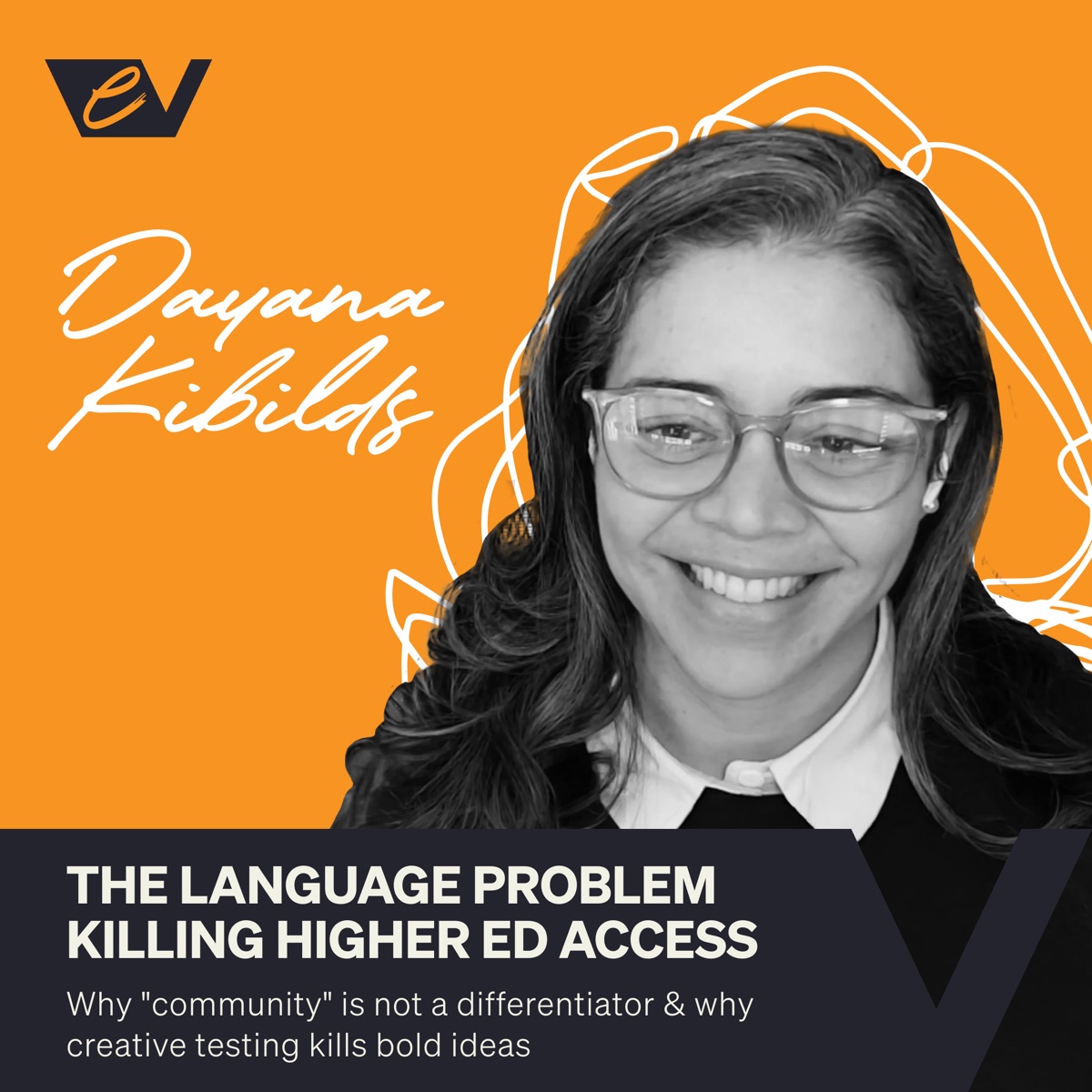
Dayana Kibilds: The Language Problem Killing Higher Ed Access
VP of Strategy, Ologie · Author, Mailed It.
Watch or listen right here
About this episode
Dayana Kibilds has spent nearly two decades helping colleges and universities find the words to say what they actually mean. Most financial aid pages come back solid red in the Hemingway app. A wall. And then those same schools wonder why first-gen families aren’t finding them.
We talk about Ologie’s work with Amherst College, why “community” is not a differentiator, why creative testing kills bold ideas, and what the future of higher ed looks like as AI reshapes what a degree is for.
In this conversation
- 01The Hemingway test
- 02Working with Amherst College
- 03Why “community” isn’t a differentiator
- 04How creative testing kills bold ideas
- 05Higher ed in the AI era
From the blog
Show note The Hemingway test, and the word that means nothing 6 min readLinks from this conversation
Episode transcript
Read the full transcript
Transcribed from the episode recording; names and phrasing may contain small transcription errors.
Welcome to another episode of Escape Velocity. I'm your host, Tracey Halvorsen. And today I am with Dayana Kibilds, otherwise known as Day. And Day is vice president of strategy at Ologie, the agency for brands on a mission. For nearly two decades, she's led award-winning work with institutions around the world. An international keynote speaker and bestselling author, Day is known for taking complex ideas and making them feel clear, practical, and possible. She loves to teach and share what she knows through her email book, Mailed It, which I cannot recommend as highly as, I mean, just read it, it's great. Email is not dead, far from it. And she also teaches through workshops and courses and through her volunteer work with CASE, Digital Collegium, and AMA. And through her weekly newsletter, You Ask Day Answers. So sign up for that. I'll include links to all of this in the show notes when we're done. Day is a lifelong immigrant who grew up in six different countries and is now happily Canadian. She lives with her son, Romeo, love that name, and her husband, Bruno, also love that name. So Day, welcome, thanks for joining me.
Yes. Thank you for having me Tracey. I'm excited for our conversation this afternoon.
I'm excited too. I think we've known of each other in the orbits of higher ed and digital and all of that for years, but I really am so excited to actually have a conversation with you today and dig into some of this stuff. I would like to start with kind of your background. You said you're an immigrant. You grew up in six different countries, so you constantly had to
Yes. Mm-hmm. Mm-hmm.
find belonging ⁓ and kind of not reinvent yourself, but find how you fit in as an immigrant. know, immigrants, the word we all use as the out, as the looking at the person coming in, but for you, it's just your life and you're going through all of that. So how did you end up in higher ed in North America?
Yeah. Yeah. Yeah. Ha ha ha ha ha. Well, yeah, how did I do that? I definitely think of myself as an immigrant, as just an identity. And to me, it doesn't mean a person from somewhere else or a person who doesn't belong. It's a person who deliberately chooses what they want their next life to be or their future generations' lives to be and works toward that, right? It's a choice. ⁓ Some people have to make it without wanting to, but the common denominator, I think, that unites immigrants everywhere is that they are trying to create a life that they were not born into. And that's just been my life since I was born. So I was born in Venezuela, in Caracas, in the 80s, mid-80s. And that was the tail end of a very prosperous few decades for Venezuela. I'm not the first person to have emigrated though. My grandparents emigrated to Venezuela from Europe after the second world wars. And then my father decided that he also wanted a better life for us, for his family. And so he moved us to Florida when in the mid 90s, when politically things in Venezuela were starting to get less prosperous. This is before Chavez. first took power. So in the mid 90s, we moved to the US. I didn't speak English. We started school. I started fifth grade. And that was the first time I moved. And I love that you said reinvent as a word, because that is something actually that I have learned how to do by choice now that I have practiced moving to completely different places. I just decide, what am I going to be in this life? What am I going to be in this life? So I was nine, almost 10 when we moved to Florida, learned English. And when I was 15, my dad started to get really paranoid because while we were in the US legally as tourists, we legally could not stay as permanent residents. And back then, this was pre-9-11, it was actually... quite easy to have a life in the US as a tourist. You had a social security number, you paid taxes, my father had businesses, and my mom was employed. Like all of those things were possible back then. But after five years of that, he started to really fear that it could just be taken from us at any point. So he started looking for a more stable employment situation and he got a job. We wanted that job to turn into a green card. This American company that hired him was like great you speak Spanish awesome. We want you to go represent the company in Mexico So we moved to Mexico all of us my brothers and I and my family and we've to Mexico City and I finished high school in Mexico City and After Mexico City, I had full and fully intended to go back to the United States. I spent so many formative years in the United States. I felt very American However, I didn't get into any universities and that's a whole story to unpack. So we were like, well, what do we do? And we started looking for options in Europe. So I am very, very lucky that I inherited European citizenship. I'm Italian by citizenship from my grandfather on my mom's side. So I could go to Europe and live in Europe. And we found a few schools in Germany that had English instruction to start. So I moved to Germany when I was 18. and I did my undergrad in Germany. And when I graduated, I made a decision based on love. I had met my love, the love of my life, I had met him in high school in Mexico. So I moved back to live with him and he's my husband. So it worked out. He, I know, such a crazy when I think about it. he got, when he graduated, he got into a PhD program at Penn State. And I'm actually wearing that right now, Penn State. And yes, we are. So we moved to Pennsylvania together, married. And when we did that, this is when I realized if I want to, if, you know, we are to have a successful partnership in life and he's going to be a professor, then I need to start working.
Nice, Penn State.
in higher education so that no matter where he goes, I can also have an opportunity at his institution. So that's when I like actively started trying to get into higher ed. Now, if you're counting, that was five countries. There's two more, or actually four countries. There's two more, right? ⁓ So in between Mexico and Penn State, there was a two month stint in South Africa. So the job that I had in Mexico, when I went back after I graduated, before I moved to Penn State, I worked for this.
Yeah.
sales company whose headquarters was in Germany, but they had sales companies all over the world. And they loved what I did so much in Mexico that they were like, can you go spend some time in South Africa and do that? Like it was a bunch of digital stuff that I was able to stand up. So I was like, yes. And the reason I counted as a country I lived in is because I had to go to the hospital for something. And I feel like if you have to enter the health system, you live there. Would we say that's fair? I feel like that's fair. ⁓
I appreciate you giving the justification for it and I'll let it stand. Yeah, I think that that's a good reason.
Yeah, I, it wasn't serious, but I went sandboarding on like sand dunes and I felt so bad. I injured my tailbone and you know, I had to get prescription pain meds. That means I lived there. I lived there basically. And then the last most recent move was after my husband finished his PhD and his postdoc. we moved to Canada, which is where we are now.
Mm. Basically. and how long have you been in Canada?
Eight years now. Yeah.
eight years now. A lot of people wish they could say that too these days.
I, we, Tracey, we moved here in 2017 and it was the perfect timing for Hispanic immigrants in the US to leave the US. Yeah.
Yeah, yeah, that's another podcast. So let me ask you this. You have a master's in applied statistics from Penn State. And I know what we're gonna, we're gonna dive into data and how we use it, when we overuse it and all of the things, but how do you go from
Yeah. Yes. Yes. Yes.
that to being VP of strategy. how does, not that, you know, it's like that just seems like a ⁓ big swing from something that's very literal to something that's a lot more nuanced and made up of things beyond statistics.
You Yeah. Yes. Well, this, have never been able to choose a lane and anything in my life. I want to do all the things. And this has just been a pattern for me since I was very young. I, you know, a lot of kids you see, um, even their parents reinforcing, whether they're good at math or good at English or good at this or good at that. And I refused, like I refused to not be good at everything basically. And I loved math. and I loved English and I loved writing and I loved art and I just loved everything. So growing up and growing into my profession, I remember when I was in Germany studying, I was very good. One of the best in my accounting classes and finance classes and my professors, I remember them telling me like, you have a career in this, like you can make a lot of money. if you go into finance or accounting or some of these more kind of number based disciplines. And I was like, but I love marketing. I just love marketing so much. And they're like, but you like, not everybody can do this other stuff. And I'm like, okay, but like, I don't care. just like really love marketing very much. And so I like always just refused to pick Elaine. And in my first job after college, I was hired as an accounting controller of operations. Like my job was to reconcile things and do accounting related, finance related things for this automotive company in Mexico, German headquarters. And I noticed this was early 2000s. Cool, I can do that job. And now what? I did it. And now what? And I remember noticing that one of the challenges that we had being an after sales or an aftermarket company of a German brand in Mexico is that we were up against a lot of products that work just as well, but were a lot cheaper, made in other places, right? Made in China or copies of our products. And what I realized, like, we needed branding. Like, we needed branding to do some heavy lifting for us. We needed the end user or the mechanics. to go to the wholesalers and ask for our brand instead of the cheapest products. So was like, well, we need to reach them somehow, right? We can't be at the mercy of the wholesalers who want a big margin. So I was like, here's what I'm gonna do. I proposed this to my boss back then. I wanna make a blog. I wanna do an email newsletter. I wanna create a YouTube channel with do-it-yourself videos that feature our products. And I wanna establish a forum where any mechanic can come and ask our technical experts questions. And they were like, how much is it going to cost? I'm like, nothing, because the internet is free. And I did all of that, but that was marketing. That's marketing. And it has nothing to do with the job, the accounting job that I was doing. And that pattern just continued. my career started becoming more marketing experience, communications experience, content experience, and that kind of audience. founded strategy to get action, get ROI, to get conversions. But then when I had the opportunity to study a master's degree at Penn State, I was like, I need to complement that experience with this kind of grounding in data, which I had always just also naturally gravitated to, but I wanted to show on paper. I can do both. My experience is going to show a lot of strategy marketing ⁓ content, but I like, I'm also very serious about the numbers. So it's just, it's both. And I think when we talked about doing this episode, told you, I really want to talk about how we overuse data is because I believe in data, but I do think we overuse it. And that's why for me, it's important to always just have both in my life.
I think that's just such an interesting way that you've shaped your life and made decisions and not let yourself be put in a lane or told, you know, well, if I'm in this lane, I can't swerve over here and drive in this lane for a while too and be just as successful. so I love that. And I have to imagine that going through your own reinvention by choice so many times,
Yeah. Yeah. Yeah.
has given you a very personal look at brand and what that means. Because if we kind of compare ourselves to brands in a way, like if you're reinventing yourself, you're spending a lot of time thinking about ⁓ what that means.
I can't. that's so true. I had never thought about that. Yeah.
Well, think it gives you, just like your immigrant status. you know, I remember hearing you talk at the AMA about having a unique perspective on the language and how prohibitive it is. The language that so many, so many, all sorts of organizations use language that they don't realize is complete insider speak, or it's not catering to the audience, but in higher ed.
Yeah. Yes. Yes.
Ironically, and it's very true, but it is ironic that they want people to apply, but they make it very difficult and they don't make it easy. And I think, but being able to frame that from your perspective, I think gives it a lot of versus saying like, well, I think, you know, I think if we change this, might.
Yeah. Yeah. Yeah.
be better. ⁓ You kind of were coming from a proof point already. And that brings me back to statistics, which, you know, I love marketing and storytelling and art and all of those things. But what I think is so challenging is that it's hard to get data around the ROI of it, right? Because it's either a long game or it's
Yeah. Yeah. Mm-hmm.
baked into so many other things that you can't just say like, we ran this ad and it had this many impressions and got this many, you know, like there's, there are certain marketing aspects where you can really look at the data and get a lot of proof, you know, that something worked or something didn't. But in a lot of cases, it's much harder to really get that proof. And I wonder if you grappled with that when you did kind of
Mm-hmm.
Now you're squarely in the strategy seat and obviously still relying on data and find good use for it. how do you grapple with that?
Yeah. Yeah, this is personal for me in a way because as much as I believe in data and data meaning like metrics numbers because you can define data as any input, I also believe in intuition, frankly, and I also believe in imagination and I believe in experience. And I was in a job prior to going agency side. where for many years I was, I want to say allowed, but it's not quite allowed. was given the opportunity to make decisions based on intuition and try things that we hadn't tried. But then there were some changes internally and ⁓ the institution wanted proof, is the word that used, proof that things would work before we tried them. And I just, I... I just remember saying, like, I can't. We haven't done it. And they will have any other universities done it. No, that's the point. I can't prove that this will work to you. I think it will based on a decade of similar initiatives, based on consolidating. cultural signals or other industry research about the generation that we're targeting. And they were so fixated on the metrics. Well, I need you to demonstrate that this has worked or will work that they ignored intuition and they ignored imagination. And so this is why I mean it's personal to me that in our field and marketing, we hear so much. You have to be data-driven. We have to meet data. driven decisions and people wear that like a badge of honor. This is grounded on the data and that is great if you are using that as one of your inputs, one of your inputs. But there are other inputs that you also need to consider, right? Like not just quantitative data, but qualitative data. What are people actually thinking or saying? What are the stories behind these numbers?
Yeah.
⁓ You also experience if somebody's been doing something for 20 years, they have the kind of muscle memory that is as predictive or as explanatory as maybe a data set would be. And then you need the things that haven't happened, right? Like the intuition and the cultural trends and the imagination even, right? So I've spent the past few months actually trying to create some content around this that kind of demonstrates that really well. And I have like some favorite examples of when things have failed miserably because they relied on data numbers and nothing else. ⁓ Like Kodak is a perfect example of what happened, of something gone wrong, right? Like they had projections, they had past sales, they had proven, right, that their product was the leader in the market over and over and over.
I love it.
and they didn't invest in digital, even though they were the ones that invented the digital camera, because they couldn't see the future, right? Like they couldn't imagine anything. They couldn't take a risk. They couldn't make a bet. And so we all know what happened, right? Another favorite example I have is Coke. So I think it was the 90s or the 80s. Pepsi came out with a campaign that was like, in blind tests, customers preferred Pepsi, right? And that campaign became so viral, we wouldn't have called it viral back then, I don't think, but it was so viral that Coke was nervous. And so they came up with a new formula, a new actual formula for the drink. And in blind tests, people prefer the new Coke versus Pepsi. So they're like, well, cool, we can't go wrong. They did the biggest, consumer, customer tests, whatever you want to call it, ever done. Like 200,000 people tasted these things. like test after test after test, new Coke was better than Pepsi. Pepsi was better than old Coke. And so they're like, all right, well, we're going to go out with new Coke, right? We're going to, did focus groups, we did the tests. the data is so clear, like you can't go wrong, right? But there were a few dissenting voices in those focus groups that were like, you can't change Coke. Like you can't change. it's not just the flavor. Like this is a brand, this is an experience, right? And they went out with a new flavor and people protested, people boycotted, they were forced to go back. And that's an example of, again, you were like, the test was perfect, the data was right, but they ignored that there's other things at play, like cultural things.
Yeah. Yeah.
brand equity, brand equity experience, right? So if we overly rely on one of these inputs, you run the risk of actually making a much worse mistake than trusting your intuition or imagination. And for me, it's not one or the other. It's can we look at more than one input before we make a decision? And when I see people being obsessed with being data-driven, what I see as numbers-driven, and I don't see what do we think? What do we imagine? What do our most experienced people think? What culturally is happening? Where do we see things evolving? And placing just as much weight on that as your datasets.
Yeah, I also think marketing is a creative practice and by its very nature, creation is about making something that doesn't exist yet. And if you want, you know, everyone wants to be, have differentiation and to do have something innovative and to really be distinctive.
Doesn't exist. Yeah.
but then they also want to know it's worked for like five other people before they actually commit to it. That was the best. I would get that all the time. ⁓ When we were doing lots of websites for higher eds, like we want something totally innovative that nobody's seen before, but I need to know it's worked for at least three other schools.
And then you can't. You're just like, but. I can't. Yeah, well then it's not. You can't have both. You can't. Yeah.
I'm like, yeah. mean, you know, there, what is it? What do you, so I know I've heard you talk about language being, you know, in particular, a barrier to education ⁓ when it comes to web content on a university or college website. How do you, how do you make that case to a provost or a board full of trustees that feels like if we take all that
Mm-hmm. Mm-hmm. Mm-hmm.
big flowery, intellectually rigorous sounding language out of it, it's going to diminish the, it's going to dumb down the institution or it's not seem serious enough for the academic place that it is.
Mm-hmm. Yeah. This is an example of, I think, where research and data actually do help. there's looking at it from multiple lenses. I am a big fan of ⁓ UX user research in general and what the Nielsen Norman Group has created for the industry in terms of how people read websites and they engage with language. The case starts there for me. It's well, it is well studied and well known. that when language is at a certain level, eighth grade, ninth grade, seventh grade reading level, people understand faster, people have less anxiety about what you're saying, people are less confused, and because of those things are more likely to do what you're asking them to do. We want that, right? We want people to apply. We want people to do the thing. So that is studied and it can be shown if they're kind of research-oriented or data-oriented that way. But... I have found most success when I pair that with an actual story or an actual use case. I use myself a lot in this. It's because I'm glad you're bringing this up because this is why I didn't get into school in the US when after I moved to Mexico. I'm a first generation college student as are many people that I know, but I was coming into it also from abroad. Right. So my parents ⁓ had even less familiarity with the US university system. They didn't go to university in Venezuela either. And my dad spoke English, but my mom did not. you know that it's not about fluency, right? It's about how complicated the process is. I was very fluent. I was an international baccalaureate student and I learned English in Florida. I, it wasn't fluency. It wasn't English. So I didn't know anything about university. So I was like, okay, I'm going to apply to the schools I know because of TV. Harvard? Cornell and my husband, my crush back then, he was gonna apply to MIT. So was I, because we were gonna be together forever, obviously. So I applied to three of the hardest schools in the whole world to get into. And I'm on their websites. I speak English. I understand I have perfect TOEFL scores, if that's what you wanna prove. But I missed an obvious requirement, which is... we need your full four year transcripts from high school, right? I thought that sending my international baccalaureate transcripts was enough of my time that I did in Mexico and not necessarily the time that I had done in the US. I missed it, missing requirements. Like I just couldn't, I didn't know. I just simply did not know. And it's because when you go on any admission website anywhere, first of all, you have to like consolidate 20 different pages of information in your mind. And then you have to understand what applies to you and what doesn't. And then what those specific, what's secondary mean? What's secondary school versus high school versus pre baccalaureate? Like, what are these things, right? And we just make all of these assumptions that this language, even at its simplest level, makes sense. That when you add complication in terms of reading level, It's, you can imagine how that just stands up this gigantic wall. And that wall, who that wall is leaving out are the students who don't have university educated adults sitting next to them with a thesaurus, also trying to understand it, but with a lot more practice and life experience to know how to decipher that kind of language. So it's not about looking smarter, feeling smarter.
Yeah.
it's access, right? Like using complicated language, just for a minute, think about who are you leaving out? And I worked in admissions for a long time myself. And one of the hardest things that for me was to have these conversations with admission counselors and provosts enrollment leaders, and for them to be like, well, like if they can't make it through that, then they're not gonna make it through the university. And I'm like, well, is your job to provide opportunity or is your job to close these doors in their face? Because I thought it was the first, right? Not the latter. And then like, you know, they're kind of like, they're taking it back a little bit, but our job is not to make it hard. Our job is to make it doable, right? For the right applicants to shine and equitable and fair. And it isn't...
You Yeah, and equitable and fair. Yeah.
A fluency thing, isn't the student themselves, right? It's who is the context. What we're doing with those systems is favoring those who have the context and the resources. And it, because it has nothing to do with the student themselves, right? So back to your question is how do you make a case? You show the research, you show the studies, you show in your own applicant pool, what do applications trends look like? Who is not showing up in your pool that you want in your pool? And then you... ⁓ you surface the stories from those people because those stories actually illustrate what's wrong versus just showing a study or the data.
Yeah. Have you ever, I mean, you've worked with a lot of higher eds, right?
Yeah. Yes.
Is there, when you're doing this work, is there anything that consistently kind of shows up as a red flag for you where you start to realize that maybe what they need isn't what they're gonna want or be able to do? Is there a reluctance? I'm just curious if you've seen a trend in the red flag department.
To be honest, more recent years, no. Like what I've seen is the opposite. It's how do we make this easier? Because everything else has already made it harder. I used to see a lot more red flags before when I was working in admissions myself. And it was about, well,
Yeah, that's true.
the decisions are made based on, we don't want to increase the workload. Or, well, if they can't do this, they can't make it in, right? They're not going make it through. What I'm seeing more now is a willingness to create access and just not really knowing how to do it. And language is the solution, folks, if you're listening, truly. So here's one of my favorite examples. Every single school that I work with, do this. It's so fun. Go to the financial aid pages that explain what you're eligible for, what scholarships, whatever, especially Dream Act, like that kind of content. And take it, copy it, and paste it into something like the Hemingway editor, the Hemingway app, which is an evaluator of how complicated your content is. And what I love about the Hemingway app is that it makes a visual. case for why you need to change your content because it highlights the complicated sentences in red. so most of those financial aid pages are red, just red. And it looks like a red brick wall. It looks like a wall, literally. And it's like, well, this is what you're putting up on your page. This is what you're putting up in front of people. And then most of the time, these schools are coming to us asking
Yeah.
We have this incredible financial aid policy and we want to attract more students from low socioeconomic backgrounds with this policy. Why isn't it working? And you're like, well, look at it. Look at it. It's red. that's another way to make the case. It's this visual aha moment of, might have just instituted this free tuition initiative for families with income under blank. But the way that you're talking about it, especially for those families who may not have, that you're going after first generation students who may not have the context themselves, they don't get it because of the language that you're using.
Yeah, was it the work that you and Ologie did with, was it Amherst where you created the whole sort of booklet that went home to the household to help the whole family kind of navigate this stuff in a friendlier way? I thought that was so brilliant and I'm curious if you've heard how that's working for them.
Yeah. yes. Yes. Yes. Yes. Yes. Yes. Yeah. That is working really well. So I had the privilege of first of all, being on that project. Amherst is an incredible institution doing really amazing things for access. And Allogy is a company that really cares about this kind of work too. And so that partnership was great. And then I had the great joy of presenting about that work at AMA last year. And that work was all, it was big. It was a big project with. messaging and visuals and brand and all of that. But the part of it that I think really stuck with me is the student journey mapping and understanding what is keeping some students from continuing on their journey to Amherst. So what we found through that work was that there was a whole segment of ⁓ a potential pool of students that weren't even making it into the pool at all. because while Amherst was devoting a lot of resources and had a lot of partnerships with community-based organizations and other outreach initiatives, even those initiatives are for students who know what they're doing. Like you don't know to go to a community-based organization if somebody doesn't tell you. You don't know that QuestBridge could be an option for you if you don't have the guidance counselor that tells you that. So there were a whole lot of students navigating this journey solo. with that, like, and you can think of like the types of neighborhoods that may have undersourced, under-resourced schools, right? The counselors can't pay attention to individual kids. And there are no significant community-led initiatives to pick up kids from the high schools and help them, right? So there are students doing this alone. And that's what we found, that while they were trying to create access through some of these partnerships, and schools should continue to do that because they do help, that there's also students, like that, in itself suggests a level of, I don't want to say privilege, but of opportunity that other students don't have. So we found that. And then we realized that the way to get at that is to create a guide that would go to the home early. And for Amherst, being a liberal arts college, there was so much explaining to do. What even is a liberal arts college when you think of college and jobs and that kind of learning environment? and not being directly tied to a profession. And we had to explain college, then we had to explain liberal arts, then we had to explain financial aid, and then we had to explain admissions. And they did that for the first time in the last admission cycle. It was sent. And what they saw this year was just incredible increases across the board in the pool in general, but also first generation applicants, rural applicants. and admitted students into their class. So that is really rewarding. And obviously all of those pieces were written in very simple, conversational, easy to read language that broke down for these families. Here's what all this stuff actually means.
Yeah, I think it's also, I think it's pretty common knowledge in science, anyway, or neuroscience that when you're under stress, high levels of stress and anxiety, your cognitive capabilities are going to decrease around complicated things because you're much more keyed up for immediate like fight or flight. You're looking for big threats. and you might even see threats where they aren't. I think that just acknowledging that this is a really stressful, scary process for most kids to go through and their families, if their families are involved, and then to bombard them with all of this complicated language that I'm just surprised that... ⁓
Mm-hmm. Mm-hmm. Mm-hmm. Yeah.
that has persisted, especially on the financial aid pages. That used to be one of my favorite.
Oh my God, it's my favorite pastime. Like everybody should try that. Well, and it's not just complicated language, it's also kind of useless language that happens too on the other side of the spectrum. I know you've been working on this, right? Like so many higher education institutions are saying nothing at all too. So, you know, when someone's trying to make a decision about whether college is even for them, seeing world class written 500 times is not going to change their mind.
Mm-hmm. god, let's go.
Right? So language is so powerful and we could just use it so much better.
Yep. We could, and I think that also sometimes you need to show, not tell. ⁓ But yeah, you know, I've long been bothered by the language, the says nothing language that ⁓ so many schools use, so many organizations use. mean, a lot of it's in a lot of places.
Yeah. Yeah. Mm-hmm. Mm-hmm.
I remember giving up, I did an audit of a brand and a site for a school that I had to get up and present my findings to a whole auditorium. And this was a religious school. So there was a bunch of nuns in the back row, just like glaring at me. And I've really never been so scared to kind of get up there and have to give my honest assessment. And they had... they had a campaign slogan that was kind of like their brand message really, that was like, we're the bridge from where you are to where you're going. And then they had a photo of this woman who was running like a track and field runner, but behind her it looked like a nuclear holocaust. I it was, I don't know, somebody had gone crazy in Photoshop. And I was like, what are you saying here?
Yeah. God. What is this? Yeah.
If anything, this is terrifying, but what isn't a bridge from, you know, if you're moving through life, everything's a bridge from where you are to where you're going. What does that even mean? ⁓ And it looks like you're trying to escape, you know, a nuclear bomb in this, you know, like are people escaping Armageddon? what, and, ⁓ and you know, that was funny because one of the nuns did stand up and, and she said, well, we spent a lot of money on that.
Yeah. Yeah. Mm-hmm.
tagline in that campaign. And it was like the sunk cost effect of just, you know, we feel like we need to stick with it because we paid a lot of money for it. And so when you go in and talk to these clients who have in the past, you know, spent a lot of money on, on some of this language or a website or a brand element, does that come into play much where
Mm-hmm. Mm-hmm.
where it's sort of like, you gotta hold onto it because you spent a lot to get it.
it. Yeah, there have been clients in our work with higher education institutions that come to to Ologie with, well, we have this and we have to make it work somehow. we write and oftentimes we find that when that happens is because there was just not enough research and strategy behind the creative. And I think that's why I really enjoy my time at this agency and etiology in particular, because what we make is absolutely beautiful. But there is so much research and strategy that goes behind every single thing that makes it out the door. Because that's how you know that it's going to work, right? And so that happens, and then we have to kind of retrofit a little bit of research and strategy. Or... ⁓ We keep some sort of umbrella that maybe bridges the umbrella and then like you put other messages around it that actually make it work. It does happen. And I think it's because there just wasn't enough research. like, I know I've said, well, don't rely just on data and don't rely just on data, but do do your research, including data and other sources. I think that's the other really important piece. One of the things that we see often is, especially if you're trying to do something different that stands out, is that a lot of clients who feel a little bit of fear, they want to test it. Right? Like, we got to test. got to do some creative testing. But the reality is nothing, nothing wins in creative testing. Nothing ever. Nothing. Right? So there's like the famous story that nerd clusters failed every consumer test. But it's like they're best selling candy now for that. Right? because people don't know how to react to change, right? And so anytime that there's testing, we know it's gonna go back to being a little bit less bold than maybe what ⁓ one of our creative leads would have suggested because testing favors the status quo in general. And so I think that's the other thing that happens where people end up paying for those campaigns.
Yeah.
is that they're afraid to actually make a decision using something other than just some numbers, right?
Yeah, I think it's, I mean, it is scary because if you really want to put out something that's distinctive and differentiates you for, so you can actually get the right students coming and really explain why you're great at being you, whatever that is. Because that means not being for everyone. That means that the people who are for you are gonna love it and hear it and see it, but the people who are not for you are not gonna like it. It's not gonna resonate with them. so it's actually great. mean, you want people to have a reaction one way or the other. So I always say, if everyone loves it, it's not doing its job.
Mm-hmm. Mm-hmm. And that's okay, that's okay, yeah. Yeah, exactly. Yeah.
Right? Because it just as much as it resonates, it should have an equal anti-resonant effect. And testing doesn't really allow for that kind of understanding to come through. I'm curious, you've worked in-house at universities and in admissions, ⁓ and now you're on the agency side. What do...
No. Mm-hmm. Mm-hmm.
What do higher-eds get wrong about working with agencies? And what do think agencies get wrong about working with higher-eds?
You Yeah, oh, I love that. Okay, institutions, and I do really think it depends on the partners, right? Like the individual schools and the individual agencies, but one of the things, now that I've gotten to work with dozens of universities and colleges all over the world, everybody thinks they're so unique. Every institution thinks they're so unique.
Hahaha
and that their problems are only happening to them and that their challenges are only happening to them. that there's no way that any external person, agency or otherwise could understand them. But in reality, there are so many parallels between what universities and colleges are experiencing and the same types of issues and the same buy-in concerns and the same, you know, it's... So it happens on the process side and it happens on the people side, but it definitely also happens on the language side and the content side. For every single time that I do discovery with a new client, if I ask the question, what makes this place stand out? I say, you can't say community. Don't say community. Say something else. Because everybody thinks it's their community. The community is so unique. It's like, it might be, but. The idea of community is not. Your community might feel different than another community, but that's the whole point. Like, of course it's differentiating because you want to belong to something, but what is the thing that we're belonging to? That's what I want you to describe, right? So I think they don't understand just how similar they sound and how similar things are to other places because unlike an agency, they can't see it. They can't see it to the same level of access that we get. when we're working with clients, right?
Yeah, that outsider perspective I think is so helpful. I think that's where the partnership makes a lot of sense because it's really hard to see this stuff once you're inside of it.
Yeah. Yeah. Yeah. Yeah. And it's like an outsider insider perspective because I'm not just like a general observer looking at websites. have your doc, like I have their strategic plans. I have their documents. I have their data. Right. So I am, I am looking across knowing very well how these places are working and where their challenges are. And I just really think institutions don't understand, like don't value that as much as they should. How Like I might not be able to tell you what someone else is doing or why, but I can tell you what you shouldn't do because of what I know, right? So it's, I think that's not often appreciated, I think. I think it is appreciated in like a direct partnership, but ⁓ vendors get so much shade when it comes to industry events and ⁓ conferences and things like that. But they have so much, like we have so much incredible stuff to share just because we see so much. ⁓
I know. Well, they need to stop thinking of us as vendors because the good ones out here, we want to be partners and that's what is going to yield the best work. I do think that, yeah, real traditionalists, yeah.
I And we are. Yeah. That's right. Yeah. But some people, some bad apples ruin this for all of us. But we can talk about what I think about conferences another episode. So on the other side of that though, what agencies get wrong, and I think this is where some of the misperception on the other side comes from, is really not understanding how things work, right? That...
I know.
us creating a beautiful brand and giving you brand guidelines means nothing to an admission counselor on the road or the social media manager in the central marketing team or right? Like if there is no strong internal team that can take strategy or a brand and translate that into tactics, then the agencies who don't do that for them, like it becomes like the bridge campaign that they paid for and they don't know how to use, right? So it sits on a desk. So I think there's, I have felt this personally coming from campus that I'm often like, all right, but like in our training sessions, we got to show them, like, how do they use this? What do they do? Like who's in the room and how do they use this? Because that's, otherwise they won't, they don't know how, right? And I don't know that,
sits on a desk.
Every person, every agency understands how things actually are used and implemented and what tactics are in recruitment or in fundraising in their clients' institutions. Yeah.
Yeah, I think that's, and that just takes time, either working with enough institutions to really understand it or having the benefit of working inside. ⁓ My first job out of undergrad was working in admissions. And so I got, yeah, I got firsthand exposure to all of that. And even now as an alum, I experienced like how I'm contacted and engaged with. so,
Exactly. Yeah. Yeah. Yeah. Yeah. Yes.
I think it's just a lot more listening that needs to happen at the beginning, you know, to really understand, yeah, how does this turn into action for all the different people that need to turn it into action?
Yeah. Yeah. Honestly, I think that the most important piece is who is leading the project on the client side and how much time do they have to do it right? Like how much off the side of their desk is this thing versus how much are they going to do some change management internally? And when you get that kind of partner and leading the project on the client side, then things work amazingly, beautifully, right? They are able to do the translating that maybe the agency can't quite do ⁓ to the level of granularity that it requires. So that's often when I find most satisfaction.
I also feel like, how many times have you experienced what we call the swoop and poop where a president or a trustee or someone comes in at the 11th hour and turns out there wasn't really the appetite for innovation or change that was being proposed.
Ha Yeah. Yeah. Yeah, I've experienced this soup and poop personally just once. ⁓ But we have enough of those to count with more than one hand. It happens, right? As much as you try to prevent it, it happens.
Just once. That's good. It does. I think that when, we're thinking about working with a higher ed is one of the questions I, I really dig into is, who, who are the stakeholders, right? Like who's, who's jobs on the line? ⁓ and, and do you have the support to do what you're telling me you want to do from the people who have a say in whether you have a job or not, you know, because we've got to make sure that at the end of the day, you're getting a raise in a promotion, not.
Yes. Yeah. Yeah.
asked to leave. ⁓ Because these projects have huge impacts on the folks careers who are in these institutions. So I always tell my team too, the client, the success of this project is not necessarily the work we do, it's what happens to these people's careers after they're sticking their neck out to say, I'm making a choice to go with this team and
Yeah. Yeah. Absolutely. Yeah. Yeah.
then they commit a year of their life to it and whatever resources. And so it's a big deal that there is alignment and everyone's marching towards the same goalposts.
Yeah, yeah, yeah. Yeah. One of the favorite feedback that we get from our clients is that the meetings with us or the work with us are the favorite part of their jobs of their day. And like that's the kind of relationship you want, you know, that where you're learning something mutually, right? You're excited mutually to do something great. But it does take that like really strong lead. Otherwise, it there's I just can't go anywhere.
That's a compliment. Yeah. Mm-hmm. ⁓ I know we're, getting towards the end here. I, I'm curious, what do you see, you know, looking forward, looking into the future without the data to necessarily back it up? What, so using your intuition, what do you see? cause higher, and I know you work with lots of other types of, of, you know, organizations, but with higher ed.
That's right. Mm-hmm.
What do you see as the biggest thing they need to overcome or address as we move into the future? Because it's under so much pressure from so many different angles and the world is changing. Three years ago I would have been like, hey kids, get that computer science degree. Now I'm like, liberal arts never been a better time to learn how to be a ⁓ thinker and a communicator.
Mm-hmm. Yeah. Yeah. I know. Yeah. Yeah. Everybody learn linguistics. Yeah. I'm going to give you two answers. One is like structural and two is marketing. So the structural piece is truly the system we have created cannot continue to exist. It will not be and cannot be necessary for every single person who wants an office job to have a four-year bachelor degree because that's what AI is taking over. Right. So I, what I see is really focused training, specific on, on, on craft, specific craft. And for those jobs that are kind of office jobs, that there needs to be partnerships with employers from the start of the degree so that it's a lot more focused training for the specific type of employer and the different roles that somebody could have there. And then, so it's kind of like taking away the middle and like doing things that are much more focused and vocational and professional. And then the top, which is research and knowledge and ⁓ a bit of a return, like a lot of institutions are research institutions, but a bit of a mission return to that type of environment and focus on knowledge generation and cures and inventions. which I think is still prevalent and very important, but has gotten in a way diluted to trying to make sure everyone makes it through. So it's like this place is trying to do so many things at once. And I think we're going to see a lot more specialization structurally. And with that, from a marketing point of view, what comes is then what we were saying earlier, you have to own who you are. You have to talk about it very specifically and be totally okay with who that's going to turn away. So it's like this focusing specialization and then like being really clear about that. You are not for everyone. That's what I see. And then what excites me about it is that in terms of an admission counselor who would recommend to a student, like, what do you want to study? Right? We're not going to tell them to go to computer science anymore, not for now. You got to be the very best at what you're going to choose to do. You just have to be the very best. Because if you're just OK at programming, AI can do it better already, right? If you're just okay at writing, AI is gonna do it better already, right? So be the best dancer, be the best artist, be the best writer, be the best computer programmer, the one that's gonna tell the AI what to do. So choose that, and that's exciting to me, because people are gonna live in their passion.
Yeah, live in their passion and hopefully realize that what makes them unique, right? Their lived experience, that time in your youth when you can maybe take some risks, travel, have different kinds of experiences, like that all adds to what you're going to be bringing to the table. And yes, then
Mm-hmm. Yeah.
being the best at something, but it's almost like we're asking. or hoping that people, it's like they're gonna come out with almost a PhD versus a bachelor's degree because they've been so focused but focused on the thinking, not the doing, not the execution. Yeah, and I think that's where, the way it's been structured for so long is like, it's all about learning the execution. And then as you,
Mm-hmm. Mm-hmm. Mm-hmm. Not the executing. Yeah. Yeah. Exactly.
as you progress, you're expected to get better at the thinking. ⁓ So I think that that's going to shift too. ⁓ But I agree with you that the whole structure of it needs to get a lot more aligned with the real world.
Yeah. Yeah. what the world needs,
Crazy time. Crazy time. ⁓
It's an exciting time for us to be in this.
Yeah, mean, a lot of people are really terrified of AI and have a lot of challenges with it. I am so excited by it. It reminds me of when the internet, when I became aware of...
Yeah. Yeah, exactly. Exactly. We have gone through this digital revolution once already, our generation, right? And we were in it then and we're in it now because you are the thinker. You're going to be the person telling it what to do.
Yeah, hopefully. So I have ⁓ started a new tradition this year with a podcast where I ask guests to leave a question for the next guest. So I have questions from Yanni and Monica who were on the last episode this year to start off and they run DO, a creative studio. And so Yanni's question is, what's something that you're kind of quietly obsessed about right now?
cute. Okay. you
It could be a show, a movie, a tool, anything.
wow, quietly obsessed? That's a good question. have to think about it for a sec. I mean, okay, I'll say it. It's so basic. It's Bridgerton. Okay, it's Bridgerton. and like, can I think of something a little bit more smart? Okay, it's Bridgerton.
No, that's perfect. That's perfect. All right. Well, you're very brave. ⁓ No, that's I think I've missed that black hole of obsession that seems to have pulled a lot of people in.
Bye! It's just, it's beautiful. It's just visually stunning. I like enjoy it aesthetically. Yeah.
Yeah, I've heard that. Okay, Monica's question is, Now that we're living in this world of AI and this mass production of very homogenized stuff in the AI slop, what do you feel is even more authentic now as a human that you're living in this new time where so much is created by the AI? Are you leaning into certain things differently? Do you value walking outside more?
Mm-hmm. Yeah.
What feels so critical to you now to define your realness as an individual?
I mistakes.
Mistakes, yeah.
And anything from like actual big mistakes to leaving typos into my copy, in my copy. If I make them, I won't change them because that's me. I'm human.
You know, what was it, Bob Ross, the painter, used to talk about happy mistakes, happy accidents. And as a painter, can attest to sometimes the best things you can do in a painting are accidents or mistakes or unintended, because then that leads you in a whole different direction. So I do think that the perfectionism of AI is
⁓ yes. Yes. Happy accidents. Yeah. Mm-hmm. Mm-hmm. Mm-hmm.
is making all of those cracks and dents feel a lot more human, which feels good.
Yeah. Yeah, exactly. So I still do a lot of my own writing and I do like use AI as an editor, but not for everything. And if I'm like purely writing and posting and I've skipped a word or there's a, I leave it. Mistakes. Let's embrace them.
Yeah, yeah. I agree. I mean, we are human. We are going to make them. Do you have a question that you would like to leave for the unknown next guest?
We are. We are. Yeah, I will ask them what is the analog thing that brings you most joy?
Great question. I think that we can wrap it up. Thank you so much for coming on. Is there anything that we didn't talk about that you really want to make sure that you get out there to the world?
We talked about it, but I'll just reiterate it. Trust your gut. It counts.
Trust your gut. I agree. It's scary, but if you don't do it, nobody else is gonna do it for you.
Mm-hmm. No, and it's just as valuable as a spreadsheet. You got this. Exactly. Yes.
Human intuition, right? All right, well thank you so much. This was great. And talk to you again soon.
Yes, thank you.