Episode 28 · Mar 25, 2026
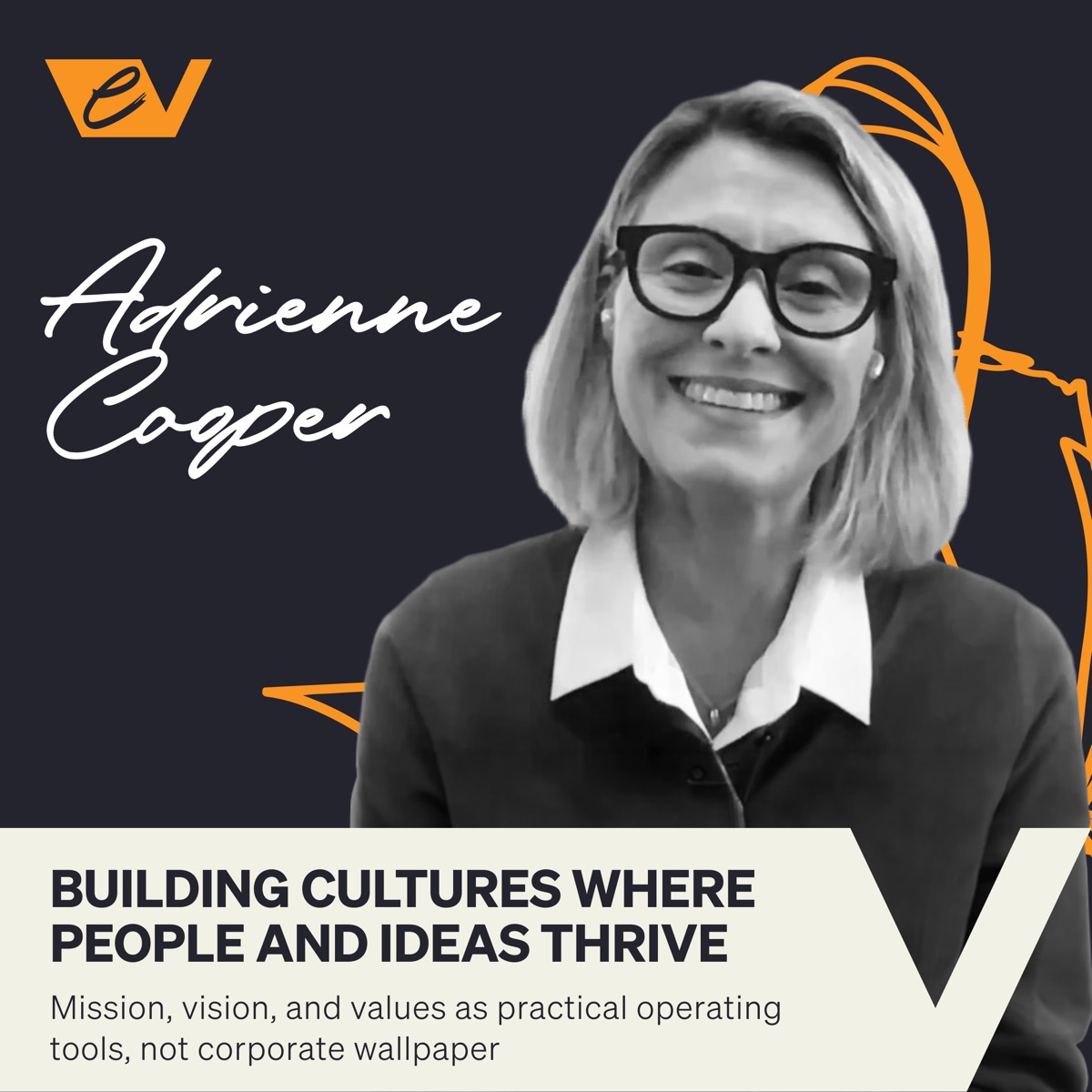
Adrienne Cooper: Building Cultures Where People and Ideas Thrive
Founder, GLADsome Work Inc.
Watch or listen right here
About this episode
Adrienne Cooper’s path from TV news producer to Allstate leader to founder of her own consultancy, GLADsome Work Inc., is not a straight line. That’s exactly what makes her thinking on culture, leadership, and organizational design worth paying attention to.
We get into mission, vision, and values as practical operating tools, not corporate wallpaper. Adrienne breaks down how she uses LEGO Serious Play to surface hidden perspectives and make sure every voice in the room is actually heard. We talk about flow state, delegation, neurodivergence, and why leadership readiness looks different than most organizations expect.
In this conversation
- 01Mission, vision, and values as operating tools
- 02LEGO Serious Play in practice
- 03Flow state and delegation
- 04Leadership readiness, reframed
- 05Neurodivergence in the room
Episode transcript
Read the full transcript
Transcribed from the episode recording; names and phrasing may contain small transcription errors.
Hello everyone, this is another episode of Escape Velocity. I'm your host Tracey Halvorsen and today my guest is Adrian Cooper. Adrian and I were acquainted through mutual acquaintance, you had done some work around mission vision values and he was looking for, or you were looking for a group that could really translate.
Mm-hmm.
that kind of work into a strong visual brand system. And he had learned about us. Anyway, we got connected. We started talking about that particular project and have now just become more familiar with each other. And here you are on the podcast. So thank you for joining me. A little bit about my guest today, Adrienne, is that she has a career arc that
Thank Thank you.
really does make you kind of stop and scratch your head. And I have a lot of questions. So to explain, she started out as a TV news producer. She also spent 15 years inside of Allstate. And that is Allstate, the giant company that we're all familiar with. She became chief people officer at a healthcare tech startup following that. And her people ops and talent work has been covered in Forbes and the Wall Street Journal. So she's not messing around here with the work she's doing and the visibility it's getting. And then she decided to start her own thing. And so I would like to talk about that whole process. So Adrienne, thank you for joining and can you color in some of the picture here on that journey? how did you end up starting? What made you decide?
Thanks for having me.
to start your own consultancy.
Well, life's evolution includes not just your own professional ideas, it also includes the people around you that you love and care for. And I found I needed to engage with work I love professionally while engaging with parenthood differently. My kids were hitting this age when I found that the options for childcare change when your kids get tween and teen. people don't want your kid anymore. Like when they're young and cute and playful, there's lots of programs and the kids are actually super engaged in that. But then they hit a certain age and they start getting bored of some of the programs and the programs start getting bored of them. But I just needed to engage and be around differently. So it was really based in that, that I found a different way to balance those things.
Yeah. I've and I feel this way too, but I've heard this from so many entrepreneurs and business owners, that the reason they did it in the first place, but also the thing they appreciate most about being a solopreneur or an owner, is that you get control over your time and the way that you spend it, much differently than when you're an employee who's got a punch clock or has a set
Mm.
period of time they're supposed to be working. so I would imagine that kind of flexibility was key too.
Yes. And for me, it was also like the mental difference between someone else employing me in a full-time employed contract arrangement versus coming to a shared agreement with a client where there's a different agency involved in that and the scope of it's differently for me personally, mentally and emotionally. I felt like I was able to deliver at my best, but I could also step away from it differently. I didn't have the same. monkey like the same wheels turning all the time like I did when I was full time employed for someone else.
Yeah, now I get it. That also must have been a scary decision to make.
You know, it's funny because I think I should say yes, but I don't remember feeling fear. But I think that's, I had been a business owner like a couple of decades ago. That's actually how I entered into Allstate originally. Both my parents were business owners. So I had patterns and had seen it and I was in an interesting place again in my personal life with. you know, my husband and decisions we had made where I felt like I had a window of transition where I didn't feel the sense of scared. I felt more scared like if I don't do it now, my window might close because I might lose my gumption. So yeah, it was kind of right time and right opportunities.
Hmm. Tell me about, you know, I don't know what it's like to work inside of an organization like Allstate. So these might be presumptions that I'm making, but I would assume it's very corporate. And I would assume that culture and people ops and things like that may not be as warmly received or well understood within an organization like that.
Mm. Mm-hmm.
Did you get into that kind of work while you were at Allstate? You were you already focused on that? And how did you make the leap from, if it was more of a corporate conservative kind of environment, to doing such playful and creative work with your clients now?
Thanks for asking that because I feel like so many people are like, I don't get it. And they're also like, don't know that the even then and now knowing me, they're like, you have an energy that doesn't say like old company blue chip conservative. But within the all state ecosystem, I actually stayed in a role that allowed me to be in a more nimble position with business owners. So the answer is yes, that I did get into that mission, vision, values work because I was essentially an in-house consultant for people who were running their own small businesses. And each of them was coming to their own purpose, their own reason why they were either going to start one or build one or buy one. And then we would go through that whole process of what's your core purpose? How's that going to translate into a mission and vision for your small business? and what values do you want to convey both to the community and to the people working for you. So I had hundreds of these people throughout the course of my career where we were doing this. And I got an MBA while I was at Allstate because I'd gone for journalism and language and I was curious what people in business had learned. And it's actually that's when I had the aha that a lot of that mission, vision, values and purpose alignment work classically as I was being shared in my MBA program fell in the HR bucket, like the umbrella. And I set the intention then that I actually liked all of that work the best. Mission, vision, values, right people, right seat, compensation aligned, motivators aligned, and every sort of rowing in the same direction and feeling good about it. And it was eight years later when I actually converted into a people ops role, because I was a P &L operational leader in the role at Allstate.
Yeah. So tell me about what you do today with your, you know, perfect right fit client. What are they coming to you for and what are you, what are you doing with them?
Mm-hmm. I often am getting the calls when they're in a moment of transition and they're looking for a co-pilot. I often describe it as a Mary Poppins approach where the Banks family is having a moment. They know they need someone to come in and assist them through the moment. And that's when I get the call. typically from people who've known me in the past, worked with me in the past, or referred me from having worked with me to other people who are in a similar situation.
Does always start with mission, vision, values work or do you integrate some of your other frameworks like the Lego serious play? I'd love for you to talk about how you integrate that and how that's been beneficial and what that even is. I mean, you see Legos and you wonder what's going on here.
Sure. Amazing. I'm glad you're wondering what's going on. So the LEGO series play and then do the calls usually come from mission, values? Either of those questions more interesting to you for me to tackle first.
No, no, I'm just kind of curious about if one needs to happen along with the other, if you use the LEGO Serious Play framework as a way to facilitate conversations around mission vision values and why that's helpful.
Yeah. Okay, cool. so, mission vision values isn't the only reason I get the call, so to speak. It's a reason I get the call. And a lot of times, or I should say, the variety of reasons I get the call is often like comes in at like, we need performance management revamps. We need compensation revamps. We want to do a leadership retreat. And then the more I get to know them or the questions I ask around what's bubbling up around this ask, it usually if there's been some like stop start or false starts with the implementation of any of the things, it usually comes back to a culture question. And so once I've asked some questions and surface like, okay, well, it sounds like actually it's a culture disconnect or culture disagreement. misalignment, however you want to describe it, then we go there. So I'm a trained coach as well. So it blends in this like coaching approach with you've come to me for this solve, but I think it's something we need to get to before we build a performance management system because I don't think creating a performance management system in a culturally misaligned organization will take. So you want your performance management system to be a reflection of your purpose, your mission, your values, and what behaviors you want to measure and guide for results. And so the LEGO series play comes into it. This was introduced to me actually by a friend, colleague, sometimes client. And it just was a huge click for me because it's about taking toys. and then playing with them and using metaphor to get your thoughts out there. With a facilitator who uses a lot of coaching techniques, right? So it's all about the structure of the questions that you ask in a group to get them to build their answers instead of just talking about their answers without that neutral third. And so it has a deep core belief that everyone in the room has a voice to be heard. And so it's structured so that each of those voices is heard versus the unfortunate default that you sometimes see in rooms where it's the loudest voice in the room that gets most of the airtime. It's the series play technique is designed to counter that. And then it's built through a series of builds where you go from like discovery questions into the really meaty ones. So ramps people up and then it's crazy when you see the individual builds then come apart into a group build. then one of my favorite lines in the build was like, wow, there's our answer. It's just like built right there on the table. And people surprise themselves. Like they can feel pretty intimidated at first being asked to build, but it's actually better if you're not a master builder with Lego because sometimes then you're looking for the exact right piece for the thought you're having. And it's deliberately
Yeah.
designed with Lego piece constraints. The bricks are constrained through a bunch of research over time about why those bricks sets work for which questions in which setting. So it really integrated into my philosophy of holisticness, bringing all the voices in the table, make sure those diverse, unique, or sometimes unheard points of view get out there.
Just a quick question along those lines, we've seen such a backlash to anything that even hints at a desire to be equitable or inclusive or focused on diversity. Are you seeing that bear out as in terms of what people are comfortable talking about or saying that something is geared towards?
Mm-hmm. Mm-hmm.
in the last two years or so.
Yeah, think people... The language is a little less forward in terms of how people are talking about it, but the desire for it is still there. And my approach on that work has classically been around what problems are you trying to solve? Like what's the market need here? Who are the humans for whom you're solving your problem? And do you have the voices of those humans represented in the problem solve? And do you have the diversity of thought represented in the problem solve? And when you put the problem solving in that framework, it's pretty clear that logically you need diverse voices in the room. You can't have homogeneity of points of view, of lived experience, whatever those drivers are. solving a problem for a more diverse group than what's in the room.
I think that's a great way to frame it up and something I'm gonna start thinking more about too when we're just thinking about our own growth and how we expand the team and the partnerships. I've always found that diversity of thought, which you're just really being curious about what people are bringing to the conversation. from their lived experiences is so interesting. if you've just got everyone who's kind of the same, you're really just missing out on so many of those extra ingredients to work with when you're trying to solve a problem.
Yeah. Yeah, I because there's no way for you to know what you don't know or to realize you're seeing things from a point of view that you thought was relatively unbiased or neutral, right? Your lived experiences just change it up so much. I still remember this moment in college when we were in a journalism class and talking about trying to create like objectivity and subjectivity in the course of being a professional journalist. And I remember this student had a can of Pepsi on the table and he was like, No, like this is like objectively red, white and blue. It just is. And I remember thinking like, well, no, if you were from a country whose flag was the same colors and they just set it in a different way, you wouldn't have said red, white and blue. You might have said blue, white, red or blue, red, white, right? Like you would have changed it up. You're like, so being in the United States and seeing something that's red, white and blue, you tend to say it that way. So like even something is like seemingly simple as that. It just, leftist imprint on me decades ago that like people see things and see things differently based upon these lived experiences, which are, which you can only get those by having diverse points of view and diverse lived experiences.
Yeah. Yeah, I mean, it's acknowledging our bubbles and just knowing, like, I know that there's a lot I don't know. And I'm also always willing to change my mind. In fact, I welcome it. You know, give me more information, give me more experiences so that I can pressure test some of these things and either evolve them or change my mind about them or learn something new.
Yeah. Mm-hmm. Mm-hmm.
But I don't think that that necessarily, I can't imagine that was the common approach in an organization like Allstate with just the constant kind of growth and learning that you might find in a different kind of organization. But again, I think all of that is just to highlight that to me, it looks like you've really incorporated a lot of creativity
Yeah.
and exploration into the work that you do with clients. Now, do you find that there are some clients that are just, it's just not gonna work culturally, even if they think they know they need the help, but have you ever just hit a brick wall with a client like that?
yes. You know, and I think, like, I think they're just, sometimes they've, we've got, we've done maybe a nice chunk of work and then they hit a space where like, they just don't, their energy is tapped out on the work and we either pause or, you know, to use the Mary Poppins approach, that's when I know to pop up the umbrella and get the wind, right? but leaving it in good terms and just like having a mutual understanding of like, All right, like, just not ready for this work in this moment or I know there's you can feel the shifts like that. So.
You talk a lot about flow and flow state. Can you talk a little bit more about that, how you incorporate it, what it means to you, and what role that has inside of an organization?
Mm-hmm. Yes. Flow state, obviously there's books about this and I've read them and that's really where it came from for me. It was kind of like an aggregation of being introduced to Agile, like the capital A Agile. And then understanding, and that was really the juxtaposition between how we had worked at all state. It did not feel like capital A Agile. It felt a little bit more like command and control waterfall. so, and, and that's not to say there. And I think the thing that wasn't as diverse at all state was it was just so risk adverse, right? So you have a, like, less about the like humans and their lived experience, but there was just this really tight cultural belief. Obviously it's an insurance company, right? So they are highly risk adverse. So moving into worlds where, know, in that
Yeah. Right.
in engineering a product where being introduced to agile and understanding like contracts are meant as backups. when you have the cultural on the team that really understands each other, gets into flow, you don't have to be so contractually bound in the work that you do. And you can iterate based upon what you learn as you go. so that's an element of flow. But I think another part of flow is when you move through these, like, through these stages of like, I don't know what I don't know, then, I know what I don't know. And now I'm a little freaked out. And then you learn about the thing that you don't know and you get better at doing it. So you're competent, but you're so conscious of the learning to getting to a place of like maturity in that discipline where it's coming second nature to you. And that's a different type of flow. So when you have a team that like has found both group flow state where they're familiar with one another, there's a shared purpose, the communication sort of frameworks are there. And then you have the people who are able to move from that unconscious incompetence to unconscious competence and they're flowing in their natural state. That's where you kind of get the meeting of the two. And then having a system that allows people to go through those stages. Like when they find something new that they are able to talk about it, share it and like figure it out and flow through the different stages that way too. So that's that continuous improvement, continuous development idea that was really an aha for me when working in product and engineering.
Yeah, and how do you help organizations systemize that? Like if you've got a junior designer, developer, strategist, anything, product manager, or aspiring product manager, but someone who's coming in who does think, I need to stay inside my lane and do the tasks that I'm told to do, how do you encourage that? Because it is, someone needs to be wanting to stretch themselves, right? And then having the work there to challenge them, but not so much that they can't rise to the occasion.
Yeah. Right. But they get outside of that flow zone comfort, right? Where the anxiety and challenge axes are out of balance, right? They're feeling too anxious with the challenge at hand to where they just shut down. Yeah.
Yeah. Yeah, like, yeah. Yeah, because we know, I mean, you don't want people to become bored and just kind of complacent and that leads to burnout in the same way that being over stressed and overworked can lead to burnout. So I think that flow state is in that sweet spot where the work doesn't feel like work, but it's not easy. But the challenges are aligned to kind of where you're at.
Right. Right, you get that just right amount of stretch. And I think that's where it's in the micro moments every day with teams. often it's classically set up as managers and people. And so the way you help the managers and people set themselves up for success with the micro moments, then that's the systems question, right? And that's for me. And so the systems question then becomes, what's the purpose of this group or organization?
Yeah.
How does that translate in what we want to do or what problems we want to solve for whom and in what timeframe? So that's what you translate into a written mission. And then your vision is that longer term aspirational idea connected to that core purpose. And then the behavior system, whether it's written as values or core principles, these are the daily expectations and behavior that we want to see from people. those get translated into the other operating documents. This is our expectation of people managers. This is our expectation of people at certain levels of maturity in their career or role level is often how it gets described in HR, your skills matrix and job families. So that's where you take these classic operational systems, but you insert the combo of creativity and structure. And then you're learning in development systems, tie into that as well. like, who needs the right information at the right moment to help them level up along the way, both individual and then the managers leading those teams. And I mean, it's true that managers create a lot of the climate that employees experience. So that the better a manager is at recognizing where their individuals are on their own different flow journeys.
Yeah.
The better each person does, the better that all levels up for the team, which levels up for the company, which levels up for whatever problem they're trying to solve for the market.
Yeah. How much do you think this needs to be self-driven by the individual? Like they need to have that desire to, you know, be performing at that level where they are, they're, know they can get into that flow state where innovation can happen and, you know, great enjoyment in the work. but also great evolution in the work. But is that something that people have inherently in them or not? Or is that something that can be taught or trained or shared for people in their jobs? Because I've seen all different versions of this.
Yeah, yeah, I think this is such an interesting question because I think you'll find for me both most the time I'm a both person I never want to give up the options because I do think there's something inherent in people. And they need sometimes inspiration or sparks in different ways. Right? So, and this is where I've lived and learned a lot in recent years around neurodivergence, neurodivergence, having people in my life that live and work differently and learn differently and understanding that like what I would have thought would have been inherent motivational drive from the way I lived and experienced it. shows up differently in people in my life that I love. And that once they've hit that spark, they're off to the races. But finding that spark sometimes takes different guidance from the systems around them. And there's a lot of systems built for normatives that don't fit them. And I think that's where sometimes that just has to be in you. gets lost for some people who just live and learn differently until they realize that some systems weren't built for the way that they flow and spark. So I do think people have to tap into something intrinsically motivating for themselves. And then when they find those intrinsic motivations, they need to be in a system that nurtures them. And so you can be really intrinsically motivated, but just feel
Yeah.
crushed by a system that, you where it's not a good match. And you might be in a system that never sort of helps you direct that. And I think that is really different depending upon where a person is in their journey, right? Like...
Yeah, yeah, for sure.
How does that sit with you? When I say all that.
I mean, it makes sense. I've been in a lot of different shoes throughout my career. for the majority of it, I've been the one that's trying to both continue my own development, but then having teams of people and trying to figure out what's going to work with them to help them kind of continue to learn.
Mm-hmm.
grow, feel satisfied and fulfilled by their work and the culture at the company or whatever that might be. And I think that a lot of it is how you can challenge people and also give them lot of autonomy and ownership over something. And I think one of the hardest things for
Absolutely.
for me to deal with is if there's just not the motivation from the individual to be given those extra areas to play and have ownership over. And I don't know sometimes if it's like generational or if it's just because people are intimidated by being given too much ownership over something. But I do sometimes grapple with like, where is it helpful to push or challenge versus invite or encourage. You know, because I think people definitely respond differently to the approach.
Yeah. It's so funny, I've been teaching workshops about this recently. It's like so many complex webs that, so the way I structure it in the teaching of it to individuals, managers is a competency and sort of like this axis of like, are they competent and capable and do they want it, right? And like being able to assess that readiness and that people are in different stages of that journey based upon task and person, right? And what they've shown you, right? And then you, so then you translate that into when and how do I delegate? So I'm using the like handing over of tasks and what I'm hearing from you is delegation, right? And so, If you're in the like just telling people to do a thing, they may have never done it before, may be very inexperienced, haven't shown you their core capabilities, or the task may be really high risk and time sensitive and there's no room for error. So then you're in the like just tell. But ultimately, I think you know, want to move further up that delegation to like full empowerment of an individual. But typically that means they've shown you a lot of capability, built a lot of trust. And then maybe you've started on tasks where like, it wasn't as high risk, or it wasn't as time sensitive, where they were able to show you some of that capability and drive. And then below full empower, you're somewhere in the consultant agree where you're like, bring it to them, solicit input, make the decision. and then set them on their way with some autonomy or in the agree of like, here's the problem, how would you do it? And then set them on the a little differently. And I think just naming those things and like naming that there's like a readiness assessment that you can look for based on task and person, and then naming that there's different stages to delegation can help prevent some of the frustration of like, well, I tried to give it to them and they didn't take it. And I hear a lot about the generational challenges in the workplace right now from individuals who've been working decades in the new entrance into the workplace, like just very different ways of, very different expectations. Yeah.
Yeah, I mean, I've heard it. I've heard the generation, like, you know, stereotypes ever since I became, you know, not the generation that everyone was talking about. You know, and I'm Gen X, right? So every generation after me, everyone was like, you know, these millennials or these Gen Z or, know, whatever, like just so much. And, you know, I've seen
Right! Yes.
really brilliant high performing people in all the generations and real just not people that necessarily like were really in the right place at the right time to do what I thought they were capable of doing. so I do think so much of it is alignment and you can't even
Yeah. Mm-hmm.
begin to have that conversation unless you have the mission vision values and like, you know, and understand how everyone is laddering up to the same goal. Because otherwise they're like, well, what am I, what am I trying, you know, why does this matter?
Yeah. Yeah, absolutely. I agree with you wholeheartedly. think it's, I remember like, I was in a workshop years ago where it was a quote, like, who do you think, which generation said this about the other? And it was like, Gen X said it about millennial. And it was actually, Baby Boomer said it about Gen X, right? And I agree with you that it comes back to that clarity around who are you as a group? What are you trying to do? And having more open conversations at the get-go around what the employee is opting into and what the employer's expectations are. And I mean, frankly, things can change, right? Market needs change, company goals change, which means teams change. And that can be really jarring for someone who thought they opted in to one thing and then it shifts to something else. But, you know, that whether you call it clarity or certainty of, you know, I see it differently in different engagement driver conversations, but that is a core driver of engagement at the employee level of like either certainty or clarity around what are we driving for? What's my role into it? And how do I, and that then translates into one of the other core drivers, right? Was that purpose or, so yeah, I think it's just like the clarity on the upfront. And when you realize that it's not,
Yeah.
as an organization that what you thought would serve you isn't serving you, that you just get, quickly communicate what it needs to be differently and then have the conversations.
Well, you talk about change. So I mean, it's a natural segue into the topic we have to talk about on every podcast these days, which is AI. Suddenly it's very easy. I mean, even I've made jokes about it. Like, this is great. I have a 24 seven research assistant who never complains, never gets tired, never completely misses the point.
You're right. Mm-hmm.
doesn't complain about whatever, wanting more time off or a raise or a promotion. So I think that just, it's such a huge shift now, especially for folks that are looking at their career path in front of them and wondering like, how do they get a foothold? It's not about the skills that you know how to do anymore as much as it's about the way you think. and your own creativity, your sense of taste, your sense of, your understanding of strategy and of bigger picture things, know, how a business operates, what the actual purpose and vision are. How do you see all of this impacting things from your perspective?
Mm-hmm. Yeah, I think it's interesting when you're talking, when we talk about it, it's like how you think that's valued. And so when you said that, like what popped in my mind specifically thinking through it as someone who's moving into the workforce, that maybe that's the signal they need to look for is like, where's an organization sending you signal that that's how you want to think, right?
Right.
of like maybe there's some purpose that really resonates with you or they're delivering something to the market that really resonates with you. And so if that's your signal that that's how I want to think or things I want to learn about, then plug yourself into the system as designed, right? That they've designed it for a reason around the way that they think and what they want to deliver and have a little trust in that, right? So plug in and if they want you to show up in person, show up in person. If there's flexibility in when and how you work, there's flexibility in when and how you work in terms of location. But there's no right or wrong there. But if you are getting signal from an organization that you want to think like that, plug in. Because I think generative AI is super cool. There's a lot of really interesting things that we can all do with it. But I agree with you. It's both its memories and how we think. and the diversity in both of those that then gets the generative AI to do the things that we as humans want it to do. And I think that's important for all of us to think about at every level. I saw something recently that I wish I could name who did the study, but it was like across all the different models, all the generative AI tools with certain prompts, they were all like converging around very basic stuff.
Yeah.
So you weren't getting diversity of thought. And so for all like brainstorming and thinking it's novel, it's not, right? Like if you haven't designed your way of thinking, design flexibility into your own system, learn how to prompt this generative AI tool in a way that supports you and your growth, right? We're just gonna converge on something that's pretty boring.
Yeah, I think it's already flooding the market, certainly flooding all of the social networks. I think those are just going to become wastelands of AI slop sooner than later, and people are going to have to have another place to go to for original ideas and creative thinking and real growth. But in the meantime, I do think that it becomes, it's getting a lot clearer.
Right. Mm-hmm.
to see the difference. And I think that's a good thing because it's going to, I mean, it's raising the floor, but it's also really raising the ceiling. So that like average is what we're gonna be, like good enough, looks good, sounds good. And it's only when you really dig in and sort of take a curators or researchers approach to looking at what the output is that you're gonna be able to know, work with it or not. So I just think it's a huge shift in how people think of their relationship to work.
Yeah, absolutely, because it's not so like, I mean, I think it was like, do the task around other people who knew the work, and then you learned how to think, so to speak, about the work. But now they're not gonna be doing those basic tasks. So people need to show up ready to plug in, maybe further outside of their flow zone. Right?
Yeah. Yeah.
But it's an interesting loop too, because I think there's that like, don't know what I don't know unconscious incompetence, where sometimes, and I don't mean that like to be derisive, I just mean it as a state of being, right? Like you don't know what you don't know. So you're sometimes like earlier stages of discovery, you don't know what you don't know, you just know you want flexibility, right?
Yeah.
I don't know, there's something and when you're doing the little basic tasks, you realize how much you don't know. And so then you either humbly like plug into the guidance of being taught to the plate, the way to mastery or you don't. And so then I think that's where you get that individual motivation of like, I'm not really interested or I am interested and I want to keep growing. So without. So it'll be interesting where and how will people plug in when it's not the basic task that they're doing to then be in the room or be present for the work and learn Biosmosis.
Yeah, I was on my last podcast. My guest was we were talking about higher education specifically. She's a VP of strategy working specifically with higher eds and she really feels like there needs to be a much more direct connection between the higher education systems or any of the education systems and the the work for the job, the focus, the
Mm. Hmm. Mm-hmm. Mm-hmm.
the vertical, the instead of this whole like, you know, I'll learn a skill or a skill set and then kind of figure out how to apply that to a vertical or a market that I think I'm interested in. And then the exposure will give me time to really see where I fit. So hopefully we'll see some of that start to change soon, because right now I think it's really, it's a, there's a lot. changing and changing fast and I think it's gonna take us a while to catch up to what is needed now. So I think it's so fascinating. We'll have to have another podcast and talk about it for another hour. But I do want to, I've started tradition this year where I ask my guests to leave a question for the next guest.
So true. Mm-hmm.
And so I have a question for you from Day Kibbles, who was my last guest, and she didn't know who was gonna be on, but her question is, what is an analog thing that's giving you the most joy right now? Something analog that brings you the most joy?
My brain goes to so many different places. So I'm thinking of analog as compared to digital only in the tech realm. So I went like cassette tapes, record players. But there's a lot of, I'm like translating that differently now into like the unplugging. Like, so like I am really enjoying when I'm not.
Yeah.
on a screen and it has been in the outdoors. So does that count? Yeah, we
Yeah. Yeah. absolutely. Absolutely.
I was fortunate, I was able to take a trip to Hawaii in February as my first trip out there. that aloha spirit really like I deeply connected there with that sense of spirituality you get when you can tap into systems that are much older than we are like as humans and see things that were dramatically different than my day to day, like the juxtaposition of coral reefs and volcanoes and rainforests and just like really old systems of existing on an island, right, that was isolated. ecosystems, yeah.
yeah. Yeah, ecosystems are tremendous. And the fact that we can go just plant ourselves into one, even if it's just walking outside and being in trees instead of in a room, what that does to your own system to like kind of plug into the other ones that aren't digital.
Hmm Yeah. And I found that there was especially engaging for me because, you know, getting away from even seeing concrete or sidewalks, right? And just really, and then the different, and ecosystems that were very different than the ones that I live in usually. yeah, so plugging into ecosystems where I'm not usually.
All right. And do you have a question for my next guest that I will be talking to?
I have a tradition for myself where I choose a word of the year to help me anchor in my year. So I'd be curious to know the persons if they had a inspirational word of the year and how that's influencing their year.
I love that. I also have a practice of trying to pick a word of the year, and then I make that my password too, so I can't share it.
Alright, your secret's safe then.
Yeah, well, thank you so much for coming on and talking to me and talking about your journey and what you bring to the work that you do with your clients and how that has shaped the life that you've wanted to build for yourself and your family. I think it's great. yeah, I'll talk to you again soon, but thanks for coming on.
Thanks for having me. Yeah, it was a pleasure and an honor and I'm a fan of your work. So it's a pleasure to spend some time with you.
Well, thank you and I'll talk to you again soon.
All right, talk soon.