Episode 29 · Apr 20, 2026
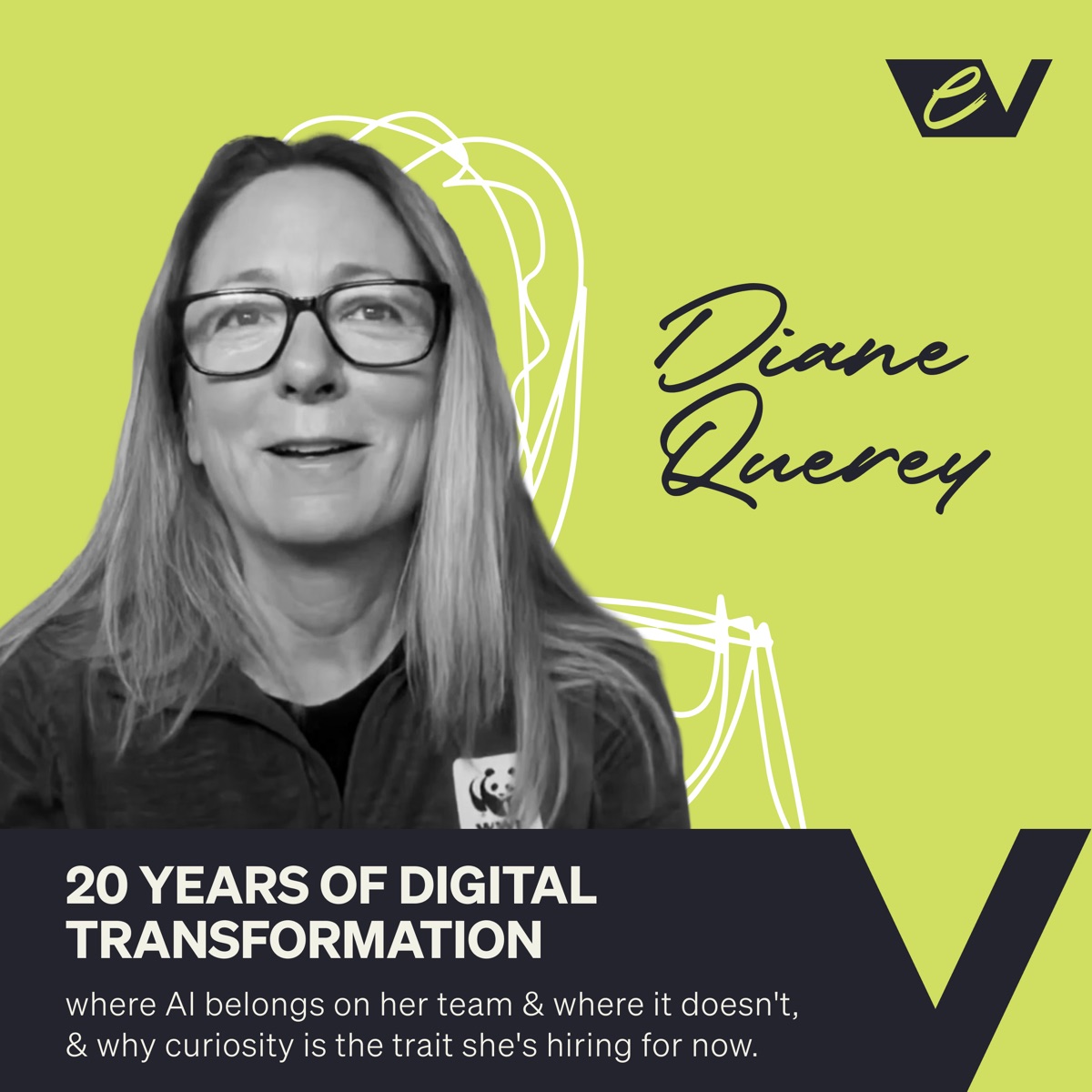
Diane Querey: 20 Years of Digital Transformation at WWF
VP Digital Platforms, World Wildlife Fund
Watch or listen right here
About this episode
Diane Querey has led digital at World Wildlife Fund through two decades of platform shifts, including the WWF Together app that won an Apple Design Award in 2013 and the Apps for Earth campaign with Apple that raised $8 million.
Curiosity as a career strategy: how a nonprofit digital team ships work that competes with the best product companies, what 20 years of transformation teaches you about picking the next platform, and why mission-driven organizations can out-innovate brands with far bigger budgets.
From the blog
Show note The Shakespeare of alt tags 4 min readLinks from this conversation
Episode transcript
Read the full transcript
Transcribed from the episode recording; names and phrasing may contain small transcription errors.
Welcome everyone. This is another episode of Escape Velocity. I am here with Diane Querey today. And I'm so excited to dive in and talk to you, especially when we get to our origin story of how we met. But just a little bit about Diane. So Diane is first and foremost, mom to her 12 year old son, Max. She's a proud member of the Querey and Horgan families of Delaware. and she's the Vice President of Digital Properties for World Wildlife Fund's US office in DC. Originally from Wilmington, Delaware, and a University of Delaware grad, her career has spanned the newspaper industry as the internet was emerging to startups in San Diego and Westchester, PA, and back to newspapers where she was working exclusively on the web, and I can't wait to get into that story. And for the last 20 years, she's been leading digital transformation at World Wildlife Fund. We have the best origin story, and I want to start there because it goes all the way back to Foursquare. And for any of you listening that don't know what Foursquare is or was, it was just a way to post on an app where you were. And if you checked in or know, whatever like logged your location and in certain places you'd become the mayor, right? So I know there was always battles between, you know, getting the mayorship of a favorite restaurant or something like that. But Diane, tell me what you remember about those days back in what, what are you talking, 2006, 2007 maybe?
Yeah, that's that's my best guess. I think I first heard of foursquare at South by Southwest We were actually playing the game foursquare, which I can't remember even how it goes But I'm to always kind of latch on to the latest and greatest new thing And so that's what I recall is like I was at South by Southwest I want to try this foursquare up I was talking to the founders and we started checking in everywhere and and you could see other people who were like checking in or people who had been there people you didn't even know you would see and and that's kind of how You and I discovered each other in Roe Vith.
Yeah, we were checking in in Rehoboth Beach, Delaware, and so there probably weren't a lot of early tech people using this app in a small beach town in Delaware. And so we just kept noticing. I was like, look, DQuery just checked in on the Bay Bridge. Who is this person? Yeah, I mean, I didn't know anything about you.
She's on her way.
I'm trying to remember, did we just both, had we both checked in somewhere and we were like, wait, are you that person?
No, think we became, somehow we followed each other on another app so I could see what you look like and your dogs were kind of the thing back then. And so when I saw your dogs on the beach in Dewey on the Bayside at Que Pasa, I was like, that has to be Halvorsen or whatever your username was. can't recall now. But it was like meeting a celebrity. It was so silly. That was like the coolest thing.
Yeah.
And obviously we continue to run into each other at the beach all the time and we've deliberately hung out together too. So it's it was a very interesting way to start a friendship, but you were my first internet friend.
Yes. It was. I know. You're my first internet friend too and you know that's the internet at its finest.
Yeah, if only it were that easy these days, Tracey.
I know, I know, those like the golden years when things were easy and people liked each other. I don't know, I think that's how it was back then. That is literally one of my favorite stories. always, know, when we're hanging out and I introduce you to someone, I'm always like, I gotta tell this crazy story how we met. But I think that that brings up, you know, another like,
Yeah, things were easy. I don't recall. Yeah, yeah.
I'm curious about were you always into technology? mean, because we came of a, we're a similar age and when we grew up, you know, there was some tech, but there wasn't, you know, there weren't Macs and the internet and all of that. So.
huh. Mm-hmm. Yeah, they didn't, yeah. They weren't even like email. I didn't have email in college. Like that's how, and I don't say that in a self-deprecating way. Like I know a lot of people like to say, I'm so old. I'm really happy and lucky and glad to be born when I was born because yeah, I was interested in things and very curious about things when I was younger. I would take apart my little Coleco or whatever little devices we were using back then. I played Atari, played Pitfall all the time, know, like all of. But I've just always wanted to kind of, I was always curious, like what's this new thing? What's this new, not necessarily shiny object, but something that just seemed like it had the potential to change things. I never was very good at putting things back together though, so I kind of, I can't say that that was very successful. But yes, I've always been very curious and the first job job I had out of college first, I worked at Grotto Pizza and made lots of tips there. But when I got a real job, as we called it then, I worked for a newspaper in Rehoboth Beach, Delaware, which we keep talking about. It's kind of a place that we both love. And I got the opportunity to be curious every day. I'd get assigned all kinds of random things. Like there's a chicken processing plant coming in, harvest in Delaware and go talk to the community and understand the environment. And I would get so excited about things that just seemed really kind of boring, probably to most people. Another one that I was really curious about was the wastewater treatment plant in Rehoboth. I got to learn the whole process of when the sewage came in and how it got treated and how it went out into the canal. And I loved every second of learning about it. So it's that kind of thing that drives me. I'm always like, what can we do with this? Or how can I understand this better? So yeah, long-winded answer to say yes. I think I've always been curious.
always been curious and always been not intimidated by tech to the degree that you will take things apart at risk of never being able to put them back together again. yeah, I mean, I guess it's that curiosity that you to do it then. You have a 12-year-old. I have two 11-year-olds. And I think about how can I try to
Correct. Exactly. Yes.
instill a sense of curiosity in them when I see that they are growing up where at a time where they feel almost like I don't want to say addicted or entitled or but they they feel they seem to feel like it's the norm that they should have every second filled with some some kind of entertainment some kind of activity and you know to say I'm bored they which they say all the time they say it almost like you know I broke my arm or I'm dying you know
Mm-hmm. Right, it's physically painful for them to not be on a device, right? Yeah.
It is, and one of the things I said to them, you know, when they were probably too young to understand, but I said, if you're bored, that's because you're boring. And they were like, what? You know, there's probably a more nurturing way to approach that, you know, it's not, it's not the world's job to keep you from being bored. It's, you gotta figure it out. So,
I'm not boring. Yeah, no, I experienced the same thing. Yeah, it's yeah, and just Yeah, exactly. It's not always a roller coaster. mean, life can be a roller coaster, but like not a literal, like Max loves his roller coasters and I do too. And I go with him on these things, which I'm getting dizzy now when I go on them, but I still do, because I know how much he loves them. like, yeah, finding ways to get the children to be bored is a challenge. But I try to balance that with what I do believe to be like genuine curiosity with being on devices, right? He has a VR headset that he goes and plays Gorilla Tag, he builds things and he plays Minecraft and he's doing creative things as part of the things that he does when he's on devices. it's really interesting when we, I'll say, you need to take an hour of boredom time and he'll get cardboard and the glue gun and he'll make up games. He really is good at making up games and it's just really encouraging to see. And I have to balance it more just when I'm working a lot. It's very hard if he's here with me and I can't really be even hanging out with him. So in the off hours, I really try to make time to not be on my devices and to give him time that we're doing something creative together that doesn't involve a screen. So yeah, it's a challenge.
I think that's great though, the one hour of enforced boredom time coupled with you also demonstrating how you can engage with him in boredom times to be creative and to come up with things. I feel like they... It's interesting, you mentioned Minecraft and, you know, Gorilla Tag and the VR headsets.
Mm Yeah.
Um, do you draw a line? Do you differentiate between an activity that is purely consumption versus creation or like interaction?
Yeah, yeah, I see what you're saying there. Yeah, I think I'm way happier when he's playing Gorilla Tag and moving around in the basement and building things. And he's always very excited and he's very kind to others, which is nice to see. But then when he's just like on YouTube, you know, watching the shorts over and over, like that's where I get kind of like, that's not good for your brain. I know it's not good for my brain, but I'll like have a board day when I'm alone and I'll get on TikTok or whatever. And I can't act like it's something I don't do. But I really try to limit that part of it where it's just like video after video after video. It's just that part feels not as good to me as the like building and, you know, he has friends that he knows kind of like we met on the internet, right? So he's got people that he talks to within the game and I'm listening at all times. And I always look at like his history and try to do all the right things as a parent. But yeah, I do try to lean more toward the creative and the active than the, you know, sitting still and watching videos for sure.
Yeah. Me too. Sometimes I just, if I spot one of them, now I threaten them. like, you're gonna get internet neck, you know, or tap or whatever device, whatever you call it. like, you're literally gonna be just hunched over just because that's you're sitting staring at your tablet all the time. That does freak them out a little bit, but it's like they are just zombies. And I just think about the matrix and I'm like, oh, you're just.
Yeah, you'll have a hunchback. Yeah.
plugged in and just consuming this stuff and it's just feeding off your data. And it's terrifying. well, we digress. But I think that's a great, know, I think that anyone out there who's a parent is struggling with these things and wondering how to balance it out. And boredom is the unlock there. But, you know,
Yeah. Yeah. Yeah, we digress. Uh-huh. I think so.
And yeah, we grew up in time when we had to get creative. We had to use our own minds and ideas to play and to entertain ourselves. We talk about how we met kind of random. It was all like serendipity, just kind of randomness. And do you feel like curiosity is a necessary component to kind of unlock more surface exposure to serendipity or luck?
Uh-huh. Yep, for sure. Yeah, I think they go hand in hand really. think every sort of major move or transition I've had in my life is part curiosity and then there's a lot of luck involved in sort of like what happens next. But like the curiosity to pursue the thing that's unknown I think leads to just a really interesting kind of path, which I was thinking about my career path. and thinking how they must seem unusual. But I think everybody's career paths are like that. You sort of have to make a decision at some point that you're going to make a move or try the new thing and see where it goes. And that kind of leads to where your story is and who you know and how you kind of decide to live your life. It's just really interesting. I always think about there's like three kind of major points in time with technology. And I've just been like kind of the year that I was born, 1970 was the right time to kind of be right at the cusp of each of those things. Right. So. I was working for this newspaper in Rehoboth Beach, Delaware, and the internet. I talking about the internet. was like, what's the internet? And so I was using my sort of boredom time outside of work to understand just what is it and how can we use it. And this is how bad it was, how different it was, is I wanted to go on the internet. So I went to the office after hours. We had this one big computer that could go online. That's where we did our research when we were working. I went in at night and I would remember dialing in at that AOL and the modem and waiting 10 minutes for a page to slowly load and typing my search terms into Netscape, I think. But that curiosity drove me to understand, how do you do this? How do I put a page up? And so I would just spend some of my off time doing that. And then the company decided to put the paper online. And so I got to figure that all out, piece it all together.
I sure do.
I just remember I had to remember that this file is local and this file is on the computer that's out there that the world can see and I have to make it get from here to here. And I would put it on my little FTP, my file transfer protocol fetch. The little dog would run and the file would go over and then I would refresh the page and then the changes are like, it's so fundamental. for me at the time, was like, whoa, I just put a...
Yes, I loved fetch.
something on the internet, like I can be a part of this. And it was really cool. people who weren't, know, people who cared about what was happening in Rehoboth, but weren't there all the time, could get their information wherever they were. And that was really like big and exciting for me. So that's sort of like the move I made there and like what curiosity drove me to then now I had internet experience in the mid 90s and that was sort of unique. It's not sort of unique. There's no degrees of uniqueness. I'm so sorry. That's my big pet peeve. So let me just correct myself.
Yeah. Yeah, and I think, you know.
It was unique. Sorry, I have two pet peeves and there are no degrees of uniqueness. And I learned that at the newspaper because I wrote a story about the boardwalk and it said, Rehoboth Beach boardwalk, the boardwalk, Rehoboth's most unique feature. And then somebody who is a better grammar nerd than me living over in Lewis, like called and said, you can't say most unique. And so I, you know, that sticks with me. So sorry, I just digressed quite a bit there. Educating people on grammar.
I'm Oh, that's great. mean, look at that. Yeah, I carried that with you. You know, I think that was also a time when the internet was being, everyone was, there was a lot of pearl clutching around what this was going to do to papers. If they went online and became digital, you know, how do they make money? Is there a paywall? Are there advertisers? you, how was that?
Ha ha ha! Mm-hmm. Yeah, it was, I they were like the people who were for it and then there were the people who were against it. And it was really, I mean, it went on far longer than I expected it to. But I think what you learn is that people are set in their ways, right? So I later worked at the newspaper in Wilmington, the news journal, which is Delaware online. I led that website. And we would have copy editors who
discussed back then.
refused to edit content that was going up on our 3 p.m. like midday online only news report and they were like, well, I do my copy editing from 9 to 11 because their whole life they had done that. So it was like in order to get the story copy edited, we need somebody who's willing to go there with us. So like it was really challenging. We ended up with having an online editor who was a writer in the newsroom who didn't know anything really about how this news or content got online, but he had to advocate and drive people to do these things. And it was a big change for a lot of people. I think now the expectation is you have a lot of internet experience for any job, as well as the other things that have come along since then. I started on my one, two, three, and I left at one. But the second one was when smartphones came around, the iPhone in particular. I was working, that was about two years into my job here at World Wildlife Fund. And we had just launched a website in 2007. But we were seeing that like, you know, people were starting to consume our content on their phones because they could. It was no longer the flip phones that actually wish I had now, some days. But yeah, we were able to kind of seize the moment there and say, we need to take this on because people can't read our content. And you had like a... desktop site and a mobile site, but the mobile site never really got the love it deserved and you wouldn't put extra things on there. There was no video and all that kind of thing. So we moved pretty quickly and we got our site launched in 2012, which is the last time we launched before the last redesign that just launched in October. So I had a website that lasted for like 13 years, which is really saying a lot. yeah, we kind of, we had to figure out how to make the site kind of accessible to all, right? And so we built it in a way that is... it morphs to your device, right? So now you can, and that's just assumed these days, right? Because so many people consume their content on their web. Yeah, but that was sort of the second kind of big transformative change that happened in technology that I think kind of drove my curiosity, my team's curiosity, and we partnered with a great agency who was able to bring that to life. So was really cool. It was a big proud moment. And I was thinking about this this morning. We used to attend all these conferences about web stuff, and I don't know if you ever went. I was thinking, I bet we were probably at the same event sometimes, but an event apart, I used to go to those and they were always so ahead and like they all knew like the coolest, latest technology. I always thought I did, but I would go and learn from them. And that's where I was first hearing about responsive design. And so I kind of missed those. They ended the physical ones or maybe even they ended entirely, but I found them extremely helpful in keeping me moving toward like what technology was driving for WWF. So it's just a point in time I always think about.
yeah. Yeah, that was a great community because it had come out of the early web adopters and folks like Jeffrey Zeldman who really was, yeah, yeah, yeah, Jeffrey who really advocated for accessibility and for clean code so that everything would work across different browsers and for standards. He was very...
Okay. I knew you knew their names. I knew it. was like, I was going to Google it, I was like, no, I'll ask Tracey. She'll know. Yeah. Yeah, and standards. Yeah, exactly. Standards. Yeah.
very much for standards. when you can't get the browsers to, you it's like you've got to figure out a way to work with the mess that you've got to work within and try to find some standardization. I was in the same, yeah, same communities, going to the same events, reading the same books, following the same people.
All those little small books, they're kind of easy reads, right? Like I probably have some still looking at my bookshelf, but I don't think I have any sitting right there. But yeah, those those are fun times. Honestly, it was really fun. It was like a community that I feel like it's it's there online, but it's just not the same as, you know, kind of getting together and paying attention for two whole days or maybe three if you got the last day and you learn the special technical thing, right, which I didn't always do.
Yeah, yeah. Yeah, I mean, there's Yeah, and I think the internet now is, it's, I wouldn't want to say it, it's more like electricity. You it's just kind of something that's there and works. And if you need to do something with it, the tools are easier to use, the access is easier. So I think back then, you know, it was such an early adoption time. And so the PN, so, you know, it's like,
Mm-hmm. Yes.
people were being generous and sharing and helping each other. A lot of creative people in that space that were bringing a lot of creativity to the whole notion of what we were doing. Let's talk about stage three of your career arc or big changes because.
Mm-hmm. Yeah, well, this is the one that's sort of happening now, Tracey. I'd love to tell you what I think is going to happen, but I don't. And that's always the case with these other two phases. Let's just be curious about it. So with artificial intelligence, I think we're all trying to figure out what's the best use of it. And we've done, we used it for some things with the migration to the new site that launched in October. So we had to manually migrate everything, which was painful.
Yeah, I want to hear about this.
Yeah, so this project went on a lot longer than it really should have, but we decided maybe three years ago, possibly even now four, that we knew we had to start planning for it because our site was so old. And I've mentioned that it was responsive. It sort of held up. And I'm really glad for that because we had a longer project time than I had anticipated, and it still held up till the end. So yeah, we had to switch vendors midway through the project. So we had brought on one vendor and I looking back, just wish one thing I would like to like give myself more credit for is like when I feel like I think something's not going well, I tried really hard to make it work, right? I tried really hard with this agency, but it was clear as of about last January that we were not getting what we were asking, what we were paying for. We were wildly behind schedule and sort of like we mutually agreed to kind of part ways, which was the best decision. for both of us. But we had to pivot really quickly. And I spent an entire weekend just networking and figuring out who the right vendors were. All this to say that as we were going through it, neither vendor could find a way to have an automated export of our content because the database was too complicated. So we had to manually migrate content. And I think that was about 6,000 pages in total, maybe more. And so imagine my life in the last year and my team's life has been a lot of that manual migration. That's where we started thinking about how can we use AI to make this a little easier on ourselves. So we used it for not any content writing, but for like metadata, right? So, you you have to have for every story, a meta headline and a meta description, a social headline, a social description. So we were using copilot, which is what our organization uses to write those. You're taking the body of the story and popping in this copilot and we gave it the prompt that said how many characters and all that, and you got what you needed and you copy. So it just saved time, right? Like that's...
Yeah.
We needed our time to be spent on a lot of other things than just the content migration with this project. So it just freed up some more time to do other things. Now we're looking at it in different ways on our social media team, which I oversee. I oversee both the web and social teams, just so it's clear what digital platforms means. It's sort of our outward facing kind of owned platforms, all of our social channels and our website. But on social, we're looking to use it for like alt tag writing. which can be challenging. I have written, I think, 300 or 400 in the past month because we're trying to correct the blank ones in our database because we're about to have an accessibility audit and we want to make sure they're there. yeah, that's my secret passion. I don't know how secret it is. I talk about it a lot at work, but I love writing alt tags. It's like my chance to be creative. I call myself the Shakespeare of alt tags. if you're on our site and you ever want to listen to it on a screen reader, you'll get to hear all my poetry. you how I describe an image is very poetic. So anyhow, that's I digress. But yeah, that's sort of what that's yeah, that's what we've been doing with AI. I and then I should mention that I'm also using it as a thought partner, which is so strange to me that like, I can rely on something that has a lot of information that I've kind of given it to like, think about things and how to approach things at like a higher level, right? Like not at the like, just write something for me. It's like,
I think that's yeah
How should I approach this? So it's been really, really helpful for me in that way to think about what is the shape of our team moving forward with all the changes that happen with the new website? How do I think about this? And it makes me wonder what I did without it. It's that kind of thing. So that's why I name it as one of the big three, because it's transformative. think I'm in the middle of feeling the effects of that transformation and trying to understand what's the right level for me to be engaging with this. it's ever evolving. But I'm curious and I'm constantly learning new things I can do with it. So it's pretty cool.
Yeah, I think one of the hardest things about this time is that the rate of change is increasing incrementally. So, and that's always been the case, but I feel like we're accelerating now. So even as I'm so interested in AI and trying to wrap my hands around it at all times and figure out the best way to use it, that, you know, it's changing just as quickly or getting more powerful or more, I don't know. Sometimes I have this vision of AI just being like this black hole that's just ingesting everything. And at what point do we just all get like sucked through that black hole and end up in, I guess in the simulation where we're all living.
Mm-hmm. Yeah. Yeah. Yeah, my brain goes there and it kind of starts hurting my brain. And to that end, I'm also thinking about, and I've spent a lot of time in the last month thinking about what sort of, you want AI to be able to search your website so that you show up, maybe not even getting clicks through that you show up on the the AEO stuff. Whenever I say AEO and then I answer engine optimization, always can't, then you go to geo and I always want to talk about geo politics. Anyhow.
Yeah Yeah.
But we want to show up there. When somebody says, how many tigers are left in the wild, we want to be the answer, whether or not somebody comes to our site. So that's source of truth. I've been thinking a lot about how much do we really want to allow it for learning crawlers. And so we're probably going to be implementing some blockers at the like, I'm getting too technical.
Right, the source of truth, yeah.
But just to kind of say, these bots are OK, and they're allowed to crawl outside, but these are not. And being more specific about that. And I'd love to share that with you at some point offline, just to see if you're thinking about that for clients that you work with. Because I think it's pretty important, particularly around copyright and images, just making sure these things are not being ingested to build models. We want to show up in web results, but we just don't want people taking full advantage of the wonderful content that we have on our website. So it's a tricky balance.
No, I think that's great. yeah. Yeah, it's a really interesting challenge. And it's not as simple like, yes, no, do this, don't do that. I've spent a lot of time recently. been running, I built in using AI this tool called Blanding. And it was just set up so that EDUs could audit their sites and see how
Mm-hmm.
how bland their brand was basically. It was looking for cliches, it was looking for original language, it was looking for a whole bunch of different things to kind of come up with its scoring on a, you know, just on a sample basis, like homepage, a few subpages. But one of the things it was looking for too is what can, you know, when I go in, when the AI is accessing this site, what am I able to see versus not from the AI's perspective? So. The answer engine optimization is really, I think, so important because the reason that's such a big deal is that's how people are searching now. They're asking questions. They're not typing in keywords. They're not finding, looking for the site that they want to go to to dig through everything to try and find the answer. They're asking a question. And now with AI built into the browsers, you're going to get all your answers to your questions through AI.
Mm-hmm. Mm-hmm.
And maybe there'll be some clicking if you want to explore further from the sourcing. But it's a zero click kind of search now.
Yeah. Yep. And, you know, of course, that first that frustrated us and we're, what about copyright? What about ownership and IP and all that? But now we, I'm, I'm hopeful that we'll be able to have like a score for how we're doing in AEO, right? Like to see like, that's also important. It's okay if they don't come for our website, which is really hard for me. That's not something I was okay with for a very long time. Like it was all about getting the click through. And now it's just about how do we make sure that we're seen as the authoritative voice on this topic, right? Which WWF can be in a lot of areas, you know, we're science-based.
Yeah. Yeah.
And we have a lot of publications on our site and a lot of citations and things that really lend to our credibility as an organization. So that's been really important for us and something we've been spending a lot of time thinking about lately. It's exciting, but it's scary, like you said.
Yeah, it's scary and it's a lot to try and figure out. And then it's not even very easy to necessarily see, okay, well, who is clicking through from one of the AI platforms? Am I set up to make sure that I can see that? What are the questions that people are asking? And even trying to, I keep telling clients now, we need to think about your content as having some aspect of an FAQ.
Mm-hmm. Mm-hmm. Yeah.
when you're thinking about writing a case study or thinking about writing anything, is there an FAQ element to this? Because then we're literally able to map the content back to how it's being asked for. And that will make the AIs much more likely to go, great. It's already in the schema that I like. It's being given to me in maybe an FAQ schema as well as on the page. So it's
Mm-hmm.
There's just a lot that I'm learning and just trying to think through. There's also a lot of spammy old school stuff that used to work back in the good old days of SEO that's coming back. So fake listicles where you write, who's the most authoritative source for all facts and data related to wildlife? You list yourself number one and then you list a whole bunch of other ones. That sort of stuff is working right now.
Yep. Yep. Yeah. Yep. Yeah, we do a lot of explainers and those are doing particularly well now that we're on the new platform. Just I think the way that we made decisions or my team made decisions around information architecture and having the data structured in such a way, I think those explainers are where we need to really spend a lot more of our time. We tend to gravitate toward like, what's the newsy thing? What's the report that was released or what was the new partnership that was. know, form to create something, you know, to positively, you know, advance our mission. But the explainers are where it's at. That's what people are looking for. And, you know, obviously we look at the search terms that drive people to our site and make sure that we're mapping to that. yeah, we're being as strategic as we can with what we're doing. But like we're thinking about one thing we talked about in the last couple of weeks was putting a couple of bullet points on the top of a pretty long story so that you can get like the things, these are the things you need to know if you don't get through the whole story. But then, Just not sure if that's the right thing. again, we're exploring, we're testing, we're being curious and seeing what works and what doesn't. And it's fun for me. I love that. It's sort of like, let's figure it out. But it'll change in a couple of weeks. It'll be different, right? So that's the other thing is, Yeah.
Yeah, it's a moving target. It's an evolving, very fascinating, evolving, brave new world. So I think we have to be trying things out, seeing what works, what doesn't work, being ready to change, being ready to be wrong, and see what happens.
for sure. Yeah. Yeah, like I mentioned with this blocker idea of saying these bots are OK, these bots are not OK, there are plenty of bad actors out there that we don't even know their names. So we can't even put them in to block them. And we can constantly go in and update. But how much good will it do? I don't know. But we're going to try it and see what kind of comes out on the other side. So I don't know. I try to look at it as whenever I get to the scary part, I go back to the part that it's really got some benefits. And I want to focus on that. Let's really focus on the things that can do to make it free up our time to do more creative thinking and be more strategic.
Yeah, so you mentioned that you use it as a thought leader, or not a thought leader, a thought partner, right? But talking about big picture things. How much, this is something I was just talking to my team about, because we've got everyone working on Claude Cowork now, and we're hosting lunch and learns every week to just try to keep encouraging them to be curious about it, as well as to find ways to work with it in the company.
Mm-hmm. Yep, for sure. Yeah. Mm-hmm. Mm-hmm. Mm-hmm.
I think if you don't dig in and learn about how to really give these AIs the true framework and information that they need to work with you uniquely, then you're just still stuck with kind of a fancy chat bot. How do you train or how do you think about setting up an AI before you start working with it?
Yeah. So the thing that I think works well is feeding whichever tool you're using as much information as you can about your goals, your content strategy, all of the kind, like you have these documents existing somewhere. If you feed them to the AI and tell them, this is the voice that we want to have on social media, we want to be upbeat and positive, playful, fun, know, like all those words. And then it helps when you sort of like run an idea past it to say, like, does this fit into that, you know, content strategy? So those kinds of things I think are really, that's what's transformative to me is when you're kind of like, well, it doesn't really get us yet. It doesn't know us. So we tell it who we are and what we want. We don't have it writing social media posts by any stretch. We don't want that at all. I have three brilliant women on my social team who come up with the coolest social media posts of all time, in my opinion. But I don't need them to write the alt tag for the photo that's there, right? So they've been working on that. prompt that's helping them make that a quick thing so that they're being more creative and thinking about what fun stuff can we do, what trends can we take advantage of that benefit and kind of drive our mission and our content strategy. that's how I think about it and how I think having it get to know you before you just say, you know, write me this. That's not how we want to use it at all.
You said something that I bet is gonna make a lot of writers out there feel a little sigh of relief, which is we would never have it write the posts for us. You have three brilliant women who write the content. Tell me more about that. Were these people nervous when AI came on the scene? I think a lot of people really thought, my God, I'm gonna be replaced by AI.
Mm-hmm. It is. Yep. For sure. think everybody has had that fear at some point. even at my level where I'm not necessarily doing the writing or doing, I worry that AI could replace my sort of strategic thinking. But that's what is definitely not happening now. I have also three brilliant writers who write the web content. Others in the organization also write it, but my team will edit it and make sure that it's within our content strategy and all of that. But no, it can never replace that. that creativity and ability to tell a story or to be funny or to be informative. But it can do the tasks that are not as strategic or creative. Yeah, for sure.
Yeah. Do you know, for me, the more I use AI, the easier it is for me to spot when someone has really like handed over the keys to the thinking, the writing, when everything is clearly coming out of an AI. I think it's a lot more apparent to see it now as it's been around for a while. And you know, the AI slop is being discussed at all times because I do think we're going to see all of these networks just get flooded.
Mm-hmm. Yeah.
just because it can at scale generate so much. But I also think there's a lot of people out there who don't notice. And so it may be effective in certain scenarios where kind of it's more brute force than artistry.
Yep. Yeah. Yeah. Yeah, I mean, certainly I felt resistance from some people on within our we had somebody come speak to our whole division back in December when we were all together here in DC. And a lot of people are very afraid, not afraid, but like they just are wary of AI. And rightly so. think everything you approach, even with curiosity, you approach with caution and you think about it. But what I've seen and I've enjoyed watching is the people who have been very against it seeing kind of the benefit it can have to free them up. So that's been good to see. I was thinking about something else, but then I lost my train of there. So just edit that out.
No, no problem. I remember a couple weeks ago, was visiting my mom and her partner was working on something where he just needed to summarize some information and a point of view to a client that was just kind of not understanding. And he thought he had to kind of outsource it for someone else to put a deck together for him and create this presentation. And I'm like, have you tried using Claude for that?
Yeah.
And he's like, no, I haven't. Now this is, know, it was really just to kind of explain why SEO was important to this client to just make the point so that they would get on board with the changes he was recommending. And he thought he needed like his SEO partner to put that first to do all the research and then put together the DAC to convince the client. And it was gonna be almost more money than he'd end up making on the additional work. And so I just.
huh.
showed him a quick demo.
Sometimes that's all it takes and they say, my gosh, wow, that's powerful. And I think when we talked earlier about this idea of blocking certain bots, like I leveraged AI to help me understand what are the bots out there, what are the good ones that we want searching? And that's where I find the information versus my SEO partner who we love working with. But this was work that we should have probably pursued back last summer early.
Yeah.
I wish we had done this earlier, but it's maybe a little too late, but I think it's still a good thing. But yeah, I leveraged AI basically to think about AI, which got a little bit in my head, yeah, a little bit meta. But yeah, it's fun to see when people start to recognize that they value, that it can help them do their job better. That's really fun to see.
Little meta. I mean, Yeah, just it's so powerful. I do think that, you know, folks that may have tried it, tried the free version last year and thought, well, it's just a fancy chat bot, you know. And it's true. Like this system, all these systems were born out of essentially just a computer program getting really good at guessing what the next best word is. When you go back to its beginnings, that's where
Mm-hmm. Mm-hmm.
It made that leap of suddenly being able to sound human and sound like it understood.
Yeah. Yep. And we did this exercise with the division back in December where we had like, these are, we want to brainstorm on each of these things. We broke up into groups and we all used AI to brainstorm. And it was interesting because obviously it's thinking about what's the most obvious thing. And they were all quite similar, all the ideas that came up with different platforms. So it was, it was enlightening to see that at that scale because we had, when I tested it, it's just me testing it, but this was like groups of people that were coming up with ideas and they were all quite similar. But it was helpful. Either way, it gave us ideas that we wouldn't have otherwise pursued. so it does, there's value there, but you still need the creativity to happen.
There is value. yeah, the original spark, the original idea, I think has to really start with the humans. It can pressure test. It can give you a lot of variations on your idea to consider. It is a great problem solver in terms of thinking through how to execute an idea. yeah, it's really, I just think for the original ideas,
Mm-hmm. Yeah. I've seen it work really well.
we're going to see anyone who's relying on AI too much is going to continue to be this compression to the middle. Because everyone's going to get the same kind of middle. Yeah.
The same, exactly. Yeah, yeah. I use it also for just in my personal life, right? I just like run things past it because, you know, I'm single and so like I'm not talking to someone all the time about everything that's going on with me. I'm sorry, I'm not single, I'm self-partnered. I heard somebody say that recently. So I'm trying to lean into that self-partnered. Sometimes I just need someone to like bounce something off, right? And so in the...
Yeah.
And the times that I'm alone and I'm thinking about things, I'll use it as a thought partner. But now I'm realizing I'm sounding like a bit of a weirdo with my AI.
No, I I use it as well for those sorts of things. If I'm having a challenge with the kids, I will load it up with PDFs from some of my favorite child psychology books, I'll say, research this book, this author, what they recommended. And then from that perspective, how do I deal with meltdown, pushing back, whatever.
Yep. Mm-hmm. Yeah.
So, and it tends to be pretty helpful or just even if it's a challenging situation, it's just a voice of, it's a calm voice to kind of give you some different ways of looking or thinking about things, which I appreciate. It's definitely talked me off the ledge.
Mm-hmm. Mm-hmm. And the kids, yeah, but the kids also can spot AI faster than I think I can. All the time, my son is, I think, yes. I think it's like, this isn't real. this, it makes me proud to recognize that my son will notice things and say, this isn't real. Like that's just junk. so I'm hopeful, but I really worry about the impact on that generation. I mean,
Do they care though? Do they care?
I always thought it was so transformative to grow up with the internet as the new thing, but to grow up with AI as the new thing is entirely different, just in terms of the scale and the rapid evolution of it. I just can't imagine. What does college look like for these kids?
Yeah, the nature of learning and what matters most in your development as a thinker, I think has completely shifted in fascinating ways.
Yes, and terrifying ways. But let's go, let's focus on the fascinating, because I think that's the only way you can kind of be cool with it, right? For the kids, especially who care about their futures, but like, what does it look like?
Yeah, and well... I do not see the Armageddon of everyone losing their jobs except for where you need a physical person doing a physical thing. But then there's robots that could. So I just don't see that world happening, at least not in my lifetime. I don't know. think curiosity and creativity are going to be really important.
Mm-hmm. Mm-hmm.
really important for people going forward versus memorization and learning a specific skill better than anyone else.
Somebody put it this way. We had somebody come in and speak to us about AI at this division meeting. I keep referring to it. He talked about when the calculator was invented, we didn't tell the people who worked in offices not to use the calculator. It's a tool. It will help you do your job better, faster, you do the calculator. So it's sort of like that. If you don't try to figure out how to use it, you're going to fall behind. But what it takes is somebody actually kind of exploring and playing around themselves. That's what I've seen. And then they start understanding the power and the good side of AI, which is what I want to focus on. think about everything that I do is sort of in the interest of taking technology and leveraging it for some good. And I don't mean to seem like a martyr, but like, I think we actually had at one of the South by Southwest, a session called Tech for Good. you know, hearing about how people are leveraging different parts of technology back when I was doing it then, it was more about the internet and how we're leveraging the internet for good. But now it's bigger than that with AI and you have to think about it as part of that. I just think there is good there. And that's the of the point I want to get to is like, find the good in AI, but be wary, just like everything curious, but cautious and creative. The three C's, Tracey, I just made up.
Yes, yes. You work with a large team. You're responsible for a lot of people. we were talking about curiosity and creativity being such important skill sets now, or traits. In work, what is it? Can you draw a line? you say, we are having this problem?
Mm-hmm. Yeah.
right now because this person lacks curiosity or creativity or adaptability? Are you seeing that?
am seeing it for sure. the way it shows up is sort of like, just tell me what you want. Like be an order taker versus a strategic partner, right? And that's something I'm extremely focused on this month as I'm thinking about the future of my team is who are the strategic thinkers? Who are like, we don't want to be order takers. That's not what our brains that have evolved and been in these roles for very long times and know a lot. That's not their best purpose, right? is to just take orders, build me this webpage, right? No, it's what is your goal and how can we help make sure that we're achieving that? Is a webpage even the right solution, right? Like, so not being an order taker, but being a strategic partner, that's where it's at for me right now. And that's where the lack of curiosity shows up in anybody that wants to just be an order taker. That's just not, that's not gonna fly with me.
Yeah. So that aligns with the conversations that are being had about entry-level jobs and younger people coming out of college that might think, I don't have the experience to think strategically, so I need to just do my time being the order-taker. And that's how a lot of people start out in entry-level jobs. They are literally the order-taker for the shittiest orders, right? Yeah.
Mm-hmm. course, yep, we've all been there. We've all been there.
And we do it wrong and we learn by how many times we fuck up and either don't get fired or do, but that's how we learn is by either doing the order successfully or not. And how do people that are just getting started in their careers or who are already in teams but have been able to operate that way successfully for their careers thus far, how do they think about changing that?
Yeah. Yeah. I mean, I think it takes some mentorship or coaching from the outside, whether that's me or training or people in culture, but just evolving a way of thinking and making sure that the work aligns with that. So I want it to be that we're not just receiving requests, but we are seen as people you want to come to because we're going to give you a better output if you partner with us. So I think it's a major mind shift, similar to the shift of being able to think about playing around in AI to understand how it will work. Like you just have to find slow ways to, and then you'll have an aha moment. I see, we want to look at the data before we decide what we're building, right? Like that kind of shift is what sort of needs to happen. And something that I'm working on in terms of change on my team.
Yeah, even just thinking about the larger implication of whatever it is you're being asked to do. That's what I always, yeah, bigger picture. But I think people do have to learn what that means to get there. And I think a lot of people don't feel like they have the right to be thinking big picture. They haven't earned it yet.
Yeah, bigger picture. Fisher. Yeah. There's also the tendency, and this is just a human tendency, and I can point to multiple points in my career where I would gravitate back to the order taking because it was easy, right? It was what I knew. And moving into a space that you're not as comfortable with, very quickly once I was moving along through my career, was dubbed as manager material, right? So that took me away from the doing and more of the overseeing. And eventually I have adapted to that, right? I'm not, well, I shouldn't say that. I migrated a lot of those pages I've mentioned with the content migration. I think I may have done around 2000, right? So like I was at night doing it. So there are times when you have to step back into the doing to get something done according to a deadline. But yeah, it's really, you've got to shift to making sure that you don't gravitate toward the comfortable, that you allow yourself into that uncomfortable space that you're not used to.
Yeah.
which may not feel as productive, right? Like I like to check off boxes, but I'm not always checking off boxes because what I'm working on is going to take months to kind of come to life.
I as a, you know, since I'm a painter, owe people will always make this comment. You know, I love your art or whatever. I can't even draw a stick figure. That's what they always say. And I'm like, it has nothing to do with your own creativity, but, even your ability, you know, your ability to paint something or create an image. And I think that that kind of gets at a core of where people
Mm-hmm.
haven't learned how to be curious and creative with the thick enough skin to know that it's not always going to work out great. You're going to make stuff that's going to flop. You're going to pitch ideas or strategic directions early on that are going to be shot down because they're not good ideas or they're not well thought out. But you have to start doing it to make any progress.
Mm-hmm. Mm-hmm. Mm-hmm.
And I think that's a real barrier for people. And I'm curious if you have thought about that when you're trying to coach your team or mentor your team into this shift of thinking.
I'm having trouble with this one, Tracey.
That's all right. I mean, it's a tough one. It just came to me as that fear is so real for so many people. That's where order taking and checking off lists, that's great. Nobody's gonna, you know, I can't like really make myself, I don't feel vulnerable here. I think there's a vulnerability aspect to creativity and thinking bigger.
Yeah. Yeah. Yeah. Absolutely. And I think this is the part that I'm struggling, not struggling so much with, but I can't help but think about the outside pressure that is happening in this world right now that we live in. very much am of the mentality of I focus on work and the things I can control when the outside world is as wild as it is. So I just think that plays a factor in everything now, much more so than in any other point in my career, which spans more than 30 years now. That's another factor that is affecting people's ability to be creative, I think, is that there's just this constant fear that's weighing on everyone with what's going on around us. And I gravitate toward thinking strategically and focusing on the future of a team and really being locked in. These are some kind of barriers that I put up so that I cannot think about what's happening. I'm seeing that happening on my team, but what they gravitate toward is the order. I don't want to harp on it too much because they're also strategic thinkers, but they gravitate more toward the order taking than I would prefer. And I'm looking to kind of pivot that slowly in the coming months.
Yeah, I think it's a, I don't think there's an answer to the question. I think it's something hopefully more people are thinking about if they manage teams or they lead teams. Because I think that when you get down to the core of what's so unsettling for people, especially right now, as you said, like there's so much pressure, so much fear, but we need to have bravery. We need to feel like I'm gonna take the time that I don't feel like I have. I'm gonna take the time.
Mm-hmm. Mm-hmm. Mm-hmm. Yeah.
to experiment, explore. It might totally not work. But that takes a level of bravery and kind of permission that I think is really at odds with the reality that a lot of people are living in.
Yeah, for sure. I think one of the main things I love about my job, there's so much I love about my job. Obviously I've been here for 20 years. It's a dream job in my opinion. But is that it's the work life balance that I haven't had in other places. We tend to be able to close our laptops at a reasonable time. And I'm in the office some days, I'm at home some days. We have something called Panda Fridays, which happens to be what's happening today. our office is closed every other Friday. And it gives me the ability to also live my life. you don't have, it's not like I'm consumed by my job. So I think that also helps for staff. Like they have time to kind of be creative and be curious and be bored. Not constantly staring into the void of the Zoom meeting.
want to, before we don't have time to talk about it, I want to talk about the WWF Together app that won the Apple Design Award. That's a huge deal, right? It's a huge deal. Just tell me what that was like.
yeah, it's my first baby. Yeah, it was huge. was crazy. Wild times. Yeah. So again, going back to curiosity, we were everybody was making an app, right? Everybody's making a podcast these days. Back in 2012, 2013, everybody was making apps. That was what we thought the wave of the future was. So we set out and we can give you 100 ideas that were just terrible that I could where I sit now. You can laugh at because they're just so silly. Like you could pop. You get a message twice a day that would tell you an environmental tip. Like who wants that? That was like just we were throwing things at the wall But we we realized that at the core of the World Wildlife Funds sort of mission or what people think about is is the wildlife, right? It's it's in the name. We do so much more obviously With the environment and oceans and everything else that we care about for us But at the core, it's it's wildlife. So we thought well Let's give something that's playful and fun for people to explore wildlife in a way that they can't on the website right? so like we partnered with an agency who They were brilliant in taking advantage of what is cool about the iPhone and the iPad. It launched on just the iPad at the time, that they used to have different ones for different devices. It has since turned into a of a responsive one that's the same on the phone and the iPad. But we said, let's focus on animals. And so we came up with all these creative ways to use all of the technology within the phone. You can run fast to see how you would race against a jaguar, and you can jump and... there's just like how far away am I from Wales right now? And we would use like some relative and so it just it took advantage of the technology, which is what I think Apple appreciated. So getting the call, I won't forget I was on the back porch of my mom's house in Rojobeth. And I got the call from the agency saying, Diane, they want us to come out for WWDC. They won't tell us if we want sorry, WWDC is worldwide developers conference. It's Apple's annual conference and they want to. they want us to fly out for it. it's like, well, they're making us fly out for it. Maybe we're going to win it. But still, we didn't know until they announced it sitting there. We couldn't go in until it was the time for the award portion. They didn't want out. It's all very buttoned up there. And they brought us in, and we sat down, and they announced it. And two of the people from the agency and myself went up on stage and got this cute little, it's in my office. I should have brought it home to show you, but it's this cute little. Apple Design Award in 2013, we won for the iPad and it was like winning an Oscar if I like weren't an actor somehow. It just felt kind of fake because it was surreal. But the app is pretty cool. It's still out there. I jokingly refer to it as my first baby because I think it launched in January of 2013 and Max came around in January of 2014. Websites are also, I have a lot of babies that are websites, but it was a big deal.
Yeah.
And it led to something really great that I don't know that I've ever talked to you about, but I'll briefly mention it. But we worked with Apple on a partnership around Earth Day in 2016 called Apps for Earth. We got to partner with all the big app developers and got like pandas in all the games and things like that and getting our messaging out there. And the app store was fully focused on all of our goals, like oceans, forest, climate. Like that was the focus of the app store for 10 days. And we raised $8 million through those apps. and Apple for our conservation work globally. And it was, it was, that was another just huge moment in my life for like, wow, you know, Apple design award and now apps for Earth, like what's next? And then it turns out what was next was yeah, our planet on Netflix was what was next. So those are the kind of the big partnerships I got to work on in my career and like kind of what I hope if, if something is next for me, that's big, I'm hoping it's something along the lines of that scale because I've really been around for some big moments for our organization.
That's, yeah, that's amazing. Yeah, I can't wait to see what will be next. I remember the Netflix show when that was going on. How did that even, how crazy was that?
Yeah, intense. It was crazy. So it was from our UK office. had a good relationship with one of the founders of Silverback Films, who was the producer of Our Planet. And he was insisting that we only do it with Netflix if WWF were involved, because they needed like a credible science, scientific partner, which is what we were. And we guided them and they gave them ins on places and good stories to tell because we work in all those places. And so, yeah. I've been in the same room as Sir David Attenborough a few times and just almost met him once. But yeah, it was really exciting and a whirlwind, right? I was in London a lot then and I was in San Francisco a lot then. yeah, there are some really huge projects I've been able to lead for WWF and it's been quite the ride. I really love my job.
Well, it's an impressive career and it's spanning 20 years when I don't, you so many people these days are told you gotta jump around, you know, don't stay anywhere for too long or people just don't, places come and go. Were you ever deliberate when you got there? Were you like, I'm here for the long haul, this is it? Or has it just kind of worked out that way?
Mm-hmm. Uh-huh. I think it really has just kind of worked out that way because at the time I, you rattled off all my bouncing around at the beginning that, you know, hearing someone else say it makes you seem, I don't know, unstable, like, and then you went here and then you went here. But I did move around a lot and try different things, but it's almost like I found home. It's just, I don't think I would have known that in 2005 that I'd still be here. It doesn't feel that long ago though, it really doesn't. And so much has happened. I just feel like it's like my family now, like being at WWF is my family and we've been through a lot together, like many people I work with outside of my team. And people tell me a lot, they say, you're the only person I hear raving about how much they love their job all the time. And I do, I rave about it. I'm a huge advocate for the organization. think, you know, the balance of work. though, in life and just the support that they give you. It's, tremendous. So I, yeah, I can't believe it's been 20 years, Tracey, honestly.
It's awesome. And I think the bouncing around that you did early on when also like the internet's coming online, it just made sense. I think back then, if you were looking at where things were going, it didn't make sense to stay put for too long.
Mm-hmm. Mm-mm. No, for me, especially with newspapers who were like I described, a lot of people like the copy editors who didn't want to edit copy early in the day. Yeah, you have to move along. You have to get on the next wave.
Yeah. But I love that you found a place like WWF that does seem to embrace growth and innovation and creativity and hopefully, I don't know, if you all are hiring, is there a place for people to go who are listening to this going, I wanna get a job there?
Absolutely. absolutely. Sure. And you can go to our wonderful new website that launched in October at worldwildlife.org. Very hard to say when you have to say worldwildlife.org. But yes, please visit and check out our careers page. have a, I think the Bridge Internships, that's for our summer internship program. I think those may have closed, but maybe today's the last, this won't air till April. Yeah, but other jobs are listed there all the time. And yeah, we welcome people.
Well. sounds like a great, yeah, I mean, it just sounds like a great place and they'd get to work with you possibly, which would be great. Now they know like, here's what this leader cares about, which is good stuff. So I started a tradition this year where I ask each guest to leave me a question for the next guest. And so I have a question for you from my last guest, Adrian Cooper, who runs a consultancy called Gladsome.
The organization has grown a lot, yeah. So it's a great place to work. For sure, and lots of other people just like me. Yeah. Yeah. Okay?
and she does mission vision values work with her clients. So she said she likes, she has a practice of picking a word for each year to kind of be her guiding idea. And so her question was, do you have something similar or if you had to pick a word, what might be top of mind?
Huh. Hmm.
And you don't have to obviously make that your word.
No, no, might, maybe I want to. I think I lean toward transition, but I don't know that that's exactly what I want to say. I think my life feels like it's always been in transition and that's fine with me. That's just the way I roll. But I don't know, I think this year change might be a little bit better. And I don't really know what that means even specifically to me, like Diane, the person, like do I want to change where I live? Do I want to change where I work? I don't think those things, but just like changing my mindsets and being open, more open to things. That's sort of where I gravitate without giving it more than. 30 seconds of thought.
That's great. And then also to put you on the spot, do you have a question you would like to leave for our next guest?
do and I have to find it because I came up with it but now I can't find it. Okay. Alright. Do you think that the idea of reinventing yourself as a woman, is that real? I'm not asking it the way I wanted to, but like, do you think women are particularly under pressure to reinvent themselves all the time?
Okay, I will, assuming my next guest is a woman. May not be, but likely will be. So that's great, that's great. What do you think about that question?
Okay, sorry. May not be. I made an assumption there. Yeah, yeah, okay. Yeah. I think it's important to constantly be reinventing yourself. I'm like I mentioned, I feel like I'm always in a transition. There's just always like, this is the mid 50s single version of me that I couldn't have anticipated. And so I'm trying to figure out what is, who is that person and what does she want? And where does she want to go? And what does the future look like? So I think reinvention is sort of just, it just has to happen. You have to constantly be thinking about what, who am I? I'm a mom, right? You asked me like to provide you a bio, but my most important role in life is being a mom. So yeah, think it's important. I think my curiosity goes with that so that I can figure out, I can be curious, what's next? Where's this going? Yeah.
I the question makes me, I know this question for the next guest, but now we're gonna answer it too. They won't hear this before they're asked.
I want to know, of course I want, I, yeah.
I think that when you're younger, you might believe that you get to a certain point of growth and then you're kind of fixed. You know, like that's who you are, that's your identity, and then you gain, you know, experiences and skills, but there's a fixed element. And then you might end up in a career and then that's fixed, or a marriage, and then that's fixed.
Mm-hmm.
as I've gone through life, I've unfortunately had to be reminded more times than I would have liked that that is a false belief and that outside factors will show up to remind you and sometimes in very unpleasant ways. But you know, life has a way of reminding you that change is constant. There is no guarantee. There is no
Mm-hmm. Mm-hmm.
you know, okay, this is just what we're gonna do now, we're gonna coast, you know, we're gonna just, cause then you start to stagnate and you get these little voices going and you're like, ignore that, that's gonna mess up everything. And then something will just show up and drop a big bomb in your life anyway.
Yep. Yep. Yep. You and I have been through some things at the same time together that are these harsh reminders. What I envy is when I see people who have always known what they wanted. I shouldn't say I envy it. I just recognize that I'm different than that, right? Like, I have been a person in transition, I believe, most of my career, most of my relationships, like it's always moving. But like I have a nephew who's always wanted to be an accountant and now he's an accountant and he's working at an accounting firm. I'm like... He knew that from like high school or maybe earlier. My brother has been, my younger brother has been at the same job for more than 30 years. Like he's, there's that there I recognize and that's great for them, but I don't know that I could, that's, mean, obviously I've been at one job for 20 or one organization for 20 years, but like it's still within that constantly evolving and reinventing. So I just, I recognize the difference. Change, change makes that a reality, you know.
Yeah, yeah. And I think it's fear. we, our lizard brains don't like change. change was a big threat in the past, any kind of change. And we're not living in those kinds of environments anymore. So I think our reaction to the pressure or the fear of change does come from a primitive place and not always the most informed place, but it's a, it's such a strong urge instinct.
Mm-mm. for sure.
that literally it's like if you're a cave person and the cave's working great, you're not going to be like, let's see what's over the mountain range. Maybe there's a better cave. Maybe there's something different. You're not going to do that until literally the cave is destroyed. Something bad is going to have to happen. For you.
Yep. Mm-hmm. Yeah. And that's where I think change and curiosity like just are so hand in hand, right? Like I keep writing down these C words. I'm a note taker. just write down all these C words, but that's where I've been going. But they're just, they're tied together, right?
Right, mean, along the same lines, maybe we'd still be living in caves if some people hadn't decided to get curious about what was over the mountain range and weren't just driven always out by bad things happening. But I do think that a lot of times a bad thing happens to propel people into a state of change. that's not always, that's okay. Like great things can come out of that. And there's a lot of fear right now around AI, a lot of change.
Mm-hmm. Mm-hmm.
It's almost like well the fear makes people think that it's going to be a bad change that happens It's going to be it's very doom and gloom and I just don't think that's the right the right equation to look at it through because the fear is instinctual it's primitive but the opportunities for reinvention for change for for things to get better is Is there as well? So I'm with you on the stain
Mm-hmm. Yeah, I agree with you.
kind of on the optimistic side versus the.
Doom and gloom. I mean, I have my moments. I'm not gonna act like I'm peppy cheerleader here, though I once was a cheerleader. I don't know why I would just bring that up, but yeah, I am optimistic, but I have my moments where I get doom and gloomy about the world. I do have hope and I work at an organization whose mission is so important and is continuing. And I just.
Yeah, Jameson Glimm. It's not it.
I'm so lucky, honestly, Tracey. It's like luck is something we didn't talk about much in this call, but I really do feel like I was lucky to be born when I was born and I was lucky to have gone to the various steps along the journey in my career path to end up where I am. I'm just so lucky and grateful. And those aren't C words.
Well, but like I said at the beginning, I do think you expand your surface area for luck to happen through curiosity, through bravery, through creativity, and that wasn't accidental. So I think the luck is there, sure. It's a factor always. I feel very fortunate and privileged for a lot of the things that have happened in my life and where I am today.
Yes. Yep. Yeah.
But I do think that it's a deliberate choice to take advantage of whatever opportunities or privilege you might have so that luck can find you. Right?
Mm-hmm. That's right. Yep.
And it certainly.
I think staying curious is so important. Yeah. Like you said.
Any final words of advice for?
I would like advice from you. Advice. just, think, stay curious. I mean, it sounds a little bit cheesy or whatever word you would use these days. But really just being open-minded to your career path may not be linear. Your life may not always go the way you think it's gonna go. But in my experience, and again, luck, privilege, all of those things have played into it. But I just think if... if everyone can be curious and be open-minded and kind of just ride the wave and you can do good things for the world.
that's great. My suggestion, my advice is if you feel uncomfortable. dig in that spot a little bit more, right? Embrace feeling a little uncomfortable. I have anxiety. I don't feel comfortable. I gotta find something to, you know, I need a drink. I need to stop thinking about that. I need to go back to my comfort zone. You know, I need my comfort zone. Just because you're having a feeling that's a little bit uncomfortable does not mean it's bad, right? And a lot of times the...
Mm-hmm. Mm-hmm. Mm-hmm. Correct.
opportunities for where you can grow and change live in those uncomfortable places. I just think it's how can you find a habit, a practice that keeps you attuned to those things? It's not really intuition. It's more like embracing the discomfort of something that feels like it's going to be. change, it's going to be challenging, it requires some vulnerability. If you're feeling those things, that's the direction to go in, I think.
Yep. I mean, we're sitting here now. This is my first ever podcast interview or conversation. And is it uncomfortable for me? Yes. But is it the way I want to be moving? Yes. And I hope this is the first of many. And I'm sure creating a podcast for you was uncomfortable. It's a new thing and you had to figure it out. So I think it's great. Yeah.
Yeah, yeah, I've built up a good muscle memory of just throwing myself into things that I have no business, you know. Like, how hard can it be? I can figure it out.
Right. Yeah, well, it's wonderful. I'm proud of your work.
Thank you. And I'm proud of yours. Well, and I'm honored that this is your first ever podcast. And I hope that I enjoyed the conversation very much. I hope you'll consider coming back in the future and we can see how things are going. All right. And until then, you know, thank you again for coming on and conquering your fears and sharing, think a wonderful story and a lot of great lessons to anyone who's listening. So thanks, Diane.
Thanks. Absolutely. Of course. Thank you.
Thanks for coming.
Thanks Tracey for having me.