Show note · Aug 2026
The Shakespeare of alt tags
Diane Querey has run digital at WWF for twenty years. Her line on where AI belongs is the clearest I have heard.
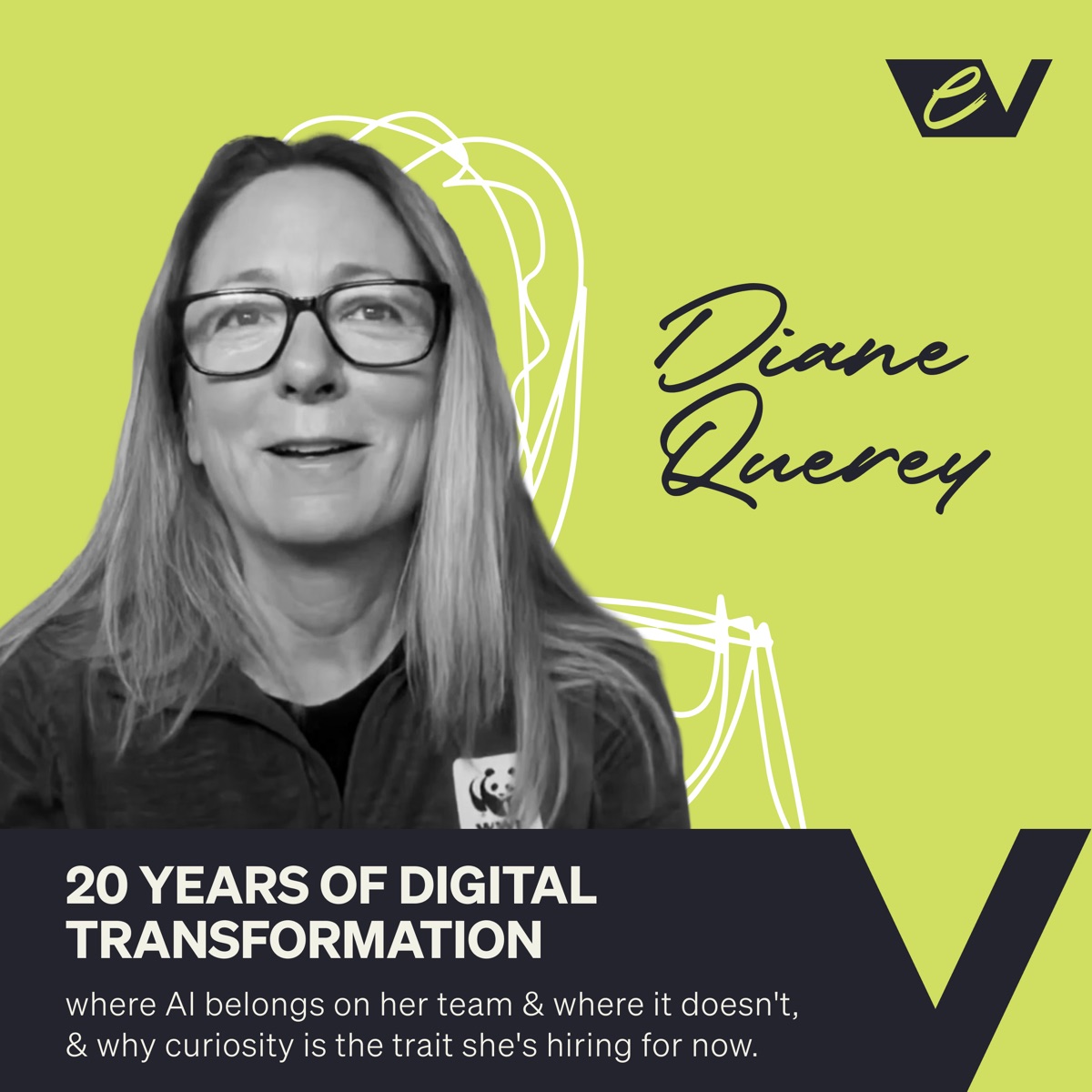
Diane Querey runs digital platforms at the World Wildlife Fund, which means the website and every social channel. She has been there about twenty years. Somewhere in the middle of talking about a website migration, she said this, and I stopped writing notes.
That is my secret passion. I do not know how secret it is, I talk about it a lot at work. But I love writing alt tags. It is my chance to be creative. I call myself the Shakespeare of alt tags.
She had written three or four hundred of them in the previous month, filling in blanks ahead of an accessibility audit. Most people would describe that as data entry. She describes it as poetry, and she means it: if you visit the WWF site with a screen reader, what you hear is her.
Where she lets AI in, and where she does not
This matters because of what came next. Her team had to hand-migrate roughly six thousand pages, after switching vendors partway through a project because neither could automate the export. That is where AI earned its place: meta descriptions, social headlines, alt tag drafts. The scaffolding.
What it does not touch is the voice.
We do not have it writing social media posts by any stretch. We do not want that at all. I have three brilliant women on my social team who come up with the coolest social media posts of all time. But I do not need them to write the alt tag for the photo that is there.
That is the whole argument in two sentences, and it is the opposite of how most organizations are approaching this. The point is not to automate the creative work so people can process more volume. It is to automate the volume so people have room to be creative.
Tell it who you are first
Her other practical note: feed the tool your content strategy, your voice guidelines, the documents you already have, before you ask it for anything. As she puts it, it does not know us yet, so we tell it who we are and what we want. Then it becomes useful for testing an idea against your own standards rather than generating something in a voice that belongs to nobody.
The three C’s
Near the end she landed on a formulation and then admitted she had invented it on the spot: curious, cautious, creative. Curiosity is the thread running through her entire career, from dialing into the internet at night on the one computer at a Delaware newspaper to a 2013 Apple Design Award for the WWF iPad app.
Caution is the part people skip. Creativity is the part they hand away. Diane is arguing you need all three at once, which is harder and considerably more interesting than picking a side.