Episode 22 · Nov 18, 2025
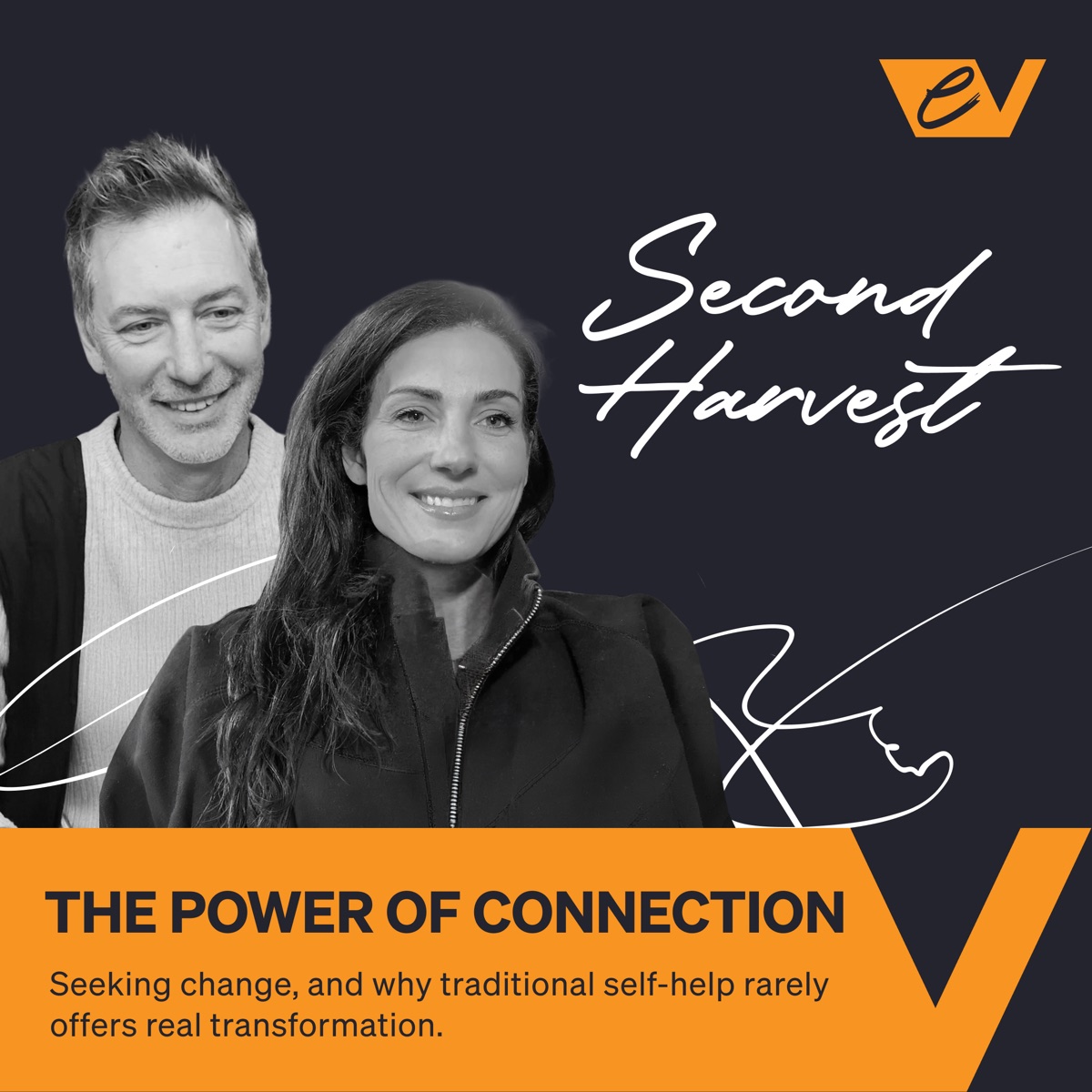
Second Harvest: The Power of Connection
Ft. Richard Banfield & Devon McDonald
Founders, Second Harvest
Watch or listen right here
About this episode
What happens when the map of your life dissolves beneath your feet? From personal loss to career upheaval to the quiet ache of disconnection so many feel today, the trio travels through the terrain that leads people to seek change, and why traditional self-help rarely offers real transformation.
A candid conversation about purpose, creativity, and what people actually need when everything changes at once.
In this conversation
- 01When the map dissolves
- 02Loss, upheaval, disconnection
- 03Why self-help rarely transforms
- 04The power of being known
From the blog
Essay When the map of your life dissolves 7 min readLinks from this conversation
Episode transcript
Read the full transcript
Transcribed from the episode recording; names and phrasing may contain small transcription errors.
Welcome everyone to another episode of Escape Velocity. I'm your host, Tracey Halvorsen. And today our episode is, i think, going to be a really great one for anyone who has kind of built a successful life and career only to realize one day that maybe there is something more.
Thank you.
um Maybe you've hit a transition point. in your life, in purpose, in work, um and wondering what's next. Over the last few years, that feeling has become increasingly universal thanks to COVID, the rise of AI, increasing isolation and loneliness. We're all feeling more separated and I think we're all craving more connection, more authenticity, and more of a sense of awe and discovery in our lives. So today I'm really happy to have Richard Banfield and Devon Warwick-McDonald on the podcast. They are the co-founders of Second Harvest and very fortunate to know them both as friends as well. um They can introduce a little bit of their own background here. I'm not going to go on too long, but thank you both for being here. I'm so excited. First of all, just adore you both and so excited about what you're doing and
Thank
hearing about the response to it. So with that, welcome and ah tell us give us a little bit of background about both of you. You know, Richard, you can start.
called thank you for inviting us to be part of your podcast we really appreciate that anytime we can spend with you is absolutely wonderful and bonus time um I think that we probably bumped into this problem in the same way that everybody else bumps into it, which is we had to experience something in our lives that was changing the way that we define success, changing the way that we define who we were, our roles and identities in that. And you know i you you and I know each other because we both grew up in the same universe of things in the client services world. where we make stuff on behalf of other people. And we've both been running agencies and businesses in that space. Devon is on the other side of the table, so to speak, where she has spent most of her adult life as a venture capitalist. and has been the kind of the one to grease the wheels of this technology change that we've seen in the last several years, last two decades, I guess, three decades, maybe kind of lost track of how many, how many tech decades we've had.
We're getting old. Yeah.
Yeah. We're getting old. Yeah. I experienced some big changes. Some of your listeners will know I lost my wife to cancer. I lost my business to COVID. it was just like, there's, you know, perfect storm of shit things that happened in a short space of time. And Devon had a similar kind of experience. you know She had lots of things gone on in her life that were career changing, personal changing, and perspective changing. And we looked around we're like, where does somebody go? yeah Where does somebody go for support, for help, for connection, for guidance?
Thank
When you're you look like us, when you're not a kid anymore, when you're not 20, you're not like rushing off to college to find your purpose.
Yeah.
You know, like, where do you go? And we didn't have a good answer initially. And we started looking at our own experiences. And we said, you know, who came to our rescue were our friends, people that we care about, the people that we love. And how do we make that happen for other people? So that's really the background to why this thing exists in the first place. And we are experimenting with that. And we're trying to find out the answers to that question is like, where do you go? Where's the safe physical and psychological space to go through transitions, to go to change, to go through, you know, understanding, awakening, if you will.
Devon, do you have anything to add to that?
Yeah. so coming from venture capital and part of my role um within venture capital is is managing, building ah network and you know connecting with fantastic executives to get them introduced to our portfolio companies. And so i found myself having conversation after conversation after conversation where the same topics were coming up or the same sort of reoccurring theme happening. was happening in every single conversation. And that was, I'm at this inflection point. I'm trying to figure out what comes next. You know, i've I've had this successful run and now I'm trying to figure out what do I want to do? Do I want to stay in this particular role as an operator? Do I want to try something different? Would I want to be maybe an investor? would I want to start my own business? Do I want to just be a consultant? You know, I have all these changes happening in my life. I've got the kids that are leaving the nest and going off to college. That gives me and my wife or my husband more time to be traveling and just where do we go from here? And so there's no playbook for this, right?
yeah
um It requires, I feel like deep, um you know, introspection and and figuring out what's right for you, because what's right for me is not right what's right for Richard, which is not right for, you know, everyone else. So it's a matter, I think, of like really kind of doing some soul searching, but in a so in a safe space where you can um just have that have that pause and that reflection. And that's what we're striving to provide.
Um, it's, uh, it's interesting because I mean, I think it is a universal experience for so many people that, um, that's brought on by any number of circumstances, right? Kids leaving the nest, uh, losing a loved one, um, going through a, a big life change professionally or personally, especially when you're you know sort of in the middle of your life and suddenly what you thought was certain is not certain. And you're faced with the reality that there is the only thing that's certain is uncertainty, right?
yeah
um
yeah
And you realize, like, is this it? where's Where do I find meaning? um
yeah
Because we all want to feel like there's meaning in what we do and and what we live through. um So I guess, you know, tell me about, you've had two retreats so far, two different cohorts. um Tell me about those first experiences. ah What did you, how did you prepare?
yeah um How didn't we prepare? um Yeah, so we we, you know, preface this with the idea that a lot of the folks that are approaching us and asking us to attend or to participate in the retreats, their idea of second half or second chapter or second harvest in terms of their life, isn't what the current narrative is. The current narrative looks a little bit like the Golden Girls. Our parents' generation is that kind of, oh, yeah, we've done now. We've done our bits. We've raised the kids. We've we've got the pension. Now we're going to move to Florida. We're going to drink Mai Tais and play pickleball or whatever your thing is.
right
And that's not our generation's thing. mean, there are probably people who want to do that, but I haven't met them. And certainly the more people that we encounter, they're not asking, where do I find the right community in Florida? They're asking, where is the purpose in the next half of my life? Because I think that I'm probably going to live another 30, 40, 50 years.
Thank you.
I better have something figured out before I enter into that period. And so when they show up and ask us about these retreats, we're also in the same mindset of, well, we don't
Thank you.
We don't want to just do the playbook thing of like what what our parents did. We don't want to have that and idea of, well, here's where you would retire. Here's where you get the second home. Or here's how you give back to your community. We're asking a lot of different questions. So what but led to the creation and organization and structure of the retreats is almost... An antithesis of what's being done right now. So everything that's being done now, we just said, well, what's the opposite of that? So you're not going to retire. Most people we meet, they're not retiring in the traditional sense. They're not stopping work. So what does that look like? What does the change in pace look like? But also, if it's not retirement, what is it then? If it's not moving to Florida, what is it then? If it's trying to create more community and family bonds or friendship bonds, what does that look like? Because, you know, that's a big concern is that we now have a loneliness epidemic in the United States and probably in many other Western countries.
you
Yeah.
So to answer your question, we didn't know specifically what the answers were, but we knew what the questions were.
Yeah.
And we stepped into this ambiguous, somewhat liminal space where we were willing to live the question, not provide the answer. So instead of saying, we have all the answers, we're the gurus, we have a playbook, we know what you need to do, come on this retreat, you'll get your certification at the end, and then all your problems will be solved. We said bullshit to that. We called you know cold ourselves as well out on that and said, we don't know what those answers are. We don't have clarity about what the next half looks like, but we know what the good questions look like, and we're willing to sit with those questions, have good conversations, meaningful conversations about that, and let the answers for each individual emerge specifically for their context. And that was the big breakthrough, is that where a lot of retreats and the wellness community is focused on a guru personality, ah playbook, a framework, a certification, we said, how about not doing that? And how about we look at question and step into ambiguity? Because guess what? When you do that, you're also training yourself for what life actually is, which is a series of I don't know what the hell is going on moments and ah series of uncontrollable things that happen to you where you are expected to adapt and change and respond depending on what those things might be. So we thought it would just be good training to have these four-day retreats, give people a taste of what that means, to live in that ambiguity, live their questions, converse with others about that, find out that they're not unique, that they're not the only one experiencing these problems, and then look around and go, you know what I actually need?
Thank you.
I don't need an answer. but I need is a way to live my question. I need a path towards living my question. And this is really important. ah need people to walk that path with because we're not yeah on the planet alone. We're not doing this by ourselves. And the community, the connection, yeah alliances that form are probably the greatest value that you can get out of these things is that you walk away with BFFs. You walk away with connections. You walk away with human connections. that you can say, I've got somebody who's got my back.
Yeah.
I'm going to push down this path that I don't know much about, but I know I've got friends who are going to walk with me on this path and help me get there, regardless of what happens.
Mm-hmm.
Well, I love, um, just the whole premise because, you know, as, as, uh, as artists, as fellow artists, uh, we know that you have to dive into the uncertainty. to get anywhere. You can't wait for there to be a plan and a agenda. And I think that as we have gotten more isolated and, you know, there's no, there's no support group for life. um yeah It's like, oh where do you go to kind of have, yeah, have the space, but also have the trust that you can go on your own journey, but in the safety
Right.
Thank you.
and camaraderie of other people who are willing to embrace that too, versus, you know, feeling like you're, you're going to be a product of someone else's agenda. Um, and so I think, you know, it's, it's a scary proposition for a lot of people, but I think it's exactly what
right
people need.
There we go.
And from the, um, from the feedback that I've been reading just on some of your posts, uh, from the people who've participated, it's amazing to me how much everyone seems to have said, like, I didn't know I could form close relationships with people anymore at this point in my life that where we don't, it's not like we work together.
Thank you.
It's not like we're family. It's not, we're not neighbors. We're not college friends. Um, Devon, I'm curious how that has has struck you, that or if you found that to be true from the from the folks that have already been on some of the second harvests.
Yeah, absolutely. i think it's, um i was I was just having this conversation with a friend yesterday and they they were asking, you know, how do you get this group people together and how do you make sure that they all click? And it's so interesting because I feel like these people, we there's definitely, you know, Richard and I both have conversations with anyone who expresses an interest and we make sure that they are kind of coming at this from the right place. But it's funny, the the right people sort of self-select. And the people that are, like, not right for this are, like, go away with strangers for four days. Like, yeah, no, that's not my jam. I'll i'll stick with ah the retreat that's coming up down the road at the Marriott, you know, that's more, you know, nothing against Tony Robbins. But, like, you know what I'm saying? More of, like, the self-help.
Yeah.
The answers are outside of me versus within me.
yeah
And so... We get the right people together. That's a huge component of what makes this successful. And the cool part is there's these people essentially do come in as strangers, but they do trust us enough to know that we're getting the right group together. And there's sort of preconceived notions of who these people are and what their backgrounds are and what they've gone through in their life. It's a blank slate. But everyone is there with the right, coming in with the right mindset, with an openness, with a certain amount of bravery, because again, they're putting themselves in this sort of unique situation, going to a different country with bunch of people that they don't know.
yeah
And then because of that, it really just allows for some beautiful conversations to happen. Whereas, yes, we all, you know, we're social beings, right? If you're putting it yourself in that situation, you're probably pretty social. So you probably have lots of friends and you've got family, but they all know the past versions of you, right? Like they have a certain conception as to who you are and what you represent. But what if you were sort of at that crossroads where you're you're evolving, right? And you're trying to figure out like what the 2.0 version is of you. And you want to give yourself space to explore that.
Yeah.
It's perfect opportunity to do it with a bunch of people who you don't really know that well. Because they're not bringing any of those judgments to the table. And so that, ah like being in that environment when you where you feel sort of fully accepted by the, you know, 16, 17 people around you are just open and listening and maybe sharing ideas. But again, with no background on you, it's amazing. Like we don't even share LinkedIn profiles before. so you're coming in kind of blind.
I think, you know, going back to my own experiences of of going through a big, you know, life change, um you know, divorce, had to exit my business. Really, my all my rugs of identity got kind of pulled out from under me um when I wasn't expecting it. And you know every time I kept thinking I was on solid ground, again, something else would get yanked out. And as those things were really getting ripped away, I had to embrace the fact that I was going to change. And that was that was exciting um as much as it was terrifying. But we do cling on to our identities and our past and how we think of ourselves and what we think we're projecting to others. And a lot of it, to your point, Devon, is built from that shared history we have.
Yeah.
But when you go through a transformation um or you're ready to to shed some of that, It's very hard to do it when you're staying, you know, everything else is staying the same. And so I love the idea of the travel, the strangers, the kind of blank canvas that you're creating, surrounded by this this embracing of this idea that the answers are inside of us.
and her yeah
um That creativity, you know, Richard, we talk a lot about creativity being kind of at the core um of a lot of this. And I do believe all people, humans are creative by their very nature.
Thank you.
I think it's how we understand the world and ourselves and our own consciousness and, and experiences of it. How did your feelings about creativity impact the creation of this, you know, the birth of this idea? And and how do you bring that into the experience for people that, may not necessarily know that they're creative.
There were two parts to it. One was I needed to be creative to be healed. So when Christy was going through her roller coaster of cancer treatments and whatnot, turning to art, turning to creativity was my therapy. And I realized being creative isn't just some kind of cute act where you're putting ink on a canvas, you are playing this weird version of what it means to feel like a god. Like you are literally creating something out of nothing. And when you're faced with death, when you're capable of creating something out of nothing, it feels incredibly helpful to be reconnected to that source, to that power of like, I didn't have anything. And then suddenly it was there. my God, I manifest that I created, i produced something out of nothing. I think when you look at the relationship between death and life, that is it, right? That is the, I can create something out of nothing. And the second part of it was, The retreats themselves felt like a canvas. So in the creative process of making these things happen, both Devon and I leaned into the creativity that we had us and painted this experience. And as user experience designers, like this was a dream come true. You were like, oh my God, I have a blank canvas.
Thank you.
you
I've got a bunch of souls that I can introduce into this blank space, this ambiguous space. We don't even know what's going to happen here. Like, it was quite nerve-wracking at times because they're there isn't a really hard and fast agenda to these things. A lot of people come to this and go, I'm not sure what's going to happen here. what is What is it that we do? There's a lot of words like mystery adventure on the agenda and no clarification of what that means.
Mm-hmm.
know It does feel like you have to be vulnerable. It does feel like you have to be open to Devon's point. That is where creativity happens. Creativity happens when there is a void, when there is a space for that to happen. And you are not person against something. You're not against whatever it is, like you know the bad boss, the shitty political system situation. are in... you are in relationship with yourself and with your creativity when you have those moments. And that feels very different. That's not like, oh, I'm responding or reacting to the world. You are producing from your source, from your core, and in a spiritual, even you know mythical level, you are changing the way that you feel about the separateness that is amongst us all. right The original wound of the universe is that it separated itself from itself. All the atoms exploded and separated themselves. And that's the original wound. And all these atoms want to do is get back together again. You can feel it. Like if you just sit for a moment and you meditate, you can feel all of that separateness trying to heal itself again.
Yeah.
And that's what we like we're doing in our tiny, tiny, tiny, thin little sliver of a way. We're trying to put a little bit of salve on that wound, a little bit of like, hey, here's some creative salve that goes on the separation so that you feel slightly less separated from yourself, slightly less separated from others. And what emerges from that is the canvas of, oh, I'm not alone. I'm not unique. I'm not experiencing this in isolation. There are others like me. I am communicating with them. I am connecting with them. They are me. They are part of me. They are part of the original experience of coming from the same source, having the same atoms. And that's what's the creative process. It does feel in a way like having a magic wand where you're like I'm going to create something out of nothing. This is my canvas. Here's what we're all going to do together. And we're going to trust that that process will look like something at the end.
Yeah. Sounds like life. Yeah.
Yeah, absolutely. And honestly, it was, um but in the planning process for this too, I mean, at the end of the day, we do sort of like i have a high level, like, what do we want to be doing during the day, right? Like, how do we imagine this? Or what are, you know, Richard mentioned some of these mysteries that we we introduce, um which I think they started calling it the the Easter eggs. Like what's our Easter egg hunt today sort of thing.
Thank you.
um And i we just have fun with it, right? It's almost like to the point and that the canvas metaphor is perfect because in the planning process for this, when we're we're doing our research and getting to know this, you know, city or location where we're going to host the retreat. It's like, well, what, what wild and fun and exciting, crazy thing could we do? Like, let's just dream it up. Why not? There's no limit. Let's, what could we possibly do? And so that is just so fun because talk about a magic wand. Like we were having a conversation one day with a, an amazing woman named Ari who had helped us plan the Jorona event because she grew up in that area and knows a lot of the people and she knows the language. Uh, um And she, we were brainstorming and I'm like, she said something um in passing about, oh well, like a hot air balloon, maybe we could do. i was like yes, hot air balloon. I want to do that. Let's make that happen. She's like, okay, I look up the price. was like, yeah, I don't care the price. We're doing it. Let's go. Let's have some fun with this. And so we try to incorporate those things that have that those moments of awe for people. And the people that we get coming to these retreats, like they're used to being in charge.
Yeah.
right like
yeah
Make no mistake about it. These are the bosses. They're the bosses of companies. they are the bo They have large teams. They're the ones that are providing direction. They're the ones that are providing structure. Right? Um, you know, they have children in this, in the home, they're doing the same things. And this is this very cool, rare opportunity to come into environment where you don't have to be in control. Like we're going to, we're going to, you're safe. We're going to take care of you, right? Like you don't have to worry about a thing. We got everything set up. We got the food, we got the sleep, we got the, everything is happening for you. All you got to do is show up and be yourself and be present.
What a rare, yeah.
And allow, yeah, and just allow what needs to unfold to unfold.
yeah
And that means that could be in the form of like sitting in that silence and, you know, going to this place where maybe you, on your sort of everyday life, are distracting yourself from uncovering or are sort of getting in touch with. Or it could be forming that connection, that bond with someone who may be at face face value or in first conversation. You're like, oh, I don't know if I have a lot in common with them. And then few conversations in, you realize, holy shit, you know, we are we're so bonded. We have so much in common. In fact, are we third cousins? Like, I'm telling you, the weirdest things happen where it's like, oh my goodness, like, you know, so-and-so, wow. Like, did we grow up in the same neighborhood? Like, we have so much more in common with one another than we, you know, than we realize.
Yeah.
And it's only if you're present and you're conversing that you realize that Yeah, there's so so much commonality between us all, and there's something so comforting about that.
What do you, how have you seen the after effects impact the folks that have have been on a few of these so far? What are you hearing
like This is funny because somebody was asking me this this morning. One of the guys that attended our second retreat, he and I live reasonably close to each other and we go for a walk through the forest from time to time. And he said to me, not to get too like businessy about this thing, but like, what's the metric? How do you know this is working?
And
And I said, well, we do have at least two people with matching tattoos. You know, hip I went to a retreat together and now they're kind of, you know, BFFs. So I don't know if that is the actual metric, but something along the lines of, did this feel remarkable enough to you that you want to share it with others?
thank
And I don't necessarily mean it on social media and broadcast it like I went on a retreat. I mean, Do you want your partner, your spouse, your children, your friends to join you on this journey of you know reclaiming yourself and finding your purpose again? And we have. We hear this time and time again. I went home. I spoke to my husband. I spoke to my wife. I spoke to my partner. I spoke to my business partner. I spoke to my children. I told them what I did. I told them that I tried this for the first time or expressed this and you know had this moment of reckoning or or breakthrough. And taking others on that journey with you seems like the way for us to know whether it's working, not because it's good for business, but because it's a ripple effect that goes into the community and Like you said, if Devon and I can contribute in some tiny little way to the world being a slightly better place where people are connected, where they feel less separated, where they feel less disconnected or isolated, then we're doing something.
Thank you.
And if that happens in proximity to the real people that matter, to your families, to your friends, to the people you work with, then that feels like we're doing something interesting. And then they constantly, I'll let Devon tell you a little bit about what's happening, like functionally what's happening afterwards. But if we can see that ripple going out across the water to these different, you know, connection points, family groups or business groups, then I think we're onto something and we are seeing that. So that's, what's encouraging us. But Devon can tell you a little bit about what she's involved in. Cause she's got groups getting together for for doing, you I wouldn't say like follow on work, but like necessary reconnections.
and her
If you, if you,
Yeah, I think um we're finding just different opportunity. I think one thing we talk about for at the the retreat as part of the the last day, because the the way that it's sort of structured at a high level is, you know, the past. We start off talking about our past and our identities, and then we focus a bit more on, okay, well, what does the present look like? And what do we, you know, what do we want for ourselves? And then we wrap up with, well, what, going to put this into motion? Yeah. And with one thing we talk about, and that can be sort of ah overwhelming, right?
Yeah.
Like, okay, I've just uncovered, you know, these amazing insights. And now you feel this intense pressure of like, well, how do I actually do something with this? And where do I begin? And what we talk a lot about is experiment, right? You don't need to have all of the answers coming out. It is, and to Richard's point, it is probably going to be a series of questions that bring upon more questions. And to get there, you got to take action. um Richard talks a lot about, you know, um and action inspires or mood inspires action.
Mood follows and action.
Yeah, mood follows action.
Mood follows action.
And so, well, what are you going to do to take those? They don't have to be giant leaps, little steps forward, right?
yeah
And um so that's what I've seen a lot of people doing. They're experimenting and we're experimenting with one another, whether it's a business idea or whether it's some sort of concept that they want to test with one another on what's coming next for them in their career, et cetera. And it's just allowed, actually, for interesting opportunities to to come together where, you know, we had one member who had joined last time. She's been in corporate for decades at this point. And she has a real calling to yoga and connecting with people. And she's been a badass in, you know, a Fortune, i don't know, it's probably 100, organization organization. and managing a large team, but she's like, I, you know, I, and something is calling me outside of this. I really want to get into yoga. Well, okay, let's run a series of experimentations then. Like, what can you do to start testing the waters? You don't have to quit your job tomorrow. No, you make a lot of money. You know, you actually really love what you do, but how can you start to your, you're, you have this calling. Let's run some things on the side. So she's starting to organize events where pulling together people from second harvest in person and online doing a yoga series. And she's she's testing it out for herself. Is this something she wants to pursue deeper? or is this something that cannot can be alongside her corporate job? And you know there's there's a two-way benefit of it, right? Because we get to participate in it and stay connected to one another. But she's also feeling it out for herself.
There's an element of accountability that seems to be a natural outgrowth of these experiences where
Yes.
Now that you've connected and you've kind of unpacked your suitcase and then decided what's going to leave with you and there's room for all the new, to have that accountability to kind of report back or or continue to kind of send in your results of your experiments and your tests seems important, right?
Mm-hmm. Mm-hmm. Mm-hmm. huh
Because...
Mm-hmm.
we We don't know, and we won't know if we don't start doing those experiments and testing things out.
and
and And that will yeah often, yes, lead to more questions. But if there's not a group to be accountable to, I think it's that's where people sort of can lose the thread and lose touch with that. um
Mm-hmm.
You know, ever since...
There's the accountability is is absolutely a big part of this and people are craving it, right?
Yeah.
the Again, these are the high achievers. They're like, yeah, I want to show up. I want to do this. And they know, okay, if there's like some sort of milestone, okay, got to take that action, right? that's This is the the language that we're sort of used to um and what's made everyone so successful in their lives.
Yeah.
There's also just getting together and having a reminder of the magic that happened, right?
Yeah.
So you go there and you have this profound experience and you come back and it's a little like, oh, okay, how do I, I want more of that. Like i that deep connection, that feeling like I can truly be myself. Like I've had a lot of people say, it's like almost like I felt like I did when I was a child, like a kid to just be myself. And they're, you know, so they, they have a hankering for that. So you, if you create those opportunities to get them back into that space where they say, oh yeah, yeah. That's even if it's a zoom call, it's still a reminder of that feeling. And that can do wonders with just, oof, okay, taking that step like that, another baby step after that call. This was a good reminder of what this could be.
Thank you.
Yeah. I'm so, you know, I, I have a lot of conversations with people and, and I often think, you know, every generation thinks they're living through, you know, once in a human existence, you know, kind of event or the end times are always, you know, everyone thinks they're living through it. But I do think that are you know Only within the last 50 years have we lived in a world where we are bombarded with so much information, with so much
Yeah.
hmm.
so many prescriptions for how to live a good life, um how to find meaning, how to be your best self, and also all the in-streams of news and horrors and you know the algorithms that know you're going to be most likely to pay attention if they can get your lizard brain really activated.
who
yeah
And i don't think we're designed to live with that much input that's all geared towards fight, flight, freeze, or fold, right?
Oh yeah.
And yet we're building systems and that's what they're designed to do um because that dictates their success. Our attention goes to those things.
you
And I'm really curious about, i mean, how do you find the sort of the unplugging and the detaching from that? How does that impact folks when they're on the retreat?
I thought we were going to have to, you know, everyone was like, oh, is this going to be one of those environments? It's like almost like you see in White Lotus where they're like, okay, I'm going to collect your electronics now and we'll return them upon your exit of second harvest retreat.
Thank you.
It wasn't like that. And I, you know, it I was kind of wondering how it would play out. Would people truly be able to detach? And um it happened ah sort of organically. I mean, I didn't see anyone that whipped open their laptop at any point to check email. I mean, did people have But did people have their phones? Sure. But they were more taking pictures, I would say, than they were sort of texting or checking Instagram. In fact, I wish I had almost kept a record of my screen time while I was out there. I'm sure I could dig it up on my phone. I bet it i bet it was probably, you know, a tenth of what it is on a normal day for myself.
yeah
Yeah.
But I think Tracey, to that point, one of the things that we we also experience now, for those of you who've had a psychedelic experience, there is that kind of door opening moment where you can see things you wouldn't have seen, right?
I think there's... yeah
You are um made conscious of things that you were not conscious of before. When we go on these retreats, there are no psychedelics, but you do have a little bit of that experience where you see yourself, you see the connections, you see the awakenings, and you can't unsee them.
Thank you.
And that's the hardest part for people is because they're coming back into their typical environments, their normal environments, their normal relationships.
Yeah.
But they've seen a part of themselves. They've seen a connection to Devon's point. They've been seen. They have literally, somebody saw them in a way that they have not been seen for a long time. And then they're coming back and that is jarring. It's very jarring for them to come back into the world and go, wait, I had such a good experience. Where is it? How can I get it back?
yeah
And we're still learning how to figure that out, like how to bring that back. But because it is, like I said, parallel to the psychedelic experience where you can't unsee it, that door is never going to close for you.
Thank you.
Now you've seen, felt, you've experienced what it's like to have one of those moments where you can really tell who you are and what your purpose is. And you can hold on to that. And then we form these alliances. Alliances is a very intentional word. This is not like community because the community is kind of sitting around watching what's going on. Alliances, Tracey, what is it that you want and how can I help you get there?
Mm-hmm.
How can I be ally? It's in the word, right? How can I be there to find your path with you and support you and be there if you stumble? That combined with an ongoing, you know, I wouldn't say it's formalized action, but
Thank you.
We are, Devon and I, spend time reaching out to people, connecting with them again, asking them how, know, what is it that they're experiencing? And they might say, well, you know, it's been hard coming back. Reentry has been hard. But now that I know what I want and I know who is supporting me, I can get there. And so, yes, the the thing, the weird thing here is the retreat makes life a little bit harder in some ways because now you've seen what you really want.
and
That's good because now you're motivated to do something about it. you're like, shit, I knew there was something more. I knew that I was hiding my light under a bushel and now I'm ready to go and do something about it. And I've got the alliances and I've got the connections to be able to do that. And in that accountability sense, they seek the accountability. had It's a good word. They are looking forward to having people pull with them and and drive forward, whatever that looks like. And sometimes driving forward is not the word. It's like, Yeah, I realize that I need less of that. I need less striving. I'll be pushing less. And actually what I need is more sitting on the couch daydreaming. Great. Let's help you do that.
yeah Yeah, I mean, yeah that's a good point, Richard. It's um brook you sort of come back and because you've had this experience and you've seen these things, you realize, ok I need to make some changes. And those could be big changes. They could just be small changes, small sort of um behavior changes or forming some new patterns in your life. But at the end of the day, change is uncomfortable. Growth is uncomfortable. I feel like a lot of times the ego sort of tries to resist that growth because it just wants to stay in that loop that's safe, that's predictable. So you have that ego having you on that loop, but you know deep down, like, yeah, I got to get off that loop. But that that friction or that tension between identifying, like I'm in that loop and that's not right for me anymore, and actually making the leap into something else, o that can be hard. But to Richard's point, yes, we now have this group that we can lean on during that time and who's likely going through some of that that same experience themselves.
Yeah. I think letting go right, is one of the hardest things to do um for the ego. And by by, I guess, just taking the step of going on a retreat like Second Harvest, you're that's the one of the biggest, that you're letting go of control.
Mm-hmm.
You're saying yes to
yeah
the unknown.
and
um and I think that ah to do that and then come away with so many gifts, I would imagine it would be overwhelming to some extent, but extremely helpful to to sort of say, well, how can I integrate these small things into my life so that it becomes more integrated and I don't need the big shock of of doing something like that.
I'm going to
um It reminds me, you know, everyone out, everyone knows, right? Like take more walks in nature, do,
Mm-hmm.
do things that, you know, feel, inspire a sense of discovery, do more creative projects. We're all told how fulfilling doing these things are, but yet I see nothing but people going, yeah, yeah, I know I should get up and do this first, or I know I should do that first.
and
And we just, so many people don't do it. And sometimes you do need a big immersion,
Mm-hmm.
Yeah, I mean, i I agree with you.
to kickstart that, you know.
I think there's a lot of there's a lot of good intentions and what we sometimes need is a good kick in the butt, right? Like, I know it's not fashionable anymore to be, um you know, tough love kind of fell out of fashion for a while, but I think we do need that.
Yeah.
I think we do need ah moment where we are facing reality, when we're not just protecting ourselves, where we're not seeking out comfort, where we're not just making things optimal. Where we are making things a little harder, where we do put the phone down, where we do go for the long walk, where we do, you know, listen to that voice in our head, which contradicts our ego. Like a lot of that stuff isn't easy, and but it's necessary. It's a necessary part of change.
Thank you.
It's a necessary part of growth. We don't want to create another... ah self-help regime that suggests that we are just optimizing ourselves to more productivity. um
Yeah.
And I know you've talked about this a lot. I know that Nancy's talked about a lot on your podcast. Nobody has ever achieved work-life balance. That is a 100% bullshit idea. bullshit idea There is no such thing as work-life balance. Work is life. Life is work. We are integrated. We are like in harmony with these things, hopefully at some times in disharmony with some of those things at other times. And it's not our job to... find comfort and optimization in our lives. It is our job to carry the heavy wood, chop the wood or carry the water. can't, you know, you're messing up my metaphors here, but it's like, you've got to do the work. And part of the retreat means pushing you out of your comfort zone. don't know why they call it the comfort zone. Cause it's like the worst zone to be in. So that doesn't feel comfortable at all.
Mm-hmm.
Like to go out of the thing that you've become accustomed to and find something better. that is more authentic and more aligned with who you are, that's gonna take work.
you
That is gonna be hard. Like, you're not gonna show up at the retreat and be helicopter parented into some change and transformation. That's not gonna happen. You're gonna be discomfort. There is gonna be crying. There is gonna be heartache. There is gonna be frustration. Excellent. Lean into that.
um
Like, let's get okay with that. Let's get okay with the fact that that's pretty normal. Like, it's okay to not feel okay. And then at the end of that, go, whew, okay, now that we've got all that out of the way, what is it that we need to do in order to sustain that? And for each person, it's going to look different. For each person, in their context is different. Their age is different. Their situation is different. All of those things are going to add to the complexity of that. That's okay. We are not trying to Build something here that says everybody comes in this factory entry, you know, in the in the door here, the assembly line, and they go through these motions and they come out fixed at the end. No, we're saying change is hard, but we can do it together. Change is hard, but we recognize and see your changes being something that we're also going through. Change is hard, but there are moments when you can also find some satisfaction at the end of that change that feel good. And that's really worthwhile. That's worth doing. And that's what Devon and I get up in the morning to. She had a meditation session this morning with ah with a bunch of second harvesters. think we should just call them harvesters, right? I don't know why we had the second.
And in fact,
And and And I had this meditation this morning, and it was very organic and spontaneous. Like, these kinds of things are happening because they are like we have reaffirmations of what we're doing is the right thing. And in 10 years time, there might be 100 people on that call. I don't know. Who knows what happens? But the most important thing that we can do is e start with an exposure moment where you like reveal what is your true self, your authentic self, the thing that you really want to do, and then provide the alliances to say, we're here for you. It's not going to be easy, but we're going to be here for you. I've had phone calls at two in the morning from one of our harvesters who was overseas. He was in Romania or something, and he was calling me. was like, I just needed somebody to talk to. Great. If that's all we're going to do, then that's the work. And that's fantastic. We can go to bed feeling good about ourselves. But don't want to do the scaling thing where like, oh, this is going to be easy for you. you just have to go to one more seminar. You just have to fill one more requirement.
um
You know, like none of that makes any sense. It doesn't work.
Yeah.
not It doesn't lead to real change.
I'm curious, how many people have you talked to who have expressed sort of surprise that they've reached this point in their life and maybe a new traumatic event has occurred?
Thank you.
yeah there's There's something about Second Harvest, right? and And that I think if you live long enough, you know Richard, you talked about the original trauma of of all the universe exploding all of our atoms into separate ah configurations. But also, I think when we're when we're children, we don't know that life will be so hard, that we will face additional traumas. And, you know, unfortunately, that becomes very clear to people who are born into, you know, trauma by no choice of their own, but also just we will lose loved ones. We will suffer setbacks. We will face illness. We will face disappointments. um Did you, you know, there's a lot of high achievers that have had a lot of success. Have any of them sort of said, oh my God, I just wasn't expecting to to get to this point and find myself here.
I mean, everybody, think between Devon and I, we probably have about five or six calls a day now. I don't think I'm exaggerating. and have Like we, between us.
Yeah.
Yeah. i I'm pretty sure that almost all of those phone calls start with a little bit of denial. Like something's happened. Some changes happened, a career change, a personal change, whatever it is. ah Maybe it's just an internal change. Maybe you just get older and you're like, Oh my God, wait, something else is going on here. And. In that moment, there's a little bit of denial. It's like, oh, it's probably just temporary or it's okay. Or, you know, I'll manage through this or I've got control of this. And then we just keep asking questions. Just like, well, tell us more a little bit about, you know, what's going on and how are you, you seeing yourself through this. And by the end of the phone call, they're like, yeah, my life is a complete fucking disaster. And I have no idea what I'm going to do about it. And there's something really wonderful about that, that just the acknowledgement that you have no control over the events in your life and that your job is not to control events and your job is not to get optimal around that, but rather b understanding that they will happen and then adapt to it.
Mm-hmm.
Have the mindset where, yes, bad things are going to happen, even to good people. And when they do, you will be okay You will find a way forward. Why? Because billions and billions of other people have done it before you. You are not alone. Lots of other people are going through this. That's the biggest awakening is that we knew it was happening to us. and We knew some close friends were experiencing change. But the fact that there are so many people going through this, really just reveals that idea that we're all experiencing some shit at some point. Now, it's not going to happen to us all the time, fortunately, but it's going to happen. it was There is no way around it. Things are much worse than you think they are. ah like
but
Things are going to happen.
So uplifting.
You're going to die. You are definitely going to die. Like 100% sure if you're a human being, you're going to die.
Yeah.
And it might be you get sucked into a sinkhole as you're walking home across the street. It might be you get abducted by aliens. I don't know what's going to happen. You don't know either. And that's kind of the wonderful thing about it is that once you realize that, it's massively liberating. You go, oh, I am going to die. There's very little I can do about it. Why don't I just get on with the living? Why don't I get on with the loving? Why don't I get on with the hope in and the empathy and the compassion? Because that is something I can control. And when you are awake to that, the funny thing happens, somehow you get luckier. And I don't think it's luck. I think you just start observing the universe in all its beauty. And you start to see all these gifts that are being presented at your doorstep.
Thank you.
So quick to step over because you're on your way to work. You're on your way to climbing the ladder.
Yeah.
So you don't see all these wonderful things that are happening. And that's really the beauty of this is that these folks call us. I had a call with a guy about a week ago. was very guarded. yeah yeah, things are okay. You know, there's change in my life, but it's it's acceptable change or can't remember what word he used, but something along those lines. And then I get an email from him this morning. Hey, Richard, remember that call we had last week? I need to get together with you. There's some big stuff going on in my life and I'd love to get a coffee with you. So not always happens in the moment. doesn't have to be one conversation. We've had harvesters who've gone to the retreat and then two weeks after the retreat, they've called us and said, You've fucked up our lives. Like our lives are not longer the same as they used to be.
ah
Now, took a little while for it all to sink in or for the admission to kind show up for them. But it happens. And it happens to all of us. And there are going to be 70 to 80 million Americans retiring in the next 10 years. It's a lot. A lot of people going through change.
Yeah. It's a change is the only, the only certainty, right?
Constantly.
Yeah, absolutely.
what's ah what's something that's What's the most unexpected thing that has happened as a result of ah you all deciding to to do this?
Wow. Sedona.
Um, well, Richard mentioned earlier, we did have two harvesters from Austria who ended up, they're writing a book together. Now they didn't know each other before. Again, they're not two people that you would have been like, Oh, those two folks are going to be best friends. Like they're quite different, but they saw the commonality in one another. They had a similar sort of shared goal and they decided, why don't we work on a book together?
wow
And then they went on some, um, they went on a ah writing retreat together in um, out out in the, The Midwest, yeah, Sedona.
donor
And um they got matching tattoos while they were out there. So that was, that was, but we saw that come through on the thread. We had a good chuckle over that, but also amazing. Just like, just so like that shows, I think that deep, deep connection. um I think one thing that's also surprise and I'll let Richard jump in is I, when we were kicking this off, we said, okay, is this going to be something where people go once and they have this great experience and they say, well, that was awesome. Chapter closed and now I'm going to move forward and I'm going to do my my, you know, or are they going to want to maybe come again? and um And if they do want to come again, what is the frequency ah at that? Is it like every couple years or what? We've now had people who came to Austria who were like, absolutely, I'm going to Spain too. So that was a big shocker that like so people would be willing to, I think we had five people, five repeats um from Austria to um Spain.
Three months later.
Yeah.
And those same people said, what do we got in store for next year? like and And the people who had come you know to Austria and then Spain said, it was a yes, like conceptually high level, we had there were consistent themes. It was a different group of people. And I was coming at it from a different point in my journey. And so it was a completely different experience. Because even the topics that we discussed, I was looking at from a slightly different angle. So that has been very surprising um to see that there is that sort of um desire to want to you know keep coming back.
yeah Yeah, you're stepping into the the river, right? And the river is always changing. So yes, it's the same river, but no, it's not the same river, right?
Amen.
For me, the blue chain sorry the biggest thing that I noticed was my relationship with Devon was so...
There's also...
enhanced and just magnificently improved because of these experiences. We were seeing each other and we were seeing ourselves in the reflection of what was happening around us in other people's experiences. And because we were willing to be open and vulnerable, we were having moments we're like, oh my God, babe, this is the thing that I do, or this is the person I am, or these are the things that I say. And in being with other people, we are experiencing change as well. We're experiencing an improvement in who we are as people, but also in our relationship. And that's, oh my God, that's like, I feel like I'm addicted to heroin. Like I want that more often. You know, how do we see each other expanding and growing in this relationship, in ourselves, with others, It's too good to be true. It's just amazing. Like, it's just feels ah it just feels like we are growing because others are growing. And I don't know why I didn't expect it. don't know why didn't it occur to me that that would happen, but that's a rising tide for all of us.
Yeah. I was ah just thinking that, um, you know, one of the things I did back when I was going through uh, big tumultuous, you know, changes and in all aspects of my life is I signed up to go to the mountains of Italy on a painting trip with people I didn't know. um and having not painted, uh, plain air, uh, and landscapes in decades.
Mm-hmm.
And, um, if if I think about going back to, to do something like that again, there's a part of me that's, that would be excited to kind of ah like share it, share what my initial experience was with people who may be doing that for the first time or continue to connect with people who maybe have done just the, the sense of giving back that you must get.
but
And as you said, Richard, how it's how it's impacted your life, your relationship with Devon. Devon, I'm sure it's impacted your life in a similar way, but not many people can can say that they get to do that.
Thank you.
ah so what and And for the people that go as well, it sounds like that's something that not just what they get, but what they're able to give to the people that they're with in that space.
one and You see, that one of the things that we do is because we don't claim to have the answers, we are not gurus, we are not seers, we do not stand on stage telling people how to behave or what the answers are. It allows for us to sit at the table together as equals and everybody is producing and contributing in a way that's that's ah feels much more like a circle of trusted friendships than it does classroom situation.
Thank you.
Mm-hmm.
And so we often joke, we go, it's a classroom with no teachers. It's just students. And we're all sitting in circle and somebody saying, oh, I had this experience. And another person says, oh my God, I had the same experience. And it turns out that that person is a year or two ahead on that journey and can actually give advice and say, hey, here's what I experienced when I went through that grief or here's what I experienced when I went through that change. And Devon and I are just watching this going like what like, we don't even really guide much of the conversation. In the beginning, we're kind of prompting and nudging. And then we're just sitting back and going, OK, let this happen. And it's something really, really amazing because we are those students as well. We're learning and we're experiencing as much as they are. And they're teaching and they're guiding as much as we were to begin with. It's really lovely.
There's a, I don't know how to articulate this. It has um Richard, you've written about ah grief and you know, if grief is the, and I, and I think this could be the same for trauma or change. If it's the, if it's the biggest pieces of furniture in a small room, you're going to keep bumping into it. You're going to keep bruising yourself against it. And so it's not about minimizing those things as much as it's about expanding
Thank you.
the room, giving yourself more space to to navigate and and embrace more of life in amongst the other stuff that, you know, you just don't want to be so smothered by it that you can't help but um be pushed up against it all.
Yeah. Mm-hmm. Exactly. You might hear.
How does that idea, ah was that sort of why the, the travel aspects of this, the, the being with strangers, you know, just,
Partly, yeah, I think, I mean, if you look at the logo, the logo is two circles. It's a smaller circle encased by a larger circle. And that idea that you've just shared is the essential. At the core of all of us are the things that make us who we are. That authentic self that literally pops out of the womb and is like, that's you. It is your core experiences. It's all the mistakes you've made along the way. It's the wisdom that you've gained. And then beyond that circle is an expansive view as well, which is the unknown, which is the ah one that's still expanding and creating and in some ways also connecting to the rest of the universe, right? So that that second circle is that. And that... guides a lot of our conversations. It guides a lot of our decisions. When Devon and I are thinking me about something, we go, are we honoring the past? Are we honoring your true self? Are we honoring your mistakes? we honoring your grief and your regrets? Because grief doesn't go away. Mistakes don't go away. In fact, if they if you took away the the thing that caused you pain, you would take away the lesson that came along with it. And so we don't want to diminish the your lessons that came from your pain. We don't want to diminish pain itself. We want to expand your your life and your experience in a way that while they're still there, they're relatively small compared to what you are now. You're much more expansive being. And those things exist, but they only exist in a way that informs who you are as opposed to defines who you are.
Yeah, I love that idea. um you know we're not We don't have an expansion limit on our on on how we experience life. There is no cap on it. And so it's really up to us. And if we just stay in our small little spot where all we see is the trauma and the pain and the hardship, and we don't realize that that can be the the opposing point of tension that can really highlight the the opposite, which is extreme joy, extreme connection, extreme peace. um you know I don't think that happiness or joy is a byproduct of ease or comfort. It comes out of those tensions because you can appreciate things so much more fully.
I heard.
And I think our ability to appreciate ah is boundless, but we need to
it's contrast right you see you can i mean you're an artist so you know this more than most
Yeah.
Without daylight, there is no nighttime, and while without nighttime, there's no daylight. Without black, there's no white.
yeah
There has to be contrast. And the smoothing out and the averaging out of our universe right now using things like AI is the hardest thing to watch as an artist. No, I want to see contrast. I want to see tension. A lot of my art pieces over the last couple of years were entitled tension, tension one, tension two, ten like
yeah
I want to see life in contrast. I want to be able to discern between one and the other, to have a taste that says, I like this and I don't like that. That's okay. You know, we we spent so much time over the last couple of decades trying to fix everybody's problems and we also made things a little beige and compromised right now we also need a little bit that like i want to be different i want to be changed i want to be odd and weird like that's good because that allows us to see the edges of our reality to they see those expansive parts of us and that's cool as well like i that's that's part of this is i don't want anybody to come out of a retreat going well now i'm just like everybody else i've got my badge and i'm a harvester and like
Mm-hmm.
you know, I'm fixed now. I want them to come out and go like, God, I'm weird. I'm full of a bunch strange ideas and
Yeah, it's the little quirks. It's the little, even just, um do you find yourself now when you're looking through an email from someone or LinkedIn post, if you see a typo, yeah I personally feel a bit more reassured that, oh, they actually wrote this. It wasn't just, it wasn't just ChatGPT. How cool is that? Like for someone who has been typo prone my whole life, I'm like, cool. If I make a little mistake, that actually makes me more special and authentic. I'm like, I'm pumped about this, right?
Yeah. Yeah.
I mean, this humanness, we're craving the the humanness.
Yeah. Yeah. yeah
And at the end of the day, we're humans and we make mistakes. And i find I think that we're actually at a point in which we're maybe going to appreciate that human humanness that much more.
yeah
ye
Because we are faced with like the output of chapy GBT, which is, you know, pretty close to perfection.
yeah it's um It's interesting, all of these systems we've used over time to value things, you know perfection, um how much time it takes you to write something, no errors, um you know well-written, well-produced, beautifully designed.
Thank you.
Mm-hmm. Mm-hmm.
there's a There's an element of evaluation that's getting really messed with now. And i I think for the better, because I think that we will be forced to look back to the the human authenticity that is really what we're after, um not under the veneer of perfection.
and
And now that AI can churn it out, you know, it is about the individual taste, the individual quirks, the individual experience, the lived experience that makes us all unique and yet also connected that I i hope I think is going to
yeah
have a a much broader appreciation for all of those things.
We're seeing that in the retreats because they are primarily analog, right? They're not digital. They're not a Zoom call. um To Devon's point, we're not anti-tech or anti-AI. We're not forcing people to lock up their phones or anything.
you.
But we're showing them with this appreciation for the natural environment, for the things that are analog. We realize that a more meaningful conversation happens around the fireplace than it happens in the comments on john chat. And because of that, people lean into that and they recognize it as well.
Thank you.
They go, oh, this is what I've been missing. And there is a value in that. That to both of your points, we are starting to see increase over time because the more digital, the more AI, the more likely it is for us to then say, who am I really dealing with here? Where's the real connection here? And as somebody in this in the ah service industry or the customers, the client services business, you know, Tracey, if you get on a plane and you go and spend some time with somebody, that relationship that you form is worth its weight in gold. And we're gonna start seeing that. we're going to We see that in software businesses now. They're making better deals when they throw a VIP party or an event or a summit where they get human beings in close proximity with each other.
Yeah.
We're seeing salespeople do better when they're willing to get on an airplane and go and visit their customer and talk to them and see face-to-face. Hey, look, I'm not a machine. I'm the real deal. You can trust this. And that's really interesting because the pendulum does swing back and forth. For us in our retreat universe, it means that we have to then consider of what that looks like going forward. Like how how else can we do that? Could we... we're considering doing a summit next year where we have not just 20 people, but maybe 200 people. Maybe it's not four days, it's only a day. But what does that look like? You know, what does human proximity look like in this age where it's easier just to do a Zoom call? It's easier just to send a text. What does it mean to actually make things harder? mean, I think I mentioned to you on one of the calls that we had, we intentionally make the retreat a difficult place to be. ah You have to apply. You've got to go through this process where we're going to interview you, where there's a curation there. You're then going to get on a plane. Maybe it's a connecting flight as well. Then you're going to get on a train. Then there's a car that's going to pick you up at the station, drive you to the top of the mountain or into the middle of you know um a medieval village in the middle of nowhere. And you're going to be with strangers and you're going to be out of your comfort zone. And we're not going to tell you everything that's going on the agenda. We're intentionally making these things weird and difficult and strange, because that's what what we are seeing as human beings is valued.
Yeah.
Like that's valued.
yeah
It's interesting for us to have those weird experiences, those strange experiences.
Thank you.
And we need to lean into that. That's part of our our desire to do this is if everybody's zigging, could we zag and do something even more interesting?
Yeah. I mean, again, happiness is not a byproduct of ease. um but We do, we, we need to embrace these challenges and scary things, I think, to, to get that tension so that there is something produced um that's new, that's creative.
yeah
The, yeah so tell me what's next for second harvest. What do you got?
ah
What's on the radar?
Well, so we're definitely going to do the retreats again. So we've already started to plan for Girona and started to plan for Austria. Those will be on our, they actually are live on our website already. We've got the summit in planning right now. We're going to be updating the website soon with some details about that. That'll probably be in New England in the springtime. um We may do more than just the two retreats. We may do three or four. We don't know yet. um We are also starting to look at some other ways to do this, whether it's a breakfast, a dinner, something like that. We've got some interesting brands saying they want to be part of this, you know, like, hey, how can we support these experiences?
Thank you.
So there's that to experiment with. And then finally, There is a component of this and also a reality that some people need to connect to what we're doing in the digital space. but We are very, very much analog and we love that. But there is, like this morning's meditation was a Zoom call.
right.
is going to be a ah yoga session online because we're spread all over the country. fact, we we're spread all over the world right now. ah The harvesters are. And so we need to be... um thinking a little bit about the other ways that people can interact with us. So we'll have some online programming next year as well. In fact, we might launch it before the new year. And that'll allow us people people to taste a little bit of this without it being um a complete experience, but enough of a, you know, a mousse-bouche to be able to say, oh, that's what I want. I want more of that.
I love that. um I can't wait to see and hopefully join um for a lot of these experiences in the future.
Yes.
um
Well, we're going to come pick you up and drag you, put you in a white van and drag you
Okay.
You will not have to drag me at all. I'll be outside your door with my bag ready to go.
hey
the um So for for anyone that wants to know more, it's secondharvest.co. co
Mm-hmm.
See you. Yeah.
right. And you can, I'll include links to the, in the show notes on, on our website at helloadeo.com, um, where I've got all the show notes from the episodes. And I think that this is great. Thank you guys both for coming on and just sharing about your experiences in creating this and going through it and what you've discovered. And it sounds, um, like a a really endless and wonderful journey to be on And so I'm just so excited and ah love everything about it. So thank you both. Any parting words for our listeners?
Well, for the listeners, I want to tell them that Tracey and i have already had a conversation about doing a retreat where art is at the center of the story or theming. um We haven't figured out what we're going to but keep listening, keep dialing in and finding out what it is that we're cooking up here because we think that there's something special where that creative, like making of stuff and the artistry is actually very much aligned and parallel to the transformation process anyway. So, you know, let's, you know, we'll do it. We just don't know exactly when we're going to do it.
And Devon?
Yeah, I just, um this has been such a fun conversation today. i mean, love geeking out over all of this. And um Tracey, I've just really enjoyed listening to to your podcast and conversations in the previous months. So thank you for what you do and bringing people together and getting interesting conversations started.
Oh.
Mm-hmm. Mm-hmm.
It's really, it's really fantastic.
Well, you know, thank you. um And yes, I cannot wait to get more involved and bring more of that creativity and art ah to more people. that You know, there's there's that flow state that we all know, we've all felt it at times, and it doesn't necessarily have to happen in front of a canvas, but it's when you are just, you feel connected to the universe.
Mm-hmm. Okay.
a
Yeah.
huh
You're almost not there anymore. And you're just so connected to everything that it can flow through you. And something is created from that, whether that's a change in your own life or a byproduct, a painting or a piece of writing or whatever it might be. i think that's, that's such a magical experience. And it's something that um we all need to, to, tap into as often as possible because I think it's, that's the human experience. So thank you both so much for doing what you're doing to, to bring that to people.
and Thank you so much.
And, um, I will be following along.
Thank
So thank you for joining me today.
thank you
Thank you.