Episode 21 · Nov 3, 2025
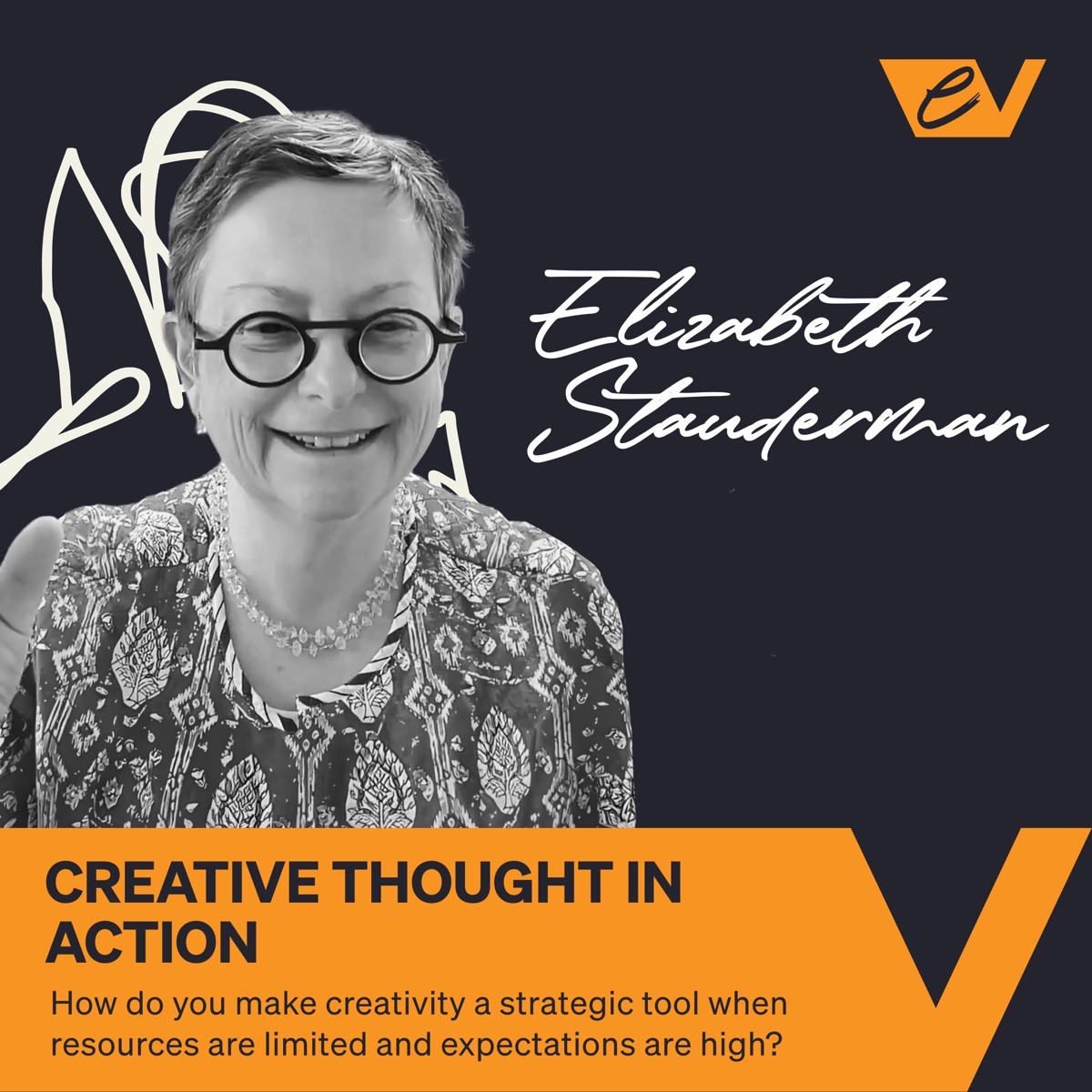
Elizabeth Stauderman: Creative Thought in Action
VP Communications & Marketing, Skidmore College
Watch or listen right here
About this episode
How do you make creativity a strategic tool, not a luxury, when resources are limited and expectations are high? Elizabeth Stauderman joins to unpack how she brought Skidmore’s motto, Creative Thought Matters, to life through a full web and brand transformation.
We explore why mission must drive strategy, how beauty can ease change, and why liberal-arts thinkers are built for the AI era.
In this conversation
- 01Creative Thought Matters
- 02Mission-first strategy
- 03Beauty as an agent of change
- 04Liberal arts in the AI era
Links from this conversation
Episode transcript
Read the full transcript
Transcribed from the episode recording; names and phrasing may contain small transcription errors.
Welcome everyone to another episode of Escape Velocity. I'm your host, Tracey Halvorsen, and today i am joined by Elizabeth Stotterman, who has worked in the worlds of communications and strategy in higher ed and cultural institutions and nonprofits for her career, um I was fortunate enough to meet Elizabeth maybe eight years ago at this point when she was ah leading the marketing communications at Yale. And we worked together on a website project there and I've stayed in touch. um We have found we share a common love for all things creative, but especially art. And I was um really excited to have her join me today. And we'll talk about how our love of art and our appreciation for that kind of informs our lives. So Elizabeth, thanks for joining me.
Well, thank you. I'm excited to be here, but I should tell you that it was not eight years ago, but rather 12 years maybe 13 years ago, because was 2013, think, first connected.
Oh my gosh.
all did. because it was twenty thirteen i think when you and i first connected
Okay. That makes sense. Wow. My my math. You know, i I definitely lost about three years thanks to COVID that I know it just has messed up my sense of time.
we all did
um Wow. So 2013. Well, I remember coming up and um and meeting with you all to talk about the Yale website and just being so and nervous and excited and so thrilled to get to work on that project with you and your fantastic team there. um And I think it was during those early meetings that, um that we started, I noticed the art that was in your office and we started. And of course, Yale's um MFA program is infamous for what a great program it is for the arts. um But give, give me a little bit, is there anything else about your background that you would like to share with people who are, who are listening?
Well, I think that um It's important for your listeners to know that i come from ah family of artists, actors and painters.
Thank you.
And so i think I come by my creative bent and my interest in visual things ah quite naturally. It's in my DNA. And i don't think that I would have been as successful in my career had I not had that sort of drive to make the world more beautiful. Although many of the graphic designers that i worked with really hated it when I said, couldn't you make it prettier
Well, that's a very interesting point, right? Because beauty and pretty and visually pleasing is a double-edged sword. um Even though we say we want that, then i think it it can fall into what feels like maybe decoration or superficial
Right, and that was that was the objection that many of my ah partners in crime would bring up. But and they do say that beauty is in the eye of the beholder. And one of the things that's important for me to always remember, i hope that I don't give up my principles ever, but when you're creating for ah nonprofit or you're creating, especially for higher education institutions, you there's a very fine line that you have to walk because your audiences are so broad and their perceptions of beauty and visual effectiveness are so varied.
Yeah.
Right. And so, um There's a piece of me that wants to go crazy. And I think that the very wild design that ah we worked on at Yale together, which by the way, is still in effect, which for a website is extraordinary, but that is just a testament to you and your team and their vision for how you could create
i know
ah visual doorway to a very complex institution. um And so kudos to you. But the one that we just more recently worked on also is um it is visually beautiful, but it's challenging to people who are used to the kind of tired old website that ah they were used they were used to.
Yeah.
And so although we've launched this project and it's been very successful, the only complaints that we've heard are, I can't find the search button. I don't like it. It's new.
Yeah. yeah changes Change is hard.
so change is difficult, but ah but beauty remains. beauty remaineds
and Beauty is eternal.
Mm-hmm.
Well, um thank you for for that. ah And i too, am very excited about um about the new project with Skidmore. And, you know, it it wow, yeah, that is a long time for for Yale's site to have have held in there. um I remember us talking about the idea of the the Cabinet of Curiosities,
okay
And when you were sharing with me how generous and spirit Yale is with what it collects, what it adds to its collection, whether that's historic, um you know, historic objects or art art objects, whatever it might be, they don't lock it away in a vault and only the, you know, the big donors get a chance to to see it or or whatever else. It's it's immediately shared.
Right.
And that...
I think actually Yale is one of the ah leaders in digitizing and making available so much of the vast collections of both art and objects that they have squirreled away in various places. always, always temperature controlled, just to be clear.
Yeah.
um But yeah, it, e it, it was really important to be able to showcase that both the collection and the generosity that allowed it to be shared the institutional generosity, I think.
Yeah. I, um, i think that really became kind of a cornerstone of our strategy for the whole project. And, um, I also very much appreciated that that, that felt baked into the the brand of Yale, certainly, but that it's it touched upon something that I believe in very deeply, which is that, you know, we're not just living in these very linear experiences where, you know, like the show Severance, you know, we kind of block everything else outside of our work life. We come in and and we just do work. We're informed and informed and shaped by all the things we experience and ah learn about or are curious about in the world. And that creates a much bigger and broader kind of landscape of of life to to work within. um Which brings me back to kind of your appreciation for art and how that's informed your life and career. we um We talked briefly about, before we started recording, about a favorite piece of yours. And and so I'd love to start with that since we I know that you've got it handy here.
Sure.
And I'll include a link to this artist's work and and maybe a picture on ah on the website once we're done. But tell us a little bit about this.
Oh, that'd be great. I will show it to you with apologies because it is taken from an angle that you can't really really see the delightfulness of it, but it's quite large.
really
It's about five feet tall by four feet wide. And it was painted by a friend for me, which makes it very special. um This particular ah friend ah graduated from the Yale MFA program. And um when she received her degree, she said to me, I'd like to paint you something. And I said, well, I would like to be, ah you know, your first client. And so she made this piece for me and it speaks to many things that I really love. I love sort of organization. i love form. I am, as you can probably tell, very interested in in color. And so, yeah, she painted that for me and I've had it since, golly, since for ah since for a long time. but and it has traveled with me from Connecticut to Virginia, back to Connecticut, and then up to New York where I now live in two different places.
All right.
And it always stymies the moving company when I show it to them and they say, like it you want us to move that? and Well, very important. and Yeah, she's now the director of um of the museum gallery at ah Hampshire College.
And what is but is her name?
And, you know, now you're going to ask me and I'm having senior moment. It'll come to me momentarily. She is a friend and I do know her well. Hold on, I will check while we're talking. Yeah.
we can We can delete this part out.
You may need to, but let me let me actually, let me let me shout out to her because she is really great.
yeah
Anyway, let's keep talking.
Well, no, it's all right, because I can just delete the earlier part.
right, hold on a second.
We can...
Hold on a second.
Let me know when you get her name and then we'll jump back in.
University College Museum Director. No. No. Hold on. Oh my goodness. I'm sorry, Tracey.
That's all right. Hampshire College.
Yeah, Hampshire. Is it Hamper? Maybe it's Bennington. Oh God, see, now I don't even know what I'm doing.
well, let's move on and and i I'll add her name.
ah
We'll figure her out and add her to the credits at the end. Let's just keep going.
Correct.
So, um, so this piece, you've had it for a long time. What strikes me ah about it from the bits that I can see is that it's, it's pieces and then compilations. So it's like parts and then the whole, and that strikes me as very, um, speaking to the nature of structure and composition and, and how things form together.
regret Right, which is very much ah what I do, ah what is done when we put together publications or magazines or brochures or websites or speeches or talking points.
and
It all is the process of gathering together pieces and making a coherent and pleasing ah whole process. if that makes sense.
It does. And while I would say maybe that was the concept, one of the concepts that she was thinking about when she was painting that, and of course, I have no idea, but you know there's a lot of conversation around on on the work side, which I equate to concept, but it's it's strategy, right? And how important strategy is when you're putting trying to put together all of these things.
right
And I'm curious, as someone who's who's worked in strategy for your entire career. How do you initially think of it when you're, when you're trying to wrap your head around like the starting point and where that strategy needs to start from, or kind of be, be birthed from? um how do you think of strategy in your mind?
Well, it's interesting. We were just talking about ah parts of a whole, creating a whole. But from my perspective, the best strategies start from ah strong foundation around mission.
Why? Yeah.
Right. um I think Simon Sinek talks about it as the why although he might argue that he's not really talking about mission.
why yeah
So with apologies to Professor Sinek, you know, ah people mistake. They use the word ah use the word strategy to mean a lot of different things. right Sometimes a strategy is just like the process to walk out the front door. I'm going to get up from the chair, and then I'm going to go to the door. um But if you're talking about trying to develop a broader strategy, the best way to inform the creation of that is you have to understand, let's assume it's an institution, what does the institution stand for? So i think mission and strategy are are very tightly tied together. And I would characterize this as being one kind of strategy where you're sitting down and you're going, okay, we're going to build a a document, a strategy document to describe a place. Sometimes if you're doing crisis communications, for example, which I also do, the strategy actually has to be much more, how are we going to... fix this problem? How are we going to communicate about it? What are all of the pieces that we need to think about? and And then how do we execute on that? So I guess, actually, it's still the process of assembling various bits of information and making them cohesive, like painting.
Yeah. So, so that got me thinking and I, I do think it's, it's the why, right? Um, you know, I might make paintings of lots of different subjects, but the why behind wanting to paint and, and share it is from a more unified, you know, value of of connection and, um sharing an experience that the paint is is the only vehicle I know how to convey it. and um And there's you know lots in there. But when you're talking about strategy for a higher education institution, um and I've been to and worked with many, many, many over the years. And what I always am struck by and why I always insist on spending some good time there at the beginning is that each one is, is truly unique.
Yep.
Their why is very nuanced and very special to them. And then i look at the things that they put out and it always feels like they've watered it down in such a way that none of that comes through. And I just wonder if, if that's just sort of like the nature of the industry and wanting to, you know, appeal to all or not be too, too.
Yeah, well, I think um there is a real problem in higher education marketing and communications where I'm just going to let's just go old school and talk about a brochure.
Sure.
um There are so many brochures, admissions brochures, for example, and they still exist in paper form um where you could take the name of the college or the university out of there and drop in another one and it wouldn't make any difference. And so the challenge when you're doing great work is not dumbing down that special sauce, whatever it is about the institution. But but one of the it's one of the it's hard for people to articulate it sometimes. They're kind of like, well, you know, I know it when I see it, I know it when I'm here and everybody agrees, oh it was so special. But I think there's a difference between, for example, nostalgia and actually what the idiom of, idiom, is that maybe a good word?
Yeah, our ethos.
each loss of the place actually is. And I've been in enough different places to know that they are very different. um We all in higher ed do pretty much the same thing. we teach students and we perform research and we publish research and we send ah young people out into the world to seek their fortunes. And But that's where I think the similarity ends. um And I think it's dangerous, especially these days when people are kind of talking about higher education as a kind of monolithic thing. Higher education does X or higher education doesn't do Y. I think that's dangerous because there is no single higher education and we would be we would be well served to think about it in a more nuanced way. But i I don't necessarily think that the times allow us to think about nuance a lot, right?
Not these days. um
Right.
And yet, you know, and and I also, know, I see the the beating that higher ed is is taking. um Some of the scrutiny is is probably warranted.
Correct.
um And, the you know, the the conversations around the cost and, you know, the ah ah ROI and and all of that are
correct
important, but it does seem that we've fallen into such a limited attention span where we want to see the the data that kind of guarantees a certainty. And, you know, if I've learned anything in life, it's that the only thing that is certain is that there is no certainty.
Correct. And I do think that um I would firmly admit to being a traditionalist, and I believe in education for education's sake.
Yeah.
I also, and in fact, that's why i decided to work in higher education. I did work in the private sector and I stepped out again once in my career to make sure that I wanted to commit to higher education. But I love the transformative nature of it, how you bring people and ideas and things from A to b um You know, it's it's also an assemblage in some ways, isn't it? And yeah, so i I think that when people take too instrumentalist a view of higher education, they're kind of missing the point. Now, I also acknowledge that everybody has to eat.
Yeah.
On the other hand, I don't think ah that ah we would be as interesting or successful a society if everyone was a computer scientist and no one was a painter, right?
yeah
I did have a conversation with a parent whose ah child, delightful child, had been admitted to and Ivy League school. And um she said to me, i am only going to pay his tuition if he majors in engineering. And he tells me he wants to major in history. I said, well, I majored in history. And I'll tell you, i can't build a bridge, but I can tell you all the components that ah need to go into a bridge. And I can tell you about the history of bridges and why this bridge works or this is bridge doesn't. and And I can think expansively about what a bridge actually is. I'm not sure i convinced her. I do think that she left about to tell her child that she was going to pay for an engineering degree and not a history degree. which So you take your defeats and you move on, I suppose.
Good try, though. Good try.
I did. i tried.
Well, you know, i think we we talked about this when um when I was up ah working with you last year. the the way that things are going right now with with AI, it seems to me there's never a better time to be kind of one of those Renaissance humans, um for lack of a better phrase.
Mm-hmm.
And why I love Skidmore's motto so much, creative thought matters. It's never been more timely. And I think if you look at what AI is going to allow people to accelerate around, it's going to be a lot of that. data-driven, crunching the information, spitting out the answers to very technical questions, doing a lot of things, um writing the code you know that the computer scientists used to know need to know how to do And now what is going to be so valuable is people bringing their learned experiences, their lived experiences that no AI can know of or have
Correct.
And how those things put together in the mixing bowl of collaboration or the work or whatever it might be, we'll be able to create something unique, something that has not been um thought of before through the combinations of those things. um And ah so to me... ah it reminds me of when the web was first getting started because suddenly there was a real appreciation for people who could come at it with different perspectives and not just, you know, there was a lot of potential, but that potential was not going to be unlocked purely through learning the skill sets.
Right. right
It was going to be through the ideas and the creativity that was brought to bear.
Right, well, so a couple of things. um One, the history of the web as I've experienced it, and I was one of the early um and developers of websites back in the 90s when all of a sudden we had this tool. um As many people in the communications industry will recall, um initially, because websites appeared on computer screens, the people who were put in charge of websites were ah the IT t folks, and the ah which is fine because the IT folks need to know how things work. But the analogy, again, the traditional analogy that I made was, if you are designing a brochure, we're back to brochures. right? And you want to have it printed. You want to go to a printing company where the man who runs the press, and they usually are men, ah has been there for 35 years and knows exactly how to get the right cyan and magenta to work to get the picture to pop, right? But you would never ask the press man to write the content or choose the images.
Right.
You would ask them to make those things real. And so I think, you know, people think thought of the website as a technical thing. And I had to keep saying, no, no, no, no. It's a communications tool. And it should be that' it should be communications first on a strong technical platform. And so you fast forward to AI. And um one of the things that I think is really important ah is that Well, let me back up and say i had ah one of my best bosses forever, who shall remain unnamed, and believed that problem framing was as important as problem solving. Because if you did not
oh Oh, sounds like, sounds like Einstein.
Yeah, right? So if you did not frame the problem properly, you didn't know if you were solving the right issue, right? So problem solving is important, but your problem solving is improved if the framing of the problem wrong. Absolutely correct. Right.
Right.
And so I think about knowledge workers who use AI right now, they have to write prompts. Right. And the prompt to my mind is the way the problem is framed. So and someone with a liberal arts education, I have argued to a number of people. ah who has a broad experience and who can draw from a range of subjects to see how they all might fit together. Again, we're talking about the assemblage of pieces.
Right.
um Has the kind of broad perspective that makes the prompt better because it's more comprehensive.
right
right And you know this isn't a a new ah subject by any stretch of the imagination. There's an ancient Harvard Business School ah article that talks about T-shaped managers, T-shaped leaders. The idea being that they have at their core some foundational knowledge about a subject, right? But they also have the top of the T where they can reach out, excuse me, and they have people skills and they know how to talk to people and they don't just transfer their knowledge, right?
Yeah.
It's a theory. i don't know.
I think it's a good theory. I mean, because it's never a one-to-one transfer. your and some There's a filtering that's happening.
yeah you're gonna have to excuse me i'm having a moment here too much talking right all right i think we're back but now i look like i'm be crying yeah i'm gonna get some water sorry about this
Oh, no worries. so Take your time. You want some more water? That's all right.
you know i was on a roll
You were, was good. We'll get back on him.
But, you know, what I just said may be wacky, but I actually think there's a grain at least of truth in it. again
I think so too. um And I think, you know, you've, you've spent your career managing and working with teams of people. So how do you feel like you've, do you feel like your appreciation and enjoyment and, you know, often travels to see art and museums, does that inform that, that T shape for you in how you work with others?
Oh, absolutely. Absolutely. um You know, ah first of all, a team, leading a team or being part of a successful team has always been an incredibly high priority for me. So professionally, I've always sought out places where there are good teams.
yeah
That is when I get my greatest job satisfaction. And when I became a leader to see my team succeed is the best, uh, success story that I can have. It's not about me. It's about the team and if they succeed and they feel good about that success. Right.
yeah
Um, but it's interesting when, um, So two things. One is it's now a pretty standard practice, but back 20 years ago or so, it was quite innovative that the Yale Medical School s sent its students over to the art gallery to look at a painting, to learn observational skills In so doing, the idea was, and I think it's been proved um that ah that a they now can observe their patients in a more sympathetic way.
hu
i You see more things, they look at a painting and realize, oh, that it's a component of a lot of different things, right?
Yeah.
And so um when I first became the chief communications officer at Yale, the first thing I did as a team building exercise was I marched everybody over to ah the Yale Center for British Art, which is one of the museums at Yale. And we sat and we looked at part of ah their wonderful collection. not only to help them ah do something together, but also to look closely at something and reflect on that, and also to talk about and see the richness of the Yale collection. I had the curators dig some stuff out of the archives to look at, right?
Yeah.
So I'm sort of going around here, but I do think that, um ah you you must um you must include some element or you must insist upon some element or permit maybe is a better word, some element of creativity in almost every aspect of work Right? Sometimes there's a yes, no answer. And if you look over my shoulder at the black and white, the two black and white pieces, that's all about typography and typography is all about sort of binary yes, no in in these particular cases. um But ah this one over here is actually a comma that's been manipulated, right?
ha
So there's where it's it's creative. And there's space for both of those things. And so sometimes you have to make that choice. Maybe it's a budget issue that only gives you $2 when you need you'd like $2,000. Although will say budget constraints create their own kind of creativity, right?
They do.
really need to figure out what you can do with a roll of twine and some scotch tape.
Yes.
And it's amazing what if you let yourself be creative and you think this isn't just a roll of twine and some scotch tape, why it's a piece of macrame, right?
Yeah.
That I taped to the wall. um So um I'm not sure I'm really answering your question, but I do get really excited about um the interest in creating encouraging observational creativity in the folks that i work with.
Yeah. And I, I think, I think it, uh, it is critical in, in every facet of our lives to, to nurture that creativity. Um, so many people just say, oh, I'm not creative. I can't even draw a stick figure. And I'm like, okay, let's move past that. That's not, you're missing the point here. Um, because I do think everyone is creative and it, it's a core aspect to just our existence. I don't think it's a, it's not about a skill or a hobby or ah or a talent. I think it's so it's a way of operating that is just as core to our existence as um you know um and emotions, feelings.
Right.
I remember in high school being given an assignment to do a series of paintings using a limited palette, very limited palette, And I love all my colors and all my tubes of paint. And so I was huffing and puffing like most of the other painters in the class. And, and the, the teacher, my teacher, Walter Bartman said very similarly, um it is, it is not about the lack of it's, it's about what you can do with what you've got. And, to make something magical out of it, no matter what, maybe it's two colors, three colors, whatever. And then at the end of the work, I remember he, he let us all know that this was actually Rembrandt's full working palette.
Oh, interesting.
It was our limited palette. And, uh, you know, that gave us all a lot to think about, of course. Um, but yeah,
Well, you know, um in in graphic design, i don't know if this is still the case, but um ah certainly in the Yale graphic design program, um there ah the the young would-be designers were put through their paces with a ah a bottle of white placa and a bottle of black a placa. And they were supposed to be like Armin Hoffman, the famous Swiss graphic designer, and create ah recreate an image from simply light and shadow. i i went through that exercise and failed miserably, I'm afraid.
But still a valuable exercise.
Well, it was, right? It shows you about form and it shows you about components.
Yeah.
We seem to have a theme here about components and putting them all together.
huh Well, it um it also makes me think about, I think one of the things I experienced as an early painter that that just hooked me And I couldn't kind of get, I just wanted that feeling of discovery again and again, but it was when I discovered the power of negative space and, you know, painting what's not there to reveal what's there in a way that just, you know, was magical to experience.
Oh.
And, and to me, these are things that apply to life. Um, And even, you know, problem solving, we, we look at, we we get so focused in on the literal or what we think is right in front of us that we sometimes forget that it's maybe what, what's not there is just as important, um, in, in how we're thinking through the problem or the the challenge.
Right. Well, it's interesting. i i think of myself ah pretty much as a maximalist in terms of my taste. And yet, one of the images that I remember most from when I was younger was a an ad campaign that Irving can irving Penn did for Clinique. And you may remember, they were the most beautiful, simple pictures of ah bottle, right? and And it was all about putting yourself in that in all of that delicious empty space, right? i mean, obviously I was trying to sell a product, but the photos were so wonderful in their simplicity and in o leaving so much space for the viewer.
and
And I still i still remember those. They were they were quite something. quite something
Yeah, I think um simplicity is very, very hard to achieve.
Yes.
Um, much, much harder than I think people give it credit for and you know, pulling out until pulling things away until you only have what's necessary. Um, but having that be, be enough to do whatever it is you're, you know, you're hoping to convey.
Well, you know, um that's sort of what developing a strategy is all about, is stripping it all the way down to the point, right?
Yeah.
And so, you know, everything's connected.
Everything is connected, um which is why i I have faith that the liberal arts will survive um and and hopefully thrive in the in the future.
I hope so. I think they're essential to creating an informed citizenry. But I also think, you know, higher ed isn't for everyone. And I, you know, need to be very clear about that. ah And I think that there has been this kind of myth, which is being debunked right now, about how really the only path was four-year college. um And there were statistics that basically said a college wage earner um will earn more over the course of their year of their life than a high school graduate or a trade school graduate. And I think that those statistics still hold true, but they're slowing and merging.
Yeah.
And there was a recent article about ah how the sector of unemployed college graduates is growing at a larger pace than others for people who are taking a look at unemployment. And that that all sounds very dismal. And then, of course, ah what the students here are talking about and their parents are talking about is whether or not AI is going to take away their what would normally have been their first year analyst jobs, their first job out of college, which would have been which would be being some kind of an analyst.
Yeah.
My response to that is I go back to the point I was making about um it's how you use AI and how creative you are about that and how broad your knowledge is to bring to framing a problem for AI to solve. I mean, I'm happy to have chat GPT fill out a spreadsheet for me.
Yeah, it's me too.
Right.
I'm happy for it to run numbers and to, um it it creates a lot of efficiency. It allows me to do a lot more than I could normally. um But it it is not to where I go for um as a source, right?
Right.
It's not a source. it's It's a great accomplice to getting things done more efficiently. um And I think it can be a, it can be a good place to, you know, to be challenged around ideas or to poke holes in things or to, I'll often ask ChatGPT to assume the role of, you know, maybe a certain author or thinker and ask them to then challenge an idea that I might be considering or help me see different perspectives. And I think all of that is great. But I do, um I am curious to see how the next few years do go for the the early job the the early job, the early career jobs.
i I think it's it's going to be worth watching and it makes me very happy that I am no longer in my early career.
Same. and it
ah
Same. And it makes me think a lot about the positions that we are, um hopefully able to create more and more of as our company grows and how we are able to bring people in who don't have any experience and who still can, you know, get their foot and in the door and be useful and maybe in useful and more meaningful ways than doing some of that rudimentary or automatic, um, technical work that the AI can can do. So we will see. We will see.
Yeah. i ah and And doesn't it take a little bit of it takes it it takes risks on your part and bravery on the part of young'un who may have great ideas but doesn't know how to bring them to the table or maybe doesn't believe that their ideas because they are not you know, the, the basis based on 20 years of experience that they're not great. Right.
Yeah.
But yeah, as you grow your company, it'll be interesting to see the types of people who are looking for those kinds of jobs. And um you know, I always like listening to the younger folks in my office because they have perspectives that I, and experiences that i would never have thought of, right? These digital natives who um work in apps and yeah and perhaps spend too much time on a screen, but there's a whole world that the olds like me don't necessarily understand understand as context for decision making or for idea making. And that's why I rely very heavily on some of the younger folk in my office.
Yeah.
Like, what do you think? And often they look at me like, do you really want to know what I And I'm like, yes, I really do want to know what you think based on your experience and, you know, the things that that you do. Because I can say, oh this is the answer to the question. and I could be, it could be the answer to the question to everybody else in my demographic, but I'm not the only demographic out there. So when you're being a creative, when you're developing a strategy, i mean, it You have to start thinking about, i guess it's really as simple as thinking about your audiences, but audiences can be inputs as well, personas, etc.
Yeah, absolutely. um you know i've I've always been a proponent of of the idea of of diversity, diversity in thinking, diversity in backgrounds, experiences, opportunity, you know access. Just the more the more diversity you can bring to a challenge, I think, the better.
Right. Right.
um And so you know we have some Gen Zs ah at the office and we've... been talking a lot about that generation and what they've gone through and how they've experienced certain things that are transformational, but they're going to impact them at a different, in a different way than they're impacting people who are in their thirties or forties or fifties or, you know, or still in, in preschool. And, uh, it's, To me, it's it's just more voices and personal you know everything is perspective, right?
Right.
And I think it's um it's a real it's real short-sighted to think that just because you have the age or the the time in the seat and the experience that that makes your perspective more valuable.
Right. I agree. And again, lots of different pieces, components that you're putting together. i i believe, and i I'm sure that there are plenty of stories written about this, but the pandemic has affected this generation of college students and young workers, just like the Great Depression affected two generations ago, right?
Mm-hmm.
That the profound difference. um And, you know, the depression and the pandemic were in many ways about scarcity, right?
yeah
You know, scarcity of money, scarcity of human interaction, um ah scarcity of experience when you couldn't go outside, right? um And it'll be interesting to see. i do think that when people talk about the greatest generation and the folks who experienced the depression and went through World War two you know, that was the, um that generation built a significant portion of the America that I certainly was raised in. I'm just talking about the U.S. right now. So what is that?
Yeah.
What's the pandemic going to do which was a global thing, and what's the pandemic going to do you um future decision-making, you know, when we're not, we're no longer around to make the decisions.
Yeah. Or, or we're at the mercy of those decisions because, yeah, I think about that a lot too.
Correct. Right.
um That scarcity of human interaction that the pandemic created and what, what that, what that did to people. And then this immersion into a world full of, you know, the tick tock world and the, the short form video and the social media and the misinformation. um what a, what a combo.
Yes.
Um,
I was wondering, um as a visual artist, what do you think about, i i find it, i've I've taken several of these um quizzes to say, is this real or is this AI? And I have to say, i don't do very well. And I wonder, you know, how you think about the impact of AI on the visual world, on art, on photography, on the things that are components of great websites or other sorts of things.
um I mean, that's a that's a ah meaty one. I think that, you know, is this real or is this AI is partly a problematic question to be starting with.
Hmm. Hmm.
And our knee-jerk reaction to, you know, fearing that that our experience of of our reality is going to become meaningless because somehow if a code can replicate a representation of so-called reality in a believable enough way that then that has no meaning anymore for for artists to depict it.
Right.
But I would say that every fine artist and and really anyone who's, I think, trying to communicate, whether it's through language or the visual arts or music, there is um there is an aspect of of the individual experience and expression. that is woven into that, it's very hard to explain it or break it down into zeros and ones.
Thank you.
But I think that, um, whether AI can create amazing paintings that rival the, the the great contemporary painters of today, i i don't know if it can. so what, right?
Right. Well, I fully think that there's going to be a whole, you you know, you had the abstract expressionists and you had the impressionists and pretty soon you're going to have, maybe you already do. So this may, this may exhibit my ignorance. You you're going to have the people who, who make fine art with intent and using artificial intelligence, right? And actually the intent piece is really an important piece because I think you can have ah malicious intent, which is to confuse in a bad way or lead people to make bad decisions.
ah Right.
But there's also a way to create
Misappropriate. yeah
using AI, if you're using AI creativity in a way that is intended to be beneficial. Although, you know, what's beneficial that also, you know, is a philosophical question. That's a different podcast, I think.
Yeah. I mean, I, I, as an artist, um, who, who primarily worked in paint, I've created imagery using my iPad and, and a tablet and, and digital tools. Um, I love, I've created still lives to make physical paintings inspired from where the imagery was generated by AI. Um, love i love the the idea that I could create ah video without the equipment and technical know-how that, that I might have needed prior, but that's no different than realizing I could, you know, plug in my little quick cam in 1997 and create stop motion and then edit it in after effects, which I downloaded probably illegally from the internet and,
Yeah. yeah
figured out how use on my own during grad school. And I could add you know ah thunderstorm. um i could I could manipulate and create in ways that were previously unobtainable because of the cost or the these skills that I needed to know or the production budget or whatever it might be. So I think it's the what what's more interesting to me is the access to create a generative AI system. is unlocking for people. But if they're using it for, to create, if if the intent is just to do it or malicious or to deceive or misinform, um then I think, you know, that's, that's the challenge that's always been there.
Right. and And it's going to get to a point where we aren't going to know whether it's a deep fake or of A shallow fake.
Yeah, I think that will be interesting when there's enough going on to where we start to question. you know It's like people that question the moon landing. um Are we going to start to question whether our news anchors are real people sitting there on the TV giving us the information? Are we already at that point? Yeah. You know, that just is a, we we we could do a whole and other podcast series on, you know, reality and and what that really is.
Right. Right.
um Which does bring me back to art because I think that the tangible, you know, if you listen to music, it's not it's not a thing in front of you. um And, you know, you have to experience it over time. Can you say you've listened to the piece of music? If you've only listened to a little slice of it, you can never listen to a piece of music in that one second, you know, split second that you can look at a piece of artwork and how those things impact you over time is, um, is so I think all again, sort of core to our human existence and it's what it, what's, it's what feeds us.
right
So I don't know that, it there I think there might be a lot of empty calories and a lot of, um oh oh, wow. And then we'll you know hopefully move past it on to it.
right Yeah, well, and also we talked about this a little bit earlier, but it's kind of like ah you do not experience a painting by simply walking by it, right? And this is all about the observation of what's going on in the painting. you know what What do you see? What do you not see? What's the impression that it gives you? And it takes more than a split second to really, i think, to really ah make that experience of of looking um as valuable as it can be, if that makes any sense.
Yeah, no, it makes total sense. And I think it's, again, i think in time it will be interesting to see if that that experience of looking is truly something that that people return to and appreciate. um You know, I have traveled to amazing places as a tourist and, you know, you run around and you try to see the sights and and then I've traveled to amazing places as a painter. And the point is to sit and look at the mountain all day.
Mm-hmm. Mm-hmm.
Um, and it's just, you know, the random mountain that you found that you decided you were going to paint that day. And it's a very different experience to sit and stare at something over time. And obviously in nature, you know, the light changes, the weather changes, um you change as you're painting it. And, you know, people still go to museums when the Monet shows come through and and they may have a calendar in their kitchen of all of those paintings. They can look at those pictures all day, every day if they want to, but they're drawn to come and be able to be in the presence in real life with a painting and stand before it and experience it ah in time.
Right?
And I think that that's hopefully something that we don't lose because I think that it, um, it's something that we, we get to do and appreciate. Um,
Right. There's a, in my, in my past, in a past ah life, I had to go to a business meeting in Chicago and it it didn't start till the afternoon. And i intentionally took the earliest possible flight so that I could go to the Chicago Museum of Fine Arts and sit in front of the Surratt painting for half an hour before I went to my meeting. It was perfect. I'm talking about the, you know, Saturday morning in the park.
Yeah.
I can't pronounce the grand jatte. And I had, I'd only seen it in books and I had this drive to see it in person and to experience it in person. And I have to tell you, it was transcendent. And I took that business meeting, which was, you know, a contentious presentation about a project that wasn't going well. I was on, I was walking on air and I found that I didn't, I had this sense of calm. Things had come together. i didn't yell at anybody. ae really was so jazzed by the time that I spent just sitting and observing and learning, right? Although I can't tell you exactly what I learned. um ah that debt it it it's I mean, this is neither here nor there, but that experience is was profound for me.
I can imagine. um I've been able to see some of my you know favorite paintings in real life. ah A lot of my favorites are are the yeah the old masters and you know Rembrandt's Nightwatch the Raft of the Medusa and some of those epic paintings that I studied in art history. And when I got to the the Louvre in Paris and got to walk up to these paintings that are massive in scale And to just be able to get up and look at the brush strokes on the foot of the you know corpse that's floating in the water beside the raft. And mean, there was so much, there was just so much to experience. And then just to step back and just see it in its size. And um granted, all the people mulling around was a little bit annoying, but
Right. It's better when you have the museum all to yourself.
Yeah. Yeah.
I, ah you know, it's interesting, this red piece behind me, which you probably, you can't see very well, but, and by the way, it's the Chicago Art Institute, not the Museum of Fine Arts, but it is the Boston Museum of Fine Arts. And one day i happened to journey into the museum in Boston and there was a massive painting by an artist named Cleve Gray, who is an abstract expressionist
Mm-hmm. huh
And it was, i don't 30 feet long and eight feet tall. And it was this amazing color field painting. And I was so captivated by it that as soon as I got home, i got my color aid out and i tried to reconstruct And it's falling apart. The rubber cement doesn't last forever, apparently. But it was one of those things where I just had to somehow or other try to bottle whatever it was that had seen. And, you know, maybe it's inspiration. um but you know, my positive reaction to that kind of observation, I think I carry through to work that I produce, but also bigger work that I produce for the work that I do.
You know, um, just to kind of bring it full circle, since you just mentioned work, when you're working on ah brochure or, um, a strategy or i know I had to bring it, i had to bring it back.
Where's that brochure again?
Um, how much of it, how much do you rely on, on your gut reaction to things when you're, when you're looking at something or you're even reading something? Um, Because I think we all we all can, you know, just the first time you see something is going to be the first time you see it and then you'll never have another first time of seeing it. But do you try to tap into paying attention to what those early inklings are or do you give them much validity? Yeah.
Yeah, it's very um she rare that I don't have a strong opinion about something. You've got reaction, rep something resonates. you know i have found it extremely easy, perhaps easier than other folks ah throughout my career that when I'm picking images or I'm picking writing two ah or editing, right, editing, writing, make to to go with what ah ah you know most resonates with me. And hopefully because of my liberal arts education and some of my artistic DNA, I hope that I'm making the right choices, right? And um yeah, i i i rarely go, well,
Right.
It could be that, it could be the other. i generally have really strong opinions, but not everybody works that way. But i for me, it's always been um take a risk. Don't take too much of a risk. um You want people to read and see and what your what you're presenting, especially if you're writing about ah place. um You don't want them to just be turned off by whatever it is that they see. And so... that's the frame that i I look at things and then you know there's color and and all that sort of thing and composition. But the answer the short answer to your question is yes, I i make decisions quickly and and it's generally based on gut, which I hope is an informed gut, right?
yeah Well, yeah. and I mean, it is. i just think um many people don't give their, they don't nurture that gut and and make sure that that's an informed you know gut reaction.
Thank you.
But even if it is an informed gut reaction, I think a lot of people second guess it or they they don't listen to it as much. um But it's a conversation. So I think you know you want to be able to carry the very beginnings of your experience of something along as you then may, might scrutinize it from different perspectives and for different reasons, holding onto that initial response and what it was about that is so important. I think because yes, you want to, you want something that's going to resonate and have a similar gut reaction, assuming that's a positive reaction,
Right. Mm-hmm.
Um, but you know, we don't remember things if they don't impact us a certain way. And if, you know, back to the, the conundrum of, of higher ed marketing, looking all the same, um, and not taking risks, it's, it's leaving people with very little to hold onto, um, in terms of differentiation. And you can't really make someone hold onto to something if you don't give them something tangible, to, to differentiate in their minds and,
Correct. Well, and that's why you know brand and brand strategy is increasingly so much so important to folks in higher ed And in some ways, it is for the for the traditionalists, and the idea that you have to market Higher education is extremely challenging. i mean, up until a very short while ago, marketing in higher education was kind of a bad word.
Yeah.
Or in the in the elite ah realm, right, of of higher education, oh, we we don't do that.
Right. Well, marketing, that word is is one, it's the cousin of sales and nobody wants to feel like they're selling.
Right. But the reality is that we we are, especially in higher ed where um you've heard of the demographic cliff and the fact that there are fewer 17-year-olds than there have been in the past. And so um the available ah cohort of customers, if you will, is shrinking. And so the competition is getting fiercer. And as as we've seen the within this industry, if you will, so many um consolidations, closures, and people predicting ah closures,
yeah
m
Yeah.
if If you could solve the problem of the cost of um higher of a liberal arts education and make it and something that didn't have a $100,000 a year price tag, you would be a genius. People would would would flock to you. But i don't i think the reality is that's that that's never going to happen. Although, you know, there are some innovators who said, well, you know, you do it all online and you only pay as you go and, you know, this and that.
Yeah.
But from a from a traditional standpoint, you know, we have to respect the fact that ah what we're selling isn't potentially as palatable as it maybe once was, not as aspirational as it once was.
yeah Absolutely. Yeah. I keep waiting for one of these you know billionaires to step in and and help solve some of these problems, but they seem to be more interested in going to Mars or taking over the universe or whatever they're up to.
Yes. Although there are, I mean, there are ah philanthropists out there who are really trying hard to ah and figure figure out this higher education model in a way that makes some sense.
Yeah, it would be.
But maybe part of the fun is it doesn't make a lot of sense. It just is. And, you know, you can have a public good without ah any particular justification. It can be a good, right?
Yeah.
i Maybe I'm, I could be naive there, but I'll always be a cockeyed optimist about higher ed.
Well, I want to wrap it up on that note because um I also, that made me think about your bio and you, you end your bio on LinkedIn with a quote. Is it in an Emerson quote that nothing great was ever accomplished without enthusiasm?
Correct.
So tell me why, tell me, tell me about enthusiasm and and why that resonates with you.
Favorite thing. Um, I think enthusiasm is an outward demonstration of the fact that you believe in what you're doing. It's confidence, but it's also positive. um And so it's less of a swagger and more of a skip, if that makes any sense, right?
I love it. it may Yeah.
And um part of it is my personality has evolved to be um ah the kind of person who tries to always think about the glass being half full. um You know, I'm the, hey, let's put together a show in the barn. I'll make the costumes kind of kind of person. And so, ah That quote just resonates with me and you know it resonates with with others as well. I'm not unique in picking that as a sort of driver, but I think it's really important. um Drudgery doesn't get you the greatest, it may get you a product, but um I'd always go for crafted as opposed to workmanlike, if that makes any sense.
It does. It does. And I love the word enthusiasm over, you know, positivity or optimism, um, because it's not about hope and it's not about a blind faith. It is, you really can't have the enthusiasm if you don't care about what you're doing.
Correct.
So you're here's to hoping that we all can continue doing things we care about.
Right.
And, uh, making the world a better place, or at least at least ah trying to enjoy it while we're here.
I'm with you. Correct.
and Elizabeth, thank you so much for joining me. And this was a great conversation and I hope we can do it again soon.
Sure. Thank you very much for having me. It was fun to ramble about
It's always fun to ramble about.
I know. um