Episode 10 · Mar 6, 2025
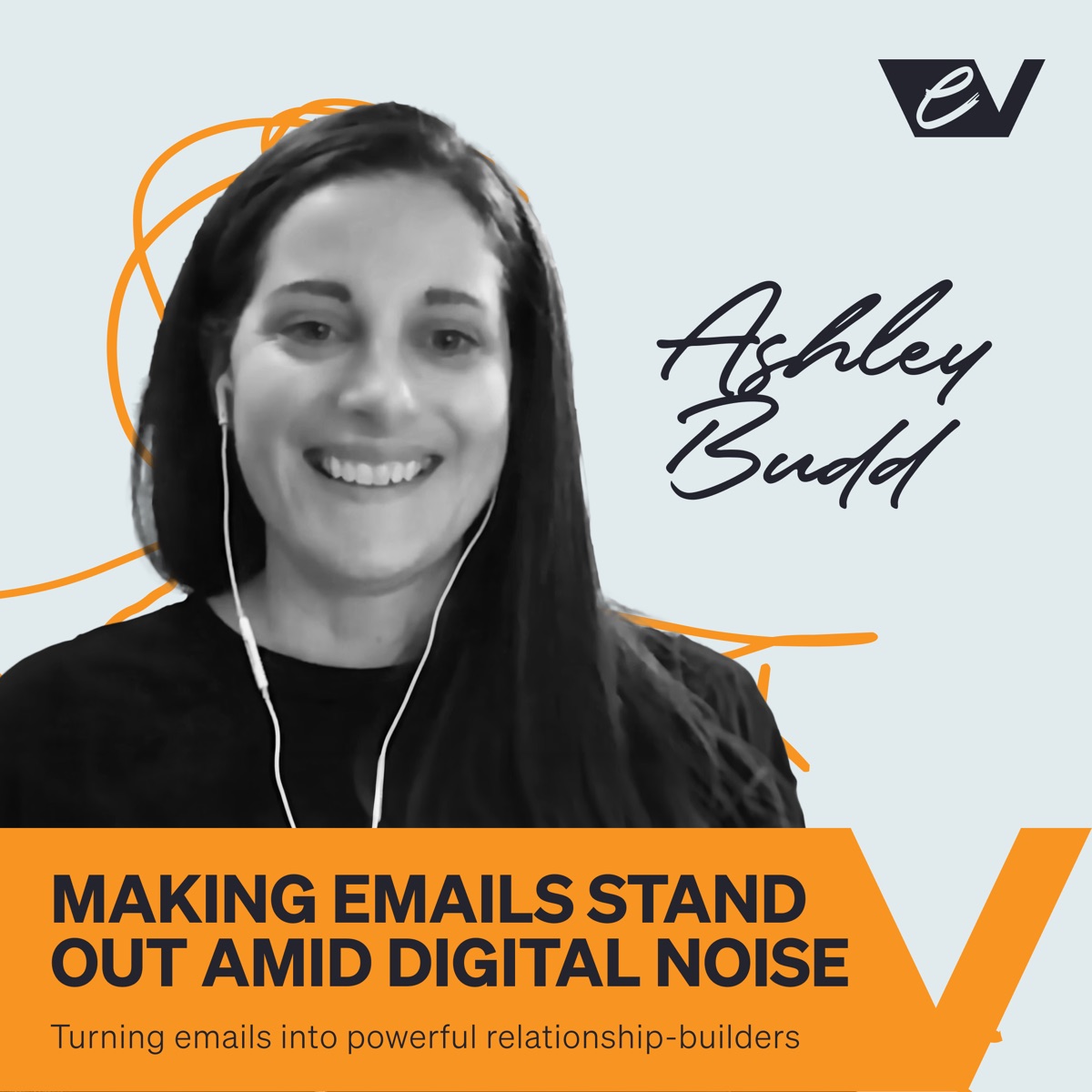
Ashley Budd: Mailed It!
Senior Marketing Director, Cornell · Co-author, Mailed It!
Watch or listen right here
About this episode
Higher ed marketing expert Ashley Budd, co-author of Mailed It! and Senior Marketing Director at Cornell, on email that people actually open.
Email marketing strategies, personalization at institutional scale, and where AI fits in the inbox.
Links from this conversation
Episode transcript
Read the full transcript
Transcribed from the episode recording; names and phrasing may contain small transcription errors.
Hello, this is Tracey Halvorsen, your host on Escape Velocity. And today i am joined by Ashley Budd, who is the co-author of an awesome book called Mailed It. um And your co-author's name is Dayana. Am I saying that right?
Diana Kibbles.
All right. Thank you. um
Yes.
So thanks for joining me.
Thanks for having me, Tracey.
We have a lot to talk about. ah yeah we were just talking before I hit record. um Ashley works in higher ed. And so obviously there's a lot of disruption happening there and everywhere right now.
Yes.
But when we were just talking about what what value we wanted this conversation to to have for anyone who listens, it's like Ashley's going to so share some tips, some hacks, as she calls them.
yes i said
um And let's use these things for good.
yeah Yeah.
Right? Like we need more.
Yeah. 2025.
We need more of that.
What a time. What a time to be alive.
I heard someone say like, you don't get to pick the time human, you know, evolution that you get to live through. I'm like, whew, no kidding.
Yeah. Wouldn't have picked this one probably. Yeah.
don't know. I mean, i i've I've also like, it's such an exciting time on a lot of fronts and it's such a terrifying time on a lot of fronts.
Mm-hmm. Mm-hmm. Mm-hmm.
So yeah.
Yes, if you are up for a challenge.
Yeah.
Woo-wee. We got one. Yeah. Yeah.
And it's complicated, right? Like there are, there are, you have to be able to hold a lot of different things as being true at the same time right now.
Yeah. Yes.
It's not a great time for, ah for anyone to think that it's just one thing.
Yes. Yes.
So that being said, um for anyone that's watching this and not just listening, I'm going to hold up the cover of the book.
Amazing. There she is. Mm-hmm.
There she is, all my sticky notes sticking out of it. And once again, it's called Mailed It, which I love. And I love your beginning too. It just sucked me right in, just the storytelling. And the but it was something I could so relate to, even though um you know i'm I'm older than you.
um
And i when I first got my hands on you know my first AOL America Online.
Yes, can we reminisce, please, about the glory days ah email?
yeah ah You've got mail.
We had a whole rom-com about this.
i mean, I used to think AOL was the internet at first, you know, um i was just sort of like, what is this?
yeah oh yeah.
ah What? And, you know, I mean, I did what I had just gotten out of college and I went to art school, so I missed a lot of technology, but I was in terms of what was being shown to me.
Okay. Okay.
um But I was, I've always been a a real geeky techie person. um My favorite.
We're so similar in that, Tracey, because I, too, went to school for painting, but picked them ah you picked a technical university because I'm a bit of a geek.
Yeah. Yeah. Yeah.
Yeah.
Yeah, I picked I picked a program in for graduate school where I could like do whatever I wanted creatively.
Yeah.
um So it was like painting and making, you know, stop motion digital films, um ah you know, which was great.
Cool.
Everybody was like, yep, that she's just doing her thing.
Mm-hmm.
um But I do remember, you know, we're email is like the OG form of communication um in this revolutionary shift in the way that we we can communicate and can share information and share data and ah connect with each other
yeah Yeah, it's really held strong.
You
right Like the creators of this thing, they thought it yeah they through.
did a good job.
It's got what we need, right? We can send immediately, receive within seconds. We can send attachments, right? Like there's all these little like nuances. The subject line is really helpful to have.
Yeah.
There's things that you don't have, even in SMS or... other communication channels that it's kind of got it all. And I think that that's why it's had this really long lifespan. um But it also got in our hands at the same time that we got the web.
yeah
And, you know, if we think about probably when it got into most people's hands was in the nineties. And by the early two thousands, we had social media
Yeah.
And I think we kind of skipped over the usefulness of email and web, quite frankly, in so many ways with social media giving us this ability to publish.
Yeah.
And now we have kind of seen social media go full full course, full cycle, haven't we? um to see where um these more reliable tools like email and our own websites, our own properties that we own, um have such a different kind of staying power.
yeah
um One of the other things I think about in just the evolution of the tool and in this time I think a lot about my father in the actual post mailbox.
Yeah.
And in the same time, right in the nineties, when we were starting to get email, his like, he would get so mad at the mailbox because it was just overflowing with junk.
Yeah.
Do you remember that? um Like every day he would go out and he would come like marching back in the house, like so mad that I put them on the do not send list, right?
yeah
Like the, I don't want the junk mail. yeah, I can remember these like glory days of email where we didn't have that. And it was like, oh, somebody sent me a message. Yay. And even my first professional role where i would go in and sit down at my desktop computer and read all, what, eight emails that I had and then go on and do my job.
Yeah.
And that's just not the way it is anymore. the way
No, no, no.
it is anymore um
And, and I do worry about that, right?
like
Like the noise canceling out the signal.
Yeah.
And yeah i worry about that on all fronts right now with, with generative AI and just with AI in general, and it's, it's ability to crank out stuff that, um that as of right now, you know, really doesn't,
Yeah. Mm-hmm. Mm-hmm. Yes.
doesn't feel good. You know, you can tell when you, when you, when you get that email that was, that was written by Wow.
No. Mm-hmm.
Yeah.
Yeah, we are pushing 400 billion emails being sent every single day. 400 billion emails being sent every day.
how
And that is you for every person on the planet with the with an internet connection.
yeah
That's about 75 emails for every human being on the planet a day, ah day.
A day. A day.
Um, and yeah, that's noisy. Um, that's, it's worse for professionals, right.
Yeah.
Then it would be for, um you know, a youngster with an internet connection.
Oh, yeah. Well, it's also interesting because, i mean, i you know, I met with a small team and we still have a lot of conversations about, okay, well, here's what I want. When you want to send me this kind of message, send me a text. when you know When it's about this, I prefer an email. When it's about this, send me a Slack.
Yes.
When it's about this, post it in, you know, ClickUp or our project management software or whatever.
Mm-hmm. Mm-hmm.
And so i I do think there are multiple avenues now where there only used to be one for email.
Yeah.
um And I think SMS and text is is another sort of interesting one where there's more professional correspondence happening there than than there used to be.
Mm-hmm. Mm-hmm.
um But I think it's also just attempts to cut through the noise.
Mm-hmm.
um But then you do get to a point where you're like i don't even know where to look. I'm overwhelmed wherever I look.
Yes.
ah And so that now you've got all the tools that come in and say, oh, well, we'll we'll filter it for you.
Yes.
right?
Okay.
So you've got your junk filters and your spam filters. And I um have for many years paid for a filtering platform called SaneBox, S-A-N-E, like make your mailbox sane again.
Yeah.
And it works pretty good, but also like I don't have the time to kind of train it and
Yeah.
You know, and now we've got ai sort of um summarizing emails for us on our phones and on our computers.
Yes. Yeah.
um So I just, a lot is changing right now with email. And I know you even mentioned in the book where you touched upon AI.
okay
and you're Like we we were hesitant to even talk about it because it was 2023 when you were writing and you knew how quickly it was going to change.
and sure yes
And the summarization is something i I wanted to ask you about because that is kind of pushing against that like very handy um subject line that we used to rely on.
sure yeah sure
And anyway, i mean, i don't want to jump into the middle of the thread, but tell me what you think about that.
sure Yeah, yeah, no, let's jump into it. Because yes, it's, um you know, I'm not afraid of the robots, I think it in the email space anyway.
Yeah.
um And I think They are here to help because billions and billions of emails, we can't possibly filter ourselves.
yeah
And so they're trying. They're not doing it right yet, but they're trying. And ah what we're really happy to hear is that the principles that are in the book um which we, you know, we tell people you need to you just need to tell people what's in the email. Your subject line just needs to be what is this email about, right? And so we've got to get away from the cute subject line that, you know, and I'm breaking hearts of creative writers everywhere who spend all of this energy on crafting a really persuasive and enticing subject line or something with a question.
Yeah.
and And you're so right about the overwhelm. um When we ask people, you know, when you think about your inbox, what words come to mind? It's overwhelming. It's chaotic. And it's some kind of like exasperated, oh like, yuck. Yeah.
And it can be stressful too, right? Because sometimes bad news arrives via email.
Yeah.
it's not
Yeah. ah yeah
it's It's the equivalent of your boss being like, hey, can we talk for a minute? You
Right. And if you are in your inbox feeling that way and the subject line is got a minute, right?
Yeah.
Got a minute for what?
Yeah.
Tell me what you want from me. Just tell me.
yeah
Don't try to trick me.
help me
Don't try to be cute about opening the email. And now maybe it will be the robots who force this. What these um filters are trying to do is they will open your email. for you. They will read the content of it and they will see whether the content matches the subject line.
yeah
And if it does, good, green light. This looks like this looks like an email that's not trying to trick you.
Yeah.
And so I do think Writers are going to have to move away from those old tactics and do more of what we're recommending in the book, which is tell them what's in the email right in that subject line and then use clear, simple language inside the email once once you get in there.
Right. Now, ah so you also say in the book, which I agree with that, like personalization it's not just about, you know including someone's first name.
Yeah.
or using the robots to be like, okay, they they said they liked sports. So let's make sure we include a sports story.
Yeah.
It's about having personality.
Yes.
Right. And, and I, I also think that human connection,
Yes. Thank you.
um authentic, like real human connection is going to be even more sort of highlighted as like, Oh, that felt good or that special.
er Absolutely.
So where do you weave in the personality? you know, all the creative writers, I think about Anne Handley, you know, and, um, love reading, you know, what these people have to say about good writing, great writing.
Yes. Yes. of course yeah Yes, yes.
And the other thing you said, which did crush my soul. i mean, there are so many things in this book that I'm like, Oh, I do that.
ah
You know? Oh, I do. i do start out with like, Oh, I hope, you know, the kids are good or hope you're doing well and hope you're hanging in there whatever it is.
yeah Yes, yes.
And you're like, no, get get rid of that.
Yes, I have.
Um,
So for anyone who's watching the video version, I have the the t-shirt on today. but I hope this email finds you well t-shirt. Um, it, yeah we, we, yeah, we need to get you one of these.
That's great. I think I need one of those.
So yes, I think the exciting thing for us was that we know that we can use email to build relationships. And oftentimes it's just used to drive people to take action.
Right.
um but we know you can build a relationship over email and that's such a powerful thing, but you're not going to do that with,
Yeah.
ah drip campaign. You know, you're not going to do that with something that's fully um automated. You're going to do that by having, injecting your own personality and personal touch into these things. And so we start in the book just talking about how do you build trust with your audience?
Yeah, I love that that. That was one of your your your quadrants or your triangle points.
the Yeah, the triangle, right.
right
that The trust triangle is one of our favorite models because it's just so simple.
Yeah.
And we we we say that first because, yes, there are some hacks in this book, right? Like we show you exactly where somebody's eyes are going to go when they open your email so that you can put your message where they can't help it but see it.
I love that. Yes.
And that's a beautiful hack. But they're not going to... act on anything or even get to the point where they're opening their email if they don't trust you.
yeah
And so all of these points about, you know, the personality that you have and the humanness behind it, i i rely on that trust triangle when I'm trying to trying to understand, okay, what is the reader going to want from me? And the points on the triangle are authenticity, empathy, and logic. And And the triangle is not ours. um This is from Francis Fry and Anne Morris. um But these three points are also what Aristotle taught in rhetoric. It's ethos, pathos, and logos. So this is human behavior.
because that's the same, yeah.
yeah but this goes back to the to the real before times, right? When we're and are understanding human behavior.
yeah
And what Francis Fry and Anne Morris would say is that you have to have all three. You can't just be authentic. um And what authentic authenticity and email means is that you yeah you have a voice, you have a personality. And in this more more and more robotic world, you're right, it needs to come through. um And it's about being honest. And I think for all of my marketing friends, we like like we can get excited about anything, right? Like we can make anything seem exciting.
and
But when you're meeting somebody, especially in your inbox, and you're in that overwhelming state, and you're just like, ah do you want to be hit with the like, I have the most exciting offer for you? No.
Yeah.
Right? So it's like, we got to keep it real. We can't say things are exciting when they're not.
No, or like, make me scroll and read.
We can't say, you know, to my higher ed friends, we can't say apply now when the deadline is three months from now.
Yeah.
Like, why now?
Yeah.
I'm, you know, I'm checking my email on the toilet. Why do I need to do this now? Right? like This is the, this is what's really happening in real life.
Yeah. False.
So the authenticity is all about keeping it real and having a voice.
Mm-hmm.
And the empathy is all about them. right It's all about their where they're at trying to be helpful, trying to meet their needs.
Right.
um And you know a lot of times it's about introducing a lot more of a nurturing relationship into the email program than just the asking and asking and asking.
Yeah.
And then the last piece, I think, you know you could be the most authentic organization, the most empathetic organization out there, but if your reader cannot follow your logic, you know, you have v lost them.
yeah
So if they don't understand why they're getting your message, that any any chance that we can, any like hole that we can poke, right? Like any chance that you give us to delete, we're going to delete because we're just trying to get through this volume. So all of those things have to have all three, but if you do all three, then you're going to build, like that's where the relationship building comes.
Yeah.
And then we can we can try to combat this volume, which is billions of emails and the same same amount of hours in the day.
Only going up.
like we're not getting more hours in the day.
Right.
So if the volume is going up, we don't have as much time to read and people aren't reading. And so, you know, when somebody says, well, people don't read your emails. I'm like, yeah, they don't, but they skim them or they'll glance at them.
Yeah.
a third of our readers are just glancing for two seconds.
I loved the this. that I want to just pause right there because it's two seconds.
Yeah, ouch.
And you say in the book, you know, write an email and then give it to a trusted friend or colleague and start your timer and just say, i'm going to, I'm going to stop you at two seconds.
Yeah.
Can you tell me what the point of this email was?
Two seconds. Exactly, right? And so, you know, if you're a communication professional, your job is not to send emails.
Yeah.
Your job is to get your message received. Okay.
Right. Yeah.
That's the job. And if we know that a whole third of our audience is only spending two seconds, we've got like another chunk that's going to skim, you know, they're going to give us eight seconds.
right
And then we've got another chunk that will actually sit there and read it. But even then, they're not dedicating a lot of time to reading. If you want to reach everybody and get your message received, we have to be able to deliver the message in that two second glance. And that's where the fun part comes in That's where I think all my user experience friends will get excited to see how we've applied solid web UX research to email
yeah
um with you know the eye tracking studies from our friends at Nielsen Norman Group that go all the way back to early web days, um where they discovered that how people read on a blank background, um a text on a b blank background, your eyes are going to do this very predictable F pattern.
ye Yeah.
And so they're going to read your first line. They'll read that you hope this email finds you well. They'll read that. They will. And then they're going to skip down to the next paragraph break. They're going to read that first line. Maybe not the whole thing. Maybe just the beginning of it.
yeah
And then the eyes do this left hand scan all the way down. And they, you know, they check this. They check this again later on mobile. Same thing. F patterns. A little bit more scrolling. Right to left reading language. Same thing. F is inverted. and It's just we are so predictable, right?
Yeah.
So, um, so yeah, we can't use that first line as a throwaway and it's hard to, you know, it's hard to not be nice and and open your email that way, but you can close with something nice.
loved that. Yeah.
And, um and I still, I still have a hard time even writing if I don't get it out of my system.
i loved i loved that yeah
So I write the, I write the nice thing and then I shove it all the way down. And then I can get the rest of my thoughts out. But otherwise, I'm stuck in the, gotta be nice. um
Well, then there's a reward. If you did, if you do scan and get all the way to the bottom, there's a nice reward of nice part, you know, it's like, Oh yeah, she asked about the kids or whatever it might be.
interesting sure There's a nice, yeah, right. Exactly, exactly.
Yeah.
i So I really do think it's the combination of on Like hacking that eye pattern, knowing where they're going to see it in a glance, and then using really simple language to make sure that it's understood when people are reading so fast.
and
And if you do that, you kind of build this momentum. And I think, again, the the empathy of it, right? Like thinking about a person who is like, I'm just trying to get through this email. They see your email and you're doing it right. Okay, I know what you want. I get it.
Yeah.
great, I'll do it and I'm done and I've checked something off and that feels good, right? If you have the momentum to understand and move something forward, now we're feeling good, right?
Yeah.
And um I do want to harp on the simple language a bit because especially in the the academic world that I'm in, like we pride ourselves in how verbose we can be, right?
Right.
We pride ourselves in the big words that we use and like, you all of the grammar rules that we can follow. And it really doesn't work. um And we're hurting, we're, you know, we're losing people by using words. um Language that, yes, of course, you know, ah they can understand it, but do they want to have to read at a postgraduate level in the email? No, they want to just be able to get through it and you feel better. And again, Nielsen Norman Group um has studied this seventh to ninth grade reading level, which is this close to spoken word, a conversational tone that we can get to.
yeah
ah People will act faster. And it reduces doubts and hesitations and anxieties and all the things that we're feeling. And so, um you know, the tools that there's tools available out to all but ah to all of us out there to make language simpler. Right.
Yeah. Yeah. Talk about that a little bit, because I think, you know, in theory, everyone's going to go, oh yeah, I should do that. But it's really hard to, to just,
yeah Right. Right. If I tell you right at the seventh grade reading level, like, I don't know what that means. So um I would say it's it's really close to spoken language. And if you can picture one person in your audience sitting across from you, and thinking about the message that you need to send, what would you say to them? And just say it out loud and write it down. and they You know, use that spoken word language. That's going to get you pretty close to that reading level. um ChatGPT is also pretty good at simplifying language.
Yeah.
ah Don't tell it to write at a seventh grade reading level. We've tried that. It gives you something written for a toddler. But if you just say simplify this, it does a really good job at simplifying. um We love the Hemingway app. That's a free tool, Hemingwayapp.com, the Hemingway editor that will tell you what your reading level is.
Mm-hmm.
ah Grammarly does this too. They'll even give you suggestions.
Yeah.
um But when we were you know we were starting to write the book and we saw how ChatGPT was writing emails, that was the thing that lit a fire because it was so bad ah writing emails.
and
And it would you know start with, we hope this email finds you well and all of the things that we knew weren't working. um So after we poked
Well, it's a yeah good is a good reminder, right, that Chad GPT and a lot of these AI platforms are are designed off of everything that's been done already.
after we Exactly. Yes. They're modeling after what they know. And so um after we published the book in August, the next task was to build a GPT. That was better um based off the book. So we pumped it with some chapters of the book and we trained it and that's available for free on our website, emailbook.co. You can find our resources in the GPT there.
Awesome.
Yeah.
Um, ah there's so much good stuff there. the um, you know the idea of building trust, even if someone doesn't want to click on or engage with that particular thing that you're asking them to do, um if you haven't wasted a bunch of their time and God forbid, hoped the email found them well, and perhaps it hadn't, um,
Right.
You know, I think that it's like, okay, well, I'll continue to open these emails because i wasn't assaulted as well as, you know, and and and insulted um and wasted time and had my time wasted or gotten confused on top of not wanting to engage right now.
Right. right Right.
You want to keep a lot of these audiences around and engaged, even though not every single email is going to require and action. And I love the other...
Right.
um point you mentioned about when it's giving day at Cornell, that you preemptively let people know, hey, that's coming.
Mm-hmm. Mm-hmm.
um There's going to be a lot of messaging coming out.
Mm-hmm. Yeah.
Like if you want to just sort of be taken off the radar for that, let us know.
Yeah.
And you, it's just, it's very thoughtful.
yeah
It's very considerate.
Right. Yes. um
And I thought that was another great tip.
We put, and this is, you know, for anybody who's concerned about their unsubscribe rate, we use this tactic on our team. We call it our self-aware unsubscribe because we are aware that we're a lot. We send a lot. Our volume is high. um, and We know that that isn't good for everybody all of the time. So what we'll do is, and this is the tactic, it's in the same size font,
Excuse me.
same, you know, same size font in the body of the email. It's not that six point tiny little font to the footer, right?
Oh, yeah.
It's right in the body of the email.
Yes.
It's typically a PS message, which we know gets read because it's different and it stands out.
Yes.
And so we will use these PS messages to say, know, for giving day, it says something like, Hey, it's giving day, not your thing. That's okay. Unsubscribing is quick and easy and it'll, you know, it'll make your inbox a little bit clearer.
Which is so nice, right?
ah
It's worded in a way that's not like, oh, hey, you know, don't have anything to give us.
Exactly.
um Or like, hey, about to fly into a rage because you're still paying off your student loans and we're about to ask you for money.
Right. Yes.
um Or one my one of my and I'm sure this is universal, right? When, when the, ah you just to go back to the unsubscribe option, which we're not talking about here with the PS and I love that.
yes and do Yeah.
um But when, when the unsubscribe is hard for me, I just want to, you know, break things.
Right.
um It's just maddening.
Yeah, it is. When I have to then go and tell you my contact information again, or like, well, I don't know what email address you used.
Yeah.
And I don't know, you know, those. Yes, it is. It's written like, that's when you get to the rage and subscribe moment. Right. But we have found with people that we work with who put these PS statements. um And I, I love to offer a pause instead of, losing them forever.
right Yeah.
And so on a newsletter, we're going to say, do you want to pause until the end of June or the end of December? Let's put these on pause. um But A lot of people actually don't interact with those. And just having those statements in the communication has dropped unsubscribe rates for some of the teams that we're working with up to 75% just by having the statement there.
Yeah. Wow. Wow.
Because people see that you know, like, oh, they self-aware, right?
Yes.
Are you unable to, you know, are you unable to support the university financially at this time?
Yes.
We understand, period.
Yeah. I mean, I can feel my, my pressure release valve opening when I imagine reading something like that, especially with, if, if it's a organization or institution that I have a relationship with, I don't want to be driven to be so full of rage that I'm unsubscribing.
Yeah. Exactly. just is this and
i don't have to do that.
Right.
Um, So, yeah, you know, you're letting them know, hey, giving day coming up. um You want to pause? We get it?
Yeah.
ah problem?
Not your thing? Okay. Let us know now before we annoy the heck out of you.
Yeah, it's like, I mean, my job.
Yeah.
Yes.
Right?
Right.
um but And we know that people who are more engaged with us, and we can talk about that. How do we get people more engaged? How can we get them wanting it, right?
Right.
We know people that are more engaged with us have a higher tolerance for email pain, right? People who are closer to us want to see what's going on.
right
And so throughout the year, to get to the point where we have a really high volume ask driven campaign, to get to the point where we're there and we have people, um you know, our unsubscribe rate for giving days, like 0.04%. It is people, they don't want to miss it because we've created this reputation that it's going to be fun and that we're going to use the same voice that we use.
and
You know, we're the same team. We're the same group that you've been hearing from all year. But what they've been hearing from us all year is that we're here for you, that we're creating things for you.
yeah
And i want my readers subconsciously when they see an email from the university to think, oh, therere there's probably something good in there for me. And I want like, I'm going to open that. There's probably something I'm going to click on because we've created week after week, these valuable offers to them. And sometimes it's just as simple as putting a smile on their face.
huh
You know, if you can imagine going, having to go through your emails and you know, a sender every time is going to make you laugh. That's one that you want to keep. Right. So again, like the, ah the empathy, um, and meeting people where they are and where they are in the inbox is not great.
Yeah. Yeah. yeah I have a million questions now ah to follow up with on that.
Okay.
or Just a couple of things you touched upon that I think are
Mm-hmm. Mm-hmm.
are you know easier said than done um and that I want to dig in on a little bit.
Yeah. Mm-hmm.
So one, humor.
Mm-hmm.
yeah so you talk about offering value and and having personality and ah and a voice and tone um that's that's relatable, that feels human and authentic.
Mm-hmm. Yeah. Mm-hmm. and sure
I i i think that's really hard for institutions
yeah
to green light or to even understand that that's what they need versus this should sound like the institution, whatever that is. Um, and humor, it's not something I usually see listed as like, that should be part of the tone.
finish Yeah.
And obviously there's not, uh, there are times when it, that's the inappropriate tone depending on, right.
Exactly. Right.
But, but how did you get, how did you get there?
How do we get there?
Yeah.
Yeah. Yeah. So we started with just one campaign. Right. So not taking a whole bite of the apple, but starting, let's see if there's one campaign that you can isolate and try this voice with and see how it resonates. And then when it does expand on that, and there are so, and I think the personality can shift depending on the conversation, right? right? ah Just like you would if you were a human with a personality talking to somebody about an important topic versus like, I'm sending you a weekly newsletter.
yeah
This is not serious. This is ah relationship I'm trying to build with you. And if I'm going to show up and talk with you every week, do you want that to be stodgy?
Yeah. Yeah.
No, you want it to have some life to it. And so i think that approach, having the flexibility of you can still be the same personality and in a more formal setting, in a more serious setting. um Your voice changes when you talk to your friends versus when you talk to somebody you don't know.
We hope, yeah.
um You hope. um And so you can give yourself flexibility in those situations. I think my office, so I am Senior Director of Advancement Marketing for Cornell University. And so we serve the entire alumni base. And we're also doing this broad-based fundraising for the university. And so do can we have maybe a different voice um speaking to our alumni than perhaps the government affairs office? Yeah, yeah, we can have a different voice there. But...
yeah
but um But, you know, giving ourselves permission to use emojis and giving ourselves permission to be very punny, right?
no
Like that is part of our personality. We're witty and we're clever. um yeah but to, you know, to the listeners who are like, not at my institution, that would never fly.
Right. Right.
i would say like you can put some boundary statements around your voice, right? So we can be... We can be funny and not be, we can be informal even, but not sloppy, right?
Yeah.
We're not going to be sloppy. We're going to be caring. We're not going to uncaring, right? So you can, you can kind of put these boundary statements around it when you're talking to your leadership about a new direction to say, we're not going to take it that far.
Right.
What's too far? Um, what,
I think that's great. And I guess, you know, your suggestion to pick one campaign where you can flex your voice towards something that's a little bit more personable.
Yeah. Yeah. Right.
And I agree, setting some boundaries and some guidelines for it and and some examples, right?
Right. and sure
To show leadership or to show the larger community, hey, here's what we're going to test and then test it because,
yeah okay
you'll know whether it's working or not.
right
And that's great data to go back to leadership with and say, look at this, ah you know, people responded really well to it. So let us, you know, expand this a little bit further where it makes sense.
Right.
um And I also think that, You know, when we talk about, um again, you mentioned this in the book, give your readers something of value. Don't immediately jump to all of your asks. um
Yeah.
I think you mentioned, like, do you need some suggestions for, like, what your parents can be doing while you're on a ah ah ah tour of campus?
Mm-hmm.
um
Mm-hmm.
Just so many great, helpful things that they make the receiver of the email not just feel good look good. but look good
Right.
you know, for having that information. And suddenly you've got a kid who's like, I'm going to look super thoughtful to my parents because I'm going to be like, Hey, why don't you guys go check out the blah, blah, you know?
Mm-hmm. Exactly. Exactly. If you are, you know, if you are trying to reach students who are, how many emails are these prospective students getting, right? How the heck are you going to stand out? If your institution is the one that's not just talking about themselves, right?
Yeah.
but is going to help them through this process, regardless of whether you they attend your institution or not, right?
yeah
How are you going to get through your senior year of high school? And you know that this one institution is there helping you with your advanced classes.
Yeah.
They're thinking about how to communicate with your parents about these issues. I don't know. Like, can they help you get a prom date? I don't know. But what are the things that are going on in their life?
Yeah.
And how do you insert yourself into that conversation? Because that's really where they're right they're stressed. How can you help them reduce the stress?
Yeah. Yeah.
how can you How can you help them reduce anxiety in high school?
It's.
um And if you're the one coming up with like breathing tips today, i might open that email.
yeah
um But instead, we talk about ourselves and our programs and apply now and apply now and look at our rankings and like, who cares?
yeah
Because I am worried about what's happening in my day, right?
meaning Yeah, it's, it's really, so you know, I've been having so many conversations just about how we consume content, how we connect, how we create relationships.
Mm-hmm.
Um, and it's just something that I'm, I'm always interested in And it's amazing to me that we tend, you know, that's why I guess empathy is on that triangle.
Mm-hmm. Mm-hmm.
Um, I used to joke that you know everyone's website was just a reflection of their internal organizational structure.
Absolutely.
and was talking with um a colleague who on an earlier podcast, actually, Miles Kemp, who runs a design agency called Variate. And I would vary it. But anyway, he was talking about Conway's law, which is and interesting theory that I'd never heard of before, which says like the way that you, you communicate internally tends to be then the way that you communicate externally or something along those lines, but ah I'm still stuff to study up.
Mm-hmm. Yeah, right.
um But a lot of this I think is, you know, a lot of email happens internal to groups and systems and it's not, it's not external. Um, and when there is a real dogmatic institutional way of speaking to each other, I think that's when you're in a situation where this is a really hard mountain to climb.
yeah right Mm-hmm. Mm-hmm.
um And I know you give some tips about building, you know, the breaking through some of those barriers with stakeholders, but do you have any suggestions for someone who is listening to this, who knows they could be doing more with their email, um but is, is stuck in that kind of a scenario?
Yeah, I think we always like to bring the evidence, right?
okay
So the book is packed with research that you can point to um to help have those conversations.
Yes.
um We love to bring the ugly worst case scenario, but right? what What could possibly happen? What could possibly happen?
Right.
um And sometimes there there is an ugly worst case scenario. so Sometimes it's like, well, what's the worst that could happen? Why don't we try this, right?
Right.
um So um I think even seeing, this is interesting, you talk about the internal um communication and how that's reflective. As I've been training, um even amongst the Cornell community, seeing the internal emails change, oh my goodness, it's so delightful to see even how we talk to each other differently or how expectations of ah communication are.
Wow, nice. nine
um And trying to pack every single little fit detail into a communication that we now know people won't retain? And what does it mean to just kind of hit the highlights? And um yeah, there's, there's, um there is a lot in the way we communicate with each other, where um it's this very, like, long form, I got to make sure i cover all my bases, and everything is been vetted 19 times before I press send. um If we can kind of get o ourselves, we got to simplify it, I think really is, is what it comes down to. Can we be comfortable with something, an approach that's much simpler than what we've, what we've built up.
Yeah. Well, I think that's, um, again, the evidence and, and going into these conversations backed up with the evidence is is great.
Mm hmm. Mm hmm.
Um, and also what's the worst that can happen, especially if you're, you're already batting kind of a zero, you know, it's like, what, we take some more swings and still nobody engages.
Yeah. Yeah. Yeah. And I want to just say something about deliverability too.
um
um Because the email service providers are getting more sophisticated, right?
right Yes.
Everybody's, the technology is getting more sophisticated. We are, if we keep sending bad emails, which I mean, were thinking of the so that they don't make sense. They're hard to unpack. And so people aren't engaging with them. we are going to have a harder and harder time even getting in the inbox.
Right.
And have found in this past year, 2024 when a lot of the tools became more sophisticated that ah partners that I work with on the consulting side, their emails weren't delivering at all. And they didn't know it.
Yeah.
um because the robots were opening them, right?
All right.
And so they had opens. um But if if the open rates are hovering around 20%,
Mm-hmm.
I want you to be worried because that is probably just robots opening. And so i have found institutions that, you know, they're they're saying email is dead or it doesn't work for us. And it's because they have put themselves in this reputational hole with the email service providers.
Mm-hmm.
um And so there is, I think it's ah it's time to relook at the program and to really reinvest in making sure that our lists are good, that we're we're doing the things that are going to help our emails deliver. um and if you're concerned about the responses that you're getting, it might not be that it might not be that the readers aren't reading. It might be actually that they're not even seeing at Exactly.
Yeah.
um
Yeah. And I think that's only going to get more and more amplified and
exactly
You know, when I think about um any large institution and all of their multiple channels they're trying to now communicate on, right?
Yes.
They've got their website. They've got their social media channels. They've got their professional channels.
Mm-hmm.
They've got the systems they know are are are sucking their information in and sending it back out to their audiences.
Mm-hmm.
They've got all these filters and and curatorial elements going on. And the lift it takes, the cost and time it takes to overhaul any one of these things is monumental. and and And it's daunting when you're also kind of at a time in in our evolution where it all needs to change very quickly.
Yeah.
um And so we've got to blow up a lot of things, I think, and let go of a lot of very static things.
Yeah.
um, outdated ways of doing things and tools that we've used and processes that we've relied on to, to do those things because we just simply can't use those things and keep up with the chain, with the pace of change.
Mm-hmm. Mm-hmm.
And to me, email is the perfect place to start because it's, it is not as expensive to overhaul your um,
Mm-hmm.
um you know, your, your content delivery team around that's focused on email than it is to like rebrand or, you know, do a whole new website project where you're talking about so much time and money if you're stuck doing it the old way.
Yeah. Yeah.
So for an institution that's like, we don't know where to start and and we're saying start with email, um,
Yeah. Mm-hmm.
There's still a lot of people that are like, well, well we, you know, we got, we, we already bought this expensive program and we're locked into using it, you know, whatever it might be. And maybe you can talk through like in your experience, what, what are, what are good platforms? What are bad ones? And, know,
just
I think everyone's just like, oh my God, we got to get personalization going. We still haven't even gotten that going.
oh
And all these tools now, especially now with AI, are promising to do all of this stuff.
okay
Like, how do you cut through the noise and and actually make some progress here?
Yeah. Yeah. So there are a couple templates, email templates that we have in the book. um They're also on the website. and emailbook.co.
And remind everyone again what the website is? so Okay. Okay.
And they're very lo-fi templates on purpose. um because we, you know, yes, there's lots of shiny tools that you can, you can use, um but these are built to be tool agnostic. So it doesn't matter if you have the fancy race car model or you're just writing your email in Microsoft ah Outlook truly doesn't matter because the principles are, um um can still be applied.
okay
you know, the What the the templates will show you um is where at a glance, in that two-second glance, where the reader will read.
Yeah.
um So you can leverage those spaces. um And there's a single call to action template that I think does that really well. The second template um we often refer to as our newsletter template. So if you have more than one thing to communicate, the piece there that I think... um The value in it, I think, is, again, it's all coming back to simplicity, but what people will do when you have a newsletter or something that has multiple calls to action in it is if you break these things up by headings, people will just read your headings.
yeah
And what it reminded me of when you were talking was, you know, if you're stuck in a newsletter template that is like campus news, organizational updates, right? Upcoming events. And those are the headings that that's what they'll see, but they don't really get any information out of them, right? So our template is just be really descriptive in those headings because they'll read them, right?
right
And be really descriptive in your links. We're done with learn more.
Yes.
Learn more is done. And you can't swap it for read more. That's not allowed.
Yeah.
um Just like click hereer was dead a decade ago. Okay.
and
We're done with learn more too. We're done with read more. What are we learning more about? What are we reading more about? So there there are some really simple things if you're looking to reinvest in your email program. the action driven links and buttons. These more descriptive subject lines and um headings that you can use. And these tactics really, really, really work. um Again, none of the tricks are going to work if you don't have that trust built there.
and Yeah.
But with those two powers combined, you're going to see your, I know you're going to see the results.
yeah
Um, I think the other thing that's really interesting, you think about the, like the whole marketing ecosystem that you were saying, you know, you've got your website, you've got your social channels, like where are you investing? The conversions are also happening in email. So not only is email cheaper, ah can be more reliable if you have a good email reputation. um, But it's also where people are taking action.
Right.
And you can use, so you know, I just, I came up through social media.
Mm-hmm.
i spent the first decade of my career as a social media strategist.
and
And so I have a soft spot for social. it, but it it's a good awareness raising tool. It's not the engagement and it's not the engagement tool it used to be. And it's not the place where people are taking actions.
Yeah. It's, um, although i would say Instagram has gotten me to buy a lot more stuff than I thought would.
Oh yeah.
Yeah.
This is true.
Um, but I hear you on most of the things, um, unless you're, you're selling really beautiful things to like put on your desk or put in your home, like little bud bases and things like that.
This is true. Yeah.
Uh, yeah. So,
Yeah, but those those groups too, I'm sure, are getting you on their email list.
Yeah, no. And you know, and it's the followup, um, because I, I might scroll by something and be interested and spend a little extra time or click around.
Yeah.
So they should know, I liked this, but now, um, Oh, hold on.
Yeah.
I'm getting a little alert on my microphone. think it's still working. I don't know. Well, we'll hope for the best. Uh, Anyway, um i appreciate the follow-up emails, you know, one or two, because that's where I'm, you know, maybe sitting at my desk and actually going to consider
Mm-hmm. Mm-hmm. Okay.
um doing something. Oh, you know what I got to stop because I'm getting another alert that my microphone is not recording. So let's pause.