Episode 11 · Mar 27, 2025
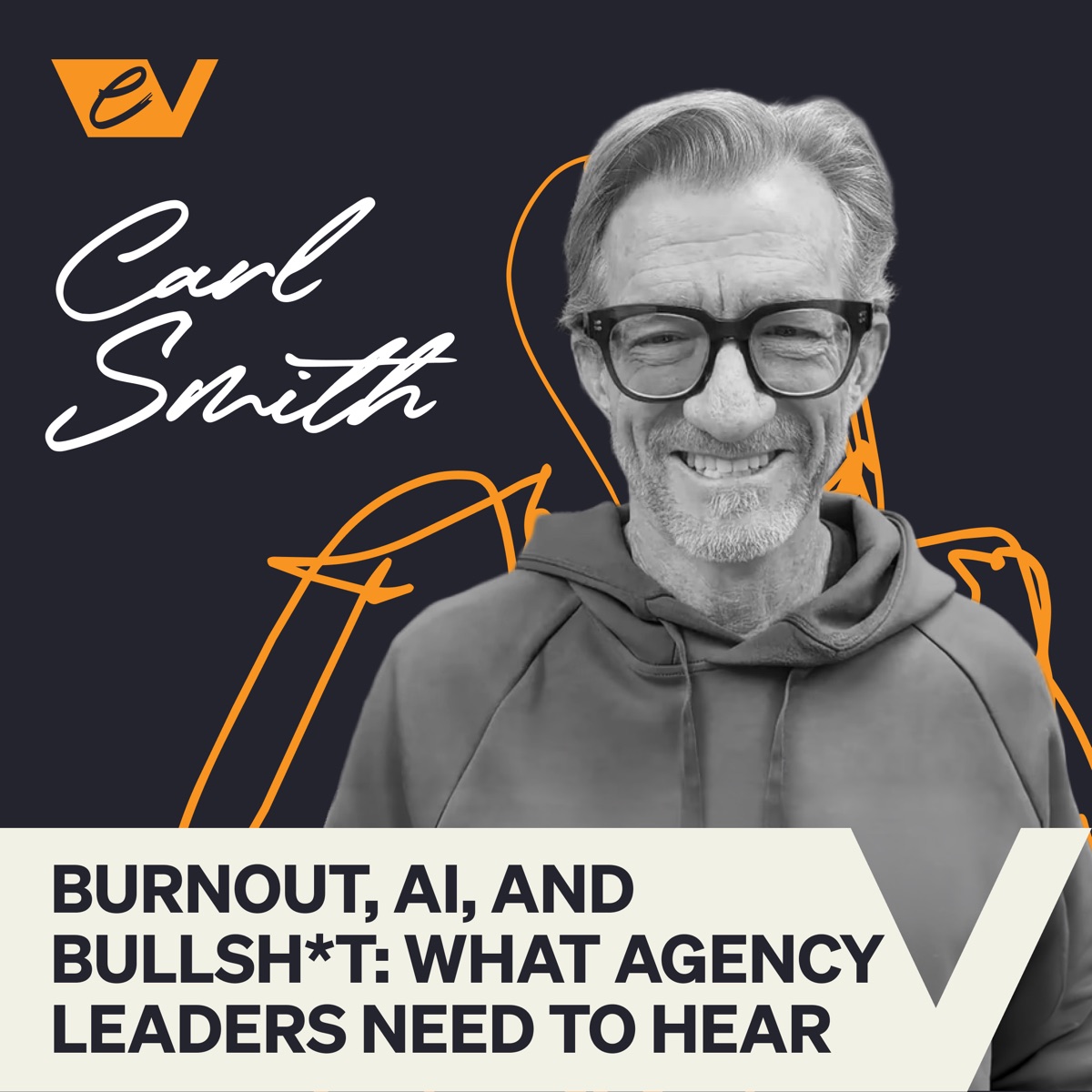
Carl Smith: Burnout, AI, and Bullsh*t
Community Builder · Founder, Bureau of Digital
Watch or listen right here
About this episode
Bureau of Digital founder Carl Smith on the evolution of agency life, the promise and peril of AI, and why trust and human connection still run the industry.
Two decades of digital-agency community wisdom, compressed into one candid conversation.
Links from this conversation
Episode transcript
Read the full transcript
Transcribed from the episode recording; names and phrasing may contain small transcription errors.
Hey, everybody, um all five of you who might be listening, here we are. and Mom. um No, seriously, I'm excited about this conversation. I'm very happy to have Carl Smith joining today. um Carl, I'm going to just let you intro yourself.
Hey, Tracey.
Okay.
Oh, well, I am Carl Smith. ah I was a theater major, ended up in advertising, then started my own shop. And during that time, these two guys named Greg decided to get a bunch of people together.
and
And that became the Bureau. And that's where you and I first met, right?
Many years ago.
People trying to figure out what the hell are we doing? We don't know how to run businesses.
Yeah.
And today it's, I just... I serve at the pleasure of the community, I think is the easiest way to say it. And we're pretty big now, around 1,500 people, 25,000 alumni.
Yeah, and and this is now, this is the Bureau of Digital, and and just for anybody who's listening who doesn't know about it, check it out.
um
it is It is a genuinely wonderful community be a member of. um i' I am biased, of course, since I was there at the beginning, but in terms i mean i've i these are These are friendships and support systems and learning um and fun and and growth, and and all of that's come out of this community, and I'm eternally thankful for it.
yeah I tell everybody, you know, the way I define it is we're a member led non solicit community. And the beauty of it is that we're focusing on the human side of leadership. Like there are a lot of great folks out there teaching all about the business side. But we got remember where people that were in these flesh shells and we're just that sounded disgusting. And we're we're just trying to make it through another day.
these damn meat suits.
That's what looking for. That's less disgusting.
Let me see if I can get more disgusting.
are you
Um, well, listen, you and I have known each other for a long time, but I do have so many questions. You know, this podcast is a great reason to kind of think about like, what are the, what are all the questions I actually really always wanted to ask Carl, but never, never thought to. um and, and we will start out with, uh, with, Well, I was going to talk about Wild Stallion. um And, you know, that was your your name, your nickname, really.
so It's coming back.
Yeah.
I'm letting go.
Yes, the whole look. But, you know, when we met and we first started talking about things, you were. you know, you, you were running your own agency and then you transitioned out of that. And now you're kind of, as I, I jokingly referred to you as like the daddy of digital agencies. Now you're just here kind of leading and nurturing and guiding. um But you have such an interesting perspective because you see, you see agencies from the perspective that, you know, agencies are usually saying like, Hey client, this is great. Cause we, we have, we have perspective that you don't have. We have this outside perspective. Well, you now have that perspective when it comes to agencies. And um I kind of wanted to start with, with how that has changed in, in your sort of your mindset of how you lead, because you're really, you're, you're leading a community now, not a company.
Yeah.
How has that, how has that changed you?
Well, I'd say it's empowered me a lot because it shifted my focus from trying to run a transactional business where
Thank you.
I'm offering a service to get compensated and you worry and you aren't always 100% truthful even though you wanna be because you gotta make payroll and let's just get through this and all of that's kinda gone. um Now I have this amazing group of humans that help each other and I just kind of guide it. i really do see myself as more of the guide for the Bureau than anything else and the beauty is If somebody has to leave, it doesn't disrupt the whole ship. If 20 more people need to come in, it doesn't overload the team.
Right.
You know, it really is an ebb and flow now, and it's about focusing on who's here and what they need and actually being able to spend hours every day trying to find solutions and connect people.
Well, that, um, I thought it'd be kind of fun to do some rapid fire questions, uh, to get started, to get warmed up. Um, I wanted to, let's see, do some like either ors here for you. Um, are you ready?
I am ready. Let's go.
All right. Um, this is either, or if you had to pick one to sort of whatever, in whatever perspective you want to, you want to take it, uh, creative services or product.
Okay. Creative services.
Freelancers or full-time employees?
Yes.
ah
um I'll go full-time.
Remote in-office?
Remote.
Retainer or project?
Retainer.
Flat structure or hierarchy?
flat,
That's an easy one. um
lumpy, but flat paid discovery.
Fixed bid or paid discovery? Value based pricing or not?
Depends. I'm going to go not because we can't define value and the industry has to agree first.
ah Design systems. Do people know what they are or not?
No.
Would you prefer a client that knows what they want or that they need guidance?
Needs guidance. 10
um One huge client or 10 small clients.
small clients.
Retrospectives or just move on.
Retrospectives. Progressives.
Progressive retrospectives. um Work-life balance or work-life integration.
work-life integration.
Take the risk or play it safe.
Say it again.
Take the risk or play it safe.
Take the risk.
All right. Good ones. there are so There's some ones i I know people are going to want to know more about.
And they've changed. Some of them have changed. Like I was project for a long time.
Yeah, well, what I mean, yeah, it's ah it's interesting. You did say retainer. So, you know you know, you're not in the position of of running an agency right now, but you you hear from and see hundreds of other people that are.
Yeah.
And while that might have started out as these little anomaly digital agencies, which, you know, we were like the agency that was born out of the non-agency, non-business kind of mindset, at least for a lot of people. um Now that everything's mature, do you see as much difference between digital agencies and traditional agencies? And if so, what do you think are the are the defining differences, good and bad?
I think it's really about how we see ourselves now as individual companies, as individuals within a company.
Yeah.
You can see over my shoulder here that it says the Bureau, not the Bureau of Digital.
Yeah.
um This is the little sneak of the the new branding that's coming out. And we dropped digital. Not everybody's happy about that. I have definitely heard from them.
Yeah.
um But the thing is, it's like you go back to 1901. when electricity was first invented, right? Or it was first enabling us to do things like open doors just by getting close to them, right? And everybody said, steam is a perfectly good technology. We don't have to use electricity. There were chief electricity officers. There were these people who were gonna help you with your electric transformation. Sound familiar? um And then it was just a part of everything. And you only noticed it when it was gone. You don't notice electricity unless it's not working.
Thank you.
Otherwise, it's perfectly fine. I think digital is going that same way. Yeah, in the late 90s, early 2000s, all the way up until 2012, 2015, I would say that digital was such a very profoundly different thing because nobody understood the canvas. And if you understood the canvas and you understood how to make it do things, then you had magic. it was very, very special. And we've ridden so many waves, right? Like so many waves have changed, like from responsive, mobile, just web standards go all the way back to Jeffrey, right?
Yeah.
But now if you are a PR company, you're probably managing social. Social doesn't exist on paper. It exists in the digital world. Do they understand React? Hell no. So I think there's different levels of digital, but I think everybody at some point impacts it. And the other thing is, if you're an architect, You have a creative output. You have a process. You have all these things. Yeah, you may not need to optimize it once you get it out there. You might need, you still need to worry about accessibility though. but But the thing is, it's about the process more than it is the output. and that's where as a human side, we need help. And when we communicate with other flavors of digital, we've learned so much, right? Because they came into it completely differently than we did. So I think it's everything. and it's its own thing as well.
Yeah, it's been ah it's been really interesting watching it mature and and real. And I love that you've dropped digital. I mean, did even, yeah, the whole the whole notion of of digital always kind of, it was always creativity and services and communication and, you know, marketing or brand or whatever. interactivity You know, we were facilitating things for clients in an in new in new arenas and as new methodologies became available. But it was still about how and why that client was saying and doing certain things with certain people. um
Yeah.
What do you... What do you think about, I mean, you know, we've we've seen a lot of ah waves. It's gotten choppier in the last five years, right? I remember there'd be long periods of time. I mean, you know, the first big disruption was probably, you know, once once digital was underway and websites were like, okay, no one's arguing anymore that you need one. and And we'd kind of gotten that under our hat. Then the iPhone rolled around and then there was responsive and then there was accessibility. And, um you know, then there were some different types of frameworks that started to become available, but nothing really was too disruptive. Um, the way that AI has been recently and, and with AI coming off the heels of, um, you know, whatever, uh, Web 3.0 and, and what was the n NP whatever's um or NF, NF non fungible.
FTS.
ah Yeah.
any
And NFTs. And like, there were, there were a few like big hypes, you know, and everyone was like, well, this is the new next thing. And meanwhile, like AI just shows up and is like, you know, forget everything that you thought you knew was coming. um And it's, It's alarming and it's also exciting. You know, I joke that it's like the best of times and the worst of times because on one hand, it does feel like the beginning again. It feels like the way it was when, at least for me, when I started to get immersed in this conversation. in the world of digital and websites and code and all of that and and design back in you know the late 90s, it was sort of like brand new pioneering environment. And now you've got AI here and it's just completely freaking everybody out.
Yeah.
um So I'd love to just get your two cents on on the choppiness and AI's role in the current chop, the current tsunami.
Yeah, I think AI is amazing. So I am on that side of ethical AI. Like I do think there's a lot. mean, when we realized that it learned everything from our bad behavior, right?
Yeah.
i like If you feed all of the prejudices into artificial intelligence, it's going to be prejudice.
yeah
i right It's like, that's what it thinks we want. um So i I think we are right at the beginning. I think they're gonna be bad actors. Unfortunately, most of them very, very powerful, influential governments and and different things like this. This is the scary part, right? When it comes to what we're doing, I think it enables us to be more creative. It enables us to move faster. It enables, sure, charlatans, they're going to show up and they're going to throw shit out there and it's going to be horrible and we're going to notice it and some people won't go with it.
yeah
But if we truly treat it as an input and we make sure that it allows us the ability to create something that is... more powerful than we could before. Like you're in the community. So you see what JP Holika did with that 32nd spot, probably.
Yes, yes.
It's all AI. It took him 100 hours. You have to realize it's still horrible for carbon. right It's 100 hours for destroying the planet. Sorry, JP. I love you. um But they didn't have to travel anywhere they didn't have to ship equipment they didn't have to do all of these other things that in a traditional shoot you would have to do there's no way they could afford all those locations let alone all the props i mean it would just been ridiculous now he says he could do it a third of the time because once and the system's going to learn i'll say just from the bureau's perspective the ability to bring a lot of disparate information together
Right.
make it cohesive and get it out every week. We have over a thousand conversations in that Bureau Slack. And when we tried over a year ago to use AI, the community pushed back and said, hey, that violates the Bureau Oath because now you're taking a private conversation and sending it off to open AI.
Yeah.
And so if I'm trying to share something personal about a layoff or maybe I'm going through a divorce or maybe this is happening or that's happening, I don't want that shit getting out there. So now... We have a lovely human named Meredith, and Meredith just goes through the document, find and replace, gets rid of anybody's personal information, feeds that more genericized version into ChatGPT. It does its best. She looks at it to remove stuff, and then Lori looks at it fresh. Nobody's seen it, and then it goes out the community, and you know what? seventy percent 70% of the people that get that email open it. On average, 88% read it, according to HubSpot. I don't know. But then at the same time, we can see every day when Grammarly tries to correct a word that's spelled correctly. And then you say, okay, let's do it your way. And then it says, haha, just kidding. Right? Or when suddenly some crazy hallucination shows up, like this stuff's not ready for prime time, but it's better every day.
Yeah.
And if we don't learn to use it, it is going to make us replaceable and a little irrelevant.
Well, I think it's, um, It's definitely threatening people who may have gotten ah an early toehold into industry by taking jobs that will no longer be needed, right? You know, just kind of like the grunt research or like the, you know, data migration or just sort of those more of those admin-y type jobs. I think AI is great at replacing jobs. Um, and I do think it's also speeding things up. And what I'm curious about from your perspective is that, do you see clients kind of pausing because they know that the paradigm has shifted? They know that, they know that things should, some things should be faster. Some things should be cheaper. Um, Um, you know, have we reached this problem where now we can't tell clients they can't have the fast, the good and the cheap on the golden triangle of things we used to tell them, you know, like but you can't have, you can have fast and good, but it won't be cheap or you can have good and you know, whatever. Like, yeah.
Yeah. You know, I don't think so because everybody's going have the same tools at their disposal.
Yeah. Yeah.
Some people are going to use different ones. Clients are going to realize that their competitors are also moving faster. So it's not just going to be about getting the thing done and getting the thing out in front of customers. It's ah but going to be about an ongoing race. So now, as you get to a certain point, other people have caught up with you, you're gonna have to keep moving forward. That's also part of why I think retainers are more important. Clients are never, except for the bigs, most mid-sized small businesses are not going to invest internally on these tools. And if they do, they're gonna be out of date in six months and they're gonna get tired of it. And so they're gonna hire specialists, right? And so what I think is interesting is you watch how it's it's coming into our industry. and SEO just pounced on it.
Mm-hmm.
You look at Will Reynolds, Dale Bertrand, Rand Fishkin, Mike King, they are crushing because they know math and they understand algorithms and they love the challenge and they see the results. So this is why they got into it. I think we're all going to still need those kinds of partners. And then we're going to have our agency partners and our agency team that is going to have to be much more adapt at it. My favorite things today is Lori. I told her, I was like, Hey, we've got to get all these speaker information, the talk titles, all this kind of stuff. Don't make them work. Just tell them to send us a title and send some bullets and then we'll share with them the talk. We're using in chat GTP, GPT, call it Chad. It's easier.
yeah
um And she sent someone out and somebody said, this is great. And she got excited. She was like, I did it. Look at what I did. And she never, ever, ever in a million years would have tried to write something and send it. She wouldn't have confidence. So I think it also enables some of the folks that we've always seen as checklist grinders to start easing into some of that creative stuff. and and And rounding themselves out. And as a human, if you accept that it can make you better and allow you to connect with other humans in a more realistic and and just loving way, think it's beautiful.
Yeah. It's, um, it's going to be an an interesting couple of years for sure.
Oh, man. Yeah. I don't know. But to your point, the other side of it is I think clients aren't necessarily expecting everything to be faster and cheaper yet because they don't fully understand it.
Yeah.
um they will get smarter. I always liked having smart clients because they pushed me. And you know me, I like to have a rationale for every reason, every decision we're doing. um And I back into a lot of them. You know that's amazing. Let's back into a rationale and get this out of here. So for me, when I started thinking about ai and not just not just language models, but all of the different areas that it can it can help us and do things, um that's where I start to think, yeah, certain roles aren't gonna be what they were. Video editing is not gonna be what it was. had a great call yesterday with Parallax. And I said, y'all are putting AI in, is it just a bolt on, like what's this gonna be? And imagine now if a project manager didn't have to do all of the Gantt charts, imagine if they didn't have to do, if they could actually say, you know what, Tim works a little better when he's under pressure. Maria really needs you to let her go the wrong path for a day and then she's going to come back. What if we could start to see the different personalities, you know, not your Myers-Briggs maybe, but, but then you can start to assemble teams based on how they're going to work the best together. You can have an outside entity looking at everything going, this worked better in this formation. Yeah.
Yeah, it it really does.
yeah
um I think AI offers the opportunity right now for everything that we, all the process, all of the structure that we tried to kind of build up or cobble together to get through things that was conformity, you know, like, well, we got to do it this way because we've got to have, you know, something that's our process and, and not everyone works that, that well in that process.
Yeah.
Um, I do think AI is offering a lot of, a lot more flexibility and a lot more productivity, um, in different kinds of ways, depending on, on how you work. So I, yeah, I think it's, I think it's exciting as well, especially from a creative perspective, because I i think that it allows you to make a lot more progress um in your thinking.
yeah
And, you know, it's all about how you use it. But I think if you are using, let's say, ChatGPT to challenge your ideas, to provide different perspectives. um It's just a constant brainstorm partner or perplexity to do deeper research. um It's just a game changer, I think.
Yeah. Yeah, I totally agree. I mean, I think what we'll find is that to your point, we are the human prompt, right? We will ask things differently. We'll look for things differently. We'll flavor our words a little bit differently. and We're going to get different results. Everyone who's just coming in generic is going to end up in the middle.
Yeah.
And then you're going to be chasing the person who did it a little different. We see it on LinkedIn right now. Somebody gets some crazy response and engagement and the LinkedIn algorithm wakes up and goes, I like you. And then everybody's suddenly chasing that. Let's not chase stuff. Let's be chased. I think that's the key is that we have to bring our own original thought into it while everybody else is just leaning on artificial thought.
Yeah. And when the algorithms are determining what is seen as the leader, um that is ah that is a ah topic for another conversation. um
Yeah, it is.
Problematic for sure. But I do think part of um part of what I'm seeing right now too, and maybe as a byproduct of COVID and and going through the lockdowns and now seeing this acceleration happening, um And just, again, again, so much turbulence is that, um and speaking of COVID, i I am coming off of just a recent infection with COVID. So I do apologize for my but for my
clark Sorry. I'm glad you're getting that.
ah sound quality. But anyway, yeah I'm feeling alive today for the first time in five days. that's good. Yeah. But I do think that people are going to start backing away from trying to live at the at the openings of all these fire hoses and hopefully kind of get back to relationships and community and the things that we know are real, that we can have a material impact on, um that that we can have some you know, control or influence over versus, you know, kind of the, I feel like it's a front row seat to panic every day if you want it to be. And nobody can, can last that long um in that seat.
Yeah.
So it'll be, i do think it'd be very interesting to see where we are in, in six months, let's say.
yeah And I think in a few years, we're going to find a lot more of us being solopreneurs. You know, a lot more of us, I think, are going to end up in in that role.
Yeah.
And then community and coming together with humans is going to be so much more important because we're already seeing the cocooning. right with remote work and even with folks who are going back into the office, it's like this enables us to be more self-sufficient without the need necessarily for the structure of a business.
yeah
And that I think is going to be the really interesting thing to watch is how does that play out? Because then you're going to have communities as watering holes, right? Places where we all get together, find something and chase it together. So.
Yeah. It's interesting. Um, during the rapid fire, I asked, uh, freelancers are full-time employees and you, you know, you, you ended up on full-time employees and that I'm curious about that because, you know, being someone who's, who's built agencies and is, is building one right now. Again, um there is, there is this, uh, this sense of the, the team, um that you're building and, and the people that you want to be. And of course, you know, people come and go. Um, it's, but it's different than bringing people in for projects.
Yeah.
And I'd, I'd love to just hear a little bit more about what you think about that in the midst of like everyone becoming a solopreneur.
Yeah. So I wasn't allowed to say both.
Yeah.
I mean, if you look at the way that I ran engine, We had a small core team and the team was eight people. And the reason those full-time employees were there was because each person had a specific skillset and passion that they could carry forward into a project. So yeah, you do get to that as a solopreneur, you are going to get to that place where you can only do one thing at a time. um But when you have a core team, Like I've got Lori and Meredith, I know every day i don't have to worry about this thing or that thing because they're doing it. Now maybe that's connecting up with a ah different entity in the future, but with with freelancers, you have that opportunity to grow and shrink without impacting somebody's life. And that to me is critical.
Yeah. Yeah.
I think it's really important, like like just right now with the Bureau's rebranding, it's me and Lori and Meredith. but we've got support from Kathy at Meet Us. We have Bill Kinney over at Focus. We have Wayne Pelletier at Renaissance. gear we've We've got everybody coming together for this, and then we'll all go back out. So, cause we couldn't do it on our own. I think that's kind of a similar model is is what we're going to see.
yeah
You know, you're bringing in these, these different experts, but you still have if solopreneur, small team. i could see it either way.
Yeah.
You still need people that are going to be able to help when you get sick, when yeah things happen.
Yeah.
Right.
Yeah. We were just ah on our standup this morning. Someone was commenting that they, they'd never felt at as much at ease at being sick because there was, there was a good team member there to you know, shout out to Nicole, um who was making sure everything was getting done.
Yeah. Yeah. yeah
um Well, that that brings me, you know, um people ask you questions all the time, all day long um in your role. What are some questions you wish people would ask you that they don't?
What's the best way to partner with other agencies? You know, we we've done webinars on it. We've done workshops on it. i think I think what Brian Williams over at Vigit has done, the way they've set up their partnership program is a great model. It's the kind of thing I wish more people would look at.
Mm-hmm.
Partnering versus growing. I think is really important. And if you partner with somebody long enough and you do fall in love, sure, right? Merge, do the thing.
yeah
but But that for me, I think is one of the questions. um Another one would be just when should I fire her a client? yes And we've talked about this before, but i think way back in, mean, take it all the way back to advertising, take it pre-web, take it all the way back. The lack of confidence of most creators is stifling, right? The inability to understand that you have a value. You are not lucky to have your job. You are skilled and people need you and you need to exchange that talent for cash. And it's gotta be a good exchange rate. I don't think even today, people get it. Some do. And we look at them like they're arrogant. So I think we also have to, we have to realize that some people just need to stand up for themselves. And the client does not have control over your life just because they have hired you to do something. If anything, you should have more control over theirs because they came to you with a need. You needed money. They needed skill. It's great for people.
Yeah, if if only we could we could absorb whatever um lawyers have managed to tap into. um ah which Which actually leads me to the whole conundrum of value-based pricing versus hourly.
Right? Exactly. Yeah.
And, you know, I love the idea of it. And especially with with AI now in the mix and and the speed of which a lot of stuff can be done, um really rethinking how how agencies charge for the work that they're going to do. how how do you so How do you see that playing out right now?
Yeah, I think it's still a hot mess. um But I think value-based makes the most sense.
Yeah.
It's just that we don't have a real definition. And I think I've shared this with you before, but we did research a few years back and we had 140 shops send in their definition of value-based pricing. I could only get it down to 17 definitions. And um like, if we can only get to 17 definitions, then we're not gonna be able explain it well. I think, and and Dan Mall said, right? he He wrote a book on value-based and he said, you need to win more than you lose. So he's acknowledging you're not gonna know the value. And I think the biggest challenge becomes, how do you define value? Is it what you're gonna save the client? Okay, is the client going to be honest with you? Are they going to share that with you? And what if you don't save them that amount of money? Are you going to give money back? Because that really feels like the way it should work.
yeah
The other thing I would say is you can bill hourly with the value-based hour. You know, it's like lawyers charge 700 bucks an hour. Some charge 300 bucks an hour. Why? Because some have more value than others.
yeah
if That's the other thing. It's not you're not locked into one thing, but it's sexy to say and coaches and consultants love to lean on it. Right. And so I Nick and I, Nick Petrosky at Promethean and I are doing this show called Agency Mythbusters. And we took that on. Does hourly pricing limit profitability? And I convinced him that it does not. But I also think value-based makes a lot of sense. do You look at Aaron Draplin, right? Draplin will do a first draft of a logo in the kickoff meeting. Then he puts it in a folder for two weeks because he knows the client's poor little brain can't handle the fact that he just cranked it out. And then he contacts him and he goes, hey, I'm almost done.
Right.
So value-based for him, absolutely. He is at the top of his craft. If somebody wants to work with you to do something, I would value-based all day long. If it is charging 500 bucks an hour versus you know trying to set a set fee. But if they want a certain outcome and they've asked you if you can do that outcome, that's not value-based.
yeah
Right. You're not the value at that point. so So for me, that that's really it. And then you've got all these in-betweens, like you can go value based on some parts and time materials on other. It's really about risk. Right. Who's going to assume the risk?
Yeah. and And how do you determine what what success is? you know If you're like, okay, well, if success what is success?
hmm.
What's the value associated with that success? And then you know what do we agree, right? is the Would you be willing to pay the 10% of that outcome to get you there guaranteed, all of that? um which is lovely in theory, but I haven't really heard of working well. um And part of it is because the the the end destination is changing all the time and a lot of it is so um subjective.
you Absolutely.
Right. Uh, you know, does, what does success look like when you're talking about brand or marketing or a website or even a product?
Yep.
Um, and who's, you know, who's willing to say like, we can guarantee it when there are so many other factors at play.
Yeah. And the other thing is the market, right? Okay. if we can't define it, that's a big problem.
Right.
But if the market won't support it, if the market says your value-based price is 10 times higher than another shop with an amazing reputation who has done great work for big names, you're out of the game. and And I don't think that's necessari necessarily bad.
Yeah.
We almost got hired by Amazon when I was running an engine. Right. And this was a product that they had to get done in a certain time frame. OK, check that box.
Yeah.
Right. we We've got this tenseness of getting done at a certain time. They had to um make sure that it worked. It was a new mobile version of a ah traditional website. And you had to be able to pinch zoom on mobile because it's fabric and you need to see the texture. So i went back and told the team and they actually told me, the person in charge of the project said, we will lose $3 million dollars if we don't get this done in the next six weeks. So went back to the team and I said, this is the perfect case for us to try value-based.
Yeah.
Know the amount, we know the timing um and they'll actually be able to see the results. So we went back and I said, we can do that for $300,000. says save of what you're going to save And we're going to have to work really hard. And the woman in charge actually laughed at me. And she said, I am just going to hire some designers and developers and flog them within inches of their life.
Wow.
And I won't forget, I replied, thank you so much for that information.
Yeah.
Have a nice day.
Yeah.
So I think that's it. It's like, there are times you walk in and you're like, okay, this makes sense. They want us they have this need and we can touch it. I'll also say it almost always makes sense for e-comm.
Yeah.
I think it was perfectly positioned to be able to say, yes, we did improve your conversion rate.
yeah Yeah. I mean, it's, uh, there's so many different, you know, when I, when I talk with, um, with clients now, like, let's say it's, it's so it's a fundraising client. Um, you know there is a There is a road there. There's a conversation to be had there around being paid based on what you're able to raise above and beyond. And so you know there's a there's a conversation that's not being had around investment. in the effort when there can be that when, it when it is dollars, that's the outcome.
Yeah.
Um, and I think that's an interesting conversation, but again, I think a lot of people are still stuck in the, this is the only way we, we craft these kinds of engagements. Um, you know, and this is the only way we work with partners, um, due to, you know,
Yeah. And I will say some people define value based as fixed bid with a higher profit margin tacked And I think that's okay. You know, you you can totally do that. um But yeah, i think I think the reality is it depends, you know?
Yeah, it does.
But at the end of the day, the toughest part of all of this is attribution. Can you really show that the work you did made that difference? In some cases, yeah.
Yeah.
In most cases, no.
Well, now that attribution is a good segue into, um, the, the question of, of, uh, ego, right? Now that you are in the position you are in to see agencies, you know it takes it takes ego to start an agency. takes ego to sit it to take those kind of risks. um
Yeah.
But egos are also very fragile and they can cause people to you know not see the the forest for the trees. um is there Is there a reoccurring theme there that you have seen that's gotten owners into trouble or has benefited them when it comes to having that unique kind of ego? Yeah.
Yeah. I think, and I'll say when I was running my shop, my ego was up there, boy. It's like, it's still there. We hang out, but, but it was really there. And I would say that a lot of what we did from the beginning was just me being a force of nature. Just like not allowing us not to get that project or not to expand outside of little Jacksonville, Florida, or not to you know, we had to do these things. But then later, I think my ego got us in trouble because I would go on firing sprees of clients, not my team. I would just be like, I don't like the way you said that. You know, I mean, not not that badly, but not that far from it, um he said, sounding like a weird cartoon character.
Yeah.
Yeah. But, but I'll also say just from watching the community and this is reality television. I mean, for me, a lot of it, but I have seen someone who pretty much, and I will say manhandled because it was manhandling, um, manhandled their company up to great heights. And when clients wanted to leave or said they weren't getting the right results, would pretty much tell them they needed to keep going and that they hadn't tried hard enough, they hadn't gone long enough, always put it back on them. Well, eventually, everybody got tired of that.
Yeah.
and And that's the thing, because eventually there was another option. And when that other option came on the scene, was very attractive because it looked nice.
Yes.
So I think that's it. And you can have you can have a tremendous ego and be a very nice person. I mean, that's that they aren't opposites.
Yeah.
But I will say ego early is important because it's a force of nature. It allows you to put on those reality distortion goggles, right, that Steve Jobs used to talk about. It's like he has to like not believe in what is right now because he's trying to get to something that hasn't been before.
Yeah.
To me, I think we were we're all doing the same thing. At the same time, Mojack Horseman's girlfriend famously said, when you look at the world through rose-colored glasses, red flags just look like flags. and And for me, that's the other side of it. You still have to know enough of reality that you don't drive off the cliff.
Yeah, well, in agency, especially in small agency world, um there's the the joke, you know, that everybody's two payrolls away from going out of business, you know, that it's ah it's a short runway um to to an outcome in in in a a lot of agencies' realities. What do you think are the red flags that most people miss that you've seen?
I would say it's definitely got to do around operations. um There are things that are just broken, but if cashflow is good enough, you don't notice them or you refuse to look at them. But I think a lot of when it comes to that, it's because of humans. right We don't invest near as much on soft skills as we do in hard skills. And the fact that it's called soft skills just bugs the crap out of me.
I know. Yeah.
It is nothing harder. And i was in an event with Margaret at Lee and she asked the table about 30 people, how many of you have fired somebody for a hard skill? They could not do the thing they were hired to do. And two hands. And she said in last year, two hands went up. And said, how many of you fired somebody for a soft skill? They weren't a good team player. They aggravated others. They were constantly a source of negativity. Half the hands in the room went up.
yeah
These weren't just agencies. These were big in-house teams too.
Mm-hmm.
But I think that that really becomes a huge part of it is operations is so valuable when you get in the right flow. You can't really scale an agency, but you can optimize it And if you're going to optimize it, it involves having people that feel, you know, Daniel Pink Drive, right? They have to feel that they are empowered. They have to feel that they are in control of their own destiny at some level. And to do that, they have to be good humans without disrupting the ship, right?
So do you think it's one of the problems is just that people tolerate toxicity in the team or that they're just ignoring those realities um because it's not a hard skill? It's not a I can't pinpoint that they're messing up so we let them stay? is What do you think?
I think it's since the pandemic. Before the pandemic, I think we would hire and fire a lot quicker.
Yeah.
We weren't worried about talent. We weren't worried about limits of who's available, any of that kind of stuff. And we were able to see a lot clearer. um But since the pandemic, the ups and the downs and the ups and the downs and the feeling that we were crushing it when really we just got government subsidies, right? It's like, oh my God, every year is going to be like this. um it just It just makes it a mess to really know anymore. And I think we're all just a little shell-shocked.
Yeah. Yeah.
So we don't know when talent's not going to be available again. and And then I'll say this too, and and saying talent sounds a little like I'm i'm looking down my nose at it. um But no, I mean, the people who actually create what it is, we the back of the house, if you're from the restaurant business, um they have woken up and they're standing up for themselves.
yeah
So just like I said earlier, how we still don't have a lot of confidence, it's changed for the next wave.
Yeah.
Like they do have that confidence. it's if they They are saying I'm worth this and they get mad when it's suddenly not available.
Yeah.
So I think they've got to realize you can't get mad and leave and then not be happy. We're not hiring when you want to come back.
yeah
yeah So I think that's it. I think it's just whiplash from, you know, everybody's looking for a job. Nobody's looking for a job. Everybody's looking for a job. And so-and-so just let 2000 people go. So yeah.
Yeah. It's, uh, I, I'm, I'm amazed at, um, the, the salaries that people want, um, for junior level or entry level positions now compared to four or five years ago.
Yeah.
Um, and it's like, i don't think inflation has, has gone, you know, has the cost of living has not increased that much.
Yeah.
Like, yes, it is, it is bad. It is hard, but, um, It is interesting. And maybe that's because the reality is a lot of people can make it on their own as solopreneurs or as freelancers. And so if they're going to take a full-time job somewhere, they want, you know, all the perks and all the safety and all of that. um But it's been interesting. That's been really choppy over the years as well.
Yeah, I think that also gets back to the whole, you know, putting a ring on the finger when you find that right person, trying to make them that full time employee, especially when you realize how much
Yeah. Yeah.
just fraud and scams and all the things that are starting to happen with AI, allowing people to look like they're somebody else to respond with information they may not have to.
Yeah.
yeah we We had a situation at one camp where somebody explained that. It was like a Russian side hustle going on where they were acting like they were Americans and to get and they were doing the work.
yeah Wow.
But all the money was getting you know sent over to Russia. And they got contacted by the FBI and said, hey, we need you to keep doing that because we're trying to track this down. um So like, we need to see each other, right? um But there's a mess.
Yeah. I mean, I, I think, I think that bodes well for, for the small teams, you know, and, and kind of like the slow growth, um,
I, yeah.
That was the other thing that, you know, while there's this speed element that feels is is so present right now with um with technology and with just the state of the world, there's also the complete opposite, I feel like, that that really needs to be attended to, which is that slower, more purposeful, more human, um like thing some good things do take time.
Yeah. Yeah.
You know, they do. um And I think whether it's building a team or, you know, forming a relationship with a client, um it's just like any other relationship. And they don't just, they're not transactional. um But we are still living in a transactional world of of business. So.
Well, and the work that we do, because it is creative, we also put some of ourselves into it. So we're really, really involved and engaged in the outcome because we feel like we are part of it. And that means that we're going to have able to get upset with each other sometimes.
Yeah.
Lori and I got into it a little bit yesterday. Doesn't happen often. I apologize because I know who's doing who the favor. Um, but it's one of those things, if she had been a freelancer helping out with back office stuff and with logistics on events and stuff, I might not have been able to be as honest as how it was feeling.
her Yeah.
She may not have felt empowered to push back. Right. So it's, I think that's the other side of it is when, when you are a creative entity, when you're trying to create something, you're not just moving widgets from place to place. You need a team that you can be emotional and vulnerable and angry and all of the things with within reason. But you can't do that necessarily with you know a patchwork of a team.
Yeah. Yeah. I mean, some of these, you know, here's another question for you ah along these lines, you know, what is the, what are a few because I'm sure there's more than one, things that that people keep bringing up as the like, we need to solve this problem. And you've just seen it, you know, if you could just send it to the sun and it never comes back again to be discussed because it is just simply like the solution, you know, the solution is like, be a human, you know, communication or whatever. um What are a few of those things that you've just seen that are, that are never going to be solved?
you know, it's, it's interesting, but I want to say, and this, this is a kind of ah adjacent to the question, but that there's a tool out there that already does this. I just want to find the tool that does it the way I want it done.
Yeah.
Right. Or that, you know, that sort of thing. Um, I think that's, that's a huge one. It's, um, but But in terms of the the thing that keeps coming up, if we could just fix this one thing, think you kind of nailed it. I mean, it really is culture and people and everybody's trying to figure out how do we create culture in a distributed world. um I think it just creates itself. It's different. It's okay. Let it go. You know, it's a the be the happy person you want to be and attract other happy people.
Yeah.
that's a better plan, but it's a great question. I'm not sure I have a really solid answer.
Fair. um I mean, you may have touched upon and the answer to this already with your, the FBI investigation. um But what's the, what's the weirdest bureau experience you've had?
Oh, wow. Um, Weird fun or yeah
Your choice. Dealer's choice.
weird. Uh, what the hell was that? Um, I've definitely had some of those moments where somebody just showed who they really were in front of the group and nobody knew it.
oh a reveal.
They did. Um, um, It was a little brutal. Um, it was one of these situations where somebody in the room, um, defends just like, uh, not ethical idea. Now. And I will say a community grows, these things are going to happen. And doesn't mean that person was necessarily a bad person, but they were in that moment. they were not a human I wanted to hang out with.
yeah
um I'll also say, i mean, we've we've gone through the whole poaching thing. We've gone through the whole um mergers that didn't happen. You know, there've been a lot of lot of things like that. But I'll also say, i mean, this happened to me personally and then also at another event. You get seated next to somebody you've had public fights with. absolutely did not take their shit in a public forum. And now you're sitting next to each other.
Oh, that's awkward.
And you have to be like, okay, one of us has to say, are we cool? Are we going to be okay?
Yeah.
Can we do this? Can we do this?
Ah.
um in ah In another situation though, it was somebody who had been a whistleblower on somebody else at a large
Ah.
corporation and they were not sitting next to each other, but neither one knew the other would be in the room.
who
And so we now let people know about three weeks out who's going to be there so we can hopefully avoid that.
Yeah. Yeah, that's a good idea.
Those are definitely um some of the things I'll also say having ah couples together, like human, like personal couples, not business couples.
Yeah.
sometimes that can get to a weird place ah because like ah we've had husbands and wives, we had wives and wives, we had husbands and husbands um and they, they end up like getting into some sort of a little rift because running a business and having a relationship is really, really hard. From what I've seen, my wife works for my company.
Preaching to the choir.
i have to I know um my wife worked for our company for about nine months and the day she came in and quit, we all celebrated because we knew she hated it.
Yeah.
Right. So I'd say, I'd say that's it. It's um people who have a past that are reunited. And then always, you always have some folks who have some sort of substance abuse issues. So you have to be really conscious of it and also try to make sure you're not setting them up to fail.
Yeah.
I think in the early days, we didn't realize that we'd have like margarita happy hours at 3 PM that are brought into the room and that poor human can't escape the thing.
Yeah.
And then the questions are going to come and then the, Oh, you're not having a, you know? So, so I think we got that, that was on us. We got a lot smarter about it, but I think another one that can just be difficult.
Yeah. I guess that's, that's so a lot to, um, I'm sure you've learned a lot of, of lessons along the way about, about curating and, and organizing, you know, groups of humans for these intense gatherings and so many logistics.
Yeah. I got a good one.
Okay.
um
Okay.
When we were in Seattle and the pilot who was supposed to pick us up from the sound when we were out doing ah whale watching, there were three seaplanes that were supposed to come get us. And the third one, the pilot was drunk and they wouldn't let him fly.
Oh.
So a third of ah third of the event got stranded on sound. Luckily, Brett Harned was with them. And they managed to get to a place where they could get to a bus, where they could get across a bridge, where they could come back. But I have never, ever, at my heart. I think they had more fun than we did because we were sitting there at this fancy restaurant worried about them.
yeah
They were ordering pizzas and taking cases of beer onto this party bus. Just having fun.
They were having an adventure. Yeah. I mean, sometimes it is when the, you know, I'm a big believer that like when things go wrong, um that's your best opportunity.
Yes.
You know, it's your best, that's your best opportunity to, for whatever.
Oh, yeah. Are we going to be cranky are going have an adventure?
Yeah. or what, you know, what's going to happen now that, now that things have gone wrong, um because there's nothing kind of more boring than complacency and everything just goes great.
Yeah. Yeah.
And that's not life either. I mean, if you if you think it is, then you're in for a rude awakening, I guess.
Yeah. They don't have them.
It'll happen. um Back to what you said about, you know, you wished more agencies asked you about how to partner and they don't.
Yeah.
um Do you feel like there's advice that you give over and over and over again from your perspective that that just gets ignored?
Yeah, i think I think the main one is that you can't be equal partners going into a partnership. It's going to have to shift from project to project. And you need to basically set up ahead of time and role play. Like say, okay, so I bring in this project and it's got these needs and you're an expert at that and we're an expert at this, but we need to have one project manager.
Yeah.
um We need to have one account manager. So i think once they can understand that and also realize that your best partners, you're not going to have a ton of overlapping services. Sometimes people partner up because one shop had a service, the other one didn't, but all the other shirt services are shared.
yeah
And then they just can't work together that well. when part of the company One company needs to be in charge of the financial side and the operations side. So you've got to have a level of trust. And and your agreement has to detail this out. um The client cannot feel it. I think they need to know it. but they can't feel it because you can, you can do the whole super friends kind of, we're bringing the best when it comes to, you know, recruitment, we're bringing the best when it comes into, um fundraising, we're bringing the best. So we're going to give you the super friends, but only have to work with us.
yeah
Right. And then we'll take care of everything else. But, but then you also have to have a plan for everybody did the work, but the client didn't pay. Now, does that mean that the person sitting at the front of the ship is responsible for paying everybody else?
Yeah.
Let's talk about it before happens. And I think that's the biggest thing. People don't talk about things before they happen. They just dive into it. Whistling Dixie, as we say here in the South.
Yeah.
Whistling Dixie. Okay. um Then you just realize, oh, there's so many things we did not anticipate. We didn't plan for.
Right.
So I think if you're going to partner with another agency and and I've got these questions, I should share these, I should publish it. but But here are like the questions you should ask each other so that you can make sure you get on the same page. One of my favorites is what are the clients you are not willing to work with? Like what are industries?
Yeah.
I'm not work with handguns, not going work with cigarettes, right?
Yeah.
Not going to work with anything that is openly anti-human.
Yeah.
So,
ah How does that play out if you don't do that up front? What do you see happen? what are what are the What are the negative outcomes that that poor planning in partnering ends up resulting in?
yeah You may not be familiar with this, Tracey, but a lot of times when you're working with a client, things go wrong. It just happens.
No, not for me, Carl.
I know. So I think it's not unlike what would happen if it was just one company.
yeah
Somebody is going to look for somebody to blame. And they're they're not going to look at themselves most of the time. So if it was just your company, a project manager may blame a developer. Right. But now if that developer works at another company that you're partnering with now your company and you know shots have been fired and so now you're going to have this little issue that you probably could have talked through ahead of time like what do we do if the client's late on a deliverable oh well we enact the pause clause oh no no no we just hustle and get it done
Right. Or what if the partner is late on the deliverable?
Exactly. And how does that impact your financial part of this? And how does this?
yeah
So I think that's really it. um It is just quick to lose trust when you're partnered with somebody and that challenge comes up.
Yeah.
I mean, you you know this. I think it was Kevin Hoffman who had the the book on kickoff meetings.
Yeah.
And he had that question there. What do you think we're going to do to screw this up? I think the partnering agency should have that kickoff and they should ask each other.
Right.
I think they should dig in and they should share the worst they've ever been and the best they've ever been.
Yeah.
And just put it on the table. Be vulnerable before you ever get in front of a client. but But people wait to partner until they realize they can't do it on their own.
Yeah.
So it's also they're just looking for who can fill the void. They're not looking for who should they work with.
Yeah. I mean, I think there, it, it's hard to partner because, um, who do you trust, you know? Um, and how do you avoid, ah getting into that blaming finger pointing scenario that, yeah, I mean, I've been there. Um, and it's like, who's, who's telling me the truth?
Exactly.
And when it's a big complicated project and everybody's pointing fingers at each other, instead of trying to solve it, honestly, um you can get into a ah real ah real bad situation real fast.
Yeah. Real fast.
Yeah. Oh, man. Yeah, people are messy.
I... I feel bad for my therapist. I do. No.
Well, I'm i'm glad glad you have a therapist because that was my other question is, you know you have to provide so much support for so many people who are going through ah stressful existence. I mean, running agencies is not for the faint of heart. um It is not a predictable, reliable, boring existence. Yeah. and you have to get into a lot of it, um how do you how do you not get so sapped and so just exhausted by it and burned out by it that you're just ready to throw in the towel? Because I would imagine it's exhausting.
It is. I've explained it as riding a Bronco bull that is just trying to kick me off. And from time to time, it it turns and it locks eyes with me and goes, I love you.
A wild stallion, Carl, perhaps?
And then it goes back to kicking my ass.
Yeah.
And that's what running a community is like. It's the Bureau. But honestly, I'm addicted to it.
Yeah.
It's so much fun on the back of the bull. um But I think There are a few things here. One, sometimes both people in the disagreement or the challenge will reach out to me independently. And one thing I've learned is nobody knows any of these conversations I've had, not even my most inner circle. I would not share this because somebody sometimes is just not going to realize and they're going to share something. I think also have to be very careful not to take a stance, but to be a sounding board.
Mm-hmm.
and to let people talk and to give advice if asked. and And I feel that I have information worth giving. But the way that I keep myself fresh is and really don't take it personally. Even if it's a friend in pain, ah try to help. And then I lean on the fact that I was able to help, that I was able to say something. I've been way into stoicism for a few years now. This is actually Frankie. Frankie is my memento mori who reminds me that I could leave life right now.
Yeah.
So when I am feeling a certain way or in a certain conversation, I'll ask myself, is this the way I want to be remembered? Is this the last thing I want to have done before I shuffle off? Also run a lot. I journal a tremendous amount. I meditate. I do all the hippie things. um And yeah, so all of that really helps. There are times where I just if we slammed phones down anymore, I would slam my phone down. There are times where I'm just so angry at the way somebody acted or something that somebody did, um, that I have to just give myself a break. You know, I'm lucky also so in that the way my days are scheduled, I can take four hours and just be by myself.
yeah
And if I didn't have that luxury, If I wasn't able to just breathe without outside interference for a while, I think it would be harder. But I also know when I'm getting ready to have a bad call, I schedule it towards the end of the day.
yeah
I know that's gonna be the last thing I am capable of doing before I move on.
um Before we we wrap up this conversation, ah again, from your perspective and everything that you see and and are on the front row for these days, If you had to give an agency ah a general bit of advice to all the agencies out there, is there is there a general bit of advice that you would give at this time, you know, of March 2025 with all of the things that are going on, ah what would your what would your words of wisdom be? Mm-hmm.
Slow down. Slow down and think about it. Give yourself a chance. You're not going out of business today. um And more than likely, you're not going out of business unless you decide to close up. So slow down, think about it and and ask yourself before each of these decisions you're you're looking at, do I wanna work at that company? Because I see a lot of owners who suddenly they make this quick switch, they see things are getting better and then they're miserable because that wasn't their passion. That wasn't why they started what they did. So i would just I would just say go slow and make sure you're you're keeping yourself in mind as well. Just doing everything for your team.
That's great. That's great. um Anything else on your mind that you want to chat about in particular that I haven't asked you about?
um I want to thank you. You know, those early camps, I remember we were, a think, in Minneapolis and we were walking down the street and i was doing really well.
ah
Like the company was doing really well. And you warned me. You actually said, hey, what are you going to do if it doesn't keep going well? What are you going to do if it turns? And i you were the first person to break through that ego that I had of everything going so well. And if you hadn't done that, I don't think I would have been as prepared when it did turn. So I thank you so much for that.
Oh, my
I'm not crying.
well, you're, you're, you're welcome, I guess. I mean, I guess, uh, I've been accused of maybe being sometimes pessimistic, you know, um, or, or an over overly realistic, but I think it's just that I like to look at things from all different angles. Um,
Yeah. Yeah.
And so I never, I never want to take anything at face value. And I think things are complicated and there's a lot of, a lot of luck at play. There's a lot of timing. There's a lot of things that are outside of our control that can have big influences on our lives. And, um, I don't know that necessarily thinking about them ahead of time really can prepare you for it.
yeah
But I do think not taking things for granted is, is something that's important because that will, that will make, I think, make you more thoughtful about every decision you make. Um, instead of just falling into a, well, this is how I've always done things because this is how they've always gone. And so I won't consider, you know, the complexity that could be the situation.
Yeah. People who are stupidly optimistic like me, we need realists in our world.
Well, you're not stupidly optimistic, Carl. um
and
wow Well, that's, I mean, yeah.
Hey, it's worked out.
I mean, you've got to have some optimism or you wouldn't, you know, you wouldn't keep going.
It hasn't fallen apart yet. yeah
um If you could go back to running an agency again, would you?
My ego would My brain would not. I miss, I miss that fighting for the next thing with a team. I'm I miss all of the trappings, but don't miss the work.
Mm-hmm. Yeah. Yeah. There's something, um, there's something really fun about, there's something really fun about it, but it is very exhausting.
Yeah.
Yeah.
And it's, I'll say that, um,
Uh,
In my other relationships, they're much healthier now that I'm not an agency.
mm-hmm. Yeah.
And I'm actually lucky to be married. The way that running that agency was.
thats Yeah. Well, good advice and something for all agency folks to think about there. um
you
And I just, you know, again, just want to encourage everyone who has not checked out the Bureau. um If they're looking for community and and good, straight shooting advice um from people who've who been through a lot of different situations, I think it's it's just a great community. And again, it's not it's not like every other person is trying to sell you a massage or however some of those old networking events.
That was another weird thing that happened at camp.
these Speaking of.
That day we had the massage break. That was different.
Oh, I liked that one. um But yeah, it's just been ah it's been great to grow and and go through life with with friends who share the ah trials and tribulations of work. And um when work doesn't feel just like a job, it's definitely been a good ride. And I've been glad to be um riding alongside of you and a lot of the other members of the Bureau for all these years.
Yeah. Thanks, Tracey.
Well, thank you for your wisdom and your stories and your perspective as always.
You got it.
And and until we talk again, thanks for joining.
Until we talk again. All right. Thanks, everybody. Bye.