Episode 18 · Sep 8, 2025
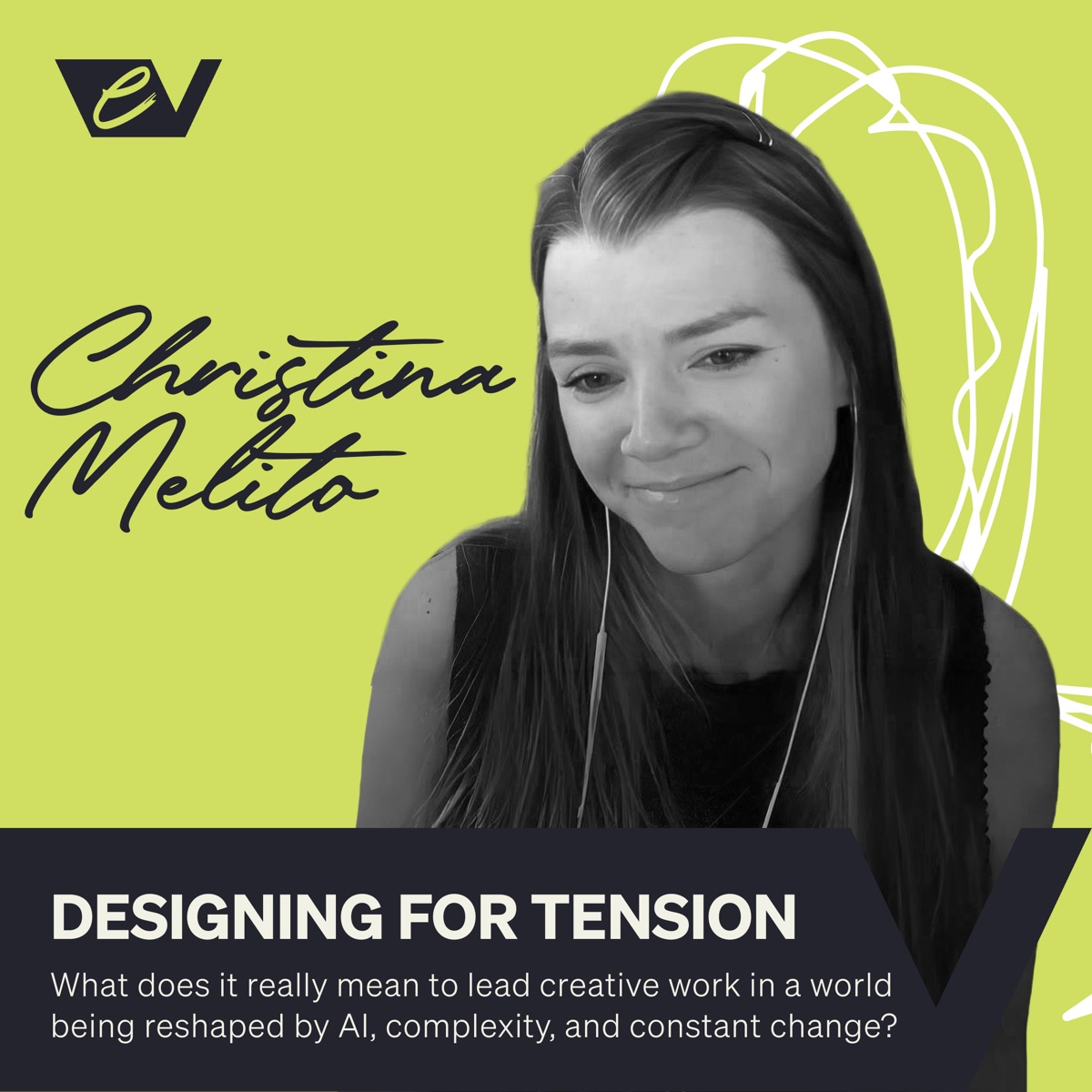
Christina Melito: Designing for Tension
Creative Director, Fifteen4
Watch or listen right here
About this episode
What does it really mean to lead creative work in a world being reshaped by AI, complexity, and constant change? An honest, funny, and deeply insightful conversation about what creative leadership actually requires today.
From managing stakeholders in regulated industries to operationalizing AI tools without losing your soul.
In this conversation
- 01What creative leadership requires now
- 02Stakeholders in regulated industries
- 03Operationalizing AI
- 04Keeping your soul
Episode transcript
Read the full transcript
Transcribed from the episode recording; names and phrasing may contain small transcription errors.
Welcome everyone to another episode of Escape Velocity. i am here, your host, Tracey Halvorsen. I'm always here. um and I am here talking with Christina Melito, who is a creative director at 15.4 and has a lawnmower going in her background right now because that's just the way things happen.
I do know. We have to get things done, don't we?
So
we still got to get things done.
Well, that's the universe just saying like, how good are you going to be able to deal with the issues we are going to throw at you today? So we're going to roll with it. um Anyhow, so thanks again for listening. And ah ah just a little background. So Christina kind of got on my radar a little bit. unusually um in the sense that she just kind of reached out and wanted to chat. And she's, you know, a fellow creative working in the same area as I am, you know, in Maryland, um has has spent the last almost 20 years working in this industry. and And I'm, ah you know, it's funny, you'd think more people would kind of reach out and ask to talk and engage. And I'm just telling you, They don't. The ones that reach out are usually like spammers who want to sell you something. So it was a real breath of fresh air. And I took her up on her request and we had a great talk. And I loved hearing about her journey and answering questions and and asking um my own. And so we decided that we would turn it into a podcast episode, which we are doing today. So Christina, thank you for joining. um if you'd like to kind of give a little background about what you're up to right now and let everybody know who's listening a little bit from you.
Well, i I will thank you again for your time about six months back when I thought I just needed a little check-in from somebody I've admired for years who's been doing great work from just around the way, you know, Baltimore.
and
And your name came highly recommended as somebody I could maybe seek advice from or just throw some ideas around with. And so I i still thank you today for that time.
You are most welcome.
and You're very generous, really.
And it's good.
we're all very busy. And so that was lovely. Um, so I'm about one year in, having switched agencies from maybe G to 15, four. And, you know, I was, I was naive. I was a little naive about how easy I thought the transition would be from, from one team to another, from a larger agency to a smaller, from one set of clients to another. and so I'm getting my groove though now. And I, and I'm really, I am starting to flourish and it's going really well. And so, you know, I just think this is a wonderful time to sit together and just reflect on the things that we we've been through together or we the experiences we've had and see if it helps your listeners. So thanks Hey guys.
Well, great. Well, um all of my listeners, how there might be like maybe 10 at this point. don't know. But we are so appreciative that you're here listening right now. and um And look, it's been crazy the last couple of years in particular. And, you know, I went, I exited my old agency In 2019, I was like going through it, figuring it out, you know, working with lawyers. It was so not fun. um and then finally, like things get signed, bam, pandemic happens. And I'm just like, well, I've already been kind of in lockdown isolation for last year, so I can deal with the pandemic. And then coming out of that, it's like the whole nature of how we work together got so changed by that. And then, you know, the universe said, let's give you a little more fun.
Yeah.
And so i just feel like what I thought was crazy times passing and then we get to a new normal that feels like normal just accelerated into more crazy and more crazy. And um from, you know, being in client services, right, we work with people and we use our creativity
Mm-hmm.
and our other talents, um not like the lawnmower guy who is using his lawnmower to mow the lawn.
Mm-hmm. My husband. Right?
But it's such a challenge and it's really easy, I think, to to navigate all the people in the mix in client services from your own internal team. And now you're managing more people and have more responsibility. And then of course there's the clients and whatever issues they have. So I think, um you know, one question I have for you being a year in where you're at, in the midst of crazy times like the rest of us, has there been, we all know that the the bad, right? Has there been one thing that's gotten you really excited that you were not expecting to be so exciting about the industry or your job or your career path?
Yeah. So couple things real quick. I remember when quarantine started and, you know, there were a couple teams I was working with and my previous employer.
you
There were like seven others of us like supporting a contract together. And I remember it was really a dark time for some people to get acclimated to the isolation or the perception of isolation and then breaking that down with more virtual meetings, turning our cameras on, of kind of water cooler talk and building time and then rituals around how we can still stay connected. So I remember that, but I thought our teams thrived and if anything, we were delivering some of the best work we had to date as a team, even though we were all virtual. Um, and so, but like, you know, fast forward to where we are now and had, could we have guessed in 2019? twenty nineteen Well, I think ai was out. I think ChatGPT was out or was just around the corner. I remember it was, and ah it it launched, it was free.
Yeah.
it I was curious. I definitely wasn't, I don't want to say an early adopter, but I was definitely an early like tinkerer of like, what is this thing? um And there was a moment about four or five months ago when my my boss came to me and said, hey, there's this like, There's this company I've talked to and I'm learning about that builds custom AI agents, like specifically for creative agencies. And I like instantly knew 10 things that if I never did again and could assign and direct to somebody that could be in the form of like this, like operationalizing that I could free myself up or the team's time up to focus on strategy and focus on concept and dedicate more brain power to what I ultimately think clients want to pay for. <unk> That's the value is like freeing up the human mind to do better work, to do more differentiated work, more fresh, more. I can't wait to tell them going to feel so bad. um And so in that moment, about four months ago, I was like, oh my gosh, Like this is the most, um oh man, like it was a very moving moment actually where I was like, oh, I don't have to flesh out a 60 to 100 icon library, custom icon library ever again. I can just define 15 of them and have an agent produce the other 90. Those are, I don't want my developer Photoshopping logos that are gonna go on the website. I'm like, no, I wanna free them up to code I want to frame up the build things from scratch and apps and build new product systems and stuff. So I am very excited about it. um You know, I, I will say some people at the company at 15 four are nervous and they're, they're, they're not sure. um And I do these little activities where I'm like, Hey, I've just saw you write a, like basically build a custom plugin for a client that's had to meet all these really complex requirements. And now that it's done and fully tested and launched, deployed, can you just try to like reverse engineer your process using chat GV? Like just test it and see, could it, could you under it's under the like, um, expertise that you bring as like a senior level software engineer, like, and you prompting it, what to do. can you get the results that you want? Can it, could it have saved you some, a number of hours? And, and he's done that a few times where he was like, I impressed with what it can do. So, um, that's just an example of like trying to chip away at, um, at the fear of something that I don't think is going away. I sometimes relate it to remember when you had, people working at print shop. I don't even remember this. You might, it might even be like, but you had people working in print shops doing paste up and, and, and manually cutting out CMYK sheets of color. And this was pre Adobe Photoshop and illustrator. And then the moment Adobe rolls out its software, it revolutionizes things.
Yeah.
And I think it created more jobs. And when Netflix launched its streaming content, very disruptive. And we can argue that there's a lot of bad genres now, thanks to Netflix, but there's all these nuances and like sub genres and there's so much more available. And in theory, there's like more demand for more content and more experiences that we're sort of democratizing those big, you know, those big, um, like production companies like Fox and I'm fine if we chip away at those big guys, you know, like, so I, I'm excited about it, but what I, well, I, nothing actually keeps me up at night. You asked me like, does anything, I can sleep pretty well, shockingly, but, but if I were to say something like keeps me up at night, it's that the gap between my skillset and even just playing with tools that like Yanni is using and like I'm drooling over every day, ah Like I want to be in the tools and just experimenting and art and having an R and D time. And I it's soon. And even the leadership team said, we are carving time out for you r and D and this person on your team and this person, like we have to start integrating it. So I don't know.
That is, yeah, I mean, you touched upon some really interesting things. First of all, just for people listening, i think it's really helpful for everyone to hear, like, what what tools are you using? What are you, if you're making a bunch of custom icons, how are you doing that?
Well, is that an actual question are you well, so,
i You know, that's an actual question because I think people want to know.
um so we aren't using a tool yet. I mean, we use, we use chat GPT or i do some of us do um to do administrative tasks to assist in either calling research or formatting and organizing research.
Mm-hmm.
Um, but that's my, my favorite way to use it right now, because I think learning and researching is 50% of my like time, um, understanding the client's needs and their industry, the market users, uh, you know, and so forth. I use it as a research tool predominantly in this moment. Um, but we, we do want to, we're, we're looking to stand up ways in which we can relieve the production design. aspect of of producing design and digital products.
Yeah. Yeah.
so that full transparency, yeah, that's where we are. We're like a very infancy stage. But the the ideas for what we could operationalize, even from proposal writing to writing technical requirements to doing technical audits pre-signing a proposal, right? I'm like, we need to better understand the beast we are about to redesign and develop.
yeah
um We can automate a lot of that.
Yeah, it's, it's right.
We can't, yeah. in
I mean, I'm right with you on AI being one of the most exciting things that I have experienced. And it reminds me of when the web was first getting started, because that's when I got in and sort of obsessed with it. And it's why I named my first company Fastbot, because I wanted a short domain name, And I had been obsessed with the idea that with a quick cam, this is back in the quick cam days with, with a quick cam, a little Adobe after effects knowledge and knowing how to publish anything on the web, I could create commercials. I could create 15 second spots. That prior to these tools being, as you said, democratized, that was the work of giant production houses and huge budgets.
Mm-hmm.
And here i am like thinking this is all possible now. um And I think that AI is is doing the exact same thing ah in terms of giving people a lot of ability. I mean, I use chat GPT.com. One of my favorite ways to use it is if something's broken or if I don't know how to do something from software to like, uh, what did I use it for the other night? My pepper shaker had come apart and all the little pieces, was like a grinder and all the little pieces had like fallen all over the table. And, and I thought, I'm going to have to get a new pepper shaker or pepper grinder. And then I took Chad GPT. I took a picture of all the pieces and parts. and said, can you tell me how to put this back together? And it did.
I love that.
And I put it back together. And if so and if I'm working in software, yes, yes.
And one less thing the landfill too, by the way, which I love. Mm-hmm.
I mean, I'm able to fix so many more things than I used to be able to fix. And i also um use it a lot to... to Well, i'm I'm thinking about like how I use the the vision part of it where it can see things. um you know ah Diagnosing my my sick plants, I'll ask it, and know hey, what do you think is wrong with this? um With the kid's homework, I don't know to that.
Right. Yes. Yes.
I don't know how to do that.
My husband, is my husband has the patience to help with homework.
i don't know how to do yeah
Yeah.
But I will just take a picture of the homework sheet with all the crazy math on it that I don't even know how to do now and just ask it to ah you know walk me through how to help one of the boys figure it out or to verify that their answer is right or even to explain what is going on.
Yeah.
So anyway, it's great it's great for that. um And I was just talking to someone else earlier who was talking about Google's notebook LLM or notebook, whatever it's called. But the fact that you can take a bunch of really complicated stuff, drop it into that, and get a 15-minute podcast that you can give your team or the client so that they can understand complicated things very quickly and very easily versus read all of this research material and books or whatever.
Oh, yes.
No, here, just listen to this and you'll be up to speed. Fantastic.
Yeah. I, in terms of like, if you use AI to assist in just communicating a creative idea, it could be if you could think about it, just prototyping, you could think about a client who maybe does like to tinker around
yeah
and it And it really is just an aid for them to get an idea out so that the right team can come in who has the expertise to say like interview and put the right, put like real people on camera and help tell that story. i I just see it i wrote as a communication tool, which like I can use that help. I think it's going to help a lot of people and reduce a lot of hurdles and bumps and friction for training and learning and really just having certain kinds of tough conversations.
So I agree. um and It just made me think, as a creative, one of the things you have to be good at is communicating abstract ideas to both clients and team members who have to execute.
Mm-hmm.
And because of that communication skillset that you do have from your profession, i do, I, I believe that is the most exciting thing for me to see how AI is changing because it does, we are getting shorter and shorter from the idea to seeing what it might feel like or look like or act like in, at least in digital spaces. Um, we were We were working with a client ah not that long ago. And while we're in discovery, while we're kicking off, we are going ahead and and prototyping and wireframing and iterating and letting AI tools, you know, give us instant feedback and vibe designing or whatever, you know, whatever. We're vibing. We're vibing.
We are, we, we recently were working on a proposal and along with the submission was a clickable prototype of of very particular kind of application they needed. And it was small in terms of its user flow, but it helped for, it helped that the proposal writer didn't have to try to attempt to articulate it and the aspects of it.
Yeah.
And somebody else on the other side got to like, kind of feel around knowing that none of the code, I mean, it was done in Figma, but like none of the code was going to be used in them, but like to to feel it and to react to it. I'm actually very pro hearing the reactions, good or bad from, from stakeholders. Cause that's telling in and of itself, because I feel like creatives are, are behavioral psychologists first um followed by researchers, followed by producers. And so Yeah, that really was something that our team found like wonderfully helpful. I think that the proposal receiver was grateful to to expedite the process. And it really helped us really fine tune the requirements and ultimately the cost, which like I am all four delivering to the client what they actually need and not necessarily what they believe they need that they've written into an RFP that we've been
Right.
mirror of response to, I'm, I'm all about like listening and really figuring out the need, the problem, uh, and, and delivering just on, on that or like versus, well, we'll sell them whatever we sell or like, this is what we, we want to sell them.
right
And i'm like, I really think we should just hear them out and maybe curb parts of our process to, to not over or under deliver, um,
Well, you know, earlier before we, before we hit the record, we were just talking a little bit about, you know, just, uh, the industry and, and how long we've been in it, how long we intend to stay in it and keep working.
You hit the record.
And, and I think basically what we're saying is we're both very curious people. Um, and who both I think believe that there's, there's always something bigger and better or more or different or more fulfilling or will give us growth, whatever it might be ahead of us.
you
We aren't sort of like looking for the finish line in our, in our lives.
Right. We embrace change. We are open to adapting. Yeah. yes
So knowing that, that we're similar on that front, um, I think that it's got to be hard when you're trying to work with people who who do like to feel like they know the answer to everything before they've listened. Or God forbid they even say, i don't know, but that's really interesting and curious. Let me think about it. And I'm a big believer in... come to the, come to whatever it is that you're coming to with curiosity, don't already have the answer in your head. And if the client is the same way and appreciates that, it lets you move so much more quickly and the outcomes are just so much better because everyone's going into it with a explorer mindset and a collaborative mindset instead of a, uh,
Yeah. Mm-hmm.
you know agency, vendor, waterfall process. you know We'll see you in three months after we've and our done our research.
Oh yeah, no. Right.
um
Well, interestingly, one of the questions that you, um, you sent prior to this meeting that we're in right now, uh, was about.
isn't ah This isn't a meeting.
Well, okay. Our cool fun chat, um, was about, uh, it had to about, what was it like innovation and risk in industries that are regulated, heavily regulated.
All right. Our chat.
And, and one of the techniques that I've used is sometimes I'll, I will want the company or the team or myself to come into that first meeting with An idea of what the strategy should be just so I have something to challenge as I listen to them. Like, cause I feel like I need something in there to bend and squeeze and pull chip away at just so that like, that's the framework that I need to debate in my mind. Is there some time like, and I like to look at their, the client's landscape. and what they're already doing and what's public facing and put together what I think their strategy is so that when we walk into discovery meetings or stakeholder interviews or look at analytics from various digital tools they're using, like, Then I can start to chip away at it or validate it and so forth. So yes, I'm all for like, are we, do we have an open mindset? Are we open to not knowing what's, what's around the next corner? um But for me, I don't, I think it's, I like to walk in with something and that that's because I would like to be more well-read or researched I like to have some amount of of a barometer, as we used to say in my old team.
Thank you.
like We build a barometer for how we know we're going to like navigate through this process and how will we know that like we're getting closer and honing to the right territory and direction.
yeah
So I just thought, oh, that's so interesting that you're like, let's go in blank slate. i'm like I almost can't. Cause like, I want to be able to have like, listen to what they say about their subject matter and be able to follow up with a meaningful reaction or or a follow question that lets them know, I understand where they are and I understand what they're trying to do.
ah
But internally i'm I'm like, was my hypothesis right? Was it wrong? Just, yeah. Isn't that, is that like, I don't know. is that weird? What do you think of that?
I don't know.
Yeah, that's fine.
i think i think it's a
This is what it is. Yeah.
I think it's interesting. i don't think it's weird.
Yeah. Mm-hmm.
I think it's interesting. i think it shows that you have a lot of empathy for your clients because you want to know where you're meeting them at. So how can you do that if you don't do your research and understand the ground they are standing on when you meet them and what they've covered leading up to that, if at all possible?
Yeah. Talk about building trust, right? Yeah. I want them to know that I'm taking their problems and what they've been doing like very seriously um so that they know at least I'm informed or the team's informed when we do make recommendations to pivot or evolve or expand or change or whatever it is, um just so they know that like we're very informed on what you've been doing.
Yeah.
And some of it's great. Some... Some of it's really great. ah Sure. And then we like inch our way when we talk about like regulated customer, you know client clients that operate in regulated industries. um Innovation isn't a 45 degree turn.
Yeah.
It's like every month, every quarter, we're we're going maybe one degree, one degree, get there. We're moving the needle. And after a year, because typically the clients I've supported my previous employer, we were on like three, five year long contracts. So we had to kind of have an end goal in mind at the beginning, knowing it it's it's 10 degree pivot. But like, how do we guide this client through in a really in a way they feel confident? maybe even still in control that like we're going to inch towards like differentiating you or like tweaking your um tone or approach you know so forth so anyhow that's just some things i'll say
I think, ah so that made me wonder, has have you ever experienced, and maybe you haven't, hopefully you haven't, but have you ever experienced a point in a project with a client where you thought you'd been building the trust? There'd been a lot of agreement and consensus, so everything feels like it's moving along in the right way. And then, actually, this is two-part question. Either one, the client says, I want to go want to make a left here. And you're shocked and also, no, we've we absolutely are not going left here. We're going right. um has Has that ever happened around you you know a creative direction or a strategic direction where they just come in and suddenly and there's the lawnmower back again?
ready
thought he was I thought he was gone. I thought he called it a day.
He was in the back for a little bit, now he's in the front.
He missed a spot right by the window. He's like, oh, I missed a spot.
He is detail-oriented in his lawn craftsmanship.
It's nice. It's like white noise. But um yeah, I mean...
Well, it's the question, have has there been a bigger pivot? Yes or no. And then if there's been a pivot, have you been able to wrangle the client back over to like, no, or like convince them
Yeah, well, what do we do when you do when you have a stakeholder show up who thinks they do know exactly what has to happen? And it's the absolute wrong thing. How do you...
I mean, i don't think I've ever been like that. I don't think I could characterize a moment like that quite that severely, not that severely, you know, like what it was dramatically, you know, but there has been a, there have been a couple of times where we've had to pivot. um And we can talk about that in a minute is your question ultimately though, like how we wrangled them back. Is that a kind of story you'd want to hear? If at all.
well Well, I do think that's interesting, but I guess my deeper question is while on its surface, something happening like that can seem like, oh no, everything was going great. And now we've got somebody showing up who carries some weight and they are saying some crazy shit right now.
Yeah. yeah
And how are we going to get this back on the rails? Sometimes I find that those moments in a project, can accelerate um better outcomes because there's this conflict now.
Sure.
There is this pressure, yeah, tension.
Tension. Love it. do
So that's where I was kind of curious to get to. um in that example, it's not invited in. And i I'm a big believer in and and invite and being in trying be in control if you can, right?
Yes. um Oh, same Z's.
Yeah.
Yeah. um I guess ah I I'll say have been there. um We to mitigate the chances of that happening again. ah when we get into discovery and we do stakeholder interviews, we try to explain to the client who would be the most ideal candidates. And it could it could purposely be people we don't we know don't see eye to eye.
Thank you.
We might stick them in the same meeting. We might not. um We try to understand the motivation. you know We have one point of contact that'll like guide us through with the context and the political climate. and And so we can understand the weight or gravity of what we're hearing from certain people. um my act My favorite thing to do actually is to pull them all into one room. That is my prefer my preference would be to do facilitated discovery session or sessions, depending on how big it is the kinds of information we need to get out of the team. And we purposely present exercises and questions that we know the chances of tension arising. Like we want to create an environment where those things are happening, where we do have to talk politely, but we do have to put it out in public and like hash it out. um And, and so I'll say, yes, there have been times that's happened. um And now we try to like get ahead of that and just embrace it and know, and now that we're really good at like managing through those discussions and, being okay with being uncomfortable and and guiding the client through. It's okay to be uncomfortable. That's exactly what we want. It's by design um and getting them comfortable enough to open up and things like that.
Yes.
Again, behavioral psychology.
yeah
And so, ah but but when there have been times where there's a curve ball, and even once in my new job, like we knew what logo we were going to proceed with of the ah handful we had presented and They shared it with some stakeholders that weren't in the traditional stakeholder team and they had a subjective thought about it. what that They could not get past what they were seeing. And I was like, I don't see that at all. but ah but But if you really want us to consider ways of salvaging aspects of this. you know we're I'm open to being flexible and finding a way that everyone feels heard, that we are empathetic and okay. we you know But some sometimes you want to pitch the work. ah You want to pitch those creative and design decisions or ah strategic decisions you almost almost want to bake a scientific angle to it, or data-driven, or like we've seen a pattern that when we do this, or when we use this color combination, or we know users prefer this type of photography at this angle, like we we just try to study up on like what does perform well, what aspects of visual layout work well.
yeah
um We go to LinkedIn and Next and Facebook and we like read the trend reports. And um and so, So you try to bring in the objectivity and how you talk about the work, how you prepare the team to even dissect the work. Right. So we recently had a visual identity kickoff. Right. Which is like, OK, we've done the messaging part portion of your brand. We're going to move into the visual part of that. And like, let's two together stakeholder team that absolutely doesn't do graphic design at all, or like study theory, design theory, um but or behavioral psychology. let's ah Let's like, like i'll tell I will tell them straight up, like how do we remove the subjectivity from it? Because we aren't designing for you. I'm not designing for me. I'm not designing for you, other stakeholder. I'm designing for your college students or for your college students' parents.
Yeah.
And I was like, so here's some criteria we recommend. How do you all feel about this? Do you agree? Is anything missing? Should something be removed? you know And it's another way to say, like to build that barometer together, because then you can go back in a few weeks time and say, remember the stuff we said, like would would make it successful. Here it is again. um And so like now that as the more i try to reduce risk, which is weirdly something I say a lot, is like, how do we better communicate? How do we build the expectation? How do we bring the client along? How do we make them feel like they know how to receive this work and make like informed decisions about it and approvals? And so the you know, we're tracked for years. We've been tracking with like, we're getting more approvals than not. We're like moving through these things. We aren't like what, what touch points, what document, whatever it is, what, what tools are we administering to manage expectations on both sides throughout the duration of what can be like a six to 12 month long project where you're like, we ain't got a lot budget sitting around to like totally redo the visual identity.
Yeah.
When at the end, someone's like, Oh, you didn't, Do a trademark research. You didn't, you didn't like check to see if this was trademarked, which like obviously we do, you know, but like there were times where like people may not have, and you're about to release a logo that looks a lot like the Nike swoosh, you know, or like you gotta do your research.
yeah
You have to maintain a pulse on their competitors. You have to make sure you're not about to drop messaging. It sounds just like their competitors. So it's, it's a lot, but I love it.
Yeah.
I mean, I love it. So.
What, what's your, ah what's your favorite aspect of, of what you do? If you could say.
I mean, I've, wow, that's so interesting. um I do feel like very, very, like fortunate to get to hear a customer's problem and then be trusted to set a team free on like really solving for their problems. And one of the questions you'd turn out was like, what is it what is a what is like an unknown?
Let's
Oh, I love the question. Hold on.
see if I can find it.
I know I got the little list here. or This list. Yeah. It's,
Biggest misconception outsiders have about creative work.
It's about what team, yeah, it's about like what what designers do that the stakeholders have a misconception about or like they don't.
Yeah.
and and And I don't know if, I try to manage this in presentations, but I don't know if they know just how much we deliberate over decisions that like, I mean, visual designers, like graphic designers are zooming in 10,000% on their logo. on their logo They're like, we're drawing, like we're in there. We're like all up in. We couldn't be more intimate with the details of the problems that they have or the solutions we're proposing for them. And so some, you know, sometimes it's a script and they want to like take a sentence out and you're like whoa, whoa, whoa. That's like the sixth beat of the eight beat structure. I don't think you under i understand the impacts you're making to this like whole message. um
Yeah.
and And that can happen in our traction. And so that we spend hours talking about their problems and really assessing their problems is I, and that we're very well researched and and aware and maintaining that pulse in their industry on their behalf. um It's something I love to do, but I think there's also this misconception of like how, you know, well read or how much do they, does the team actually care about, know, I'm like, weirdly a lot.
Well, yeah.
Like we think about it at 6am sometimes.
I know, right? Sometimes more than the client even.
Right. Right. Well, so I love when a client is like, Oh, thank God we found the people. We found the people.
Yeah.
Yeah. You do it. ah you tell me and they show me numbers. Sure. And like, cool. And explain it to my stakeholders. Great. And I can go to sleep at night, you know,
Yeah. Yeah. I think it's the best compliment when, uh, when someone says, you know, wow, this, this really feels like us. This feels like the us that I always thought we could be, but I could never articulate it. I could never visualize it I didn't think anyone, i didn't think it was possible.
Mm-hmm.
And then not only do they feel like it reflects them in a powerful way, it reflects them with big headlights, right?
Mm-hmm.
ah Shine a big path. forward for them. Because what I love is, yes, hearing the problems. and I'm a obsessive problem solver. it's you know It's probably why I need my own therapy is because of how much I try to fix and problem solve for everyone. But I i think that a lot of times clients don't either don't know or they don't allow us, speaking collectively as just creative people, to, to dig for the problems because we want to solve business problems.
you
We don't want to solve aesthetic problems. We don't want to, we're not into redecorate.
performance problems.
Yeah. And our process is not for performance. This is not performative strategy. Um, whether it's a website or brand packaging, whatever, it's all about the business. And a lot, so many times actually, you know, I get an ah RFP or somebody reaches out and they're like, here's here's who we are and here, here's what we need. And I'm like, yeah.
Here's an example. We are a company, we just bought our competitor company and we're merging now. And we think all we need is a website with like no real UX, you know, support or research or, um you know, no consideration of how voice and tone and brand is shifting for one or the other, or this now new entity. um And it's, You know, we, of course, in this particular instance where it's two companies merging, they think, easy peasy, just give me a new site. And we're like, well, will you continue to to administer the same sets of services? how does one customer like How does a customer base from one company feel about now getting services from the competitor company?
Right.
And we're like, have you thought about how that? And in the end, I don't know if they saw the value of that, but we were like, we don't know any other way. Like yeah we really think it's our responsibility to tell you that this is a problem you should address now versus waiting until something fails down the road, like really embrace fully, uh, what you're trying to do here so that your company is at least positioned to like do better. Ultimately.
Yeah.
Yeah. So,
Yeah. It's, it's so fun. um and and And I think you're right. I think we probably spend more nights lying awake thinking about our clients, businesses and projects.
It's fun though, right?
It was fun.
It's not scary.
Yeah.
It's just like fascinating and fun. And like they're real problems. Like they're real problems.
Yeah.
um that's That's what's like so wild is like I get to assist in hopefully helping them and like being a fresh perspective or even like saying, here are three distinct patterns we're seeing. And like, what's your reaction to that? Sometimes you want to ah create environment that they discover it like you just like lay the groundwork and you're like, what do you see?
yeah
And then they're like, oh, right.
Yeah. i always I always warn clients or caution them or or promise them that they may think that they are signing up for a brand project or a website project. It might not even be digital at all. But they if they are not transformed through the work, they will do.
right
for the better, right? And the business as well, but everybody involved is going to change through this process. That's when i think you start to understand that like a website redesign can be a complete organizational transformation.
Yes. Change management. yeah
It can, it will, it can and should change everything for the better. And so to, to just realize that That's what you're really doing. You're not doing a website. You are changing the organization.
Yeah.
And who the organization serves will benefit from that, which will ultimately, you know, serve the organization.
So sometimes if you were to say that that exact language to a client, they might think, oh, but we're not ready for change. And so some sometimes I like to just like, here are the problems, hear about how their current web team manages blogs and posting and ah making updates and adding new landing pages and so forth. you can hear the lawnmower totally apologize but um sometimes i just want to hear i want to like hear ah the ways in which they manage their brand and operate in their brand and use their tools and then we kind of like to just bake in best practices knowing their needs and let it be an aha moment and like let them happily discover like this just got way easier like you no longer have to manually put this blog post there or this article there like it will
yeah I mean, you've got a really big lot of them. yeah
cascade through it. all Related content is going to work so much better now. And I almost like like it to be that, oh I don't know how to explain that, but there's been moments when we're doing training and the client's like, oh my God, I love how you built this module for this thing that I hated dealing with before. And we're like, uh-huh.
well
So, yeah.
Yeah. I mean, making people's lives better by removing pains in their asses is, is great, but I think you're right. You don't want to freak clients out by saying everything's about to change. Are you ready? Yeah.
And I'm sure you're not going and saying that unless you know that's what they asked to hear and or been been like they're paying for.
Yeah. I mean, so some of them aren't, and some of them aren't ready or don't want that. Um, and that's fair. Right. But I think there are a lot of clients who, who know that other things need to change, but they're talk, they think they're talking to me about X, Y, or Z. And what ends up happening is it, it, it's a holistic change. it's going to touch all aspects. It's got to have buy-in. It's got to have support. Like it's got to have momentum. It's got to have belief, whatever it might be from the right people in the right ways, you know, which back to your point earlier of, of reminding people that this is not for them, nor is this, you know, this is not in my studio.
Mm-hmm.
This is not a pro a personal project. We are doing this work to, communicate and to create action from very specific audiences who have their own very specific pain points and needs and concerns and stresses.
Like prompt action. Right.
And it's almost like if you do it right, you finally detach. It's like a conjoined twin that you finally detach. And the organization realizes, oh, we can do our own internal stuff. And then there's our marketing and our brand and our website.
right
And we don't, we can solve them in different ways because they should be solved differently, but we don't have to just keep being tied to our own structure, our own way of doing things, of thinking, of talking.
in our own ways.
um We can change that. You know, i think I was just talking to very brilliant strategist about working in, um who was she working with? It was it was like a ah was a hospital system. and i think it was ah it was a higher ed hospital system. and She was saying that these doctors who had spent a lot of time and money get to get a lot of you know initials after their were liked to use big words, big complicated words when they were explaining what they were going to do with whatever their specialty was, right?
Oh, to patients
Yeah, just a lot of jargon and big complicated medical terminology that your average reader is just going to be intimidated by.
scary too. can be depending on your, yeah.
And she literally found data that supported that when you present medical information in easy to understand plain language, there is a so there is a trackable drop in mortality.
How?
So she was like able to use data to convince these doctors and these, you know, maybe professors too, um, med school doctors, I don't know. Basically you use plain language, drop all the jargon and, and trying to be sound impressive because you're smart and everyone knows it and you'll actually be saving lives, saving more lives.
That's amazing.
And they were like, Oh, okay.
I get that.
okay Well, I guess we got to do that.
Like we are in this profession to do just that safe life. So how could we not? Right.
Yes, yes.
That's wonderful. Yeah.
Yeah.
You know, obviously work, maybe not obvious, but I used to work for the government and one of, you know, speaking of regulated industries, um, we had to communicate at like an eighth grade reading level. Like that's a plain language.
yeah
Plain language is I think their term. It's like written in policy. like if you're gonna do strategic communications, it has to be at these kind of this this reading level for the general public because people just need to understand how taxpayer dollars are spent. and if you're saying and if a scientist is writing their research paper about the wonderful cutting edge life-saving vaccine work we're doing and research and development we're doing uh but they're like i don't understand ha um you know how do you either turn that into a metaphor or like really distill it down to um the the building blocks of the fundamentals of like what a scientific research like approach is and how much time that will take to turn into a life-saving vaccine or therapeutic you know like um i i that's that's also fun it's hard work though like how do you just i love distilling down problems into like their simplest forms so that we can like rebuild a story or like a narrative around or package around um around that so yeah very fun yeah
Yeah. Absolutely. and Yeah. And finding where those stories are true, right?
Yeah.
And which ones are the jargon that they've been living with for so long.
Yeah. Yeah. Sometimes I, I've been in virtual calls with scientists and, and I will, I'll be the first to ask the question. I think everyone's like thinking, but afraid to look maybe, I don't know, not as polished, but sometimes I'm like, Are you talking about a vaccine? yeah like Like they're just like so 10 feet ahead, like way high up here like language barrier. And I'm like, I think you're describing a new approach to a new style of vaccine, blah, blah, blah. And I'm like, is that right? You know, I don't mind kind of getting them to kind of start all over. in those rudimentary building blocks, like I'll be the, i don't, I don't care.
Yeah.
Yeah.
Yeah. It's, I think it's human nature.
I look vulnerable.
It's human nature that, um, the closer and deeper we are into our own little world, the harder it is for us to remember that not everyone is there with us.
Yeah. Mm-hmm.
You know, it's that myopic kind of self-centeredness of the human experience that can be problematic and
Mm-hmm.
But I do think that it's ah it's a great reason why everyone's always going to need an agency, right?
Right. Everyone's going to need someone to to distill and and repackage or or sometimes just remind the client, like, do you realize, like, from my perspective, this is a huge, valuable thing that you just explained to me, but you brushed right over that.
Yeah. Yeah. Yeah.
And like, what? We need to lean into this, please. And they're like, really?
Yeah, there
That seems cool to you? I'm like, what? This seems mind-blowing. So... um so those yes that and those were some of the scientists like yeah hey
Yeah, even just remind, if I had a dollar for every time I reminded a client that it's okay to keep retelling the great stories because not everyone has heard Yeah. Yeah.
and especially in this day of age i mean click click switch you know news feeds like ah
Yeah.
it's moments you if you even have that um to remind people of
yeah yeah
Yeah. Your position and, and, or your thought leadership or the experience you've had or the the foundation you've laid like, yeah. Yeah. i would
So let me ask you this before we, uh, before we wrap up now, especially now that, uh, your lawnmower guy, is he done?
I know now that I got quiet.
Is he done or is he just really far away?
Well, it's starting to rain. That could be it here. At least I'm in Ellicott city.
Um, what advice would you have for other women or anyone? really, but who is coming into this field, is getting started, is thinking about it, and wants to know that they are, you know, maybe following the right path. I don't know. Would you have any advice, any tips, any guidance?
um Yeah, so In the end, like, be true to yourself and not everything's comfortable and and that's okay. um But it is still important to like get feedback. or like get validation, whether that's from a peer or people you're working with people that are observing you do your thing. Um, something that, um, I absolutely leverage that from, from peers, um, even peers I don't work with anymore, uh, or whether it's a career coach or a therapist or psychologist, like it's okay to, um, talk through your problems, your, your creative, your like career problems and things like it's okay to be vulnerable, but seek feedback and continue to like hone and find your voice and your approach. And I would say it's don't miss the, don't like, you must seize the opportunities to get those questions out. Like, don't be afraid to ask in, in a big meeting with stakeholders, if something's gnawing at you and and, and in time you, you, you might find more clarity as you go about like, why am i why do I even want to ask this question? But like, just seize those moments and don't be quiet and don't, Don't worry about how people might see that. i yeah I'm the person that cuts people off. and I'm like, I'm sorry, but I promise it will all boil down to a better solution and recommendation in the end.
Mm-hmm.
if you can just sort of get around that I can be a lot sometimes or whatever. um And it's something actually like Steve, Steve Smallman's my boss. He's so elegant when carries people through stakeholder interviews. And i love the training of just watching him and his element and just being so graceful about extracting information from people and in a really comfortable way. um But ask the questions, pulls the threads, like, You getting the information you think you need to confidently make decisions about someone else's company, um that's really important. And ask for forgiveness later, or like someone can pull you aside after that meeting to say, i don't know if I would have gone about it that way.
Yeah.
You can be like, okay, but I got the information I needed. Because that, you know, give what you need, get you what you need from others.
Yeah.
Get as much training as you can.
ah Yeah.
from the place.
And, and the relationships that you form
Yeah.
over the course of your career are going to define it more than anything else. So be really cognizant of, you one of the, one of the jobs, one of the last jobs I took before I started my own company was because of who else worked there. I wanted to work with those people.
Yeah.
um I wanted to learn from them. And what I, what I would.
You're lucky by the way, you may have been at a place where you're like, I know who I don't wanna work with.
Yeah.
And just waiting for the moment where you could even get to a team or an environment or even if it's in-house, you know, where, oh there's a whole different ways to think about problems or process or to approach peers or to get feedback or whatever.
Well,
So like, you're fortunate.
Yeah, I was. was i've I've had a lot of ah lot of lot of luck um and tim good timing.
Yeah.
But what I would also just say is don't wait around for somebody to show up and tell you now you are an expert. Now you have a right to have an opinion. Now you can play around and try things and experiment. Now you're allowed to have a voice. No one is going to show up and give you that badge or that certification. and so to your point about digging in and doing your research, it's like if you want a job somewhere or you want to work in a certain field, dig it are you you want to win a client.
You study that agency. You want to be somewhere you network with them. you do you do a fake project that's in the same industry of clients they're supporting.
Yeah.
That's advice I've definitely given people who, um for a variety of reasons, whether they geographically just need to be at a place where they are. I'm like, you need to be strategic in how you're even studying either the people you want to work with or the agencies you want to be at or the in-house shops you want to be a part of.
you
um If it's like an industry or calls, that like you you can really back that mission and like it's really meaningful to you. Like I have a ah breast cancer survivor friend who's just finished school for design. I'm like, you know so much about the recovery process and cancer and like, and you're so passionate about it you could like totally work for a nonprofit or, you know, your your amount of passion that you bring, just like being a survivor could like totally be infused into the work you do day in and day out that you have immense conviction for.
Yeah.
But it's also okay it to like go anywhere and just see, just like open yourself up to experience and learn from that.
Oh yeah.
Cause not everybody knows what what they want.
um
I'm like, just get somewhere.
No. And the first couple, yeah, the first it's all just just don't stop making moves.
don't know.
Right. Um, I think those first couple years do as much as you can do throw yourself, do the grunt work,
Yeah. Yeah.
you know, do it while you're young and you can stay up late and you don't have kids to get home to and, you know, and then take your vacation time and go have fun, but do as many different things as you can do. And, I just think, again, putting yourself out there, having an opinion, always being curious, and just throwing yourself into things is the only way to to make progress. so and i'm you know You are one of the few people that's that's reached out and connected with me in a meaningful way.
Close my mind.
Um, so I say that just to, to say, you know, when I've reached out to people that I'm sure are like never going to respond, um, sometimes they do more often than not, they do because we're all sitting there thinking the same thing. Oh, they're so busy or, you know, they're so whatever.
have nothing to lose, though.
They're not going to write back.
I mean, yeah, the only thing you'd lose is not getting a response, but like just be ready for that.
Yeah.
And then the moment they do respond and you're like, oh, my gosh, then you're like, I can't. I have to use this time so wisely. Then then then the nerves kind of, you know, what's the best pieces of advice to go seek out?
Yes.
Yeah.
Yeah. i I had a great, I'll share one story.
Yeah.
um When I was just getting started with my first company, i had gone at my last job. They paid to send a couple of us up to New York City to so to a conference. it was This was back when Flash was still around. We went up to Flash Forward in New York City, and it was just a great conference. It was so fun. It was like half creative, wild, cool stuff, and half super geeky technical. It was like developers and artists all together. And so I came back. I had a great time. um Learned a lot. Was super inspired. And then I remember thinking, damn, every, that audience was so diverse and there were definitely about 50, 50 men, women in that audience.
Oh.
Um, and from all different, you know, it was just a very, it was a great, great audience. Every single person up on the stage was a dude. And this conference was run by a woman, Linda Wyman, the famous, infamous Linda Wyman. So I wrote her. I told her how great the conference was, but this was something I noticed. And I was just curious about it. I didn't come at her. I didn't attack her. But I was i was just like, how is that the case? so And she wrote back and said, you will be surprised to hear that we don't get speaking proposals from women. So there's only so many we can ask that we know of that are out there. And she said, so I look forward to reviewing your proposal for your talk.
No pressure.
It's the best throw the gauntlet down moment um in my life, honestly. And I'm eternally grateful for her for doing that. Because did I did send in a proposal. It was accepted. I spent six months like driving myself batty because I wanted to create something to show, to demonstrate what I was talking about. And then I nearly threw up at least 1,000 times preparing to get up on that stage in front of 2,000 people
yeah
to talk about something that I was just kind of figuring out myself.
Yeah.
And it was one of the best experiences of my life. And it totally helped launch my company. and um But, you know, that never would have happened if I hadn't written to her to share some feedback and ask a question. Oh,
Yeah. I, I, you know, I, I don't think I would be a 15 four if I didn't just kind of bump into some people at an AIGA event. and just got to talk and shop and business. And was Will Smallman. He's a, he runs the business and we were just, I was transparent. I'm a creative director at ADG. And, you know, so he knew, I didn't know how he would perceive like a creative leader from another shop. Like I wouldn't, not real competitor, but ish. And we just, what mattered was we spent 25 minutes just sort of immersed in talking about what the industry's like. And, um, the, it was just fascinating. and from there, we just kept talking and the chemistry was great with the team. And, um, and so I, I think networking is, is where, where is it? I think cold calling, putting resumes not knowing where they're going and, you gotta just get out and talk to people. The experiences are just so much more rich and, and you never know who you're going to meet or the opportunities you'll get or with the podcast you'll end up on.
Yeah. Yeah. Yeah, no. Yeah.
Uh, but I will say conferences is one way that I keep like, ex ex high, like,
Yeah. no start yeah
Talk about a way to validate. i with Me and ah my the so senior designer, Kristen, I work next to, we both went to first round. It's a day-long set of presentations but where agencies show you their first round brand pitch decks. And they're like unabridged, unedited, like this is what we show. You see our strategy. and And I knew my experience the first time I went. That was one of two of a few moments in my last 10 years that i were core memories where I was like, I think the same way. I have the same philosophy and ethics and like, I can do that color palette. And so I asked her after this experience, which she found wonderful. I was just like, were you validate, were you like, oh my gosh, I i strive to achieve that, wanna do that? Or do you feel like you already are just maybe on smaller scales?
Oh gosh.
She was like the latter girlfriend. I was like, yeah. Like I was so relieved that she saw in her abilities, like we're doing this. Like it's like a smaller scale.
yeah
It's not Wolf and Allens, you know, but, but like, heck if we're not doing just as informed and, and, and critical and like awesome work as they were. And so when I came to 15-4, I said, Steve, false man, My goal is I want to like have a first round pitch deck that I can take one day to this conference. Like that's my, I want them to come to Baltimore. I want to like dream about the agencies that would be on that list to present. And like, could we make it to that list? And so that's just like, you, you got to create your goals. I've, I've heard you talk about that in the and other episodes and like create, what's success to find success for you. It doesn't to be like revolutionary. You could just take these one off little things and like, I do love sitting.
Yeah, it doesn't happen sitting at home though. It doesn't happen.
No, I'm not going to lie.
doesn't happen.
I do love sitting, but you got to get out there. You got to put yourself out there, go to happy hours.
look i
have to,
i I hate networking more than you can imagine. I'm i'm an introvert extrovert. I can be extroverted in certain situations when I know what I'm gonna be talking about or i'm with a small group of people. Big groups of people where everyone's wearing their name tags and you're just walking around like, hey, who are you? Hi. i would rather stick needles in my eyes.
Ooh.
I find it to be so uncomfortable.
Hi. I'm going to try to get you to one.
but
I'm going to try to get you to one.
yeah
That's my goal. October. i don't know the dates yet, but it's coming.
Well, I will accept. um I will accept and maybe it will be less painful because you have it right.
I think you'll see. i think you'll see.
yeah I think you will invite me to a good one.
Yeah. yeah
um But yeah. And i so again, you know, if you're like me and the idea of all of this is, you know, scary or painful or intimidating, um it is so great to reach out to people to find, you know, a mentor, someone that can help say, I'll be the friendly face when you show up and, you know, we can hang in case like there's creepers there whatever it might be.
Mm-hmm. Or clicks. It's usually clicky.
yeah Or clicks or if you're just not sure, but, um, but you do just have to start saying yes to, to getting out there and and forming those relationships because even if 99 of them are awkward and uncomfortable and the one that will stick could change your life.
Mm-hmm. Right. They could change everything. They have their whole trajectory of like, yeah, it could.
Yeah.
This is true.
um All right. Well, this is, that's a good, good one to end on.
Oh, yeah. It wasn't microwave baloney.
Thank you. Yeah.
but You'll have to listen to some other episodes to figure out what that means.
i
But yeah.
yeah You know, um nobody wants microwave baloney is really the moral of the story. So don't
Which, by the way, is essentially a hot dog. I mean, like a hot dog, hot dog.
flat, flat round.
dog.
hot Hot dog.
hot dog
Yeah, I guess it is. i guess And I suppose you could roll it up. You could invent a whole new food group, really. It could be a roll like fruit roll-ups. It could be meat roll-ups.
me We could. or we could we could what's Let's not and say we did.
Baloney roll-ups. All right. Check in in a few months when Christina and I have launched our new hot rolled meat line.
Thank you. That will totally fail before it even even launches.
ah No, seriously, thank you so much for joining.
Thank you.
Thanks for suffering through um the universe's way of just trying to make it a little bit more uncomfortable for you with the lawnmower. Thanks to all the listeners for um laughing along with us about the lawnmower. And I hope this was an interesting conversation for anybody who's listening. Christina, I'll see you at that networking event. Thank you again.
Thank you.