Episode 16 · Jun 23, 2025
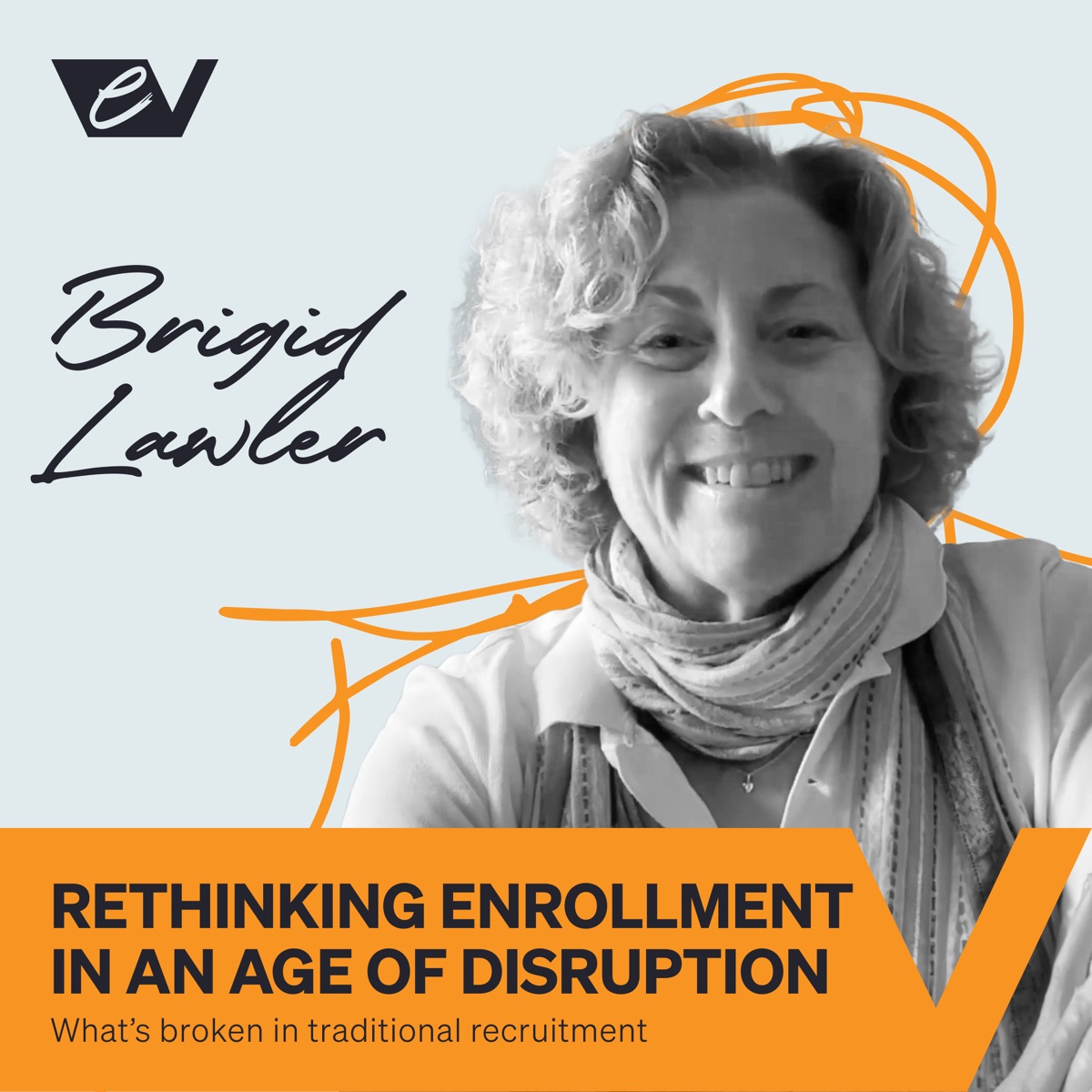
Brigid Lawler: Rethinking Enrollment in an Age of Disruption
Enrollment Strategist · Higher Education Consultant
Watch or listen right here
About this episode
Enrollment strategist Brigid Lawler joins to ask a heretical question: why the traditional admissions funnel might need to be flipped entirely.
A conversation about rethinking enrollment strategy in an era of demographic cliffs, shifting student expectations, and institutional disruption.
Links from this conversation
Episode transcript
Read the full transcript
Transcribed from the episode recording; names and phrasing may contain small transcription errors.
Looking at the camera.
Hey everybody, welcome to another episode of Escape Velocity. I'm your host, Tracey Halvorsen with Adeo. And today I am really excited to be talking to Bridget Lawler, who is an enrollment professional, um worked in higher ed for a long time, very passionate about this space, has seen a lot of things come and go. And we're and right now, you know we've been working together briefly and and just want to Talk about you know how breakthroughs have have worked, how you find them, how you how you when you need them, how you get a team to embrace them. And you know meanwhile, Bridget, thanks for joining. And if you'd like to kind of cover a little bit more about yourself, now's your time.
Yeah, I mean, i I can't thank you enough ah for the opportunity to have a chat with you. and We had a great chat when you first like started thinking about working with the last school I was at, and I really enjoyed the conversation there and glad that we have a chance to kind of extend it. Yeah, I mean, ah yeah I've spent about 30 some odd years in higher ed on both sides. Right. i I was on the student services side and career services and then crossed over to admissions and have just seen um have just seen a lot of. really interesting things happen over the years. And um it ist it's always been an interesting time, and but it is particularly interesting now. um Yeah, that's, you know, that's
Yeah.
I am a person who I think maybe doesn't always fit the mold of enrollment. ah I really love the idea of of ah small little places that are scrappy and do things different.
yeah
And yeah, and just trying to come up with creative ways to to really highlight all the things that each place has. You know, it breaks my heart when I think about small schools that are are not going to make it because those are great places. um And it's just the the landscape, it makes it so tough for them. Anyway, ramble, ramble, ramble, ramble.
No, not at all. I think, um you know, I also have worked in higher education from the agency side for, I guess, 25 years now. And on, in you know, my background is in the creative arts and really in in creative expression that then really moved into the digital space when when that all kind of started happening back in the in the late ninety s um And we started working with higher eds, not necessarily on purpose. And I remember thinking, um one of our very first clients was Delaware College of Art and Design. Now this was a long time ago, but I remember when we showed the president some of the original design ideas, his main concern was that we had used photos of students who had hats on and he wasn't comfortable with that. And I thought, you are the president of an art school.
Okay.
What is going on? And you know I think that that was an early um indicator that I'm still working with organizations that have been around for a long time. And over time, any company organization group, it falls it can fall into historical thinking, legacy thinking, processes start to kick in And you know there's not necessarily a ah change plan. um It becomes reactionary at worst. um At best, there is, you know, forward thinking leadership team in place in any of these ah situations. And, you know, what what I loved as I continue to work with higher eds is that the ones who started coming to us and working with us wanted to think differently. They wanted to think outside the box. They knew they needed to, they knew that their brand could back it up and they had the internal support to do it. And that led to fantastic projects with Bucknell and Yale and Brown and, you know, and big name schools and also some really great, you know, little schools that you may have never heard of. But they they still had that need and that desire to push the envelope and really differentiate themselves by doing so. What I think is interesting is that even in my old agency, over time, our processes started to become redundant. And I started to see, oh we are, we're becoming a company that, you know, just kind of runs through the, the grinder on this stuff. And, you know, when we talked and and you talked about some of the other groups you could work with, it was like, you didn't want that. Um, I've been thankful for the last five years where I've gotten to spendt you know work on a startup. I'm working in emerging markets. I'm working in places in politics you know where there's you've got to move fast. You have to differentiate. it is You've got to pay attention to what the the polls are saying, what the audiences are saying, what the consumers are saying. And so... It's been refreshing to be able to bring that thinking to Adeo. And when we were starting to work together, you know, it was very clear that that was an idea that you felt very strongly needed to be part of the work we did together. um But it is a challenge. right It is a challenge to break those habits. How do you make people suddenly get passionate and feel like they can take risks and you know but you've got your jobs on the line? um
I think you can touch on some really great points. And one in particular is, ah you alluded to, I think, is i think institutions tend to have an idea of who they think they are. And I'm not always 100% sure that accurate. they are accurate right They have ideas about who their students are or who their competition is. right And they get sort of stuck.
Right.
And it may have been. right like That may have been what it was. right
ye
and But the landscape is ever-changing. and And the same for for the for your prospective student. right
right
I think, again, there is no one size, right? Like people will say to me, um nobody wants a view book. View books are dead. And I think to myself, are they? Are, are ah pardon me, but crappy, run-of-the-mill, dime-a-dozen viewbooks dead? Yup. They've always been dead, right? But I think I look at a generation of people who have been so tied into technology, who... are actually craving tactile, right? Like those things that they can actually like look and touch and feel or whatever. um And so it's like, how do you, how do you take something that is so old and run of the mill and has the potential to be expensive and useless and make it something that is differentiator?
Yeah.
That's one example. I also think we have this tendency to say, oh, and Gen Zers are this, or Gen Zers want this, or Gen Zers want that. When in fact, I think part of the challenge is they're all over the place, right? and I remember taking my one of my step monsters. ah She was a junior, right? And her dad, Canadian, no experience with the college search process. great for me, right? Because I had this opportunity to kind of go out and see what was going on. And I remember when we started the process, she was so fixated on the physical space, right? She wanted to know like, what were the dorms gonna look like? And what was the campus like? And what was it close to? And even down to like the food in the rooms. And it wasn't until like that maturation, right? Like that process of starting when she was young, like right when she you know became a junior that spring and watching how that really morphed into a value proposition. How much is this going to cost? How much is it going to cost my family? Do they have the program that I'm interested in? Or I don't know what I'm interested in Are they a place where I'm going to be able to figure that out? Right. and So I think that all of those things really presents a challenge ah for enrollment when you're trying to figure out how do you market, how do you find ah how do you find that top of the funnel that's actually really going to yield for you, right? Yeah.
Yeah.
yeah
It's interesting too, um you know, higher ed ah being so, you know, traditional and kind of stuck in its ways. and And I agree it can, you know, I think for anyone, the longer you're staring in the mirror and the closer you get, the harder it is to really see the full picture. So, but the the other challenge is that, you know, the majority of them, they are, marketing themselves to this very elusive demographic because their, their preferences, their desires are kind of emerging. Um, they're not fully defined, you know, college is a defining moment in most people's lives where they have that time to fully kind of develop into what will, you know, be a more fully formed human eventually.
Right.
Um, But none of it is is kind of locked in stone and they all do come from, you everybody comes from different backgrounds and has different concerns. And I think you know you have to kind of throw your lasso around a few of them and make some generalizations about what what those concerns are or preferences. um But they don't wanna be spoken to as if you've you've lumped them in and you're speaking to a a target demographic or a Gen Z, know, So it's ah it's a really great challenge. um And I think it's, you know, look, brands like Nike and all the other ones, um how many millions of dollars a year do they spend on market research trying to understand this particular age group and what motivates them to, you know, get their parents to buy them an expensive pair of sneakers? And we're talking about a lot more than a pair of Air Jordans, you know?
Well, and it's interesting, right?
Thank
You bring up the parents, right? Because now in higher ed, I mean, depending on the demographic, parents have been involved to a certain extent, or whatever way, but I'm fascinated by by how much you have to have a really two-pronged approach, right? The one that is is going to appeal to the prospective student, but then also how are you appealing to the parent and how that changes by demographic, right? From a first gen parent to, you know, somebody who has had experience with college has, you know, come from different backgrounds and how much now, ah again, young folks are actually okay with their parents being a part of the process, right?
yeah
I can remember that not being the case, you know, that was not even a, in fact, it was almost ah but a deterrent, right?
Thank you.
Like if you, if it was the school that your parents really loved, there was a tendency to go in the complete total opposite direction. But now, you know, You really, when you're building out your marketing and your branding and your comm, you know, whatever those comm flows look like, you have to have another, you have to have an an almost an entirely, um I don't want to say different, but you do have to be looking at how do you morph what you're doing to appeal to those different, and those different segments of who your market actually is. And the parents are a big part of that.
Yeah. And it's tough too, because i think a lot of kids, um, are heading into college, not knowing what they want to do with their lives. Right. And so then they're going to the parents saying, you know, i want to go here. i want to look at this school. um you know, want to study these things, I think, but this place will give me, you know, time to figure that out. And as a parent, you're like, well, what are you likely to do with your life? um If you go here, you know, like, let's, let's just look at some possible outcomes, even. And it's like, you almost have to give the script to the kid to say like, and hand this part to your parent or guardian, whoever's worried about, you know, 10 years down the road when you can't even, you know, think past next month in terms of, you know, your life's ambitions, you're still kind of working on a much shorter timeline typically.
And it's a it is very much demographically based, right?
um so
I know I was working at a state school in Massachusetts and it was, um you know, the state liberal arts college. And the market was a lot of first generation kiddos, you know, but transfer students.
yeah
And that idea of taking the time to choose something, particularly in the liberal arts vein, was really considered quite a luxury by first by some of these you know folks who were like, no you will go here.
Right.
I will. You are OK to go here as long as you are doing something that is perceived as a good field to go into where there are good jobs, et cetera.
right
Right. um And you'd read the application and think to yourself, oh, my goodness, no. This person should not be going in this direction. They should be going in this direction. um And so, you know, how do you create that space um where folks who have not had that experience um or for whom it is a luxury, right, understand um that there's so many things that you can do if you create ah a space to be an agile thinker, right? Yes.
Yeah, I mean, i think higher ed has struggled with showing the the value of the liberal arts education in general.
Yes.
um I think that now is a very unique time in the history of human evolution where I think that you can make the case that nothing else matters. um when When we have so much change and so much disruption, that thinking, you know, critical thinking, communication skills, creative thinking, um exposure to lots of different, you know, cultures and and learning areas of of academic research, whatever it might be, the liberal arts right now is like, yeah, that's what we need everybody to get really good at that. Yeah.
I think also the challenge has been in where liberal arts schools have sort of shot themselves in the foot a bit is um it shouldn't be in either, like one is better than the other, right? Like there is tremendous amount of value to knowing what you want to do to choosing to go to a state school, right?
Right. Mm-hmm.
it's I think somehow the conversation became a one is better than the other. And I'm not 100% sure that that has done anybody any favors, right? Because there's a specific big market for for each, right? Like there are many, I've come across many students who do actually know what they want to do and who do not waiver, right? and And or who for whom that larger state school experience has been great. m And so I always am fascinated by this. I've seen liberal arts colleges do it. I've seen state schools do it where they sort of denigrate the other, you know, like they speak almost disparagingly of the other. And I think, well, no. There's room for everybody. It's more a question of, you know, who's going to going to thrive in an environment or who's going to be most successful in whatever environment.
Yeah.
And, you know, um i think I think that was always pretty interesting, right? And again, cost is so... so compelling. and I saw the last school I was at, you know, looking at the information about crossover applications and seeing that for the first time or for the first time in the school's real history, the top 10 crossovers were state institutions.
Mm-hmm.
Now, again, how do you compete with that when you were printed price tag is significantly higher, right? how do you How do you have those conversations with students about what are they actually paying, right? like So there's there's so many there's so many things. i don't Did you see that article recently? it was was in the Times and it was somebody who was talking about Syracuse and they were talking about, used very strong language, the word poaching, about how Syracuse ah
I did read that, yes.
as of May 2nd, right, was suddenly reaching out to all of these kiddos that they had admitted who didn't accept and offering them more money. And I had to really chuckle to myself and think, ah this has been going on for a very long time, right? Like the tone of the article almost made it sound like it was something that was new. And I thought, no, it's near new for Syracuse, right? Schools like Syracuse have probably never really been in that situation before. And now they find themselves there. But so many small schools,
Yeah.
yeah There's a couple of things there, right? First of all, students don't tell you where they're going. So you're constantly like so bombarding them with messaging, right? Because hope lives. You think, well, maybe they're going to go to an admitted student day and it's going to be like not what they wanted. And then they're going to be like, oh, you know what? Yes, I will come here. Or, um you know, unfortunately for many in enrollment, you don't that's You don't want to have to go out on the in the 11th hour and say, here's more money, right? Like the plan should be, how do you have those conversations up front in in January, in February, I would even say in the fall, right?
Thank you.
How do you have conversations with people about affordability and merit awards, right? Like the fact that Syracuse was having those conversations after May 1, I kind of thought couple of things, poor Syracuse, but also it was just it was such an interesting article because it was I felt like the tone of it was like as if this was a new thing. And I wanted to chime in and say, no it's a new thing for schools that have never had to struggle like this, but it's quite an old, and unpopular practice for a lot of schools that are really like having to like slog it out all the way up until the actual start of class, right?
Yeah.
Number of schools that are making their class by May 1, smaller and smaller. And so,
Yeah, mean it's tough it's challenging times for sure.
oh, incredibly trend.
um There's a lot of compression happening. You've got, you know, the, just the, the enrollment cliff, I guess we're heading off of it. Um, but I don't even think that's the biggest issue as much as it's the, just the negative conversations about the value. um you know, yeah.
about value, turn on investment about, yeah, there's so, there's so much to, it's like somebody described it to me as a big ball of Christmas lights. That's just completely tangled, you know, it's pretty, it's sparkly, but man, is it a pain to like sort of unravel and figure out like, how do you get in front of it? Right.
Yeah.
I look at
And you know, it's, it's, it's, it's so expensive for, for many, um or it requires so much debt to be taken on. And there've been so many conversations about how crippling that can actually be. So, you know, why would you, put your child or yourself in a situation where you're setting yourself up for failure, not success.
Well,
And, you know, it's hard for people to make sense of that.
and I think part of the, you know, part of the struggle or like in my head where I've gone is I've always thought to myself, okay, I'm somebody who is attending ah very expensive institution, right? Whether it's state or private, whatever. and i I want to be i'm going to pick on sociology, I want to become a social worker, I want to become a sociologist whatever that looks like right well. It may be a good idea to take a look at what is the earning potential and what is the education requirement for somebody to enter into that field, right? If you want to become a social licensed social worker, unless it's changed, you you needed a master's, right? You need to pursue a master's degree. Well, your salary, even with that master's degree, what is the income? What is the income for that? So there's nobody sort of not even sort of there's nobody having these conversations with folks early on about if you choose to go to school here and you choose to pursue this particular field.
Yeah.
You will need to do this and it is going to cost you this, but you will likely make this. Like there's no real conversation about that cost benefit analysis, right?
yeah
had a student at state school say to me, I chose to come here because I knew I was going to have to get a master's and I knew that that was going to cost me significant more significantly more. So I chose to come here for undergrad because I knew I'd get a good education, I'd have a good experience, you know, and then I wouldn't be so over my head for grad. That to me is like was mind blowing. Right. It was like ah thoughtfulness about about the next step. Right. About to your point earlier, when parents are like, what will you do with this and what will it cost you and to do something with it? How much education do you have and what what will it look like to continue? So.
Well, you know who has, i mean, I saw in your background, you did work for an arts institution for a while.
Very, very briefly, yes, but that was enlightening.
Yeah. You know, because I think of all the people that have the hardest, the hardest self, um when it comes to outcomes and showing like, okay, you know, if you you know if if you say you want to be an artist, there literally aren't that many good outcomes to even look to. um And I think it's been really interesting to see how how art schools have been addressing this, um you know, in in their content, And in the reality that most people don't go on to, if they're not teaching, um don't necessarily go on to have professional fine art careers, um but they might leverage their creative thinking in all sorts of interesting and entrepreneurial ways that I've always felt was kind of a ah storyline that
What?
that had a lot of a lot of angles to it. What was your take? What was your take on it?
A lot of angles and a lot of, i think, to your point, missed opportunities. you know and creative side of things is everywhere. There is no business that doesn't require those skills, right?
yeah
um And so I think, yeah, it is more about how do you have that conversation about all of the things, all of the different folks that are working in these different types of occupations who have come from this background, right? And how this background lends itself. um to, you know, so much of what drives ah what you see in the media, right? or or Or, gosh, everything you pick up has an artist attached to it, right? Or creative, some sort of creative aspect to it. um So it's really just how do you how do you explain that? How do you make that how do you make that conversation happen?
you.
And how do you um also help students to understand like the likelihood that you were going to be able to make your living initially through your art solely? and Maybe, maybe not, you know, but like, how do you have those conversations about what are the other things that you can do, right? How, you know,
Yeah, it's it's a universal, i mean, creativity is a universally needed, um but under no undervalued for sure.
Now you. Right.
And I think and misunderstood um characteristic or trait or whatever it might be. you know i I do think we are all creative, but to our points earlier in this conversation, it gets kind of seen as a threat um because the act of creation means new um so if you are just like no we are going to do it the way we've always done it we are going to think the way we've always thought and nothing new nothing's going to change that is not where you are going to have any kind of creative thinking and so i think there is um there's some there's some need there you know i think it just even in our society for there to be a an understanding of how creativity impacts positive outcomes um because everything is changing whether we you know want it to or not
And when you do something that is unique and different, right, it it rarely fails.
see
um It's just a question of patience, right? It's a question of people having patience to understand that things that are creative are often not a quick fix, right?
Yeah, not not a quick fix.
It's always
um That's why you don't want to like leave it for the end when you're in dire straits and you suddenly think, you know, we'll just get really creative with this one thing and it'll it'll pull us out of our whatever situation we're in. But I also think that ah I think people are naturally um fearful of others having opinions about you know their brand or their marketing or their messaging or their company or themselves. And when you when you do good creative work, um it's not it's it's unique. It stands on its own. It's memorable and it has a point of view And that's going to, not everyone is going to love it, you know, but you want everyone to have an opinion, whether it's a, you know, Hey, this is amazing. Or, Oh, this is not for me. This is horrible. I think a lot of people would rather just stay right in the middle, um, than risk that kind of scrutiny because then you do have to be really clear about whose voices matter. Um,
And that's that what it all sort of distills down to, right? comes back around to that whole idea about who who is making the decisions and whose voice, right?
Thank you.
um And so often, particularly in higher ed, you know, the folks who are um who are making the decisions or who have the say, m innovative, creative, something that goes too far from what their idea of the place is.
you
You know, it's just, it's very difficult. to kind of throw yourself out there. When I was working at Marlboro College, and they did this great rebranding view book. they It was still to this day, I look at it and I go, oh my gosh, like how they captured this place, you know? But there was endless conversation and back and forth because one, it was so, it was the the focus of this, of the campaign was physical, like visual faces, right?
Thank you.
And there was this there was this individual who had a piece of blue gum that you could see And the amount of conversation about the blue gum and you know, that you didn't you didn't want the blue gum and it was just, you know, that's, wheat the blue gum was Marlboro, right? Like that was the kid, that was the student, that was the individual, you know? And it was um it was hard for some folks who came from a different background, who maybe had been when it was a different place,
Exactly.
But I also think who were at different points in their lives, right? That is a huge challenge because we, so many of us in higher ed, we're older. And what we think is good or works or is right, I know I'm guilty of this, right? The stuff that I'm like, oh my God, that's amazing. Somebody young might look at that and be like, no, it really isn't, you know?
Yeah.
and And so that's the challenge, right? Is how do you stay fresh? and current and um you know, how do you, how do you keep testing those boundaries when you yourself start to just get very fixated on that stuff that appealed to you, right? Like, yeah.
Yeah. And also like there's a, you know, I mean, how many schools, especially right now, can afford to go through the revisions on, you know, to to update their their brand and messaging, to redo all the materials, to redo their website? You're talking, you know, historically speaking, that would be years and heading towards a million dollars, you know, and a lot of people's time. And it would just be a tremendous amount of of effort. And so you needed these things to be almost as timeless as possible. um and know And I think there's ah there's a pressure there to like, well, let's not make it too unique because what if then, you know, we got to redo it in two years or I don't know. That's what we-
Well, that's it, right?
you
How do you also keep things somewhat ever, ever clear? You know, that's a challenge.
yeah
and But also what I think is so challenging is that so many schools are spending so much money on on their, on a reliance on large schools. We have to be careful on large. and On large companies that are basically just. Sending out the same stuff, right? Like you could look at things and go up. I know which company did this. I know which company did that.
Yeah.
When.
Yeah.
if they And again, it's a challenge because bandwidth, right? Not even so much financial bandwidth, but but bandwidth, like people, the people to actually do the work when you want to bring it in-house.
yeah
and you know that that is That is the constant you know push me, pull me. um Personally, if you're a small place, I think you have a much better outcome when you are working within with a young, not a younger, but with like a firm that is doing a lot of different creative things, right? Because they are gonna look at you with a fresh set of eyes and they're gonna come at things in a different way.
Yeah.
And so the money that you spend there versus really a significant amount of money that you spend handing it over to someone else, um I just have never seen that work for small places, right?
yeah
Just, and you know, there's no affinity building. There's no um really taking the time for discovery to understand, like, who who are you? And, like, there's always talk of the funnel, right?
Mm-hmm.
Everybody wants a huge top of the funnel. Well, yeah, of course, because you're not yielding, because you're spending so much time throwing the spaghetti against the wall that you're not finding the people who are going to yield. To me, and enrollment funnel should be somewhat straight, right? It's not about so much at the top. It's about how much are you actually yielding, right?
Yeah.
Because if you're doing it right, your funnel should be straighter.
that's a i mean That's a great point. And you know i know that with a lot of those bigger agencies, um you know you're getting people who maybe have a couple years experience and they just they don't wanna lose their jobs. So they're gonna look at, well, what's worked for somebody else?
Well,
um What was deemed good work by somebody like this client? And that's probably what I'm gonna lean towards. So, you know I do think it's hard to be sure that the team that is gonna be working with you um is going to you know truly be trying to take those swings. um and do the research and build the affinity and understand all of the nuances that each each small place is so unique. um But-
I somebody say to me once about a bigger company, well, you know, you just really have to, you just really have to watch them.
it is
You have to keep, you know, your hands in and you have to basically you have to do the work. And in my head, I thought, then why am I not just doing it myself? Like, why am i why am I writing the check for this? You know, it's really what you just said is
yeah
it's almost more work because amount of time and energy that goes into making sure that you are not just getting the template, you know, you could have, you could have spent that time and energy, you know, just doing your own thing.
Yeah. can
But it's scary because if there's one little slip, if there's one little pause, know, in the met in in those communications going out or in any step, the the effect is it is really, it's significant.
Yeah. Yeah.
And so that fear is real. And people who have experienced the hiccup when they've moved from one place to another, you know, one company to another, um that fear is real. and it And the impact is... It's hard to come back from. So I get it. I understand. But at the same time, yeah, it's interesting, right?
yeah
Enrollment people. I'm always fascinated when you tell them like how much you do in enrollment, it's marketing and communications, it's financial aid, it's retention should be and right. Like you have to be just doing everything.
Yeah.
yeah. and yeah
And then, you know, how much internal leadership and guidance are you having to do too to to align your internal leadership? stakeholders with whatever it is that you're trying to accomplish to you know towards an eye towards enrollment. um Sometimes those things can be at odds.
Yeah, they can definitely be at odds. And it's also always interesting to me how I think people really underestimate or overestimate how much they think they know about enrollment um and how there is this assumption that it can't possibly be that hard, right?
Thank you.
If everybody just works a little harder, if everybody just visits a few more schools or, right, or it's just, it is it is one of those places where everybody feels that a bit like they have the ability to sort of weigh in. Yeah. And while you want that, right, you you want to create that collective, you want to create that environment where everybody feels like they're a part of it.
Amen.
um I think, you know, it is it's challenging sometimes to just have a conversation with people about. what is a funnel and what, what is the cycle of admission? Right. Because I've had, can't tell you how many times I've had people say to me, well, but you still have June, July, and August. just No, you do, but you don't. Right.
yeah
Like your class is made the January before that class. Right. Like,
yeah
or Or not even ah even further down, right? like So January of 2025, you are basically setting the tone and building out what your fall 2026 class is going to look like.
Now, ah this leads me to a question, right? Which is, so you've got all these metrics that drive all of this. You've got the deadlines, you've got all the, you know, early decision and and all these things that the kids are trying to weigh, you know? um Do you, and I agree, nobody understands it. And it's it's such a long tail, long game. and And we've got to contend with these stealth applicants, right? the people that you don't know, like they're gonna just show up and you're gonna be like, where'd they come from?
Oh my gosh. Right. right
So, I mean, how do you work with so much unknown in that kind of space where you're trying to to go, are we gonna make our our numbers here? Are we gonna have a good class?
And then there's the Christmas lights.
hundred ah
I mean, there's things that you can do, right? Like you can, you can back out your funnel. You can look at, okay, how historically have we yielded? Where have we yielded from? And that's part of it. Then there is, where is the potential for new?
Mm-hmm.
How do we get there? How do we leverage not having the ability to physically be in places how do you use third-party vendors to get your message out um how do you use social media in a way right like that is that uh the statistics now for kids how they want their messaging like majority of them want through it through it's you know like they want it through tiktok or instagram right like they don't
ti Yeah. Or YouTube. Yeah.
Right. um And so, you know, there's there's so much. um But do their parents want that communication? So again, it's like you're building out all of these different um all of these different mechanisms, throw into the mix um transfer populations or non-traditional students, right?
Yeah, international students, yeah.
It's Yes, and it and international is interesting so much so this year, right?
So,
Because for schools that have doubled down, you know, very aggressively on international students, that's thats thats could be that could be why we'll see many schools not hit who normally hit their numbers.
great.
Right.
Yeah, i think a lot of schools don't openly discuss the fact that international students do not qualify for aid. So they are all full pay. So there's a there's a big bag of cash coming with each one of those international students. and you know And that's fine. It's great when this is such a ah destination for education um and research and all of that. But now, and let alone, will they even be allowed People.
Well, they beat that in.
um
And so interesting, right? Schools that meet full need. So think about that.
Yeah.
So a school that meets full need is incredibly popular with international students. Of course, right?
Mm-hmm.
and And that also inflates your numbers when it comes to selectivity. have over 2500 international applications and you know because you're meeting need you're only going to be able to admit maybe like a really small class size of like 50. So you've now just right like think about your selectivity because nobody's disaggregating from that set that selectivity right those international applicants who you know you're never they're never you're never going to admit them they're not going come right because you can only do
Yeah. Yeah.
and right? Like you can only do so much, right? Small numbers.
Right.
And so there's, yeah, there's just, there's so much there. um And yeah, right? Like if you're a school, like if you're a research institution, where like your significant number is coming from, you're going to hit it. You're going to feel it this year, I think. It seems like
Yeah. Yeah. I guess we'll see. um It does just feel so much turmoil in higher ed in the last five, six years. I mean, there were times when I was like, whew, I'm glad that I'm not trying to solve those problems right now. ah It's, you know, and I guess I'm a glutton for punishment because I'm i'm back right at like the juiciest point in the storyline.
Right.
um But it is an incredible, and I love solving complicated problems, and this is a complicated one. um I'm just curious, you know, as we we we kind of near the end of this session, like when have you seen groups or teams or individuals have have the ability and go ahead and do something really different and have it work.
I mean, i know when I was at Barbro, we were struggling, struggling wildly, you know?
know
And it was this whole notion of um a needle in a haystack. You knew that there were kids out there that would be perfect. Keep saying kids, students, right? That would be perfect for the place, but it was like, how do you find them? And was really fortunate in that there was just trustees and president and faculty because it was such a small, such a intentional place.
Thank you.
that we we were able to start a program. It was the Renaissance Scholars Program, and it was also this program called Beautiful Minds. And it was an institution that was like, okay, how do we take how do we find the essence of who we are and we build these programs around it, right?
Mm-hmm.
And so not only are we gonna find the student who this is gonna appeal to, but we're also gonna find the student who's gonna be successful here, right?
yeah
And how do you change the culture of the place? And you know we we would have town meeting every week, And I remember everybody knew what the goal was. And we did this exercise called, who do you know? And it was everybody, we we were like, who knows somebody in Wisconsin?
Thank you.
And who knows somebody in Michigan? And the job, it became everybody's job to recruit and to find those students, right? and And that was really, to me, that was like such a great moment um because it was just the collective, right? It was everybody understood that admissions was everybody's job, right? Nobody is coming to a school because I'm effervescent. They might be attracted to that initially, but they're coming to a school because I'm making an assumption that I'm effervescing, but they're coming to a place because they want to study with you, right? Or they want to be in a classroom with you, or they see you as their potential best friend, right? Or they see... um And so I think that that is so crucial. um And that was, again, one of those instances where I just felt like I was very fortunate in that moment um to have people buy into this scheme and to really become
Thank you.
to go from in to go from a place where we would have enrollment events and nobody was there except admissions to four years later, having an open house that was current students, faculty, spouses, family, prospective students, families. It was just this amazing experience. It makes me sad that Marlboro couldn't hang in there, right? um But you could see how that really, that that is really what has always driven me and I think has attracted me to small places, um is that idea that you build this collaboration between the entire institution. Everybody in the fall should know what is the goal. What's our enrollment goal? And the admissions folks should be reporting back to faculty, staff, the entire campus regularly. Here's where we are in terms of our number of applications. Here's where we are in terms of our number of deposits. and almost like i won't always always joke about a t-shirt i want a t-shirt with the number on it just the number so that everybody is on board and gets it right like um yeah i can totally become the person who is just a little bit of the kool-aid drinker when it comes to that bad expression not supposed to use that but anyway right like
yeah yeah
That is the stuff that when that fires and it's working, you're like, yes, because at the end of the day, um assuming people are working at an institution because they really believe in the mission. You know, they love the institution.
Yeah.
They believe in it, but they also never lose sight of what is the purpose it is. You are going to change this person's life. This is the first major decision that a young person makes. Where they're going to work, who their friends are, who their partners are or aren't, right? All builds from where they go to school. And to have people, really, it's an honor for a student to even visit your campus because of all of the places that they could go to get them to choose to
Yeah.
to to come to your home, right? um You can't lose sight of that. And even if it's not the right fit for them to be able to say like, yeah, this probably isn't for you, but you know, maybe you should think about this place, right? That whole Gimbel's Macy's sort of a thing where at the end of the day, when you say to a parent, I just want them to find a place where they're going to fit and land and feel great, that should be the that should be the end game. And I think sometimes you get so caught up in the numbers not being there and the net tuition revenue and all of that, understandably, right? Because it's the survival of the school. But I think sometimes it's easy to lose sight of what the mission is, right? Why are we doing this? Why are we in this? and And it's because you believe in the transformative power of an institution, um of a place, right?
I think it's hard thing it's so hard for people to get into that mindset, especially when they're fearful, when they're in a place of reaction and defensiveness and they're scared about what's going to happen. It's not where your best thinking is it's going to happen.
No. Yeah.
um or you risk takingking or your your lens shifting like what it sounds like Marlboro was from grassroots and and changing kind of the culture or really embracing the culture and and the turning it inside out so that you allowed all those bundle of Christmas lights to to shine out and and through these lenses that aligned at least with you know what you could do at Marlboro. um Sounds like like a great experience to go through that.
yeah
And that does take time and leadership and it's, it's got to start from the inside. Right?
Yeah. And trust, right? Like people trust that you're, that you're, you know, that you're, I mean, again, I've been at places where people have said, don't talk about the numbers.
Yeah, absolutely.
Don't tell anybody what the numbers are. And I'm like, okay, if you're like me, if you don't tell me, i instinctively go to the worst place possible. That's just my, it's my nature, You don't tell me what it is. I'm like,
It must be really bad.
exciting You're not telling me because it's terrible.
Right.
And nine out of 10 times, that is the reason. So in my mind, it's like you have to give context, right? This is what the number looks like. But... understand, right, that these are great students that are going to have a great experience. And like, how do we get together and make sure that they stick? Right. Or, you know, just the more education you can provide to people that work in an institution with you about
Yeah. Yeah.
you know, the process and and and and where and who and how, i think the better, because then I think people begin to trust you, that you you know that you are working hard and that you do want them to partner with you, right? That you do value that they are the reason, right?
yeah
Again, it's not the admissions office. It is the tour guide. It is the faculty. It is the staff. It is the experience that somebody has when they're talking about their financial aid.
Yeah.
Oh, by the way, not just when they're thinking about coming there, but what does that look like all four years when that may change, right?
yeah
and I think it's really just how does an institution support not only the prospective students, but the incoming students, And the faculty and staff and how do they create that environment where everybody feels like we are in this together, right? Like we are all looking to do our best work because we believe in the mission. We believe in the place, right? Great.
Yeah, I think that's the dream and, and like, um ah yeah, rocky roads ahead. So I think it's also like you said, let's look at the numbers. Let's look at what rate reality is, is showing us and not bury our heads in the sand. um But but know that if we get through this, we will be different, we will be better, we'll be better suited for the future, we'll be better aligned around our mission and our values and and our you know are are our vision for what where we're trying to go and and the way we're trying to change these kids' lives or these students' lives. um So I do think it's it's just a scary time. So I certainly, you know, we can sit here and pontificate, but I also have a lot of empathy for folks that are in these positions as well internally.
Yeah, it is the hardest job.
Yeah.
I think the only thing that might be harder is folks that are in development, right?
Yeah. Yeah, they've been hard too.
um Yeah.
And a lot a lot more counting on development these days. a lot more on pressure on them.
Because you, you know, if you are realistic, you do have a realistic idea about what your numbers are going to look like.
yeah
And so, you know, you cannot necessarily turn things around in a year or on the back of admission for a lot of schools. Right. There is. but That's so hard. Right. Like that's the challenge for development. Right. Because how many people are like, well, I'm not going to give until I know that this place is going to make it. And you're like, if you don't give, we might not make it. Like you have to have that leap of faith, right?
Yeah.
and So that I think is probably the only job where I think, whew, that might even be more aggressive than enrollment. Because again, right? Like what do you say to somebody who's like, well, I'm going to just wait and see, you know, if you guys can get the numbers in and you're like, ugh. Yeah.
Yeah. Well, on that note, I just wanted to say thank you for this conversation. um It's been a pleasure you know getting to work with you briefly and and getting to talk to you about all of this. And from from your perspective, I think there's just a wealth of experience and knowledge and perspective on all the challenges that are going on right now. And so I think a lot of people will be excited to hear thank so Thank you so Thank you so much.
Well, thank you so much. I can't even tell you what a pleasure it is Anytime somebody lets me geek out on it, I'm happy to do it. Yeah.
All right, well, we'll have to do it again soon then.
Thank you so much.
all right, thanks, Bridget.