Episode 04 · Jan 28, 2025
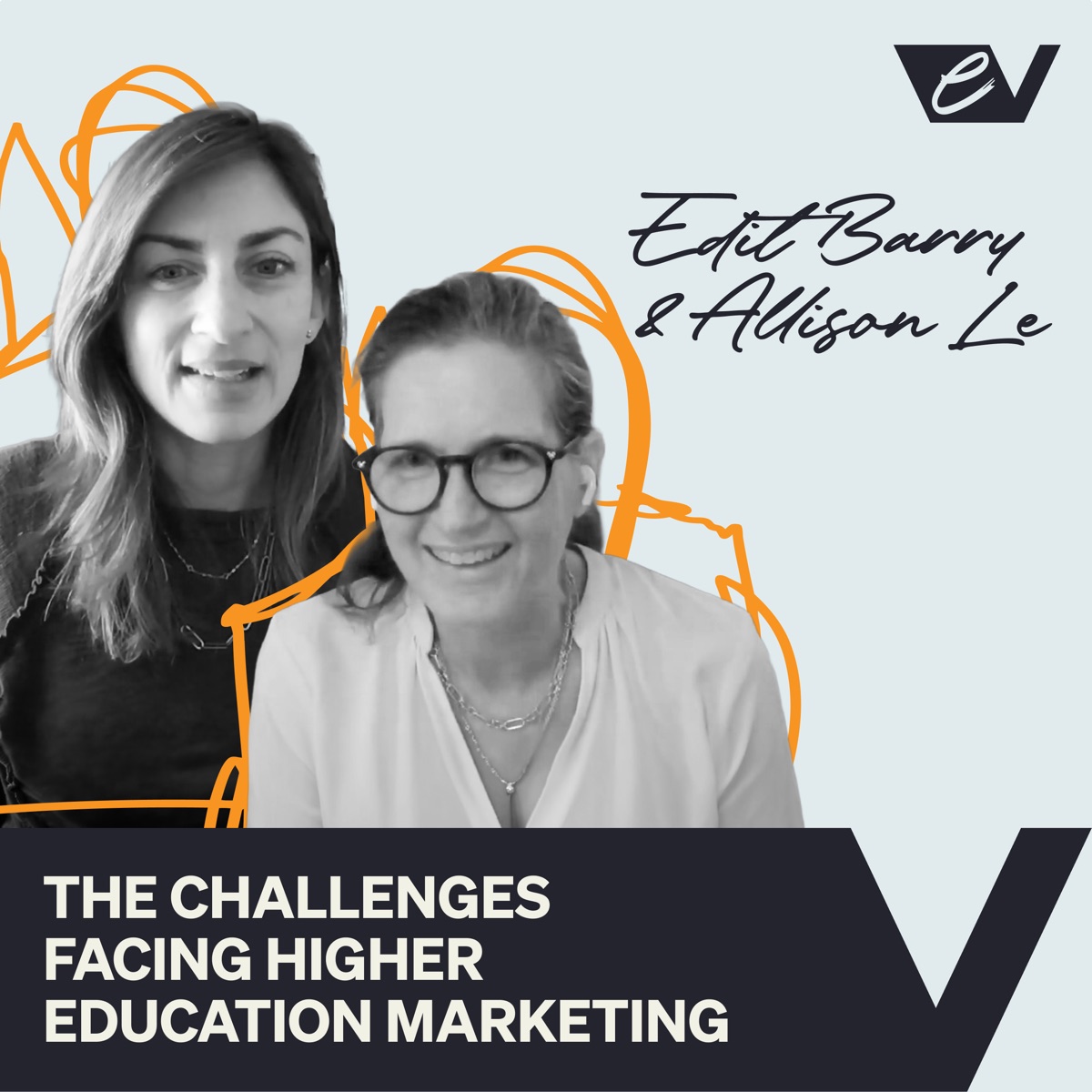
Edit Barry & Allison Le: E&A Collaborative
Co-founders, E&A Collaborative
Watch or listen right here
About this episode
Edit Barry and Allison Le co-founded E&A Collaborative, a women-owned brand consultancy for higher ed and mission-driven organizations.
Building a consultancy on partnership, and what mission-driven clients need from their brand partners.
Links from this conversation
Episode transcript
Read the full transcript
Transcribed from the episode recording; names and phrasing may contain small transcription errors.
Welcome to another episode of Escape Velocity, and today I'm thrilled to welcome two extraordinary women who have spent nearly two decades shaping the way educational institutions and mission-driven organizations tell their stories and connect with their audiences. Edit Berry and Allison Le are the co-founders of E&A Collaborative, an award-winning women-owned brand consultancy that has earned its reputation for delivering purpose-driven branding and transformative results. So Edit and Allison, thank you for being here. um I'm so excited to dig in and talk about some good stuff today. um Just been so impressed with the work that you all have done over almost two decades, and we've had the chance to work together in the past. So you know I have some familiarity with the two of you. I have really loved watching you start your own thing and um work on some of the campaigns that you've you've worked on, um which have just had remarkable success. I'm thinking um thinking in particular of Global Refuge um and Wittenberg University, which were a recent,
Thank you, Tracey.
projects right that had pretty amazing outcomes.
ye
So maybe we can talk about those, but I'll just mention them as recent highlights.
Yeah.
um
Well, Wittenberg was our hundred million dollar capital campaign that closed out its, but reached its target about six months early and then and then beat it by about $13 million. dollars Yeah.
Yep. In COVID, no less.
and Amazing.
We were very proud of that.
Amazing to have anything good happen along those lines during COVID. um And that was specifically for a campaign project?
It was.
Yeah, that was their biggest a fundraising campaign ever.
Wow. Well, we may um go back and dig in on that in particular as we get into our topics today that I know we wanted to focus on. um As you know you know, I just love talking about and thinking about how how we have breakthrough moments, how we push through things to get to that next level of growth or innovation or creativity. And where there are challenges and or opportunities along the way and a lot of times what one person sees as a problem or a challenge is indeed another person's opportunity. And one of the things we have been talking about, and I would say we've been talking about this for a long time because it keeps cyclically repeating and that is the notion that everything starts to look the same. when it comes to brand and marketing, in particular, one of the notorious areas that this happens is higher ed. And everyone knows it and everyone talks about it.
Mm hmm.
And yet here we are once again in 2025 with this amount of what we've all started calling Blanding, um which is just, it just feels so counterintuitive and and and not not right to meet the time. that we're actually in to see this kind of happening. So I'll throw that all out there and see see who wants to pick that up.
Well, Blanding's interesting. I mean, it's essentially thinking about trends getting just too trendy and then getting boring because you're seeing it all the time. And with higher ed, um that tends to move slower in in trend like through trends anyway. It's this notion of trying to like fit into something rather than belonging. so trying to fit into what everyone's doing versus how can I be authentic and still belong in this category? That's kind of how I, I look at it. And there's so much empirical data now in web design and, um, higher ed marketing that says it should look this way. It should be this way. This is how users interact.
Right.
Um, the, the, the notion of kind of going against that and trying something new feel can feel scary.
Do you got any need to add on there?
Well, i didn't I didn't know this term, Blanding, until you introduced it to us. um And what I thought was, you know, the examples that we saw of Blanding today are cars, like the white SUV that all looks exactly the same, no matter what brand it is, or Airbnbs that have that kind of
huh
you know, Munstera plant and the macrame and the same kind of beige, light pink, you know, wood.
Yeah, yeah, it's almost like AI is a real life mimicking AI, right?
Yeah.
And it's all kind of, it's kind of everything is looking the same. And in terms of higher ed, what we've tried to get schools not to do is focus on features. We have this many programs and we won, you know, this This is our ranking and this many awards and things you can, you know, a parent could make a chart and lay out the differences that way. um But to focus on higher ed branding takes you to a different level of thinking about who you are, what you care about, what your values are beyond, you know, these are sort of features that we're looking at.
Yeah, and the the brand of a higher ed, you know it's it's represented in so many interesting ways. It's not the logo and the tagline and the colors and the shield and the mascot and you know the president. it's It's like, no, it's it's actually reflected in like What is your first year you know student doing between noon and one during their first semester on campus? like what is that What do these little snapshots look like of people's lives as they're growing and changing and um evolving within this idea that is you know whatever name, college, or university? It's an idea.
Yeah, dare dare I say vibe, the vibe of an institution, right?
um Yeah, vibe.
like
The vibe of an institution, I was just talking to um one of my nieces who's a you know rising senior and just starting to think about colleges. And she's like, yeah, so my friends know that I'm looking at UVA. And so they had one of their friends is there and posted a video on YouTube about like, how many times she stopped into the coffee shop in one day to get various you know fancy coffee drinks. That's what my niece was curious about.
Mm hmm.
you know Versus she went somewhere else and went on a tour and the tour guide was like, oh yeah, I'm dragging.
Yeah.
I just spent 24 hours like studying in the library. And granted, that's probably an add accurate presentation of that particular college's level of you know academic rigor and study requirements and stress. but i mean My niece wasn't very interested in that, nor did she find that very appealing. Because study or not, like what's yeah what's the vibe like? um What's someone like her doing with their time and how is she going to get to that information? It's not going to be on the college's website, most likely.
Mm hmm.
Yeah, the college's website, you know, the materials that come out often have the institutional voice, um which is important, right? we We, as, you know, parents and rising seniors looking at colleges, like, you you want to know the programs and the professors and how, you know, all this important stuff. But yeah, we somehow getting under the layers to the vibe, like, what's your life going to be like on this campus?
Yeah. Yeah. I mean, I think you just you're not expecting that kind of content on the college website. So I think that's as long i think you know kids are going to be looking um elsewhere for that. They're not going to trust it, even if you did put it on the college, on the institutional website. They're not going to really trust it as much. But what they are going to do is get a sense of trust for the institution on that website. So it's like the nuanced things like, you know, how easy is it to for you to find out what the financial aid situation is or what the tuition situation really is? You know, how helpful is that website to doing some of the really scary or intimidating things that you need to do in your college search or application or visit process? Right? um I think that's where a lot of schools are still really, it's like you're still making it a pain in my butt to find out how to give you potentially half a million dollars. Like don't do that. Don't make that hard for me. You should not make that hard.
Well, and even if the...
Well, they probably won't be giving that money online, but to figure out who I talk to and also, you know, a lot of, a lot of what needs to happen with fundraising should not be happening online. Like a $5 donation, a hundred, 500, a thousand, but a big donation should involve a face to face relationship, like an ongoing conversation. Um, so. Maybe it's easy for the introvert to sort of lean on the on the website to do a lot of relational work. um But I guess the way we're talking about this move from like thinking about your brand book, like your identity manual as your brand, to thinking about events, is very much the the evolution of how students are thinking about, you know, choosing the school that, you know, where the sweatshirt is the one that I want to wear.
mm hmm.
Like, I want to be identified with that in my senior class picture. I want to be wearing the Yale sweatshirt or, you know, there is the RISD sweatshirt or whatever it may be. um And now I think with we just We just were in a session last week about youth marketing and what the next generation is looking for. And events is like what they're looking for. They want to actually connect with real people. um Yeah, it's not just being associated with a name or a brand, but it's like, where can I go where I feel like I belong?
Unity.
And I can find people who are interested in the things that I'm interested in. Not just the concept of, yeah, they have my major and there will be other people in my major, but sort of feeling like they have an awesome Instagram in the chemistry department in such and such engineering school.
you know
um And I want to be part of that.
OK,
Like that's exciting and cool to me.
So that actually goes back a little bit to what I said at the beginning, which is like schools need to aim to show belonging and not trying to fit in, right?
okay so.
They don't want to fit into this category. They belong to this category, this category of liberal arts education of, you know, whatever their category is. And it's similar with students, right? They want to feel like they belong there. They belong with this community, with these people. They're not there to try to like fit in because they're supposed to be there because for any sort of like reputational purposes or anything.
oh Well, to that point, right? So belonging, fitting in, whatever it is, if it's belonging now, great. How do you know if you're going to belong somewhere if it all looks the same? And every single bit of video footage I see on every college, I mean, we should make a compilation because it's all the same. Not to mention that well yeah everyone has their drone footage of buildings.
All the drones. Yeah.
The talking heads, the drone shot.
But then all the footage, the sports, the people wandering through the pretty buildings and sitting together. And um it's just all the same. And i even on, I don't know, like is there more interesting diversity and personality in those social media challenge as channels? And is that where it's happening?
I think people are still trying to figure it out, and there's a lot of video that's like, I am so-and-so from this state, and I study this, and here's my day walking around, you know. Campus, here's this empty courtyard where we meet after school.
I'm sorry. I'm sorry.
It's very, very awkward and nobody's like owning the medium because it's weird. And I don't think people have a sense of who exactly I'm talking to. And if you don't know who's watching, you know, having that introduction just feels sort of like an extension of a campus tour rather than, I don't know, putting someone out there who students can relate to, even if it's only a few. It doesn't have to be your entire student body.
Well, why do so many schools seem to suck so bad at like getting good student generated content and keeping it up? It's just like, I know it's hard, but it's it's less and less hard every year. As the tools get better, it get you know the the the technology is easier and more accessible.
here
Most people can just be live streaming like from their pockets practically. um Is it fear that like weird stuff is going to go out under the institution name and they're not going to have a chance to censor it or edit it?
Thank you. i think they're yeah
I don't know. Allison, maybe you have ideas about that. i I don't feel like I could speak to that. I can say, as someone who's ah worked with schools to recruit focus groups of current students on campus, that it's hard for people in the admissions office to connect with people beyond the people who give tours on campus or work in the admission office because they're just not making connections with those with those kids.
Yeah. Yeah.
um So that's part of it. People are working in the office. And the easiest thing is to be like, Hey, Mary, like show up at this thing.
it
Um, so that's part of it.
Yeah.
But I also, you know, in terms of what an enrollment, enrollment VP needs to be doing, that's like very in the weeds. So it's a lot to, it's a lot to ask to manage it and to sort of make sure that people are saying the right thing.
Yeah, yeah, no, I mean I.
Yeah. And schools are risk adverse. Like they want to make sure that the kids that they are highlighting or representing, you know, the school properly. Right. So I, I understand the fear of, you know, doing something different, getting out there and trying, um, not to say it's not needed. It is, but, um, you know, and, and schools are, uh, universities and institutions, they're, they're late adopters to. to trends and technology especially as well. So it's something that just takes time and and a lot of trust.
Yeah, but I also think thats a if you don't have a strategy and you don't know why you're doing it, then it feels like flailing.
Yeah.
Yeah. Yeah, I was just gonna say that too.
you know hope Hope is not a plan. Yeah.
Yeah.
Yeah.
um it just it just seems like I mean, I understand historically higher ed has been very slow to move.
so
They tend to have smaller budgets. there There is some level of bureaucracy, not like a government organization, but a decent amount. People are territorial. um Change adoption happens at a slower rate. You've just got people that get tenure or they get in their jobs, they don't leave. However, I would say at a certain point, there's going to be enough external pressures saying you need to figure something out or you're not going to survive that they're going to the fear will have to You know, bypass all of those more traditional reserved tendencies because they won't be able to afford to wait and I think that right now there's a lot of pausing because there is so much change in technology right now with artificial intelligence. There's also so much pressure on these schools and their budgets. They don't know what they're going to have to cut, if they're going to have to cut, where they're going to have to cut to stay viable.
Mm hmm.
And there's just so much scrutiny on them. And even people questioning the validity of this investment and the payoff, um that it's just like, i I don't know where, you know, at what point do the the tensions become so great that you start to see people doing really interesting things. And I think that, While I don't think this is because of financial pressures, I do think it's worth mentioning what Harvard's doing. I mean, we looked at Harvard's site recently, and um it was ah it was our clients over at Skidmore that brought this to our attention. Holy crap. right like Harvard was just like, no, this isn't where we're talking to prospective students.
Yeah, it's pretty cool.
We don't need to have visit a plot. We're night we're not asking you to give money here. We are showing you like really our great thinking.
yeah
Yeah, they're opening up a different kind of conversation. So if you think of this is what's bland about higher ed websites.
Mm-hmm.
It's like the big image, whether it's moving, whether it's static with some kind of either tagline or just like exploded logo over it. And then very standard sort of navigation, very expected, you know, from one site to the next, pretty much where all these elements are going to be. um So then you have, you know, maybe you have news and events somewhere on there. um But you know exactly what you're what you're going to find when you open the site. And there might be some gimmick, you know, that sort of draws you in, or maybe not.
Always.
um And sometimes you can tell that the site hasn't been updated in 10 years. And sometimes You can tell that they have engaged a really great graphic designer and the design just really stands out. um Like for Wellesley, we looked at we looked at Wellesley in this kind of beautiful bold type and amazing color palette, but just sort of pops. I think what Harvard's done is completely rethink what happens on the landing page. And it's way more, and I mean, not more, it is editorial. Like, it's editorial.
Yeah.
It's like magazine content.
Yeah.
It's for people who read, but it's not dry.
Yeah.
It's not from a Harvard voice. um It's very friendly, open. It's like all the things that you think Harvard isn't. It feels on the level.
yeah
um It's not talking down. It's sort of giving advice and it's very warm and inviting and and totally friendly and ungated.
Yeah.
so
mean And it's it's like they're going through um episode or not additions, right? Because the first time we pulled up Harvard, it was a feature that was all about HIV research.
Yeah.
The second one, we you and when we pulled it up, it was a feature on aging.
Resolutions.
um
Resolutions. I think they probably had updated it like right at the new year.
Resolution. Right. yeah Right. And now it's cancer. cancer research um and all about their you know view of the disease and prevention, diagnosis, treatment, support.
Yeah. I mean, it's worth saying, and I'll say what everyone's probably thinking is that Harvard has given the gift of its reputation to do something defiant, right? To try something bold and different. um that a lot of other schools would be too nervous to potentially do, not to say that they shouldn't necessarily, but that they are like, well, we're not that, we can't we can't do that, right? So I guess the question is, how do we empower other schools to be as bold as Harvard is with their new landing page, with their new homepage?
Well, I don't know that every school should be as bold as Harvard. um but But I do think that if you talk to any of these schools, if they're a client or you're just talking to them, they you dig a little bit, you'll find out that they're doing some really interesting research somewhere.
Yeah.
Or there's some really cool stuff that's happening. Or this you know this this amazing entrepreneurial success story happened. They bury it.
Mm hmm.
They do.
They bury it in their news.
yeah
They bury it in their campus stories. They bury it under so much boring that nobody is ever going to read it or care about it except maybe the parents of the kid that it's about.
Yeah.
But they bury it all. And I don't know if any higher eds, oh my gosh, they're just they're so, they have such a hard time at sort of being like, this is great and we're gonna treat it like it's great. um But I think there is there is great stories and content They just need to turn themselves inside out. Maybe not like Harvard's doing it, but they need to turn themselves inside out and get past all of these layers of categorization and brand and voice and target audience.
Or how it should be, how it should be organized, the boxes that have been set.
Right, right. Yeah, blow it up.
Mm hmm.
So boring. And honestly, they've They're going to have to blow it up at some point because these websites have just gotten so big and so cumbersome, and they're going to they're going to change now faster and faster and faster because they're going to have to be. So it's now is a good time to blow it up, I think.
okay I was thinking the way that um people used to design websites there was a lot of thought to the information architecture and how you moved from the front from the front like inside and it's almost like thinking about an LP like listening to the whole thing from the beginning to the end and how artists would structure the album to have a certain flow and now we're not in like vinyls anymore it's like people are just
following
to
Yeah.
Yeah. No more flows. Yeah.
popping in this whatever page they're looking for is popping up for them. um They might even be searching for something totally different and then your search engine AI is pulling some example into a conversation about something that has nothing to do with your institution.
Yeah, it's like everything everything is getting pulled out and sampled and remixed and and combined.
um there's who
Mm hmm.
And I think about, ah again, my niece, they have a program at their school, some some software application. And that's where she looks at information about colleges. She's not going to their websites. She's not reviewing, like, US News and World Report. She's going into Squire or Score or something.
Right. Sion scores.
Yeah, I don't know.
S-E-I-O-R-O-R.
um Yeah, something that like the guidance counselors have them all using and it matches her up to stuff and she can see, you know, what which which she's like, which schools do I have the best chance of getting into?
Mm hmm.
because she doesn't, you know, no nobody wants to waste all that time and money and then end up not getting in anywhere. Um, but it was through that program that she was saying she was looking at information and how much more, you know, in a year or two, are we just going to be asking our voice assistants on our phones like, Hey, tell me what schools are within, you know, 50, 50 miles of here that that you know I could probably get into with this GPA that have good sports or you know kind of a rural feel, they're just we're just going to be asking.
Yeah.
And so your content all has to be ready to to to kind of embrace that too.
Right.
Okay.
And I think there's a lot of room there for marketers and, you know, admission marketing people to work on identifying who that student is for the student. Like, this is who we're looking for. in a vibey way. Not, you have this GPA and this many extracurriculars, but like, these are the, these are like, yeah.
Right. Yeah, like you like this many you like to have this many cappuccinos every day. And this is your favorite.
These are the characteristics of someone who thrives here. And we did this for Wittenberg. We did a poster that's like, we are, you are this and sort of finding the connection because that's what kids want. Connection, like,
Yeah.
Do I vibe with this place? is like do Do I fit here? do i Will I belong here?
yeah
do i Do I feel like this is my people? These are my people.
Right and it and it's like don't tell me your core values in response to that as a way that you are answering that question But do show me like the cool stickers that they create every year for like the talent show Or do tell me the funny story about how everyone loves chicken finger friday you know like Tell me those things because that starts to give me a sense of the vibe um
This is my place.
Yeah.
Mm hmm.
Yeah, and that's important for the students. I mean, that's less important, we could argue, for the parents or the people that would be paying for the students' education, right? like they So there's a way, but the the website, the vibe, all this stuff has to appeal to multiple audiences.
Yeah.
in that way, um which I think is where a lot of institutions kind of get um kind of fumble over their feet, right?
Do you think that's why the blending happens? Let's go back to blending. There's so much good stuff that they could be doing.
Yeah.
between the content that's getting buried, the the good you know insights and stories that matter that are just getting buried under all of this same generic sounding stuff and same generic looking imagery. Why is it only Harvard doing anything interesting right now?
Yeah. You know, kind of similar, it's like,
you know
Well, part of it does cost a lot of money to redo a website, Tracey.
and it That too, but also when you're when you're in it, when you're in the institution and you're like day in and day out, it's really hard to step outside of it and look in and say, this is what I see or this is what is missing or, you know.
That's a problem too. Very true.
So, I mean, in in that way, um oh that's why we have jobs.
That's why we have jobs.
That's how we're consultants.
Outside consultants that can offer that perspective are so important.
Yeah.
um
Agree.
Because yeah, when you're in it, you're just like, you can't see it.
OK, then why are then and the consultants aren't doing a good enough job, which should should be even better for us to write.
Or schools just don't have the time or resources to even and engage consultants, um you know, budgets have been slashed or something.
Here's.
i think lyn
But you know, they spend time, they spend money on consultants for so much bullshit.
see Yes.
They don't do it document it for this.
And I want, that's a very good point. Right.
Yeah.
Yeah.
And they don't, they're, we're very anti the consultant who does a big report and the report ends up spending, you know, costing a ton of money and just collecting dust.
Right.
Yeah, that they can't implement.
If you don't, if you don't have a vision for where you want to be, then doing a whole pile of research for its own sake is not going to get you anywhere.
They don't. Great.
Right.
You need to know, you know, we want to go from point A to like point Z in five years.
And yeah, and right.
And it's not just a strategic plan. It's like a ah different vision from a strategic plan.
Yeah, the information is nothing if it can't be implemented, right?
Yeah.
mr Here's the thing too. So every, every higher ed out there now has been through a couple of, I'm sure, very painful, very expensive redesigns. I'm sure they're getting more expensive, not cheaper. I'm sure they're taking longer, not less time.
Right.
That can't keep going that way. I mean, we've got to be at the end of the road for these massive 18 month long taking
what
Yeah. Yeah, I mean, for as fast as tech is changing and trends are changing. um Yeah, projects need some of that speed.
It's ridiculous. It's ridiculous.
we How do you say president you know university president so and so? We know you're in a bind. You've raised a lot of money, but it's never enough. You're closing departments because you just can't support them. You feel like the walls are closing in. um Do your website.
I know.
Yeah.
ah Spend $250,000, $5,000, $1 million dollars on your website.
What do you need?
It's very hard to convince someone that that's worthwhile.
my
Well, look, I think that's true. um And I don't know that that that particular like way of looking at it, it would be worthwhile.
Mm-hmm.
um I think that the paradigm, left for lack of a less overused word needs to change with with just the whole way that the process is thought about.
Yeah.
um you know when we started when when When we started talking to Skidmore, they didn't have 18 months. They didn't have a full website budget to work with. They had a specific challenge and they wanted to know. And so tell they told us what what they had that that they were working with and said, can we work with you on this? Can you bring can you help us solve or at least move the needle in positive ways? with what we've got, what with what we're looking at. And yes, we absolutely can. I mean, a lot of it is just like this, I'm not gonna show you my cards or I'm gonna wait until year seven rolls around and I get freed up for my website redesign giant budget that's gonna cause half my staff to quit and leave because it's just gonna be so miserable.
Mmhmm.
And I gotta go through the ah RFP process and deal with you know potentially a bunch of douchebag agency people that are gonna be stuck with them for 18 months. So sorry, not everyone's douchebag at an agency. But um but I mean, i've lived i've I've watched it all happen. And so I understand that it's not something that anyone wants to do, can afford to do, can afford to wait to do.
Yeah.
So I think it needs to change. And I think that you know forming partnerships with outside groups to both inspire and inform and collaborate with your internal teams
yeah
Instead of hiring an agency to do a project, I think is one great way to start thinking about things differently. And I think that as agencies are breaking up and more and more people are becoming consultants or small shops or freelancers, there is a chance to sort of remake up what you think of as your team, right?
hey
Yeah, totally.
Definitely. i I mean, yes, I think that's the way higher ed should be moving when it thinks about working with outside consultants.
Yeah.
I think that we're small. You know, there are two of us, E&A Collaborative. We bring in people when we can't do everything. So we'll build a team around what the project is and what it needs.
Right.
um But we don't have to staff, you know, we're not paying a staff all year long.
Right.
So we bring people in as needed. It makes the costs more sustainable. um, and appealing actually.
Yeah.
Um, and we, because we're small can work with a center, an Institute, a school within a major university and have relationships with people who are not necessarily in central comms, but who need comm support that central comms can't provide. Um, and we can do that. Like, yes.
Yeah, you can augment, right? You can augment and meanwhile you're forming a relationship with that team and with that institution and that becomes more valuable longer term. So it's like I do think that the relationships offer so much value that once you invest in like why work on just one project with a team if they're going to get to know you and you're going to get to collaborate to the degree that you should be. Spread that around. you know see if get them get Get the admissions team involved. Make sure that the advancement team is involved. like Don't just so keep siloing things as much as, again, higher ed. We know they love their silos, too.
whom
um But I just think, again, the more that that can be flattened and that collaboration can be brought in, the And the more that instead of saying like, well, we've got to do it this way, because that's how we used we've always done it. So we'll wait until we can do it exactly that way again. What if the just the question is, here's what we've got to work with. What's the most impactful thing we can do right now?
Mm-hmm.
And yeah.
That's the best question.
That is.
What I love is that, and that I spoke about this with Pete Mackey. When a client comes to us and they have, there's no budget attached to what they want.
Yeah.
We're just spinning our wheels, like figuring out
I know.
how to build something that we think you'll want to pay for. If you come to us and say, we have X dollars, we can do amazing things with your X dollars. And we don't have to waste our time fumbling around. Well, what would they be able to afford to pay? And what do you think the competition is going to, you know, give me the dollars and then ask people what they would creatively do with your money.
I know, such a waste of time. Here's what I also, I'm kind of amazed that this model doesn't doesn't exist more frequently, maybe it maybe it will um one day, but you know I get as invested in the success of these projects as the clients are. It doesn't do me any good to do the work if it doesn't move the needle for the client, and so you know or I can't use it as a portfolio piece, or I can't go back and that too.
Yeah. Yeah. Well, and just by nature that you care about what you do. I mean, we're the same way, right? we
That too, yeah. No, I mean, it helps that I that i care. um However, because I care, It's like I love the notion of the value-based pricing, right? So this isn't about how many hours Tracey's gonna have to sit thinking and pecking away at her computer and having Zooms with you and flying out to meet with you and corralling the team and having them brainstorm. It's more about like, if we do a great job at whatever it is we're gonna do, what's what's the likely outcome?
Mm hmm.
What's the value of that? you know If we're going to do an amazing fundraising site for you and make your campaign just the most exciting thing anybody's ever heard of, and even your high donor high value donors that do need to get taken out to lunches and dinners before they're going to give their millions of dollars, they still want to go feel good about it when they pull up the website and show all their friends, oh, this look, here's a mention of me and my $100 million gift.
Mm-hmm.
But if we do a good job there, that's got tremendous value.
yeah.
And I don't know why there isn't some sort of investment pricing structure, just the way startups are always like, well, we'll give you a well you know it will give you some shares once we go public. I mean, it's a much better deal to work like that with a higher ed.
yeah.
you
And to piggyback off that, what you just said, it relates from like the schools funneling down to the families that are looking to pay for yet therere their child's education, right? Like what is the value?
Right.
What are the outcomes? Like why is this important? Like how do we, you know, so it's all the same questions, right? Just like continuing down to the end purchaser, right?
Right, it's all showing that it's a good investment.
Totally.
It's a good investment. There's value being created here. So we just need to keep showing it and keep talking about it and keep delivering on it. But yeah, it's the same premise for sure.
Yeah, it's tricky, ah you know, coming at it from, like you said, people put a price on their time. We don't necessarily tell you this is the number of hours and this is our hourly rate. unless we're working on like something quite small. Um, but to think about it in terms of value, I feel like this is a whole other conversation about like the value of marketing and how marketers, how consultants price what they do.
Yeah, it is. Well, yes, I mean, i I love reading anything that um Blair ends or David, you're right about this.
Yeah.
Yeah.
And you know, value based pricing is a great, great read. And I love the way that he frames it up, which is just, um you know, if you're trying to get a sense for a price one day, it's or you know, a budget, um it's it's really, it's not about the budget, it's about the value. What's the value that you're trying to to generate from this effort? And then once you establish what that is, okay, well, wouldn't 10% of that be worth spending if you were guaranteed it was you were going to get it?
Mmhmm.
And that's the other thing too is no no consultant consultants and agencies should get better at guaranteeing, you know, like get some skin in the game, have some, have some.
I don't know. i think I think on a website you can measure KPIs, clicks, time on site and and all of that.
ah i mean Sure. Sure.
When we do a logo for a campaign, we can't say because we made you this gorgeous logo and we came up with this totally meaningful campaign name that equals, you know,
That's why you got all the donors you got, yeah.
and you're fun but We can't do that. like we can't We can't put a dollar amount on it.
But you can say, you know, again, here's the thing.
Yeah.
You can walk through the mental exercise of of saying like, okay, client, we're going to do a logo for you, um, for your campaign. Let's imagine it's three years from now. We just ran into each other at the park. We're going to sit down and have a little chitchat on the bench here. You are really happy about everything that has happened since we started working together. Why are you really happy? What has happened? And you let them describe it. Oh, everyone loved the logo. And we got people who we'd been trying to get in touch with forever who were willing to engage. And we raised more money than we've than we've raised before.
me
And everybody was excited. And only a few people made a stink about it because there's always people who make stink about it. um you know Now, granted, you can't tie that back to an analytics platform. but when you when you Just talk about what you want to have happen. It's not about KPIs.
Yeah, it's I was just, yeah.
Right, there's qualitative um benefits to all of it.
Yeah. Yeah. And I think that sometimes we forget to just talk about that.
Yeah, the qualitative outcomes are just as important. But the quantitative is where it's like, oh, look at the the numbers and the change. um And I think that's sometimes why it's hard to convince these institutions to take on these projects, right?
Yeah.
Because there's not quantitative data to back up the invest the investment. as much as there would be potential qualitative data.
Well, everyone's running around. They've been waiting for qualitative data to save the day um over quantitative or quantitative. Well, whatever.
yeah
They want their data. They don't want their they don't want their analogies. They don't want the the harder things, you know, but everything's not so black and white.
Yeah, it's not.
So I think that you need both um and you should be paying attention to both. but You know, look at AI, it's very good. It's very good, but everyone right now is pretty much of the same mindset that like, If you want AI to come up with the ideas or create the quality or be the creative or the strategist or the idea thing, it's all flowers, no heart. There is no human in there. It is going to pull from all the other blandness and all the other crap that's on the internet, which isn't so great for, from a lot of our perspectives.
Yep. Yep.
Um, and it's just going to spit out a new variation of that.
Hmm.
So is it incredibly fast? Is it great with data? Yes. um That doesn't necessarily mean we're getting better.
Yeah, agreed.
don
yeah
um Oh, wait. Hold on. out Let me use my dramatic piano sound effect here. oh All right.
That just sounds so operatic.
That sounds wistful.
um
As we, I was just ranting though about not too much coffee did today.
I think AI, ultimately, the more efficiency people can get out of it, the more they will embrace it. like it makes It makes certain things take much less time.
Sure, but AI cannot do these projects that we're talking about, right?
Yeah.
AI cannot do these human-centric, strategy-driven, creative projects that will like hone in on connection and community and thoughtfulness. AI can't robots can't do that. People have to do that.
Yeah, so how do people do that?
They hire us.
Well, what i think I think that I was just looking at some tool today that I was imagining i was imagining doing a ton of qualitative research, focus groups, individual interviews.
but
You collect all this information, you have transcripts, Imagine putting them into the AI and then having it pull themes. And I can, I can run all those groups and listen, but I'm not going to hear everything.
yeah
And it just seems like it can go through all that much faster than I can read it and like underline and highlight things and then like put them in categories.
Totally.
And that's exciting to me. Like that would save a ton of time.
Yeah, I mean, I wish every admissions person out there, A, you know, received consent to record their conversations, but then just was recording all the conversations they're having with the prospective students and their parents, because that's where you're finding out what are the questions, what are the concerns, ah you know, there's so much information being exchanged in these conversations. And, you know, I think eventually it'll just all get, um, deciphered through AI much like it is already on, you know, AI is already like summarizing my text messages and my emails and things like that.
Yeah.
So we can we can ask the questions and dig in on ways that are going to be totally unique to our lived experience and our
But we can also do things that I can't, which is have the conversation in the first place. Yeah. And we can gather to the data, we can ask the right questions, we can um create original insights.
Yeah, and maybe not not have as much of our own bias in there too, right? Like I know that I will listen for things that reinforce whatever perspective I have or way that I want to go in my thinking. So there's I'm always biased in what I'm hearing.
Right. But we're also not scientists.
And we're not scientists. um But I think that does impact how well we listen. and how and how we digest information, even even if it's a you know a big report and document from a consultancy you know that they that they paid a bunch of money for. yeah I'm still going to have selectivity in what I pay attention to. um based on my own biases. So I do think that AI's ability to decipher and run through a lot of transcripts and and recordings is is really great. One of the best ways to use it is is to transcribe or to let it summarize transcriptions.
Yep. Yeah. And even, you know, you, I would never just the same way I had a 10 year old car. It didn't have those blinkers in the, in the, uh, mirrors on the sides that warn you when there's a car.
A blind spot warning.
Yeah. Blind spot warning or whatever.
Yeah.
I, and then I got a new car and it had this blind spot warning. And of course when it's beeping, I'm like, what is that? I'm not used to it, but I don't trust it.
You're going to crash because you're distracted by your blind spot.
I would never fully trust AI. Like I would always rely on myself to verify that it's pulling the right thing. And they talk about hallucination free AI, like, and I never, It's such a bizarre idea that AI would like see something that wasn't actually there.
Well, it's interesting, right? We think about AI's hallucinations, where it just makes things up. It's trying to just give us an answer it thinks we'll want. I mean, it's really just trying to guess the next best letter or word um at its core right now. But so we're like, oh, we'll double check it. But we have our own biases and blind spots too.
Yeah, definitely.
you know So yeah,
Yeah.
Goes both ways.
interesting times.
Very.
I mean, it was getting a little boring, so um okay with um okay I'm getting stirred up.
Well, even on the business end of what's happening with AI, it's like it's pretty ah it's still the Wild West.
a It is, but so you know bringing us back to our our thing we started out talking about, which was this blending. I mean, you think AI is going to help or hurt on that front?
That's a good question.
Hahaha.
I don't think that AI is built to be innovative. right AI is built to like take what it knows and to give you a version of that.
Yeah.
um So I don't i don't think, you know in terms of creative, like a visual ah visual output of some sort, I don't think AI could move the needle in any meaningful way. Humans have to do that.
Yeah, and yet it's like infinitely capable of combining and mixing and churning out like any flavor, color, texture.
Mm hmm.
Mm hmm.
I picture like all of the internet, everything was put into this giant sausage-making machine, and then there's the grinder. And like depending on your prompt, you know you get like a different string of something coming out. It's just very strange. And it's at such volume that um even if everything starts to look different because everyone has the capacity to generate imagery and content to such a degree that they never could before. I wonder if that will just create so much noise that it won't even matter.
Yeah, I think it would. I mean, back to that sense of like vibe and feeling like you belong to a place and community. I mean, God forbid that these institutions start saying, let's like, we don't need to hire photographers. Let's just AI some images for our for our materials. I mean, it's ah It's the same sort of like moral moral question of, can can we just use a stock photo of kids reading in a library?
Right. Right.
The answer there is no, is that institutions don't do that.
But I think youre it creates it creates an opening for weirdness, for like doing something really unexpected, um like the anti-blanding
um And similarly, yeah, they shouldn't rely on AI for their graders.
Yeah.
version of the SUV is the awful, hideous, heinous, expensive Cybertruck that we all despise, I think.
Yeah. Yeah.
But if you have this sort of assembly line-ish version of things coming out of different car brands, and then someone is like, let's blow this up. There's a moment there.
yeah
That's like an event.
Yeah.
That's a thing.
right And here's the thing, I notice every time I see a Cybertruck, my 10-year-old stepson thinks they're gorgeous and loves to fight me about it because he knows that i'm that I find them to be visually offensive.
Yeah.
Well, maybe he's an early adopter.
Yeah.
Well, you know, but he's the target customer.
Yeah.
And the avant-garde, the avant-garde always becomes like the standard.
you know
Yeah, brutalism, you know, all these movements that were so, um ah so offensive to the senses, you know, you get that can be an early signal too.
yeah
Mm hmm.
Yeah. Yeah. I mean, I think we could urge our clients to be disruptive and you know think outside of the box and try something new similar to what Harvard did.
Mm hmm.
um Maybe not going like full Cybertruck. I don't know. but
Well, I guess I would always want to go back to if it's not appropriate for you, then you shouldn't be doing it.
rain Right. Right.
Like if you are not innovative, avant-garde, cutting edge, don't make a cutting edge website.
Yeah.
Great.
like You need to do enough enough work.
Authentic. Be authentic. Everyone craves authenticity.
and yeah
You need that outside eye. You need outside input.
Well, you're getting you're getting to a good point, right, which is be authentic.
Do the individual interviews. Do the focus groups. like
But it's really hard to know what that means. I mean, even your most traditional conservative institutions, they're unique.
Yeah.
They are unique. They are different than even the other conservative traditional institutions, but it is really hard to put your finger on that when you are on the inside for sure.
Yeah, yeah.
And and to not try to get bogged down in thinking that the only time you get to talk about that is if you're redoing you know your brand.
Yes.
it's like decoupling all of this restrictive thinking and realizing, no, we can talk about storytelling and authenticity and connecting with audiences and how we are are doing that in the going forward in the future. um in much more nimble and and engaging and fast ways if we just like decouple from that rigid project-based thinking that I think has gotten really stale.
mm hmm yeah.
Mm-hmm. No, I think that's actually an excellent point and it's just making me think there's room in higher ed to bring branding people in even if the goal is not to redo your logo.
Yeah.
If you just want to figure out like what are we about?
Yeah.
Because we're just saying we have this many faculty and this many majors and you know, What are we about? Because it can't be that.
Yeah. And the times are changing faster and faster. So what you were about two years ago is not what you're about today. And it's not what you're going to be about or you what you think you're going to be about six months down the road.
And if it's values that are consistent, how are they expressing themselves in all the new things that you're doing?
Right.
Yeah.
Right.
Because you're doing new things.
That's the thing with these like values and taglines, you know, show me why.
Yeah, it's one thing to say these are our values. It's another to like, live them and show them.
Yeah. Yeah. And ah again, it's it's this idea of turning all of this inside out.
Mm-hmm.
don't Don't keep layering everything with these these categories and these buckets and these processes.
Right. and And the... And show, don't tell is always like the phrase, you know, the ninth grade English teacher phrase, but it always comes back.
Always good.
yeah
Yeah. Yeah.
yeah
Like, don't just show us.
And just think about you know what's the last what's what's the last thing that you remember seeing online?
Tell me something.
what's the right What's the last interesting thing that you remember reading about or hearing about related to an institution? Just pause for a minute and think about your own experiences and like what's resonated with you. Has it been the bland? you know Was it on the website?
Yesterday, Hopkins magazine sent out an old piece. They put out a newsletter and it was like an old article about how every snowflake is different.
Oh yeah, I think I saw that because a friend and I were talking about snowflakes and are they indeed?
Every single snowflake is different. That's so insane. Like, think about how much snow there is on the ground. The fact that there are people with all the other you know, political craziness going on, are studying the world in a way that makes you still go like, wow, like, this is a wonderful world. That to me is what higher ed is really supposed to be. It's not about indoctrination. If higher ed was so good at that, we wouldn't be where we are right now, right?
Right.
We would be in a very different place.
Indeed.
But higher ed, you know it tells us it gives us tools to monitor public health events, and it gives us insights into just wonderful things that make you feel like, wow, about the world.
Yeah, it teaches us to be curious because the reality is we don't know everything.
um who
And I don't want to live in a world where we know everything.
Yeah.
And I don't want to live in a world where we think that the AI knows everything.
And the I mean, bad example I love because it's like, you know what? All of these students who are coming to your school are also very different from each other.
yeah
And it's so easy to get into, you know, the demographics. What states are they coming from? How can we appeal to more people from the Northeast? Like that kind of thing.
Yeah.
There's got to be a point in admission where The individuality means something.
Yeah, and the fact that maybe you're it's about that you're creating a space where all those differences can come together and become more because of that. You know, the people I got to meet that were so different from me and the way I grew up when I went to college, that was one of the main things I wanted and I knew I needed to get in my life, get out of my little bubble.
yeah
And if I'd just gone to another school that was just like my high school, or if I'd stayed right at home, or if I didn't have the opportunities I did, um I wouldn't have gotten that. But um you know I didn't, I was not eager to sit around and find more people just like me.
Yeah.
Yeah.
For the school, we've been talking for a long time about in higher ed about the demographic cliff and there's going to be a point where there's not enough high school kids to fill the classes and there's going to be schools that just fall away.
Yeah.
um And how do you get a school from the, that edge of like hanging on and about to fall off to like safely in a landing zone. Um, I think is going to come down to all of these, you know, using all of these tools to connect with students in a real way. So, you know, you've got to do, you've got to do more than say, we have these majors in this.
Yeah, all the ways.
Yeah.
We won this many Fulbright awards.
No, and you've got to be engaging with your prospects, your current students, your alumni, your community, they all matter.
Mm hmm.
um And they're all going to different places.
And the yeah.
And they're all becoming different variations of that over their lifespan. So it's a really, it's a fun and complicated space that I think is super ripe for doing some exciting things. I hope Harvard is just the beginning for more people taking some chances and not falling into all of this blending that we see.
Yeah.
um But on that note, we are at an hour. And I just want to thank you guys for a great conversation that flew by. um
Yeah, this was fun.
We covered a lot.
Thank you.
We covered a lot. I think there's also some openings for a new pod or another ah episode.
Oh, we can do part two, part three, part four.
yeah
We'll do the marathon one where we all have lots more coffee and just keep going.
and
um No, thank you guys so much. Always, always love talking to you. And again, just congratulations on the success that you've had. I hope personally that we get a chance to work together on some projects soon.
Definitely.
And we will um in the meantime, just kind of keep beating the drum here and hope the right people hear us and get in touch.
Mm-hmm.
to do some fun stuff.
Thank you.
All right.
We appreciate it.
Thank you.
Thanks, Tracey.