Episode 13 · Apr 15, 2025
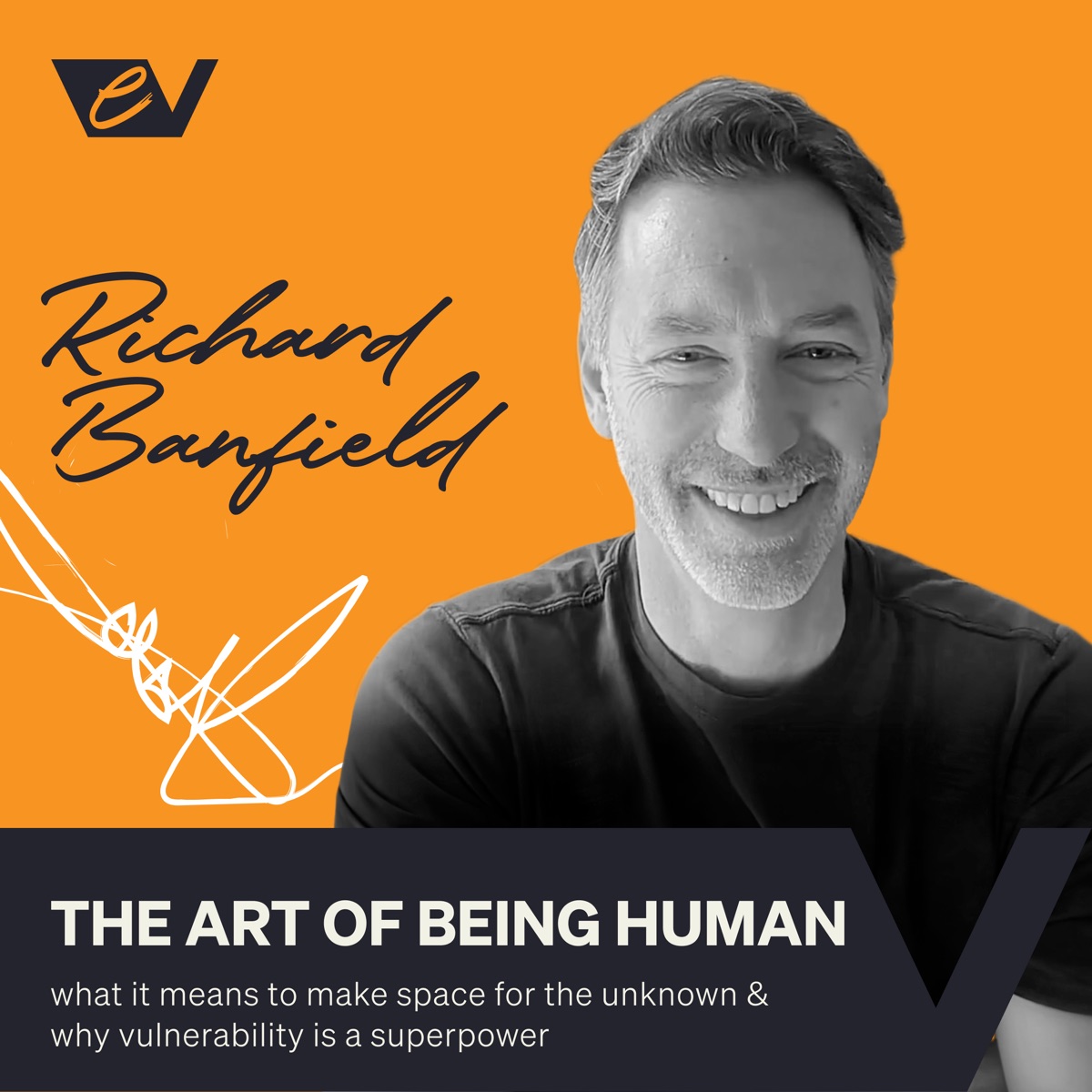
Richard Banfield: The Art of Being Human
Artist · Author · Former Agency CEO
Watch or listen right here
About this episode
Artist, author, and former agency CEO Richard Banfield on creativity, identity, grief, and personal reinvention.
What happens after you leave the thing you built, and how art becomes the practice that carries you through reinvention.
Links from this conversation
Episode transcript
Read the full transcript
Transcribed from the episode recording; names and phrasing may contain small transcription errors.
We are here today ah with Richard. Well, I am here today with her Richard Banfield. And um Richard, thanks for joining me. ah I appreciate it. I don't know. i don't want to dictate where this conversation will go at all because we always have great conversations when it's really just very open-ended.
Yeah.
um So thanks for joining me.
Thank you. I will. I'm, I'm honored that you would think that I would be a worthy guest on your wonderful podcast.
Please. Please. um you know I don't even know where to start in terms of like introducing you to people who don't know who you are because you are like a you're like a James Bond. you're like a man of many You're a man of many talents and skills and experiences and perspectives. and um so If you want to just give a ah little intro from your perspective of who you are, that'd be great
Yeah. Sure. Well, let's start with that. I think one of the hardest parts of being ah human being in a modern society is identity, right? We know this, right? It's just really hard to tell people, enough information that they can then assess or understand what it is that they're dealing with.
Yeah.
And, you know, i have a lot of interests and I have a lot of things that I care about. And I've noticed that society would prefer it if I would organize myself into a singular box. but Like, hey, you're this thing or that thing, or you have a title that relates to this individual focus area that we can make sense of. And for a long time, I did that I participated in that idea. And I just more recently over the last several years, I've just decided that I don't care anymore. I don't mind that I've got 15 different things that are going on and that it's uncomfortable for people to not clearly define me or identify me or put me in a box. um And so, yeah, to that point, there is there are so many different places to start. I'm i'm an artist like you. I wish I was nearly as good as you, but i um I'm an aspiring, should I say. Thank you.
You're very talented.
um That art also finds its form in writing. I write almost daily. I've published four books, or actually five books. One of them is a parenting book, which is just a fun thing. um And I intend on, I'm actually working on another one that I've spoken to a publisher about on grief, which we can talk about separately. um i am a recovering ceo i ran an agency for many years and before that i ran venture-funded company and i've been holding various executive positions in companies so i'm that as well um and i'm a parent i got three boys um I'm a divorcee, a widower, and also much in love with my current partner, Devin. So I'm all those things as well. um Yeah, and I like to do a lot of the things that other people do. I, you know, collect strange things, and I travel the world, and I do stuff that doesn't necessarily fit into the persona that you would have defined from my LinkedIn profile. So that's a terrible um start to an interview somebody is thinking, gee, what am I going to learn from this guy? Well, but I don't know.
Well, thank you for for running through that. and um And I i agree 100% that everyone wants a box to put everybody into. And i think that probably comes from just you know survival skills and lizard brain, just but you know friend or foe, fight or flight.
Mm-hmm.
um It doesn't work for the human experience.
It's odd.
It probably works for the animal experience, but not the human experience.
but
um One of the things of think of when i think of you ah is is you're just a very, well, you're very authentic. You're very, um you're not pretending or holding any punches or, you know, but you're very empathetic and, um and discerning with your, with your attention and your empathy. But I was just reading a post. I haven't gotten through the essay yet, but it was talking about high agency and what that term means and, you know, how people demonstrate it. um But it it is, i think you demonstrate a lot of high agency. You know, there are there are optimists and there are pessimists and there are people that think the glass is half empty and there are people that think the glass is half full. But I think people with high agency think they are the tap.
I like that. I was going to say, as you were saying, you know, talking about the half glass and the full glass, what I was thinking, I need a hamburger.
like go
yeah
um But I think that's also why, you know, you and I have always enjoyed talking with each other um because I think, you know, every exchange is an opportunity to, you know, what, what I'm sharing with you, what you're sharing back when we engage with anyone in our lives, I feel like we kind of look at life through that lens instead of um transactional or it's just all, it's all an experience and it's
Oh, yeah. oh yeah
It's what you make of it.
ah You know, the identity stuff is on my mind a lot because, as you know, we're organizing a retreat for people who have got to that, let's call it midpoint in their life. Midlife crisis might be two too specific. But a point in their life where they're trying to think about what's next. And a lot of that is identity related. Like, well, I was this role or this thing, whether that's, you know, CFO or a parent or... husband, wife, partner, like a thing I was like, I was in a very identifiable place. And now because of maybe some change in their life, career change, their relationship change, maybe they're empty nesters, they're thinking about their identities very differently. And what's kind of curious about that is the conversations that you have with people when they are re establishing or re evaluating their identities is that there's not a really good set of vocabulary for this. We don't have a lot of good stuff to be able to say, oh I'm now, you know, in that second stage. As you know, we call this retreat, the second harvest, but because I'm obsessed with those kinds of ideas like these seasonal changes. But there's not a really good set of vocabulary for us to understand who we are, and how we collectively understand that. So if you and I meet for the first time, especially in a Western society, the first question is, what do you do? Like we are identified by the doing not the being. Right? And It's kind of curious that we would start a conversation there. And you know you and I are going to be at at this event next week because it's to be 40 something people there. I think maybe I know seven, eight-ish people. The rest are new to me or I know of them, but I've never met them. And a lot of it will be about who we are. And there's that peacocking that happens where you show up and you're like, how are things going? Oh, I'm fine. I'm very busy. um um things are good you know life is great um and as you know our our friend nancy will be there she'll be the first one to call bullshit on that you'll be like well what does that actually mean what does it actually mean to be these things like what are you saying are you protecting yourself from the hard conversation from the vulnerable conversation where you say yeah life's not actually that great but like shit's hit hit the fan and i actually don't know what i'm doing
yeah
And, you know, ah this is happening in my relationship and that's happening in my work and this is happening in this thing and it's overwhelming and I'm scared. And how many people are going to have that conversation? Right.
Yeah, well I think a lot of people are, i mean, if they're, a lot of people are like, don't give me that because then I'm going to feel like I need to, now I need to help you try and fix it, which is right.
right
So, but of course, that's, that's, so that's a problem. People need to not try to like, they just need to receive and listen. But a lot of people don't want that. So I think, you know, that it's also, it's not just what we choose to say in those situations. um It's what we've learned is acceptable to say.
Yeah, because God forbid, we actually tell people how we're feeling.
The truth. Yeah.
God forbid I say, you know, I'm actually like a hot mess right now. um Because then, as you say, if there isn't an immediate available solution that somebody can say, well, oh I can fix that for you, then what are they supposed to do with that? Just the being in that liminal space of, well, I don't know what you need. I don't pretend that I would ever have an answer for you. But here's a space where we can just talk about that. Yeah.
Yeah. Just to hold space.
Yeah. Yeah. yeah
Yeah, holding space for and and truly seeing other people and then and sharing, truly sharing your state of being.
yeah
is um it's It's so wonderful when it can happen and be genuine, um but we don't do a lot.
yeah
We don't do enough of it.
Well, we don't do enough of it. And we're also in this time in history where there is a potential for us to go in either direction, right? We can be more automated and more AI-ish and more technocratic in the manner in which we present and organize ourselves. Or we can see that as being partner to what we do you dare I say it, let that stuff take some of the mundane crap away from us so that we can focus more on being present, focus more on having that space available so that we can be open and caring and vulnerable. And so it's kind of this weird crossroads that we all face now, which is, what are we going to do in this moment? How are we going to invite this new technology into our life? Are we going invite it into our life as a partner so that we can create space? Because the fear then is, oh, I've taken care of all the mundane and the administrative and the logistical stuff. Wow, now I'm sitting with myself and now I have to be with myself and I have to think and feel God help us like we spend so much time making ourselves busy so that we don't have to think and feel. and now we're in that rare moments that we were given this gift and saying like, now you can get a lot of this stuff back. What are we going to do with it? Are we going to just say, no, actually, now I can do more. So I'm going to do more and just turn up the dial on the doing.
ah her
Or are we going to say, actually, I'm going to get a couple of hours back every day. And I'm going to daydream because they're out the window.
Yeah.
gonna go for a walk so it's a really interesting choice we have i'm curious as to what happens
Yeah. It is. And, you know, so many people, especially high achieving people have a real hard time with not feeling busy or productive all the time.
yeah i was that guy
And, and yeah. um And right. And just acknowledging the value and the benefit of things that are also enjoyable and maybe just relaxing, maybe daydreaming, maybe going for a walk, maybe going on vacation. It's not like it's it's not like something you have to sneak off and do and not tell anybody because you're not, you know, oh, I'm going to take a week off. Don't tell anybody. I'm not being productive. It's like, how did how do people get into that kind of mindset? Yeah.
Well, I've been writing about this a lot because it's on my mind. um As you know, one of my art pieces is called Shame Will Kill You. And i spend a lot of time thinking about embarrassment and shame as a don't know, a structural part of our life, like how we organize around that. And, you know, on the one extreme, if you've got like ah a culture, say, like a Japanese culture, where on the the upside of the of that is a dedication to craft. So we've all seen movies like the Jira movie where they spend, you know, 20 years trying to figure out how to make a particular kind of sushi dish. And even then they have this humble approach of saying, well, I'm still a beginner. I'm still like learning how to do that. Now there's two parts that one is ah that humility of craft, right? like it I'm never really a master. I'm always learning. That's wonderful. That's the positive side of it. And then the negative side of that is the shame of not doing it correctly and the extreme shame of not being worthy. Like, oh, I don't i am not a member of this contributing society because I haven't achieved something or I haven't reached mastery level or something like that. And what's interesting about that is where craft gets really useful is in the sense of that you are dedicating yourself. But where it gets less useful is when it starts becoming complicated so that you avoid shame. And that might not seem obvious to everybody, but becoming a craftsperson is really just another way of saying I'm avoiding shame. like I'm avoiding embarrassment of not knowing what I'm doing, not being able to speak to this craft or this art or this work. And you know, as an artist, the most perfect state of art is when you are curious when you are, I'm not sure what's going to happen, I'm going let this flow.
Every time.
And that's when you are sure of yourself, that's when it's not so great. And so there's a ah really, I think, a creative tension there. I wouldn't say it's entirely negative, but it's a creative tension between this idea that we can master something and this idea that we are running away from shame. Somewhere in between that spectrum
That's really interesting. um i I've seen ah people very close to me struggle with that. It's a little bit of perfectionism, but I also think the the shame is something we don't talk about enough. you know The perfectionism is fueled by this avoidance of shame. And what I see is that it stops a lot of people from being as creative as they might want to be, you know, because they always, people will say, Oh, I can, I can, I can only, I can't even draw a stick figure, right?
mm-hmm
Like how many people have said that to you? And you're like, it has nothing to do with how well you can do something that has nothing to do with it. But that's immediately where people go. And it, it's sad to think about how many people, um never let themselves enjoy the creative process or realize that it's all, it's all creativity because it's all making and creating something that wasn't there before. And that's life. That's every day, you know, tomorrow is not here yet. So we are all creating tomorrow together.
Yeah.
i get I get to create how, how my moments, um, are experienced, you know?
and Yeah, I think for you, I know, somewhat of what you experienced, but that curiosity and that openness to creativeness is healing as well.
Yeah.
It's, it's not just for making pretty things. It's a necessary part of being vital, of being alive is you don't when you're having a shit day, when you're grieving, when you're scared, you don't rush to technology to solve those problems. The answers are very often in the art in the beautiful poem in the beautiful piece of work in the theatre in the music. mean, how many of us use music as our therapy, just like connecting to something that isn't completely understandable, that is very much emotional. And that is the work. The work is, can I stay in this curious state and allow myself to be in that ambiguity while also trying to figure out how to explain that to the world? And that's why I press so hard on make art post art is making art, there's value in that.
yeah
And if you are making art, and that is sufficient for you, that's great. But because we we're in relationship with the world, we're in relationship with others, and we're not separate, in any form at any level at any like, yeah, whether it's cosmological level, or all the way down to the, you know, the subatomic level, we are not disconnected, we aren't separate. And so the making of things, the creating of things, that doesn't have to be a painting, could be anything, the creative work is really an opportunity to heal that original wound of separation, or at least the illusion of separation.
Mm-hmm.
And when you do that, you step into that opportunity to create relationship. And in that moment, you need your identity less. And you need the connection to that person more, or you at least create more of a connection. And so the peacocking around your identity, like, oh, this is who I am. This is my title. This is my car. This is where I live. What are the identity things? Those become completely pointless and meaningless when you are working into relationship through curiosity and through that, like healing of the separation wound. So.
Wow. That's, ah that's intense. And no, no, I'm here.
ah Sorry. we We can talk about other stuff. Yeah.
I'm here. No, I'm here for it. You know, you know, i like to get deep like that. You were just making me think, um you know, people are, you know, talk about painting because it's um nothing when I'm in the, in the, when I, when I'm in that flow state, right. Which is not a guarantee that I will get into that every time I'm painting, but
Yeah.
When I'm able to get into that place where I lose time, i do not feel like I'm thinking ahead of any decision. Everything becomes very, it's almost like things are flowing through me.
yeah
and so I'm just the vehicle. And when I can be in that space, it's very, it is very meditative. um it It just smashes the ego away, but it does make you feel like you've for me, I feel like I, that's the time I feel most connected to being a, a human, a spiritual being, not a, um, you know, yeah, not a meat suit.
Yes. Me too. mes suit
ah Second time that's come up. Uh, yeah. Um, And it's it's really magical. And I do think that when you then um share it, it's the – when you share something you've created and you know that it it came from that place or it was an attempt at least to to get to that place, um I think it's the ultimate form of of human connection. you know Because you're translating – your experience at its most sort of magical, mystical, no ego time.
Thank you.
And if little bit of that is translated and shared with other people, While they, you know, people always say like, how do you know if something's good? And it's it's not about the skill or the, you know, unless you're looking at like, okay, who's the most best photorealistic painter, you know, or something like that. um For me, it's like, is that spark of, you know, I'm feeling something from this that had to do with the the experience that artist was having when they were making it
Yeah. Yeah.
it's like ah It's like a ah sound that you can't hear, but you feel it from from art and from anything.
Right.
you know from any there's just it's that
Yep.
It's indescribable, but I think it has something to do with like were they really letting it go and at that place where magical things were happening and
Mm-hmm.
you know And ah to be just to share with anyone who's listening to this, like that's a rare treat. That is not something. So you know if you're someone who creates on the regular, um trust me, we are all suffering through lots of false starts and scrape it off and start over.
Yeah.
This sucks. Yeah.
Well, that's kind of the fun part of this, this season that I'm in right now. And I think you, you and I both share this is that I've had an opportunity to follow the playbook and do the things that everybody said i needed to do in order to be successful. And I have been like very, and I'm very gracious for my success. I've had a lot of wonderful things happen to me. But I also realized that it's insufficient for me to be a creative and spiritual human, you know, in this universe that we live in, um that having the nice stuff and having the titles and having the the rewards that are associated with work and business, those are insufficient. they're They're nice. And I don't, deny that they are interesting or good for some people and for most people but they're also ah kind of um they don't really tickle that feeling you say that you know that thing that the wonderful magic call it the alchemy of life that it doesn't really have any of that and creating
Yeah. yeah
opportunities to seek that out in my life and with others, whether it's like through a retreat or, you know, in conversation, we have a group of people that meet regularly, we do this kind of thing. finding ways to do that on the regular is so, so so important. And it's hard when you're old, right?
it's hard Yeah.
So there's stuff going on. Maybe you've got kids, maybe you've got a business, maybe you've got like, you know, in the world that we live in, a lot of the people that we talk to are ah either owning or running or managing some thing, right? They've got team to manage or organization to manage.
yeah
And then they've got home life and they've got all the things that are connected to raising family. And it can quickly become obvious that we're spending the most important part of our time and our years doing the things that are the least important. Now, this is not news to anybody. Anybody that's listened to this is like, well, thanks, Captain Obvious. What do I do about it? Well, what you do about it is that
Yeah.
you You just like a conversation where you would jump like we did straight into the interesting deep stuff and avoid the small talk. You can do that in your life, in the actions that you take and then the choices that you make.
yeah
You can choose not to be part of the small talk of life. So small talk is a really good metaphor because immediately people understand like the anxiety or the social anxiety and awkwardness that comes from talking shit with people that you don't really want to talk to or making choices about the conversation that you don't really care that much about. And we've all done this. We've all been to like a, let's go to friend, a kid's party, and you're talking to a bunch of other you know parents there and they're like, so what school did you go to? And what do you do? And, you know, and you're just like, man, oh man, this is what I want to be talking about right now.
Yeah. I know. I'm going to poke my eyeballs out.
Yeah. And so you have choices. So the choices are, you don't have to go to these things, right? That's one version of that is the involvement and non-involvement.
ye
But then there's also the opportunity to say something like, hey, we don't have to do this. We don't have to have small talk.
Yeah.
Tell me what's going on in my life.
Yeah, you can ask me an interesting question.
Yeah, well, you know, here's what's actually happening in my life.
Or I can ask you one.
um
Yeah.
You know, as as you know, when when I lost Christy, so for those of you who are listening and don't know, I lost my wife to cancer a few years ago. And there was this thing that snapped in my head where I just didn't know how to have the small talk anymore because there was this huge, big piece of furniture in my room. that I couldn't get around. Every time I walked into the room that was my life, I would bash my ankles up against this huge big piece of furniture called grief. And that's all I could see. It's all I could feel. It's all I could notice about me is that if I was in a room full of people who are couples, well, I guess notice that I was not a couple. Like all of the things that you would assume would just be normal were suddenly abnormal. And The thing that helped me the most was understanding that I can expand the room size. I can't get rid of that piece of furniture that's so big. I can't get rid of grief. I can't just throw out that important part of my my experience and my memory. But what I can do is I can expand myself and I can open my heart and I can open my mind so that the room that I'm living in proportionately is way bigger. and I'm not going to smash into that piece of furniture every time I walk into the room.
That's a great question.
Yeah. yeah And the only way to do that is to expand your ideas and your voice, because then the action follows immediately from that. So when you walk into a room full of strangers and they want to talk about the way that you go, I've got a question for you. How are you guys dealing with X, Y, Z? And you like throw in a hard question in there, or I'm curious, like who else is having a shit year? And I guarantee you, and because I do this all the time, 90% of people will be like, yeah, yeah, I'm having a challenging year or I'm having a challenging moment or things aren't going the way I thought they would go. No, there are the peacocks in the room that'll be like, no, I'm fine. And, you know, I've ticked all boxes and, you know, like and in general, you will find a small percentage of people who are living their best life.
Yeah, they'll wander off. Yeah.
And that's great. You've met them at a moment when things are great. But most of us have got baggage or we're dealing with challenges on a day-to-day basis. And we need a forum to be able to talk about that. Now, we have counselors and therapies in our life who fool some of that. But then again, that's not really the kind of conversation you need all day. and You don't need to be talking to therapeutic level talk
yeah
with somebody every single day. You need version of that, which is, shit thing happened to me at work. And I just want to ask you guys, has this ever happened to you? Or, you know, my partner and I ran into this issue the other day. And like, I don't know, am I the only one who's ever had this experience? And mostly you're not.
Well, I think there's a there's a big aspect of vulnerability. that you're talking about, right? And fear and shame all boiled up in that. um ah You know, I can think back some of the most poignant, like made my heart feel like everything was going to be okay. Interactions I've had yeah over the last, you know, five or six years have been like with an Uber driver or with the lady at the grocery store or with, you know, just random sort of random acts of kindness.
Yeah.
But the kindness was just that they saw me.
Mm-hmm. Mm-hmm.
And they made space for what I was experiencing because I clearly you know was not okay when these people were seeing me. So they there was no there was no need for any of the like, how you doing?
Mm-hmm.
ah the weather's great, right? They were like, she's clearly not okay right now. And they didn't just, they weren't uncomfortable by it. and they And then that let each one of those experiences, let them share something. um And yeah and we so it was just these moments of connection that were really beautiful and really just made me feel better.
Well, you mentioned this now, and it is true, that if you lead with either vulnerability or trust, that's what you'll get in return.
Yeah.
So if you lead with mistrust, so in our work situations, we know that that's true. If you lead with listen, you know, what we're going to do is we're going to put a policy in place where we make sure that even though you're working from home, there's going to camera on you all day.
Yeah.
Make sure that you do the work. Let me tell you how that ends. We've seen that movie. It ends badly, right? It's you lead with mistrust.
Yeah.
You're going to get exactly that in return. Same with vulnerability. If you open a conversation with, Hey, this is happening. it doesn't have to be bad. I'm like, Oh, like I'm challenged. Could we like, I am overwhelmed right now with something else. Like it doesn't have to be necessarily like, you know, therapeutic level conversation. That could just be, yeah, I, you know, I've had to like stop watching the news because I can't deal with this stuff right now. And I don't really want to talk about the news, but I do want to talk about how people, you know, deal with that stuff, right? So that might be a good conversation, like that kind of way of saying, yeah, I'm i'm also a fragile human being.
Yeah.
But the key thing here is our society has told us that what we need to do is work on who we are as a doing like as a as a you know in employee so like you can do professional development you can do courses you can do certifications you can go to school okay
yeah You can get your morning routines nailed down with your cold plunges and your, yeah.
right and this all is supposed to be the stuff that we are then communicating to the world about who we are But what's really important is if you do the work on yourself, if you go inside, if you go inwards on that journey, and this is a somewhat oxymoronic thing, but the expansion that you create when you go inwards is far greater than the expansion you create when you go outwards. That's like a hard thing to like see because you're like, wait, I'm going in, there's less space in there. But turns out that like there's a whole universe inside of you that wants to be explored. And that is limitless as well. And that work that you do on yourself is more important than the work that you do on your job. Because when you work on yourself, then you do your other things better. You do your parenting better. You do your job better because you show up and say, You know where I'm really good is here. You know where I'm really shit is here. The things that I'm triggered up here, I'm, and you're just so much more ready to have good conversations because you are conscious and understanding and awake instead of being in this like state of, well, if you believe my LinkedIn profile as being a complete resume of who I am then we're good. But the reality is, You know, I get triggered by stuff and I'm flawed and I make mistakes and I'm imperfect. And we are living in a society that is, it's a little scary, right? You'd say something and suddenly you canceled. You say something and suddenly you're like not sensitive enough, not being empathetic enough. And as a leader, you know that. I mean, it's like, how many times have you had a conversation with somebody and they're like,
Yeah.
well, you better lawyer up because, you you know, this is about to get serious. You're like, I'm not even sure what I said.
but
ah i know that this is not a story that lawyers can fix, so right? this So, you know, it's like doing work on yourself and going inwards is so much more important than that, you know, MBA or the certificate that you got from ah certain, you know, institution. It's way more important.
Yeah. Yeah, and one of the best ways to to do that is to um open yourself up to... different experiences, new experiences, whether that's, you know, through travel or just opening yourself up to have vulnerable conversations with other human beings, to go into situations from a place of trust, not mistrust, to just let your guard down. um Suddenly, you know, that I think that kind of starts to help crack open the ways that you can go inward too. um Because I think a lot of people do block themselves off from going inward.
Yes. Yep.
you know A lot of people want to avoid hard things. um you know i think it's – yeah.
Justified in many cases, it's, you know, you can get hurt and you know, you can get heartbroken.
Yeah.
um
Yeah.
two things about this that i I'll throw in here. One is, and these are both t-shirt ready slogans. So
right.
take no
Let's have one.
um when, when I started dating Devin, who you met earlier, yeah thank you.
Yes, she's lovely.
She came out of her own traumatic experience. She was going through a messy divorce and she had left her role as a partner in a company, much like you, you actually kind of very similar kind of
Yeah, I can't wait to...
Lots in common. um And she said, you know, one of these weird phrases that keeps coming up in my mind is hearts break open, right? And then there's this hearts break period open version of that, which is the reality is hearts break. If you are willing to be a human being and willing to be in a relationship with something else, could be a dog, you will be heartbroken.
Yeah. Yeah.
You will outlive the relationship or that relationship will outlive you or you will go through some experience where you'll be heartbroken. For sure. It is guaranteed that some bad thing will happen to you if you're willing to go into that.
Yeah.
The thing is, can you remain open? So yes, hearts break open. But can you remain hearts break? That's the fact. Open.
yeah
Can you still remain open to the next thing? Now, when Christy died, i was pretty sure. Now, I'd already been divorced once before. I thought that my relationship and my marriage to Christy would have been the final chapter of my life in terms of meaningful relationships. And when she died at the age of 39, that was a shock to everybody. It was like, this is not supposed to happen.
Yeah.
And I thought that was my last chance. I was like, Okay, you're done. You've had, you know, two really memorable and interesting relationships, where there was love, there was heartbreak, but you're done. You're 50 something years old, who the hell is gonna, like, pick up this, you know, husk of a human being, who's been hollowed out by these experiences. And, you know, we're done. And When I so that I gave myself this, this is, you know, the kind of vulnerable stuff that I like to talk about. So I just said, like, well, I'm going to be completely celibate, I'm not going to have a relationship, I'm not going to have, you know, the quick fix rebound, I'm not going to have like the tender style, like cave in and out of my life kind of thing. I'm just gonna do nothing, no relationship. And all I'm going to work on is how do I open my heart? Nick, how do I open my heart to the things that you just mentioned, the experiences? We traveled a lot, as you know, boys and I literally just traveled, spent a year traveling.
Yeah.
ah I opened my heart to all kinds of conversations and ideas. And believe it or not, that's exactly what the counterintuitive universe tells you is like, when you are willing to forgive yourself and open your heart and expand yourself, then this amazing, beautiful person entered my life. And she literally opened the door. And I was like, Oh, there you are. I had no intention of meeting you. I had no intention of seeking you out. I was not on the path of like, you know, seeking other seeking relationship. And yet, the universe was like, great. Now you've opened your heart that you've basically said, you trust the universe, you trust what's coming. And boom, it was like, no amount of statistical evidence could have organized that or no amount of like, you know, um choreography you could have organized that.
Yeah. And it's, yeah, it's, it's, ah it's hard to explain that it's like, it's like scientific fact that it works that way, you know?
like it just works. And I mean, it is it is actually scientific fact, because if you study quantum mechanics, this is how quantum mechanics works.
Okay.
You have this, you know, level of entanglement. But what's really cool is related to that and another kind of little kind of t shirt worthy slogan, which I borrowed from a guy called Rich Roll, who's got a podcast um is this idea of mood follows action. And in my earlier part of my life, in the early seasons of my life, I was very often waiting for the motivation to show up or for the um to show up or for the inspiration
Yeah. Action would only follow the mood, right?
Yeah, I was like, oh, if I'm just motivated enough, then I'll do the art piece.
Yeah.
Or if I'm just feeling creative enough, I'll write the thing or whatever the case may be.
Yeah.
If I'm just feeling attractive enough, then, you know, somebody will enter into my life.
Right.
And instead, it's the opposite. And what's really interesting about that, and if you kind of have this perspective on life in that this 3D universe that we're living in is really a projection of our, you know, of our ideas and our thoughts, you know, is that when you take action, what you're doing is you're manipulating the space around you and the universe around you. And you're literally creating the opportunity for that, whatever it is, the happiness or the joy or the sadness, whatever, to enter into your life. And so mood follows action. And works both ways, by the way. Mood follows action. you know good mood follows good action and bad moods follows bad action.
yeah
So you got to like, you're like, oh yeah, because it's surprising that I'd get into a lot of fights with my partner because I am a, you know, an asshole when I like show up in this, you know, then I do these things, right? So you have to take full responsibility for your life.
Yeah.
When you buy into mood follows action, you also have to take 100% responsibility for the things that I do say, because that's an action as well, or even think, I guess. That's going to have a consequence. There's an order of consequences or reactions to that. And I have to take responsibility for it. And so it's kind of agency.
yeah
It's back to what we started this conversation with is like, You have full agency when you take full responsibility, where you can control how your mood's going to be, because instead of waiting for the mood to change, you make the mood happen. And then you stay open, because then you don't really know what's good for you. You don't know who's going to come into your life or what's the best thing. Instead of trying to control it all, it just delivers. just delivers on what it is that you're taking action towards. And that is what
Yeah. Yeah. Sitting around um and kind of hiding from it all is, i think, you know, everyone's kind of first inclination when, when hard things happen or heartbreak or grief, it's like, um I remember part of my process that I was going through, i i i so I started just saying to myself, like you need to just get out there and be around other people. And even though you have had to kind of try to process, like everything was ripped away in terms of my identity. So you know that was that is like, who will who am I when I walk out the door of my apartment now? um what It just was very, I felt very naked and very vulnerable. um And I had to grapple with that and realize like, oh, well, I'm still me. And I still want to have relationship with the world um and my life. And I want that to be, you know, that experience to involve other people and doing things I love doing and, um asking the questions I want to ask, you know, and and not let it kill my curiosity and kill my trust and kill my um spirit. And so one of the things that I just repeated over and over in my head was just say yes. Like for for for for right now, just say yes to whatever it might be.
Really? Yeah.
You know, if it's a friend wanted to come over or, you know, going out, oh, I should go out for a walk.
Yeah.
It's a beautiful day. Say yes.
Yeah.
So a lot of it was saying yes to myself.
this is ah This is something i actually wrote about recently because I ah had... that same perspective of like when I did have a yes year, I watched the Jim Carrey movie and I was like, oh my God, I'm going to do the same thing. I'm just going to say yes to everything. yeah Literally be like a friend would call and say, hey, we're off to um off to the Dolomites. And we're like, I have to say yes. Like I i know I can't afford to go now, but I'm going to say yes anyway.
but yeah
But I think it's also, there's like the seasons and reasons things. Like there are periods in your time when you just need to say yes to everything.
Yeah.
And there are times in your life when you say no to everything.
Yeah.
And the discernment of when those times are is the hardest part of being human being.
yeah
Because when the counterintuitive nature of it is this, when things are good, really good, you often have to say no to things.
yeah
And I'll use myself as an example. I've got... a bunch of stuff going on right now. I've got some advisory work stuff that takes up some time. I've got a startup that I'm working on, got the retreat. I've also got my hobbies, like the art and the other stuff that the family went. And saying no to stuff is actually very, very necessary right now because there's so much going on. And the counterintuitive thing is, when you're feeling scared and vulnerable and nervous, and you've just had your heart broken, or you just lost your job or whatever, saying yes to everything feels counterintuitive, because you're like, no, I want to protect myself from being heartbroken again, or from being disappointed again. And I remember when I said, I'd started a company, it had failed, it was, this was when I first got to the States. My then wife and i we had a young son and I just had a baby. So it was like two young kids at home. And she was like, I'm going to be the one who goes back to work because I can get this really good job at and Fidelity, which was, you know, the place where she could get a really good pay, yeah healthcare and and salary and whatnot. And I said, okay, I'll be the one who stays at home. And it quickly became obvious we needed two salaries because we live in fucking Boston, which is expensive.
Right.
And I was like, Oh, shit, what am I going to do? I can't like get a full time job. I'm taking care of kids and stuff like this. And, you know, and so I just walked around the neighborhood and asked people if they had jobs, like, Oh, do you want me to mow your lawn? Do you want me to clean your garage? I've got this baby in this, you know, beyond thing that was strapped around me. hope you don't mind. But you know, I'll help you do whatever. And saying yes to all these things was so humbling. it was humiliating as well. And because I'd been a CEO of a bench funded company months before that, and I was mowing my neighbor's lawns. But at the same time, being open and saying yes to these things then led to other things. Then people were like, oh, I know somebody, you're a CEO. Like I know somebody who needs a CEO for a startup. Like you should go and talk to them. And of course that led to new things. So it was like,
Yeah.
weirdly counterintuitive that when you are at your most vulnerable, that's when you have to let people in.
It's very counterintuitive. um But I think, and i and I totally agree, your life goes through so many different stages in that. um And I suppose there's probably in-betweens, right? But it does kind of vacillate. back and forth between that, like when you must say yes and be vulnerable and be brave and all of those things. And then there are times when, yeah, it's like there are, you're, you're, you're so fortunate. Things are so great that you actually need to really start saying no.
Yeah. Mm-hmm.
it is um because i know, i know we're all big fans of the 4,000 weeks book.
Mm-hmm.
um And I do think it's a, this is a perspective, a and wisdom that I'm so fortunate to be at a stage in life where it's like staring right at me. um because ah I've been around long enough now to really know that like the clock is ticking. And so that ruthless prioritization, um rings a lot truer. you know, I think, I do think people have midlife crises, but I also think a lot of people just get that wisdom um, What matters most? What am I going to put my time towards and how am I going to approach it?
Yep.
And just being honest about that instead of saying like, oh, well, I'm going to try and do it all.
Yeah.
um And then beating yourself up about it, you know?
That comes back to that identity thing. If you can figure out who you are, if you can do the work on yourself and understand what drives you, what's your creative energy, what are your, your energizes versus your detractors or your the things that grind you down. you get better at that as you get older. You just be like, yeah, I'm not going to do that. That sucks. I don't like that. you know Now, that might go against some of the identity thing. Like as a CEO, you're supposed to be good at many things. You're supposed to like handle a lot of different situations. But as CEO, you also start to realize, yeah, I'm not actually good at a lot of things.
Thank you.
I'm pretty bad at most of the things that are required by an organization. And that's why I'm going to hire interesting people or i' going bring technology in or whatever the case may be.
yeah
That realization isn't obvious when you're a young CEO. You're like, oh, I'm supposed to be the to take the the model student here. I'm supposed to have all the insights and all the answers. And then you're like, how is that even possible? You can't know all this shit. That's too complicated. It's too wild.
Yeah, I i remember, um I think one of one of the things I'm thankful, I did always i was always very aware of what I was not really good at. um And I had no problem. I wasn't sort of like, don't point don't point out my flaws. you know I'm like, no, yeah, I'm i'm horrible at that.
you
And i loved building teams around that. you know I'm not going to try and find people that do the same things as me. or mirror something back to me i'm like, no, I want to find people who are actually really much better at the things I'm bad at. But um I also found that, you know, being a ah a leader or being a parent, um but being someone who's expected to show up in a different kind of way as part of that role does mean talking about
Sorry. Yeah.
the human condition more than it does about like, you didn't clean your room or you didn't get that done by the deadline that it was set for. You know, if things are falling apart, it's not, that no conversation around like the logistics of that thing are meaningful at all. And so it's like, Nancy, again, always says, um you know, there's no, there's no work-life balance. It's work-life integration.
Yeah.
You know, we're, we're all still humans.
Yeah.
whether we're at work or we're in a certain role, um we still bring all the the messy realities of that to the table.
Yeah. Well, and I'm probably quoting Nancy, because she's so brilliant. But one thing that you can be sure of, if you work, and if you are in a relationship that a 100% of the things that you interact with will be human beings.
yeah
It's just if you've got a customer, it's a human being. If you've got an employee, it's a human being. If you've a partner, it's a human being. Now, there is talk about like how AI and agents and things like that will replace some of these things, and that's fine. But in fact, what's more likely to happen is that as AI becomes more and more part of our lives, we will start to trust digital less because every email, every text, everything that we receive will be like, does this, this is really human? Or is this just like, you know, some part of the AI extension, right? And so what will happen is the roles that you and I play, mostly business development, right, because we're trying to move people from one place to another. That role will become much more human, will become much more likely to sit in front of somebody and go, I know you're not ah figment of my imagination. I know you're not AI generated human being. Like I can see you, I can hold you, you know, I can hold space here and we can shake hands and hug and look at each other in the eye. And I can now trust this interaction or this future transaction or whatever it is that we're trying to do.
Cause it'll be relational.
And yeah.
It'll be relational or relations.
And so I think that, that it'll actually become more important for us to develop those skills more important for us to be doing the work of being human beings.
I totally agree.
and And it's like, it's really cool. Like, it's actually really fun. Because suddenly, the thing that you thought was going to be the scariest thing in our generation of change is actually like, Oh, this is making space for me to be a human being. That's cool. While also taking away the mundane shit. Like, I don't know about what kind of relationship you have with AI, but I don't know how the fuck I got work done before this stuff. Like, so productive.
I, yeah I use it. I use it ah all the time and and I do have to actually stop. And, and sometimes um if I'm just cranking, I'm like, okay, you are riding on a, a productivity high right now.
Exactly. Another like dope mean hits like AI.
You know? Yeah. You've been, you've been mainlining AI all day and you need to like step away from the computer
yeah
Um, but every aspect of what I do, it's just been, it's been like, it's like that, um, I don't want to glorify it, but it, but it's like that movie Limitless.
yeah
right It just allows you to obtain knowledge much more quickly um in ways that work for you, whether it's listening to you know take a big document and dump it into Notebook LM and listen to a two podcasters discuss it.
yeah
It's a great way to absorb information versus you know sitting down and trying to read a document. And I just think about how um especially... people that are younger than me that have just come up without being sort of trained to absorb, and to to learn and to process information the way that i was, this is going to be so helpful for them.
yeah
Yeah.
It really is. And i it's it's not...
yeah
It's surprising in ways that i didn't think it would be. So the work that you and i have done or that you are doing running an agency that I used to do, um for instance, like yesterday, ah one of my clients received a an MSA from ah potential customer. And they had failed to redline the changes. So the changes had been made. But there no way to see the changes. like you Now, that is a human task that is untenably difficult to go back and look at everything. But taking two documents and putting it into ChatGPT and say, how are these two documents different?
and pay off.
Please create a red line version for me. 10 seconds later, it's there. right Now you can also see where they're trying to like screw you because that's like their job. Their job is to kind of like figure out how they can get what they want and not what you want. Or you know in the case when Devon was going through her divorce, being able to take documentation that is like onerous and complicated and put it in and say, like what are the key points here? What are the things that I really need to notice?
yeah
like What's likely to affect my XYZ, whatever those parameters might be? And have those insights instantly without an spending tens of thousands of dollars with a paralegal that really is also distracted and human being and doing their best but clearly probably not achieving all of their outcomes and so this is really important stuff is like we're making better decisions we're making better choices because of the accuracy of this stuff and we're stopping that delusion that we're good at this stuff we're not good at this
yeah
We're terrible at it. where Doctors are terrible at identifying disease. I know because we went through five years of cancer diagnoses and treatments and stuff like that with Christy. They were disastrous. They were disastrous.
Yeah. Yeah.
You know, like to the point where it's like life and death. And we're just not good at that level of accuracy.
yeah
So having this these things at our disposal actually makes me happy because I'm now less concerned that I'm screw up. My risk, because my risk tolerance is high as a normal, just in in general. But now my w risk tolerance can remain high instead of me having to dial it back and dial back and edit myself into being like a fragment of who I need to be. Now I can be risk tolerant and also accurate, which is amazing.
yeah
It's such a breath of fresh air.
I totally hear you on that. um I mean, even just from from using ChatGPT to prove things, ah to just give me that little extra level of confidence, like, all right, you know, it's like it just it just did the spell checking and the grammar checking for me. You know, I mean, you do have to keep telling it, like, don't rewrite it. Don't rewrite it. Just want show me. If you want to rewrite it, show me where you want to rewrite it. Tell me why. But, but stop rewriting it. um But there's, so i mean, throughout the day ah from the note taking apps that will just pop up and automatically record your meetings and give you the notes because, you know, like you can be distracted.
Yeah.
You could, you could have a million things going on in your life and yeah, there's life going on.
Yeah.
And so be to be able to capture the information that, and then to be able to, to tell the notes, Tell me what's the most important out of these notes um when I need to know it.
Yeah. Well, what do I need to do? Like what's the follow-up?
Yeah. What are the takeaways? Yeah. what what What did I say I was going to do in that conversation?
What do I commit to? Exactly.
What did I say yes to?
Yeah. And how can I get out of it?
Right, right. um Now I've talked to so many people about, I feel um with AI the same way I felt when I started to kind of get into the the web. um When I started to learn how to do things, when I realized that I could buy a little, remember those little round quick cams?
Yeah.
um One of the early like separate sort of cameras that you could get for your Mac. um I'm talking like late ninety s And you'd you know you'd hit the button to take a picture and then you'd walk away and you know grab a beer and come back and like, okay, be ready for the next picture. And it it could do really low res video and it could do stop motion. And I was just like, wait a minute. So I could make like stop motion films, you know, claymations or whatever I wanted to make. And then I could learn how to program, ah ah build a webpage and learn about how to get something up on a server or whatever.
yeah
And I could be putting this out. Normally I would have to have like a production studio and, and all this skills are teamed and and equipment. And it just blew my mind that that's how radically everything was changing.
Yeah. Yeah.
it It just – I had all these ways I could express myself now that all these different mediums and and these um places where, you know, you you could put it out there and anyone in the world could see it anytime they wanted. It's just – it blew my mind. And with AI, I'm like, oh, I can go to Luma and type in like two people dressed in animal costumes wrestling in an English countryside. And 30 seconds later, i will see a five-second video of just that.
yeah yeah
You know, high def. And so whatever you can imagine now, you can start to kind of bring to life. And the from a creative perspective, i just find that to be exhilarating, i you know.
yeah i mean we're getting to the point where that it's almost like that idea of the singularity where the mind meets the consciousness of the universe and we're slowly getting there. We're getting there where we're like, oh, we can create and call it manifesting or magic or whatever you want to call it. But the the moments between idea and physical object or creative output, it's just getting increasingly shorter and shorter and shorter. And we're just like,
Yeah.
oh, I've got an idea, 40 minutes later, you've got the app for that, or you've got to the creative output of that, and you just seconds or minutes, and eventually it's going to be down to like microseconds, and then we're going to be like, wow, what ah what can't we solve? what like I mean, I know that we're right now we're in that phase where we're still making animations of cats and studio games, but
yeah People wrestling.
That's actually that's part of it. That's like, i you know, for me, those are the, the, the gateway drugs to doing the thing you like, you need to start doing something really basic and then go like, Oh, I can do this. I can also add this to like my workflow or some other version of that. it just gets increasingly more interesting.
Yeah, so beyond ah people in animal costumes wrestling and all the the weird stuff that's fun and novel, the the deep research functionality of both Perplexity and and now ChatGPT and the ability to have really quick, immersive work doorways into information or ideas and then to have that exchange with the platform or this, you know, whatever system you're using um to dig into something is to me the, the most exciting part of the, the sort of the knowledge-based um aspect of AI.
Yeah. Yeah. Yeah. m
And I agree like that we should be, so we should start solving problems with, in really, really great ways going forward. um
yeah
I'm curious, and I, I'm curious, ah you know, there've been a lot of, you' you've written books. um You saw, I think the Atlantic published a ah list of all the books that meta had just sucked up into its AI to train on. um And I get it. Like it would have taken years to go and get permission and rights to, to absorb all of that knowledge and information in all those books. How do you feel about that, that aspect of it?
um So maybe controversially, I don't as an author and as an artist as somebody who creates essentially IP because that's what I'm creating, right? Some kind of intellectual property.
Yeah. Yeah.
um i don't care. I'll tell you why. um i don't write books for the money. Nobody does. Very few people write books for the money. um Those that do are also pretty much lying about the book as the moneymaker, because the book never makes money. What makes money is the attention you get from writing the book.
Yeah. Yeah.
art, in our experience, very rarely, like I can't, I'm a very prolific artist. Very, like probably, I can produce like 3040 pieces in a year. That's really a lot but given that's like the average size of a piece of art, right?
yeah yeah
That, by the way, that's probably the least complicated thing I've ever created. um I cannot earn enough of a living as a full time artist.
Yeah.
it's not It's just insanely difficult. But what really is interesting is as ah both as a medium for me to have cathartic and of ways of expressing myself, cathartic ways of dealing with my grief or other anxieties that I might have. That's one thing. So that probably saves me hundreds of thousands of dollars in therapy fees. Like there's that.
ah
Now, on the other end of the being an artist and identifying as an artist and being able to share of my art creates so much value in my life that I can't really put a number. like somebody of you might say, well, I'll pay you $2,000 for that piece. I'm like, okay, it's not really worth $2,000.
Yeah.
It's worth way more to me, but it's worth $2,000 to you because you're buying it. That is the nature of transactions. And umve noticed that when I create when I publish, the more available I make it, the more free it is, the more likely it is to be, you know, grabbed by the search engines and AI and all the LLMs and stuff like that, the more likely I am it to actually raise my ah awareness, both in the creative process and also in the what happens afterwards, or the results of that, which is people call me and say, I saw the thing you wrote, or I noticed that you were the one mentioned here, or I noticed that you were the one who published this thing. And we would like to engage you in a 10,000 or month engagement.
Yeah.
i mean i think that I've made so we the um the four books combined, I've sold about 60 something 1000 copies over the last time. It's not quite 10 years, it' like eight years ish, right? It's a lot, by the way, it's a lot in like, I don't know if you know about book sales. But if you sell more than 1000 books, it's a lot like
Yeah. I don't know much about it except that I know it's c incredibly challenging to
And these are boring business books. These are not like, I didn't write any JK Rowling shit.
yeah
Like this is like the very, very boring, narrow stuff. 16 different languages. and And that's probably contributing to the the numbers. But I can tell you that i the checks that I get every month from my publisher, are they range between $50 $300 month.
Yeah. Not changing your life.
and but Never, never going to. It's paying for groceries, maybe.
Yeah.
If that one trip to Whole Foods, really.
Yeah.
But what's really amazing is the consequences of writing the book. People would call me and say, can you come and speak at a conference? Can you come do this?
Right.
Can you work with us? Like Design Sprint was the first book that we created. And for Freshel Soil, which was the agency I was running at the time, that was the most amazing wedge device we had ever created. People were lining up for design spints. And we were charging anything from $20,000 to $60,000 a week for the design, so depending on the intensity and the team that was involved in that and the outputs that were expected. That was millions of dollars worth of revenue from a book that the book didn't create.
Yeah.
those outcome of the book created or the illusion of the aura or the halo effect of that book.
yeah I mean, when you put it into a book, I mean it was the idea that created
Yeah.
that But you when you put it into a book, it does legitimize it to some extent, um at least in other people's minds. and But that was a vehicle to get it out there or even to say, you know oh, I'm going to tell you about this idea that I wrote about in my book.
yeah
you know is it Again, it just it's like, oh, well, it must be good if if it's in a book.
Yeah. Yeah. And the idea that you can create something like that. um So the the concept of the meme was invented by a guy called Richard Dawkins, who's a geneticist. And he wrote a bunch of really interesting kind of weird books, mostly on on genetics, but also on atheism. And the idea of the meme is that an idea is a thing that's like a gene that can then go on and interact with other ideas. And And so the weird concept to think about it is an idea that's out there in the universe that you've not just made, but also projected into the universe. And this is where the make art post art concept came from, which is you've to make a thing and then you've share a thing.
Yeah. Yeah.
And by making a thing and sharing a thing, you're then allowing that meme or gene equivalent to go out and have sex with another idea. And that combination of those two things creates something much more interesting. And if we know anything about genetics, it's the more diversity we have in genetics, the better. Like when you bring weird ideas together, you create even more interesting ideas. When you create weird gene connections or combinations, you get healthier gene expressions.
yeah
If you take the same idea and you marry it with the same idea, guess what happens? You get a weird mutation that ultimately kills you, right?
Yeah. breathing yeah
so So ultimately what we want is the diversity of ideas. So to get back to your question about how do I feel about ai you know, scraping the web and stealing, because they have, they've taken my publication stuff as well. And I probably published hundreds of articles by now.
you
I don't care, let them because I'm not going to make anything out of that anyway. And the more likely it is that those two that my idea meets with another idea, or somebody else's desire to share my idea, those two things can come together and create value for me. And it has and I have evidence, I've got like 20 years of evidence with that.
Yeah. i Well, I love it. Um, that's, I think that's probably a good, a good place for us to stop this conversation.
I carry on all day.
We, yeah. Uh, we, I mean, I, love talking to you. Um, I can't wait to read more about, um, the meme guy and, uh,
Richard Dawkins. Yeah.
I will, yeah, I'll get some follow-up details on some things so I can add some links to the show notes that I will post on, um on Hello Adeo's website. But Richard, you're just a joy.
Thank you.
And so I thank you for being here on this earth when I'm here too.
Well, you know, I'm just visiting. The mothership's going get me sent.
Yeah.
Yeah.
Singularity is upon us. Pretty soon we'll just be, well, I mean, clearly maybe we're just manifesting each other. um
i I hope so.
Yeah.
I really do.
Well, i'm I'm pretty happy about about it if I've manifested you.
Yeah.
So thank you for just being an awesome um person and for sharing everything that you shared in this conversation. And I can't wait to see you soon.
Yeah. See you next week. Bye.
Bye.