From the archive · Jul 2026
Your content is slowly killing your readers
The 2014 essay that rewrote a NASA headline, and got me invited to Goddard to make the case in person. Republished, because none of it has aged.
I wrote this in August of 2014. I picked NASA as my example, not to pick on them, but for the opposite reason: I love what NASA does, so the gap between how thrilling their work is and how flat their web copy read was the sharpest illustration of the problem I could find anywhere.
A few months later they invited me to Goddard Space Flight Center to talk with their content and marketing team. That is the best possible outcome for a piece of criticism, and it is the reason I still believe in publishing the thing you actually think.
The essay is below, lightly edited. Twelve years on, with AI now generating more content per hour than humans made per year, every word of it is more true.
Stop making bad website content and start creating stories
My job is to turn people into great story makers. This is important because if you are putting out bad content, nobody is reading it and nobody is caring. You are adding noise to an already deafening abundance of nothingness, and I am not interested in letting that be OK.
Generally, the people and teams I work with have no experience in the creative arts. They may not even have writing or storytelling in their job descriptions. Yet they are being asked to be storytellers.
Storytellers are not fact tellers, data sharers, number crunchers, picture retouchers, code tweakers, big-picture strategy thinkers, mic pointers or camera-button pushers. Storytellers are asked to craft and convey meaningful, engaging content for the digital platforms we live in today.
One of the best ways I know to teach people to become better storytellers is to start with something that maybe is not so great, and make it better. By deconstructing the elements of a dull story, we can begin to see how to turn our ingredients into much more flavorful experiences.
Let us use NASA as an example
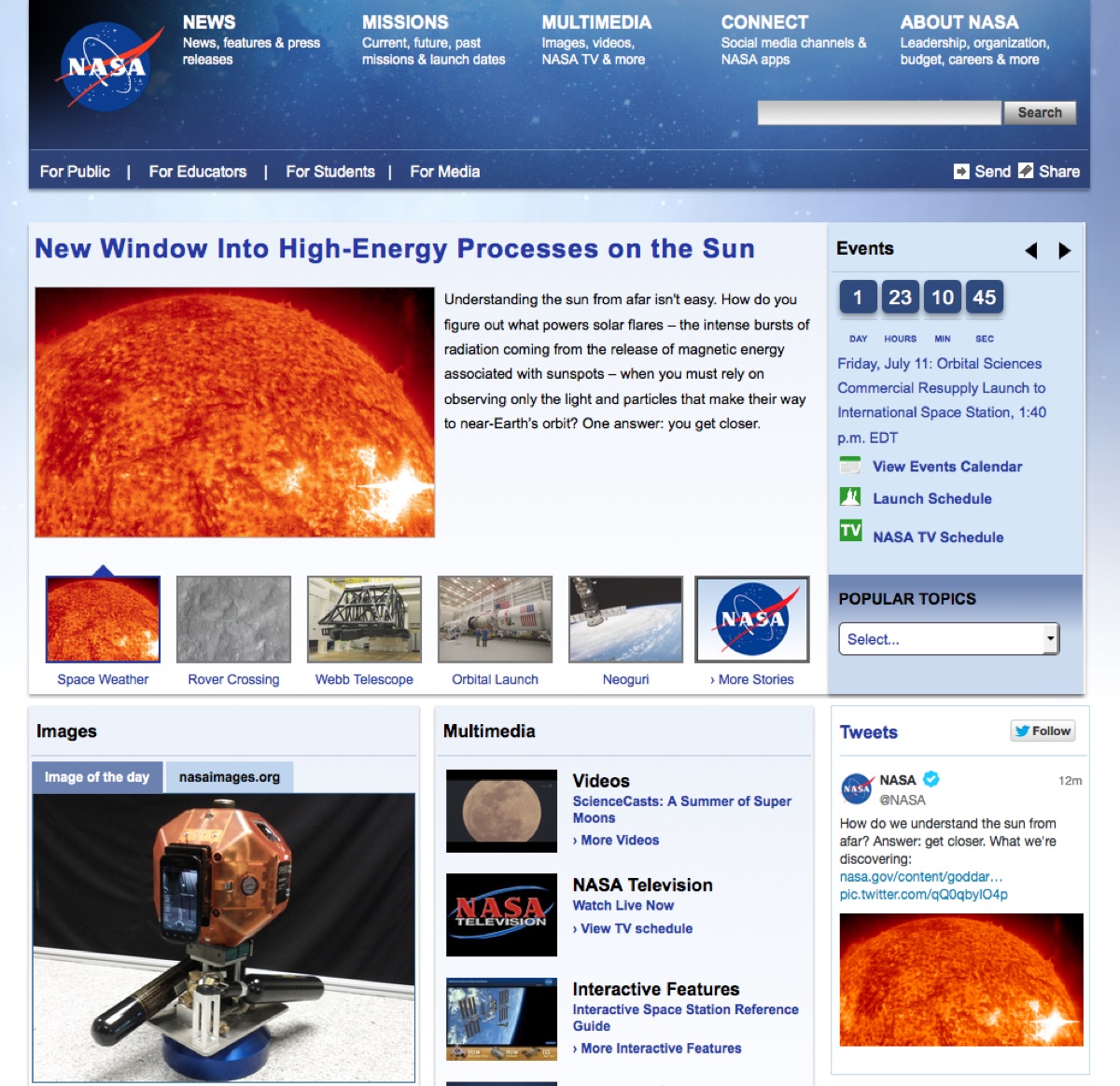
Nothing is more exciting to me than the notion of an organization like NASA, so when I arrive at their website I have high expectations for how engaged I am about to be. At the time I visited, the leading story was “New Window Into High-Energy Processes on the Sun.” Dig into that title alone.
Is it evocative or merely descriptive? Does it entice the reader, or just categorize? If you happen to be interested in high-energy processes on the sun, it lands. For everyone else, it is a closed door.
Read the article and you learn something genuinely remarkable: the neutrons these scientists need to study only last about fifteen minutes once a solar flare creates them. How do you get close enough to something as deadly and inhospitable as the sun to study something with a fifteen-minute lifespan?
A story has a cover, and here it is the headline and the leading image. So what if we made the title serve NASA’s actual values? Assume one of them is exploration of the unknown. Now the title can be:
The Dark Side of the Sun. The fifteen minute life of a neutron may unlock the mysteries of solar flares.
We just turned an academic label into something intriguing that also says something true about who NASA is. And then get a real image. Humans started out as a species using pictures to tell stories. An image will always grab a reader faster than words. Good imagery is not a nice-to-have.
Then start with why
We fall into the habit of writing as if we are back in fifth grade, dutifully covering who, what, when, where and why. Only one of those five actually matters to the reader. The other four are context.
Why something matters is all that really matters. The answer to why gives it meaning and purpose. Otherwise, who cares? Start with why, and do not stop until you have arrived at something basic, something core, something universal. Ask it at least five times. That is your real starting point.
The original NASA story never tells us why it matters that we understand these neutrons. A little outside research does: solar storms can be devastating to the human population. So the story becomes:
The Earth’s Worst Threat May Be Our Own Sun. By studying the fifteen minute life of a neutron, scientists work to unlock the mysteries of solar flares, and prevent one from disrupting life as we know it.
A solar flare can seriously disrupt the electric grid and everything running on high-frequency circuitry, potentially leaving the entire population of earth without electricity for weeks, months, or years. Until recently, studying the output of such flares was nearly impossible, because the output element has a lifespan of about fifteen minutes and any near-sun study is working in an extraordinarily hostile environment.
Now the reader knows why this is important work. I have gone from thinking “these people at NASA are really smart and doing interesting stuff” to “NASA is a critical organization whose work has a direct impact on my life and the future of our world.” I am now far more likely to want a relationship with them.
I am not suggesting linkbait headlines. I am suggesting you get to the meatier emotion that is already sitting inside your material, waiting.
Approach it like an artist
Take a look at the last bit of content you were asked to create and see if you can make it better. Approach it like an artist. Let it become a creative process. Allow yourself to start with an idea and let it take you somewhere. It is fine not to know what it will look like when you are done.
In fact, you should never know where your creative process will take you.
Give up a little control, never stop digging, and listen to what comes out. You will become a story maker, and people will connect with what you write.